
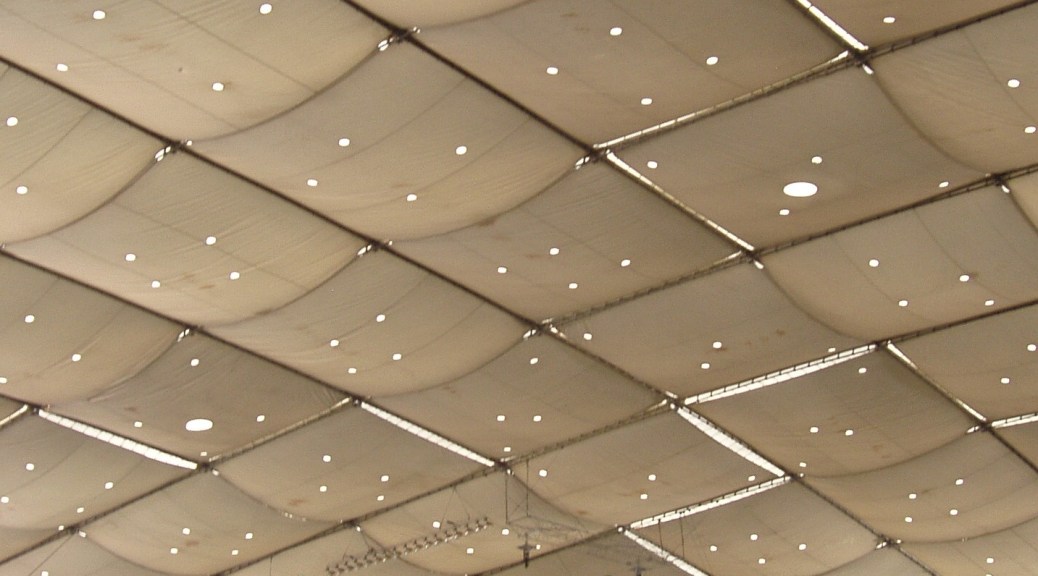
Lots of attention has been given to yesterday’s final game at the Metrodome, with the consensus that the highlights of its three decade life span were the Twins’ World Series victories in ’87 and ’91, and the Vikings loss in the NFL’s National League championship game in ’99.
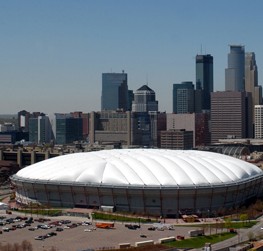
All the recent references I’ve seen to the Metrodome’s cost (55 million dollars) have had to do with what a bargain that was, considering the history that happened there and the new stadium’s price tag of around one billion dollars.
I’m old enough to tell you that the many, many public discussions leading up to the building of the Metrodome did not often include the word “bargain”. Many people found it amazing that any community resources at all would be used to help pay for a sports palace. And “palace” is the right word – though the building is portrayed as being rather utilitarian in the modern press, at the time it was considered to be a remarkable advance. But there was strong opposition. And if anyone leading the effort to build the Metrodome had said that the thing would be used for only thirty years and then abandoned, it would have scotched the deal, I’m certain.
What I haven’t seen mentioned lately is how much of the Metrodome struggle was about strengthening downtown Minneapolis – returning excitement and activity to the city’s center at a time when everything seemed to be moving to the suburbs. Though literally none of the promised surrounding development materialized, to the extent the building kept downtown as a regional destination point, it was a success. But the sports arena longevity prize will have to go to some other structure. Williams Arena, perhaps?
What torn down building would you like to have back?
 Trail Baboon
Good morning. I know there are many historical buildings that were torn down which should have been preserved. I haven’t been involved in any efforts to save historical buildings mainly because that hasn’t been an issue where I live. I wish that my neighbors hadn’t cut down some large trees in a lot near our house. I didn’t tell them that I thought they should save the trees because they weren’t my trees.
I do think they should not have been so quick to tear down the old Guthrie Theatre to make room to expand the Walker Art Center. I like the expanded area of the Walker that replaced the old Guthrie and I like the new Guthrie Theatre. The old Guthrie was an important historic building and I think they should have found some way to save it.
LikeLike
Maybe I’m just getting old and curmudgeonly, but I don’t like the new addition to the Walker at all. The mew space seems designed to confuse and disorient me; can’t find my way around that building anymore.
LikeLike
I have the same problem with the new hall ways at the Walker. Apart from the problems with the hall ways, I think the addition is good.
LikeLike
I’ve commented on this here before, but I find the design of the new Walker so irritating- it puts me in such a bad mood to negotiate its spaces that I generally avoid going there unless there’s something I really want to see. I miss the old Walker (two iterations back) that was torn down back in about ’69 or ’70. It had grace.
LikeLike
I agree!
LikeLike
I hate the new Walker and the new Guthrie (the cattle-chute escalators and the dim, dark upstairs lobby, anyway; I haven’t seen any of the stages) with a passion. We call the new part of the Walker “The Angry Robot,” because on the approach from Uptown those weird windows look like a squinted eye and a gritted set of teeth in a silver face. The new Guthrie is either “IKEA” or “the fish processing plant”, depending on how mean we’re feeling that day. I swear, if I see another cantilevered anything on a public building again, I won’t be responsible for my actions!
LikeLike
Maybe trapezoidal windows seem more creative than rectangular ones— if you’re twelve years old. The problem I have with both the Guthrie and the Walker is that there’s no transitional space, like a lobby or an atrium where you can pause and get your bearings before you proceed inside. At the Guthrie, you get no sense of the space unless you subject yourself to the conveyer belt escalator. There are no choices offered as to how you might engage the space and no way to orient yourself to the outside world. The same is true for the Walker, except the approach is through a series of blind hallways. As CG says, both have a cattle chute-like vibe. Certainly not human friendly.
LikeLike
I’d be interested to hear what buildings you like, Bill.
LikeLike
I love the MIA, especially the wide stone stairs worn down by thousands of feet over the years. You can get lost in there, I never seem to get the hang of the layout, but then each room is a surprise which I like. Every so often a fountain 🙂 And I like the Landmark Building in St. Paul with the center atrium. I don’t think either of them are in danger of being torn down fortunately — they have the feeling of having been there forever. Although I haven’t been in there for decades, the Foshay Tower is a lovely art deco building as I recall — the silhouette, the floors, the elevators.
LikeLike
There are people stationed at various places in the Walker that can give your directions. Also, I think there are some central areas, at least one near an entrance, that are welcoming area including the area around the snack food service and the area around the gift shop. Entrance from the parking garage requires you to go up a fairly long hall way and stairs or use the elevator. However, the parking garage does give you a direct entrance to the building which is fairly convenient.
LikeLike
The Landmark Center in St. Paul actually came perilously close to being torn down. When I first worked in St. Paul in 1972, there was a still a post office in there, everything was run down and the roof leaking, and it seemed impossible to find enough money to repair it. Fortunately a group of determined citizens decided it was time to do so something about it, and a massive fund raising effort got under way, but I remember well the naysayers who doubted that the place could be spared the wrecking ball. So glad it was saved. We were married in the Chief Justices’ chambers on the second floor in 1979, a year or two after the refurbishing had been completed.
LikeLike
This in regard to PJ’s question about buildings I like. I’m really not that hard to please. I tend to dislike self-aggrandizing designs, which I consider the Walker and Guthrie to be. I’m with Robin regarding the MIA and the Landmark Center and also the Minnesota History Center and the Science Museum. As far as buildings in downtown Minneapolis, the trouble is, I don’t know the name of many. And some I like from the outside may be a disappointment from the inside. I do like Cesar Pelli’s Norwest Tower. I love the Rand Tower and the Foshay Tower and the Ivy Tower. I like the Barbara Barker Center for Dance on the West Bank.
I’ve never liked the Weisman Museum. It’s superficial chaos on the outside and pleasant but forgettable on the inside. Superficial chaos because the drama is only skin deep. The underlying building is, as far as I can see, prosaic, requiring little or no special engineering. Chaos can be refreshing, as long as it is surrounded by order. Frank Gehry has chosen chaos as his signature. That’s sort of like playing the part of class clown. One is entertaining, more becomes, well, chaos. And chaos becomes tiresome, dated, and irrelevant. I like architecture that creates a dialog with its surroundings, both natural and architectural.
I can’t say I’ll miss the Metrodome, since I’ve never been inside. I think of it mostly as a traffic obstruction.
LikeLike
The only landmark that I can remember that I wish I could have back is Dania Hal. It was razed in 2000 as a result of a devastating fire. I didn’t think Dania Hall a particularly beautiful landmark, but it was a place that held a lot of wonderful cultural memories for lots of people. It was a West Bank landmark, and a lot of people were saddened by it’s loss.
I can, however, think of several buildings that I’m grateful have been saved. Prime among those is the Landmark Center in downtown St. Paul and the old Mayflower Church which these days houses the Russian Museum of Art.
LikeLike
Dania Hall was an interesting and distinctive building for the west bank; I remember going to a couple of concerts/dances there in the late ’60s. If it hadn’t been for the fire, Dania Hall might have had a shot at restoration.
Or maybe not. There’s a reason why Minneapolis, known to some as Teardownapolis, lacks the charm of downtown St. Paul.
LikeLike
If I recall correctly, Bill, Dania Hall had actually undergone some renovation and was slated for even more. I had attended numerous concerts and dances there.
LikeLike
Now that you mention it, PJ, I think you’re correct. It may have even been something connected with the renovation that caused the fire.
LikeLike
Our beautiful traditional Japanese home in Kyoto where I lived for 15 years — which was torn down and replaced with an asphalt parking lot. It had tall wooden front gate (10 feet tall), a long stone walkway, a huge rock in a tiny bamboo grove, a back garden with koi pond. All of our expired pets (cats, hamsters, crickets) were buried there so in a sense it was a sacred burial ground.
Also my maternal grandmother’s rambling old boarding house in Berkeley, California which is now part of a city park. However, we can find the exact spot because the boulevard tree is still there! We lived there for a year when I was 6 and that house was magical for us kids. Grandpa had built a floor to ceiling aviary for Grandma’s finches in the corner of her bedroom. She had a big organ in the other corner that she played every morning and evening. Grandma was church organist, just like Anna’s mother. The upright grand piano sat in the living room (where I learned to play “I’m Always Chasing Rainbows”). There were always 3 or 4 university students boarding there — from the 1920’s to the 1960’s — they were her “boys” and many of them wrote letters and came back to visit her till her death in 1966. Grandma’s basement was a treasure palace–full of canned peaches and pickles, boxes of string/greeting cards/buttons/bottle caps/everything a child could desire for art projects on a rainy day. She saved EVERYTHING! There was a basement billiard room — one wall filled with a complete set of National Geographic magazines. Grandma’s bachelor brother, Uncle Howard, lived there and slept on the billiard table till he married Clara Belle Bell the neighborhood bachelorette when they were both in their 70’s. Grandma’s house was draped top to bottom with ivy and blooming honeysuckle, and her cookie jar was always full. I can still see Grandpa watering the roses in his fedora hat, pants and suspenders. They didn’t have a sprinkler in 1954, so he would stand out there with a hose for two hours or more hand-watering each plant. Grandma grew pansies tucked into the shady spots under the ivy, and there were four-leafed clovers growing in one corner of the lawn. I still have one.
When my sisters and cousins and I are gone, there will be no one left who remembers any of this.
LikeLike
we will. what a wonderful recollection. it sounds like a house to remember. the neighborhood must have been right too if they turned it into a park. the house in kyoto wher the crickets are buried is a neat one too. parking lots make me sad. what a waste.
LikeLike
What great memories, Robin. Hope you have lots of pictures of both your Grandma’s house and the house in Kyoto.
LikeLike
Nice memories, Robin, nicely described.
LikeLike
Robin, what wonderful memories. Not just of the places but the people who created them. I would be very sad to have known them and then lost them.
LikeLike
Yes, this is a lovely description Robin. You capture the place, time and personalities. Of course I’d like to know more about Clara Belle Bell – a woman with a name a writer couldn’t make up because it sounds so … made up.
LikeLike
I know, Dale! Which is why I’ve never forgotten her name. Since we lived there only the one year when I was 5 or 6, I recall very little about her, but we did have one close encounter. In September of the year, I received a written invitation to her home. Since she lived three doors down from Grandma’s house, this was rather formal, but she was a very proper lady so this would have been right in character. She was quite large (my Uncle Howard was short and slight) and always dressed in black and lace. Formidable. She had a September birthday and it seems that every year she had a birthday party for everyone she knew who was also a September baby. Since I don’t recall having had any conversation with her, I can only assume that Grandma had let the cat out of the bag. We were a rather motley crew of all ages, none of us acquainted with each other. Very formal. My Grandma had me wear my white Easter gloves. We all sat in a circle in straight back chairs and ate melty vanilla ice cream and chocolate cake and drank tea out of china cups. She and Uncle Howard married a year or two later after my family had returned to Japan.
LikeLike
It interests me that I have no affection whatever for the old Guthrie, although that is where I was when i fell in love with my erstwife. Even in those days the building struck me as cheap and ugly. What I’ve noticed is that whole era of architecture, while it created buildings that were or are “important,” did not create buildings that formed emotional connections with the public. When homes or public buildings from that era are due to be replaced, most people are eager to say, “Good riddance!” Many of the structures from that time are modern in the worst sense of the world: cold, formal and cheap looking.
But who am I to judge?
LikeLike
I’m with you regarding the old Guthrie. In fact, I wouldn’t mind seeing everything designed by Ralph Rapson go away. The Cedar Riverside Towers? Soviet era design at its worst. The Ted Mann Concert Hall? Please…
The old Guthrie was a box with superficial panels affixed to the outside. My memory of those panels was of flaking away stucco with plywood underneath. Tacky. And the spaces allotted for the behind-the-scenes workers were small and terrible. Robin and I volunteered in the costume accessory shop for a time. The space was underground and windowless and cramped. Obviously the architect’s attention was limited to the showy public spaces.
LikeLike
I don’t mind the Ted Mann Concert Hall, but the Cedar Riverside Towers can go. Tacky, tacky, tacky. And I say that despite once working for the firm that manufactured those ugly colored panels.
LikeLike
I thought of the old Guthrie as an important historic building because of the design of the stage. Perhaps if I could take a closer look at it I might find that it really wasn’t a very outstanding building.
LikeLike
I went to a play at the “new” Guthrie last fall featuring a friend of my sister’s. We met him afterwards and he had some interesting comments about that building. Sometime during the construction, it was discovered that there was no “vom” on one side (short for vomitorium – one of the under-audience side-entrances for a thrust stage). The architect’s goal was to have a beautiful, un-interrupted rounded facade on the outside, damn the needs of the actors. A boxy bit was added to correct that. Even with that addition, getting from the vom to backstage (and vice versa) required a ridiculous dashing through hallways and up and down stairs. A building built without completely considering the needs of the occupants. My dearly departed architect-community-theater-actor-set-designer father would not have allowed such a thing, I like to think.
LikeLike
I’d like the house in La Crosse I lived in as a little kid not to have been torn down. It became a parking lot and I never got back to the house as an adult to reminisce and remember some of my first memories of anything (I was about 3 when we moved to La Crosse and five when we left).
It was a nice little duplex with hardwood floors and a long hallway from front to back that was great for running through at full speed, then veering off into the bedroom and leaping onto the bed. I think we even were allowed to ride our tricycle down that hall in winter time. At least that’s what I remember doing maybe once–must have been a really crazy day for Mom.
They didn’t exactly pave paradise, but they certainly put up a parking lot.
Chris in Owatonna
LikeLike
LikeLike
I’d like to have he Spiral Bridge in Hastings back. Technically, that might not have been a building, but it would to day make for an awesome walking, biking, running and fishing destination and tourism boost with far better development of the old town Main Street of Hastings (2nd. St.) than at present and almost certainly commercial development of the north bank of the Mississippi River as well.
LikeLike
Agreed. Would have been expensive but fun.
LikeLike
I went to an auction in Hastings recently, at the recently-sold house of the mother of a friend of mine. Grand old house that was once located on the highway through town, but was moved back a block at some point. A graceful home, much attention to detail in all the woodwork; wallpaper in closets, stained glass windows in unexpected places, built-in drawers and cabinets. I didn’t bid on anything, but the tour of the house was an event in itself.
LikeLike
My dad built a greenhouse on the North Shore about 1950. The original main building had been a gas station, and my family lived there until Dad built the family home in 1956, the year I was born. He added houses as he could afford them, and they were configured as separate buildings, some running north-south and some east-west, connected together with a florist shop over time. There were ramps and steps and corners and nooks and crannies, along with doors between every house. There was a main boiler that was nearly two stories tall; I remember when it was coal powered and then converted to gas.
As a very small child, I swept, pulled a few weeds, dug in the dirt, and was amused by pounding nails into the bench, which Dad would then pull out, pound straight, and re-use. When asked to describe my first job, it was as a first grader armed with a grease pencil and white plant tags. I printed ten each “Red Magic,” “White Magic,” and “Pink Magic” to identify the petunia seedlings and was assured that I was helping our family business.
In grade school, helping out was a challenge because my dad assumed by then that we all knew everything he knew. Let’s just say I did a lot of guessing and grabbed many a begonia in a 2.5″ pot when he wanted an impatiens in a 3″ pot! (I think I was in college when I finally admitted to asking, “Do you mean 3 inches high? or 3 inches wide?”)
In the early spring, plants that could stand cool temps and shade were put in the “lath house,” which was built completely of spaced narrow strips of wood. When my older brother was a kid, he could never understand what the joke was–he thought my dad called it the “laugh house.”
I played throughout the grounds as a kid and worked there off and on until I went to college. I knew where every tool was stored. I learned how to make wreaths, wrap potted plants for delivery to church or hospital, and plant baskets for the cemetery. I weeded, transplanted, climbed, and crouched. I knew every knot in every board on the benches and the idiosyncrasies of every faucet and window.
Dad retired in the late 1970s and sold the greenhouse to two guys who had worked for him for years. The greenhouse remained a great place to visit; I still knew where everything was. After Dad died in 1985, visits there were full of great memories, time had stopped and he was still just in the other house, watering.
As the years passed, it actually became more painful to visit, instead of less. The memories of Dad were everywhere, around every corner, soaked into the wooden benches and the soil. Around 2009, the guys who own the greenhouse apologetically announced that upkeep and repair were more expensive than tearing it all down and starting over. I wasn’t sad at all, I was thrilled. I was so glad these old buildings were going to be torn down. It felt as if the ghost of my Dad, and all of those happy memories, could be released.
The new greenhouses are streamlined, modern, and convenient–and remain a testament to what my parents began. I know they would be thrilled.
LikeLike
Bonnie, great memories! Where was this?
LikeLike
In Two Harbors as you first come into town from the Duluth end.
LikeLike
Wonderful memories, Bonnie. Sounds like a great place for a couple of kids to grow up.
LikeLike
Exactly how I remember wondering around it. People in town sometimes referred to the owner of Anderson’s Greenhouse as Greenhouse Anderson. And a greenhouse across from a cemetery is a good placement. Never really know Bonnie L.’s father a handsome spark plug of a man. Two guys who took it over are sweet guys.
LikeLike
I’m the doily. Clyde.
LikeLike
Let’s deconstruct and reconstruct WP.
LikeLike
I can just about smell the dirt and feel the florists’ foil in my hands. Wonderful descriptions.
LikeLike
I have a book called ‘Lost Twin Cities’ showing many buildings from the TC area that have been torn down. Probably the most famous was ‘The Metropolitan Building’.
I never saw it but I miss it anyway.
The old gateway Park and Pavilion that was between First Street and Washington, Nicollet and Hennepin Avenues. Turned into a spot for homeless and drunks. But it had great intentions when it was built and for the first few years. The whole I94 corridor sure cut a swath of homes out.
We are in the midst of remodeling our entryway and mudroom at our house and thinking that it was built in fall of 1968 its 45 years old.
I remember the dome opening; sure wouldn’t have thought it would only get 30 years out of it.
Kelly lived in a basement apartment while we were dating. It was a cozy little place that has been torn down and replaced by a parking lot. Was only sentimental value but still… we miss it when driving by there.
In Rochester we’ve lost some old buildings too; Mayo Clinic has saved as many as they’ve torn down.
Our farm; lots of buildings have come and gone. It doesn’t seem to me that much sentiment was attached to farm buildings of 60 years ago. Course they were built with scraps in the first place.
Buildings today are built better with better materials so therefore the price is higher in the first place. Imagine building the stadium out of left overs… functional, yes. But hmmmm….
I’m still not so sure about all the glass walls.
I don’t mind the new Guthrie. And yes, the old one was certainly cramped backstage and downstairs. New one is better to work in for the crews.
LikeLike
I don’t know the Cities well enough to discuss buildings there. Built no connections to buildings in my few years there.
They burned down my childhood home as practice. A good end. I jokingly suggested to my sister that we should gather some ashes from it and scatter them over the grave shared by my parents ashes in SD.
Bonnie L.’s and my high school is gone. It was falling apart. Had no real character. It was thrown together as a WPA project. It was a landmark up on the hill to many people driving through.
LikeLike
I do miss a collection of buildings scattered across the campus, the ones named “Temporary West/East/South/North of ________________.”
😉
LikeLike
I worked out of Temporary North of Mines for several years. I had no feelings for the structure, but it was creepy to be officing with so many folks whose careers were obviously going nowhere.
LikeLike
I looked for the quirky things on campus and they were so quirky tucked in between the great brick buildings. The dairy barn on the Farm Campus is gone, which is fine, but I wished I had photographed the hay mow, it’s wooden trusses and polished worn floor.
LikeLike
My first high school – Minneapolis Central High. It was a grand old building with slate steps, hardwood floors, giant windows and a brick castle sort of appearance. The halls were wide and the classrooms drafty, but it had character. When Minneapolis needed to cut costs in the early 80s, they closed Central as well as West and Marshall U – the Marshall U building survived to become offices for small businesses, but West and Central were torn down. The West site became the Uptown YWCA location. Central’s site eventually became home to an elementary school building named for the superintendent who had closed Central (oh the irony). What made the closure of Central and the others all the more painful was that they closed the 3 oldest schools simply because they were old – there were newer, smaller, buildings that remained open that, on average, cost more to heat and light (and pay for upkeep) than the old lovely buildings. Oh, and more than once in the last several years Minneapolis has had talks about building a new high school because the remaining buildings are too small to house the anticipated student population.
LikeLike
And now Marshall U has been torn down.
LikeLike
Oh no! When did that happen?
LikeLike
Evening all. I can’t think of anything that I was sorry to see go. I’ve had several childhood homes (I lived in LOTS of houses when I was little) demolished, but as I rarely lived in a house more than a year at a time, I didn’t invest too much emotion in any of them. I wasn’t too sorry to see the old Guthrie go, however I will join the Trail in my dislike of the new Guthrie. Why does it always have to be so dark in the common areas? And like other baboons, I also love the MIA. Since they change around the exhibit spaces on a regular basis, I can often get turned around.
I’ve been hunting for a Guindon cartoon for several years now that relates a little to this topic. It’s a lovely drawing of the Foshay Tower with the IDS looming behind it. Caption: The tallest building in Minneapolis and the box it came in.” Always loved this one.
LikeLike
My mother and her sisters always lamented the loss of the old Schuneman’s department store in downtown St. Paul. It was across Wabasha Street from the Dayton’s/Marshall Fields/Macy’s building. There are some photos of it at http://www.twincities.com/1000/ci_22792825/interactive-lost-department-stores-downtown-st-paul?source=pkg
It is now – you guessed it – a parking lot.
I was never in it, but it does still seem to haunt the corner where it stood.
The former Dayton’s store will probably be knocked down before long. It’s certainly not impressive architecturally, but it holds many memories for many people of my generation, as Schuneman’s did for my mother’s.
LikeLike
It seems every large structure built in the Cities in the last 50 years was a temporary box, unworthy of living more than 10-40 years. Why is that? Are all these new things to be so short-lived?
“Those who do not study the past are condemned to repeat it.” Why do we keep building flat-roofed buildings in Minnesota? The library where my wife worked added a new wing to an old Carnegie plan library. How easy it would have been to put a gable roof to match the lines of the old building. They did not, but rather laid down a flat roof, guaranteed not to leak for 10 years. Was a 10 year projected life meaningful for a public library? How long did it take it to leak? About 2 months. Was it really guaranteed? Sort of.
The old Minnehaha elementary school of my childhood had to be replaced, ceilings fell down for one thing. But I wish one such building somewhere still stood. The need for the new style of elementary school I understand, but they are all low dull windowless lego piles. And of course character and originality cost money, which we are not willing to invest that way. But the schools built in the first half of the 20th century were interesting to the eye and proclaimed something about education.
The church we left in Mankato in disgust over other issues had the stupidest design possible. Fully 40% of the floor space other than the sanctuary is hallway. A hallway wraps around three sides of the sanctuary for no reason and the same hallway design wraps around three sides of the fellowship hall in the basement. They decided to do a renovation, for which they raised $2.2 million in six weeks. Not pledges. but the money on account. These were the same people who could not match a bare-bones budget for three years that over worked the pastor and included little charity and small support of the larger church structure. They are changing the front entry (which was bad) inside and out and redoing the sanctuary. But they will still have all those hallways to heat, cool, and clean.
LikeLike
Well, out here we have far fewer buildings worthy of rebuilding. Most weren’t built that well to begin with. We are a long way from forests, and buildings were kept small. They have tried to restore some of the older farm houses built by settlers from the Black Sea area, which have a very distinctive design. The predominant architectural style can be described as that built for large Catholic families trying to keep warm.
LikeLike
Funny 🙂
LikeLike
One local worthy here built a large brick home in the early part of the last century that was a replica of his frat house at the U or Minnesota. I participated in a AAUW home tour of it once. It is large (three stories) and pretty inconveniently arranged place, Interesting, though. The later members of same family still live in it.
LikeLike