Sam McGee, Weather Denier

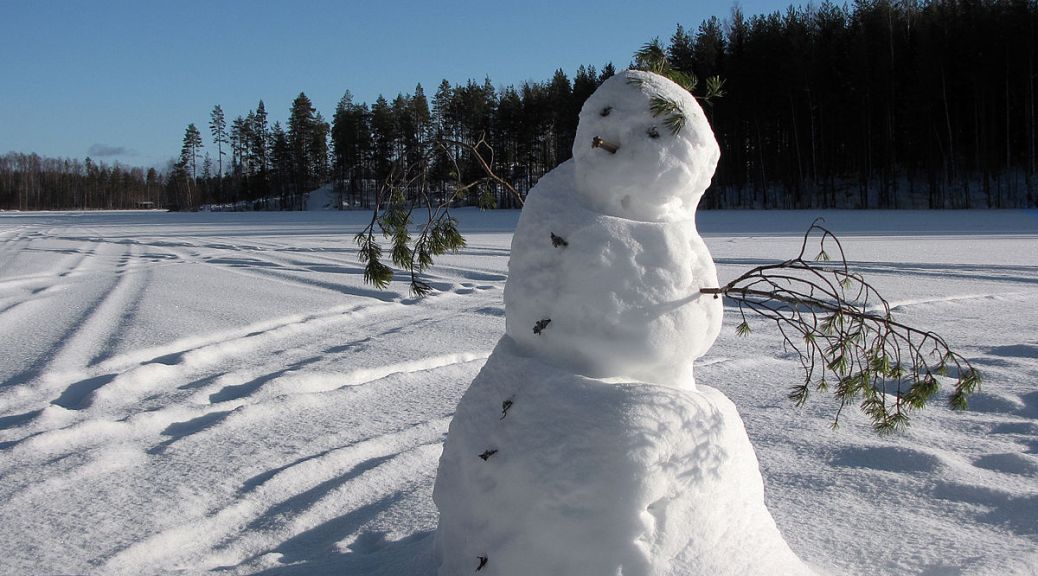
Header Photo “Snowman on frozen lake” by Petritap – Own work. Licensed under CC BY-SA 3.0 via Commons

Of course there are noisy climate change deniers who refuse to accept scientific research because it conflicts with their closely held political beliefs.

That’s almost understandable.

But what I can’t comprehend is the much more commonplace lunacy of daily weather denial.

A good winter storm reveals it, especially in more tightly packed urban locations. Some people downtown believe they don’t have to put on anything special to be outside because they’re only going to be exposed for a short time.

And besides, heavy clothes worn in layers just don’t look that nice. But I think inadequately dressed office workers look silly shivering as they wait to cross the street.

When I mentioned this pet peeve of mine to Trail Baboon’s sing-song poet laureate Tyler Schuyler Wyler, he said he also has a certain peeve that pesters him – presumptuous people who rip off the work of other poets merely to get a laugh.

And right after saying that, he presented me with his latest opus, which included an insincere note of apology to Robert W. Service and The Cremation of Sam McGee.

There are fashions worn in a winter storm
that would otherwise seem gauche.
Everybody knows layering your clothes
is a common sense approach.
Even dilletantes in fine restaurants
will adjust to a degree.
For a little while they’ll abandon style
if their name’s not Sam McGee.

All Sam’s garb was sheer and he wouldn’t hear
of a parka or a fleece.
If a shirt or gown had an ounce of down
his frustration would increase.
“It feels very wrong and takes far too long
to suit up for cold or sleet.”
“And besides,” he’d wink, “there’s no risk, I think.”
“I’m just gonna cross the street.”

Right across the way sat a mad buffet
called “The Sacrificial Goat.”
It was hip and loud and it drew a crowd
that opposed the winter coat.
They disdained its buik and they’d tend to sulk
if harsh weather was foretold.
Putting on their things, they’d assume it’s Spring.
‘Cause it’s cool to not seem cold.

So off Sam would skirt in a polo shirt
with Bermuda shorts below
Into two degrees with his naked knees
and flip-flops, to face the snow.
“Winter air feels fresh on my naked flesh!”
he declared. “It’s strength of will.”
“And what’s more,” he spat, “I don’t need a hat,”
as he stepped into the chill.

Quite against Sam’s plan the snowflakes began
to collect between his toes.
And those flopping flips, ‘midst their many slips
became rigid when they froze.
Trying to be brave, Sam’s blue eyes turned grave.
As streetward, on he pressed.
At the crosswalk light, his mouth thin and tight
He tried not to seem distressed.

In the urban grind one will often find
that delay is the routine.
And slow went the time at that corner sign
with Sam blocked by traffic’s stream.
Then a passing truck’s plume of slushy muck
sealed the frosty fate Sam faced.
For his flops got iced and nothing sufficed
to dislodge a man encased.

With each frigid blast nature built a cast
that enveloped Sam, complete.
It was clear and slick and six inches thick
from his head down to his feet.
Looking through the shell one could clearly tell
that his face showed some regret.
A wardrobe reform could have kept him warm.
but he’s not been thawed out yet.

In December’s pale, teachers tell the tale
of the legend Sam became
Heading off to play on a chilly day
All the children learn his name.
Don’t go out of doors with just summer drawers
against winter’s nasty breeze.
you could be marooned in a white cocoon
like the ice man, Sam Mcgee.


Are you (or have you ever been) a weather denier?
Chance Encounters

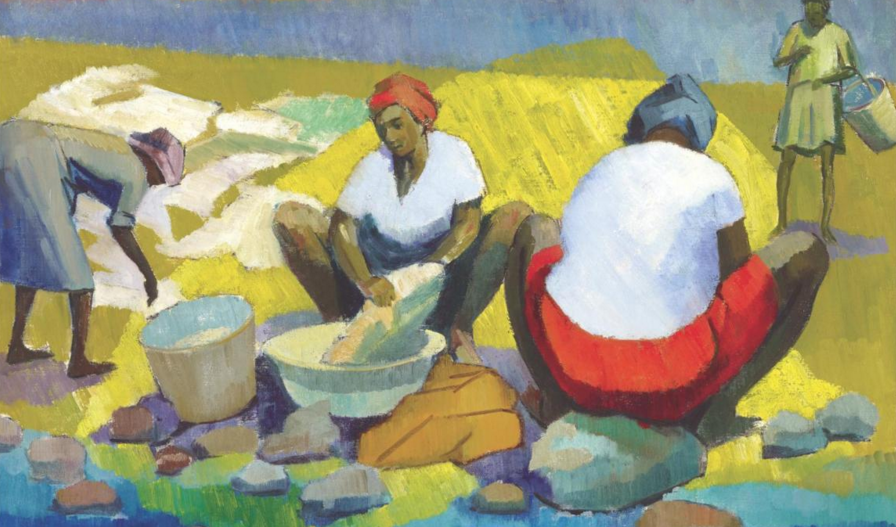
Header image – Washer Women by Barrington Watson 1966 via Wikiart

Today’s post comes from Plain Jane

When I think of the people who have had a lasting impact on my life, most of them are folks who were, or are, a steady presence in my everyday existence.

On several occasions, however, my life was impacted in a major way by a chance meeting, a short interlude. I have written about two of them, briefly, before on this blog: Bob Dean and Barry Watson. Both Bob and Barry had a far greater influence on my life than the short time we spent together would seem to justify, and for very different reasons.

I met Barry at a small cafe in Basel my roommate, Annette, and I often visited.   I don’t recall the details of why or how Barry and I started talking, but we did. By the time Annette and I left that evening, I had learned that he was a painter who had been studying a couple of years in London and Amsterdam, and that he was on his way to Madrid for a few months before returning to his native Kingston, Jamaica. As Annette and I were getting ready to leave, Barry asked if I’d be interested in meeting him the following afternoon; he wanted to visit the Basel Art Museum and show me some of his favorite works.  I said why not, and agreed to meet him on a bridge close to where I lived and worked, and not far from the museum.

I had never before had a conversation with a black person, so I was both fascinated and a little aloof; I think Barry sensed it. Our first afternoon at the museum was spent looking at the remarkable Klee collection for which that museum is renowned.  Barry had a high regard for Klee’s work and enthused about its merits to this complete novice.  I’m ashamed to admit it, but I had never before set foot in an art museum, and had not had prior exposure to modern art; I was mesmerized.

Afterward we had a bite to eat and talked for hours.  When Barry walked me home that evening he asked me if I would like to see some of his paintings. Promptly on high alert, I responded “not tonight, maybe some other time.”  “OK,” he said,” how about tomorrow afternoon?”  And so our next rendezvous was set.

When I met Barry the following day, he greeted me with a bear hug and a huge grin.  “You thought you were really clever last night when I asked if you wanted to see some of my paintings, didn’t you?” he asked.  Without waiting for a response, he continued, “I was really the clever one; I had the slides of my paintings in my pocket the whole time, and could have shown them to you anywhere. But I wanted to see you again, so I didn’t tell you. You thought I was trying to lure you to my room, didn’t you?” He was right, I admitted it, and we both had a good laugh.  After that I relaxed. I realized that we were kindred spirits who enjoyed each others company, and that I could learn a great deal from him in the few days he had left in Basel.

Barry and I met two more times, and on both occasions spent hours at the art museum. He introduced me to Picasso, Miro, Chagall, and the museums impressive collection of works of the Holbein family.

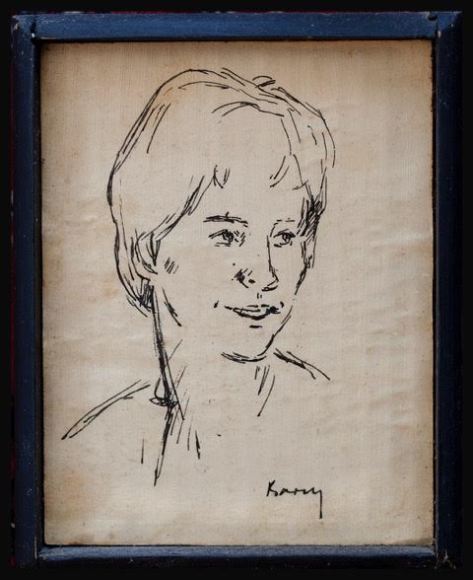
Barry Watson's portrait of PJ
Barry Watson’s portrait of PJ

As a parting gift, Barry sketched a portrait of me in pen and ink.  He signed it: Barry.  He didn’t sign his last name because he planned on becoming famous, he said.  He didn’t want me to sell this keepsake, but to keep it as a reminder of the time we had spent together.

When we parted, we made no attempt to stay in touch.

Seven years later, as a freshman at SIU, I came to know several students from Kingston, Jamaica.  I asked them if they had heard of a painter named Barry Watson. To my surprise, they said they had.  He had become a quite prominent figure in the Jamaican art world.  They told me he had become the director of the Kingston Art Museum.  This was in 1968, before the internet made access to all kinds of information possible, so I had no way of verifying whether or not this information was accurate.

Fast forward to sometime last year when a blog on the Trail Baboon jogged my memory, I decided to see if I could find out what had become of Barry.  I was astonished to discover that he had, indeed, become quite the celebrity in Jamaican art circles, although he had not been director of the Kingston Art Museum. I sent him a message asking whether he remembered our encounter so many years ago.  He did, and must have shared our story with his family.  I was saddened when on Wednesday morning I received the message that Barry had passed away the previous evening at 10 PM. He had just turned 85. The volume of his work is impressive, and the quality of his work is remarkable; check it out.

Thanks, Barry, for introducing me to art, and R.I.P. old friend.

Here’s a link to an obituary for Barrington Watson:

And one that shows some of his work:

When or how has a chance encounter impacted your life?

First Time Foods

Today’s post comes from Cynthia in Mahtowa

Going through some old letters I had sent to my mother from my first teaching job in Port Angeles, Washington in 1964, I found a paragraph describing all the “new” foods I was eating. Foods I had never heard of in my small northeastern Minnesota hometown such as artichokes, zucchini, Swiss chard, eggplant, turnips, parsnips. (I led a very sheltered food life.)

I remember that first taste of an artichoke – a more worldly friend teaching me how to tear off a leaf, dip it in butter and scrape off the soft inner part with my lower teeth. How exotic. Later that friend’s aunt taught me to use mayonnaise with dry vermouth and garlic for dipping — still my preference.

Washington state firsts: Dungeness crab. Fresh salmon. Fresh apricots. Carrot cake.

So this got me to thinking of all the “exotic” foods that I was introduced to since then.   Five months in Switzerland, four of them living above and eating in a bakery/tea room — cheese fondue with bread dipped in kirsch (cherry brandy), lamb curry, gibfeli (croissants), café au lait, escargot, tripe soup. I have fond memories of all but the tripe soup.

On the small Italian ship I took to Europe in 1965 I had tongue and my first cappuccino. When we landed In England I had coffee with Demerara (brown) sugar. Did I try steak and kidney pie? I might have. But that really hot Indian curry in a English restaurant made me feel guilty for not eating it all because of the hungry children of India.

In Greece I watched a man slam an octopus repeatedly on the rocks. Was he trying to kill it or tenderize it? But I did not eat octopus until many years later and then in a sushi restaurant. (A friend traveling in the Orient had octopus so fresh the sucker stuck to the top of his mouth. But that may have been the least exotic thing he ate on that trip…was it duck bills or duck feet?) Squid entered my eating repertoire much later, though the first time I had it I was unnerved by the little tentacles.

When I was a child my father paid me to eat asparagus – or, tried to. He had tricked me into eating horseradish when I was five. How could I trust him to steer me right? Asparagus cooked to a gray mush? Then in 1972 I paid $2.50 for three spears of properly cooked white asparagus in a San Francisco restaurant. There I also had a “bird with a long beak” for an entrée. It had four legs and no wings…a rabbit, perhaps? Did the waiter mistranslate or was he leading me astray and making fun because I didn’t know French?

Asparagus was the first thing I planted when I moved to this farm. It still comes back every spring. I eat it sautéed it to a bright and crispy green.

smorsbrod
Smørsbrød

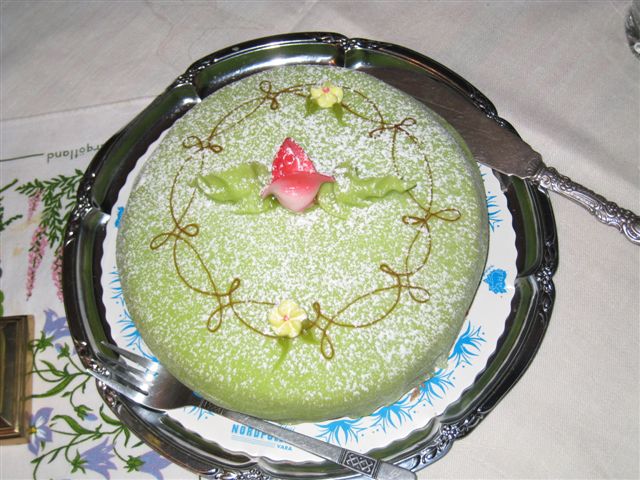
First time food that has not been repeated: Rocky Mountain “oysters” (our kid goats’ testicles). Foods have become favorites: really, really hot Mexican food, goat meat, spanakopita, lobster, clams, mussels, lamb. Swedish Princess cake made with marzipan, whipped cream, raspberries and custard. Every cake I ate in Norway. Scandinavian open face sandwiches (smørsbrød). French goat cheeses and Norwegian brown cheese. I could go on…but won’t.

What “exotic” foods have you tried and fallen in love with….or not?