
This week’s farming update from Ben
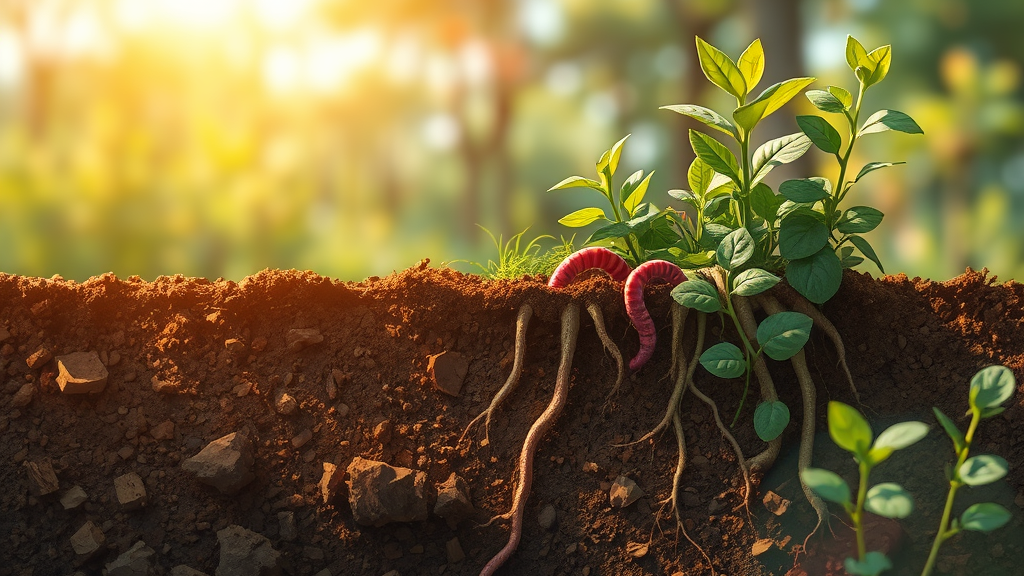
I attended a soil health meeting on Thursday. It was a program known as the ‘I-90 Soil Health Tour’ with four stops across Southern Minnesota. A real nice free lunch was included. And this wasn’t a “free” lunch with the purchase of something, it was a free seminar WITH a free lunch!
There was a lot of data presented. We talked a lot about what makes good healthy soil. How much is water, how much is open space, minerals, and how a plant is able to use minerals once they’re bound with the soil. We talked about how quickly some fertilizers or minerals bind with the soil, which means the plant has to use a different process to utilize those minerals.
One way to test the biological activity in the dirt is to bury a pair of cotton underwear about 6” deep. Dig it up a couple months later and see how far it’s degraded. Healthy soil with lots of microbes will have it just about all gone. I may have to try and remember that this spring.
Once the soil gets to a certain point and we begin to understand the different ways minerals are accessible, a farmer can use less fertilizer, which means less money of course, which everybody likes.
One of the speakers was a soil scientist. He works with farmers all over Southern Minnesota. This gentleman really needed to just lighten up and have a little more fun with his entire presentation, because while the subject was interesting, his presentation was about as dry as dirt. This guy started off trying to get the group to speak up and throw out some answers and apparently he was gonna stand there and wait until he got them. Come on buddy, read the room. Are we just gonna sit here and stare at each other while you’re waiting for an answer? It was during his presentation that I spent a lot of time looking around the room and thinking about what I can use to write this blog.
He talked about a drop of rain, falling at potentially 45 MPH and the impact that drop can have on one grain of sand, but that got me thinking, how fast DOES rain fall? So I googled that. Generally rain falls at 15-25 MPH.
There was maybe 150 farmers in the room. I had a good time watching the room, the body language (the guy across the table from me was drifting), a lot of arms crossed, hands on chins, a few elbows on the table with head resting on palm. There was 5 women in the group. One guy limped in with a cane. Maybe he was 85 years old. He had good comments. One thing he pointed out was to get a soil potentiometer first thing. Check for soil compaction and a hard pan before anything else.
It felt good to see all these farmers interested in improving the soil.
One of the things I always hope when I write these blogs are to give you some knowledge of farming and how much farmers do care. We have to take care of the soil.
For our farm, I’m looking at how long I think I could be farming yet, knock on wood, (I’m 62. Have I got 10 years left? 20?) and what I can afford to implement and change. Of course we always hope the farm and soil diversity would outlast us.
These quotes were said at the meeting:
“In the end, we will conserve only what we love, we will love only what we understand, and we will understand only what we are taught.” – Baba Dioum, Senegalese forestry engineer.
“Dirt is dead, soil is alive”.
“We’ve always done it this way” are the most expensive words in agriculture.”
These quotes I found online:
“To be a successful farmer one must first know the nature of the soil.” — Xenophon, Oeconomicus, 400 B.C.
“There are two spiritual dangers in not owning a farm. One is the danger of supposing that breakfast comes from the grocery and the other that heat comes from the furnace.” — Aldo Leopold
And of course these:
“Man, despite his artistic pretensions, his sophistication and many accomplishments, owes the fact of his existence to a six-inch layer of topsoil and the fact that it rains.”
—Attributed to Paul Harvey
“One teaspoon of soil contains more living organisms than there are people in the world.”
=================
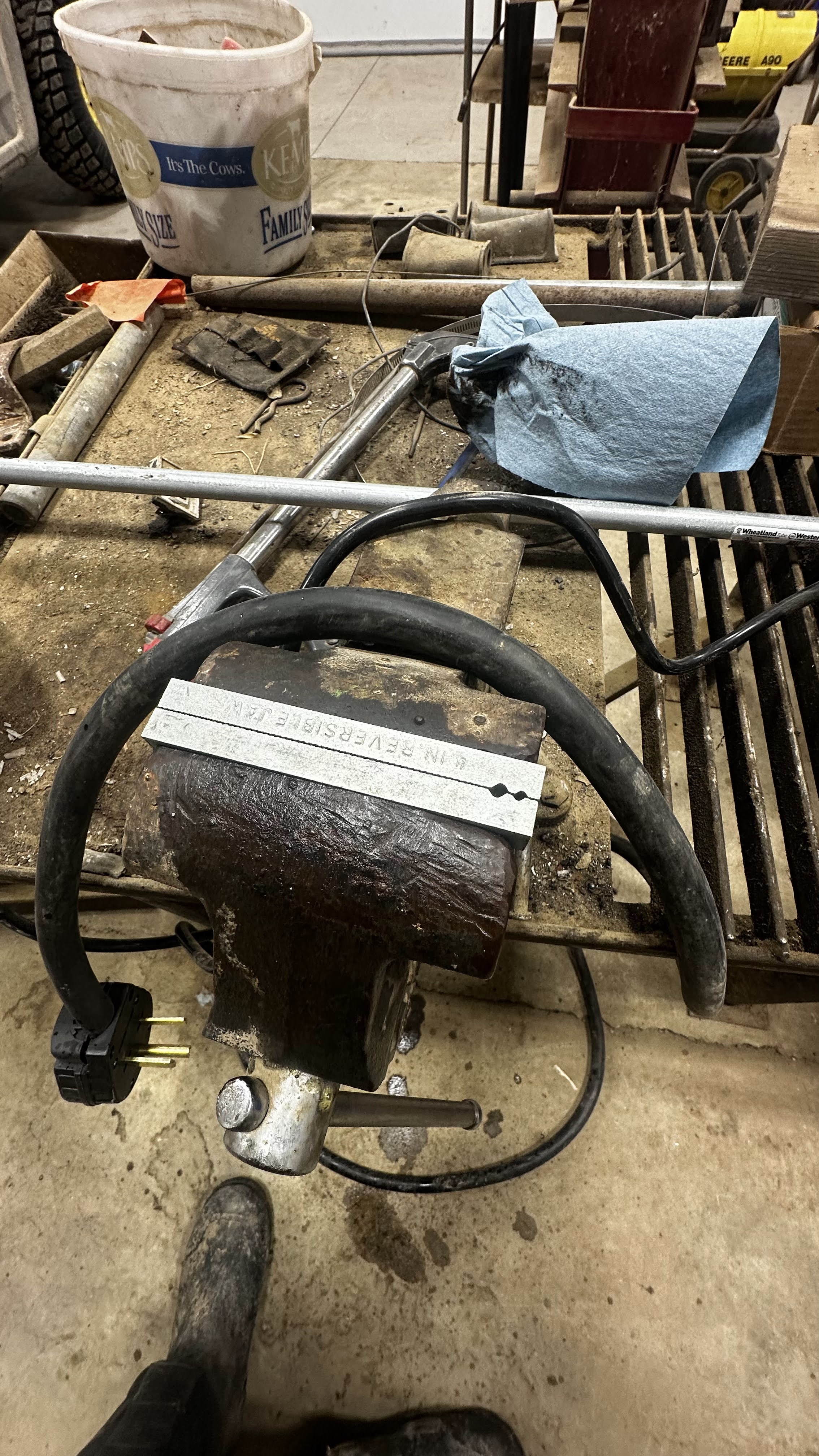
Out in the shop, I got the new ventilation fan wired up last weekend, and I replaced the jaws on the vice on the welding table. Years of beating on things had broken off the ends.
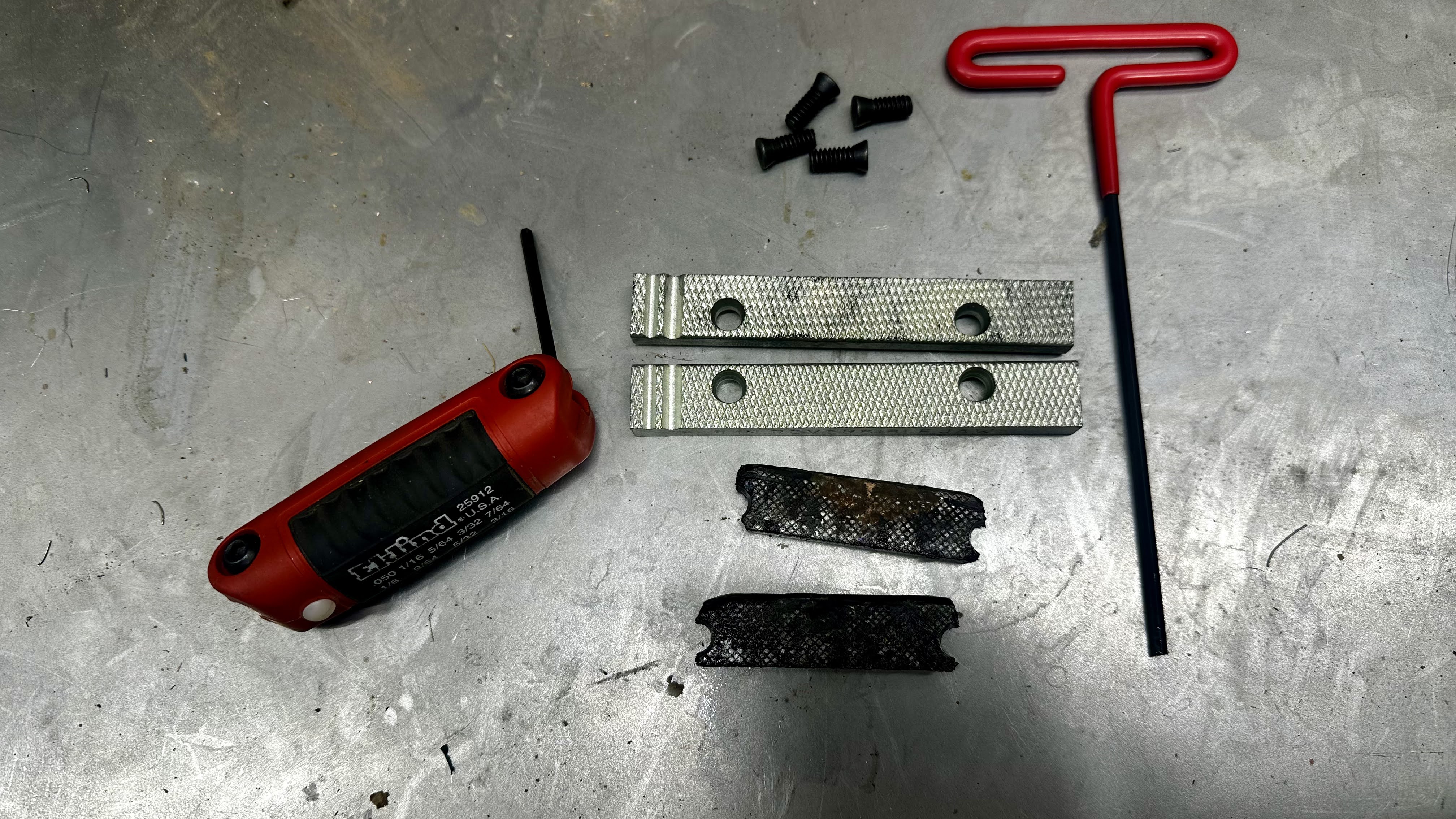
Took me a while to find 4.5” Craftsman jaws for replacement. But then I lubed the bolt and frame and it’s just like new.
The table this vice is bolted too, I made in 12th grade welding class. Still using it.
The current chickens have started laying a few more eggs, and I’m even getting a green one now and then. I don’t know what’s become of the green egg laying hens. Have they just been taking the winter off? We’re back to just one chicken in the garage.
The coyotes seem to be making the rounds again. The dogs are often out barking at 3AM or 5AM. And then sniffing around the crib. Course it’s too dark to see anything. I may just start shooting into the dirt to scare off whatever is out there.
I started looking at ordering chicks for spring. My usual place doesn’t have any available until May. That’s later than I like. There’s another place I have used a few times and I’ve got some coming on March 31st. $260 for 50 chicks. Four different breeds including 20 ‘Easter Egg’, ten ‘hatchery choice’, ten Silver Laced Wyandotte, and ten Lavender Orpington. Mabel from a few weeks ago, I think she is a Lavender Orpington. The chicks will be coming from Willmar, MN.
EVER DUG UP ANYTHING UNUSUAL IN YOUR GARDEN?
READ ANYTHING BY ALDO LEOPOLD?
 Trail Baboon
A Sand County Almanac, of course.
Nothing of interest in the garden so far but it’s possible. The house is just over 100 years old and the land itself was once part of an acreage owned by a man from Maine whose son died at Gettysburg.
We did find a 1920’s fashion plate from a Paris magazine hidden in the walls.
LikeLiked by 4 people
She wasn’t a farmer, but a gardener. She resides in Conneticutt. Ruth Strout (the sister of the mystery writer Rex) was all about soil health on her little acreage where she grew vegetables. She was an amusement to her neighbors, too, for, apparently, she gardened fully unclothed.
That’s not likely a costume recommended to Minnesota farmers.
LikeLiked by 5 people
Whoops… she’s been dead a long time. She RESIDED and gardened in Conneticutt.
LikeLiked by 3 people
I remember reading Ruth Strout back in the ‘70s, when we were first married and setting up our first gardens.
LikeLiked by 2 people
As I recall, her thing was not turning over the soil in the garden. I don’t remember what she called it.
LikeLike
Probably something like No Till.
LikeLike
I read about her too!
LikeLike
Back in Waterville, I gardened on a fairly steep slope surrounded by mature black walnut trees. The soil was very compacted. There was a level area down the hill from the house. I tried to garden there. I added compost constantly, and worked it in to the garden beds I made. The soil was still really hard to work. Tomatoes wouldn’t grow due to the black walnut trees. I did get some good squash there, but that was about it. I grew some potatoes in the compost pile, but they wouldn’t grow in the garden itself.
After watching me struggle for years, a neighbor told me that the level site I’d chosen for the garden had once been an alley. Well, I guess that explains the compaction! Anyway, the level ground ended at the south edge of the garden, and the hill dove steeply down from there. I killed weeds on that south-facing slope using sheets of 10’x 100’ black plastic for a year. Then I tilled it lightly, and planted a native seed mix from Prairie Moon Nursery. I ordered some nice native plants from them to add to my seed mix. They had to be dug in, so when I dug holes to put them in I found things. A metal toy soldier, a metal toy dog, shards of blue and white pottery, old keys, tin cans, lots of wire mesh. I asked my informative neighbor about the relics I found. He told me that the alley ended in my yard, and that people used that slope to dump their household garbage. Well, that explained a lot. I was trying so hard to make a paradise on top of an abandoned alley and a dump. Sheesh.
Yes, I’ve read Sand County Almanac and other things he wrote. I love his quotes.
LikeLiked by 3 people
I know some of the folks at Prairie Moon. (namedropping…)
LikeLiked by 2 people
It’s a cool place!
LikeLike
From The Writers Almanac for Saturday, February 7, 2015 (by GK):
It’s the birthday of inventor John Deere, born in Rutland, Vermont, in 1804. He was a blacksmith by training and by trade. Business conditions weren’t very good in Vermont, so in 1836, Deere decided to move out West to Illinois. There, he found that the traditional wood and iron plows used back East were no match for the farms out West. While New England soil was light and sandy, the prairie sod was heavy and thick. Farmers had to stop frequently to clean soil and clay off of their plow blades. Deere had the idea that a properly shaped blade would scour itself as it went along. He experimented with some new designs, and by 1838 he’d sold three of them to local farmers. He sold 10 the following year, and 40 the year after that. By 1841, he was making and selling a hundred plows a year. Deere’s innovation became known as “The Plow that Broke the Plains.”
LikeLiked by 4 people
Wow! How timely is that to Ben’s topic.
LikeLiked by 4 people
There is a place in Illinois on a lightly used state highway, if I recall correctly, where you pass up on a hill a large John Deere plow. I found it quite moving. I passed it driving east just before sunset.
Clyde
LikeLiked by 5 people
Rise and Shine Baboons,
What an interesting topic, Ben. Thanks. The only social media I engage in other than the Trail is BlueSky, which has an entire gardening topic about soil health. It is pretty important, especially following the practices of the 1060s-70s when the prairies were over-plowed and under protected. They thought fertilizer would repair it all. Those practices also led to distressing snirt blizzards which left our cars covered in frozen mud. (Mixes of snow and dirt blown everywhere).
I found all kinds of childrens toy action figures in my yard. Some of the prior owner’s children left a lot of plastic figures in the yard where they had a sand pile. We dug out a lot of the sand for the garden and found these guys buried there. Most were from the 1980s. I have not read Aldo Leopold.
Can’t wait for those chicks, Ben. How many chickens do you have now? We are off to puppy obedience training.
LikeLiked by 5 people
Love “snirt blizzard”
LikeLiked by 2 people
I have a foam and vinyl ‘bumper’ on the bottom of the shop garage doors. They’re called ‘Snirt Stoppers’. It’s a better seal than what the doors came with.
As for how many chickens we have now? I don’t know. A bunch. Some here, some there. Some over there. And the one in the garage…
LikeLiked by 3 people
I took a seminar at UW Superior, which I found enthralling. It included several 2-5 day courses in one summer on the Lake Superior basin. In the literature part one of the readings was Sand County Almanac. It led me to finding some other writings by Leopold. It spun off into reading other writers who wrote in defense of the land, a few a bit off the center line but interesting people. That was 50 years ago.
Clyde
LikeLiked by 4 people
Clyde again. I am ever grateful for my farm childhood for teaching me how food comes to be. Pork, beef, oats, many vegetables. We used natural fertilizer and plowed to prevent erosion. When I shop, I remember that. Right now the field in front of me that I talk about now and then, is being turned into a 180 unit apartment complex. They started digging up the soil this week. I see how deep the rich blue earth is here, about to be covered in cement.
There is far from adequate street access to that lot. There will be traffic snarls and accidents. I sure hope I am moving soon.
LikeLiked by 5 people
That’s too bad, Clyde. I hope they’re leaving that ravine and all those lovely bur oak trees alone.
LikeLiked by 1 person
They cannot cross a demarcated lines quite a distance back from the ravine. On the first day one driver took his cat very near that line, and three people came. Racing at him.
LikeLiked by 4 people
I’m glad they’re protecting that ravine. It’s a very nice feature and it drains to the Minnesota River.
LikeLiked by 2 people
Martian soil.
LikeLiked by 5 people
Our back yard is poorly developed grass. I don’t know how the soil is. We are planning 3 very high and large raised beds, and putting in a raspberry patch. Our neighborhood was a former farm owned by my high school civics teacher and her husband, who was a judge. We will haul lots of garden soil in the spring.
LikeLiked by 5 people
It’s alarming how much soil it takes to fill a large raised bed.
LikeLiked by 4 people
ANd how much shoveling it requires. I hope your find some local strong young men to transfer the soil.
LikeLiked by 1 person
That is the plan.
LikeLiked by 1 person
Consider having the soil delivered, if that’s possible. Otherwise you are shoveling it twice.
LikeLiked by 3 people
I’ve found pottery and china shards, old coins, a child’s ring… that’s all I can remember.
I can see I must FINALLY read the Sand County Almanac… embarrassed to say I have not read anything by Aldo Leopold except short excerpts.
That’s fascinating about your class, Ben – interesting to observe participants sometimes! And I love the quotes.
Somewhat OT: We started taking a Sr. University class called the Aging Brain, have been to one of 5 sessions. Maybe I’ll have something to report later.
LikeLiked by 4 people
There is lots of discussion about climate change but little about the more immediate problem: planet wide soil degradation. The US Dust Bowl was bad enough.
LikeLiked by 3 people
Leopold wrote very nicely about the Oak Hammock Marsh on the south end of Lake Winnipeg.
LikeLiked by 3 people
Most recently, I’m hearing about Aldo Leopold from a book I mentioned recently, “Where the deer and the Antelope play” by Nick Offerman. He’s comparing the viewpoints of Leopold and John Muir because Wendell Berry told him too.
LikeLiked by 3 people
Wendell Berry is one of my favorite American authors/essayists/poets. I really like his thinking about agriculture and urbanization. It’s unfortunate that more people don’t read his work.
LikeLiked by 3 people
i thought id enjoy wendell berry snd listened to nick offermanns comments but when i listened i didnt enjoy it and had to stop. i dont remember what bothered me but i was surprised by how intensly i felt the need to stop
i read sand county almanac and john muir and enjoyed them both but wendsll barry was a problem
nothing in the garden or in digging in general.
i always wonder about disking the soil in the fall to be sure it ready asap in the spring. i have spent many hours driving the winter roads and watching the winds blow the topsoil off to the east. minnesota wisconsin and dakota.
it feels like shaking the dice on how much you’ll lose. you remember the good years when you get planted early and have a great harvest but what a price to pay on the other end of the spectrum when the fargo wind blows for a couple days intensely enough to peel off the top of the hills and blow it into the missisippi heading for new orleans at the expense of the future
today i feel bad watching field become subdivisions of homes without souls. they focus on postage stamp lots with 3 car garages and making it look like its worth 700,000 dollars.
where do you go to expand farming
there is no rural sprawl and thats a shame
LikeLike
A Sand County Almanac, and Rachel Carson’s Silent Spring were required reading for my sophomore ecology class at SIU. Unfortunately, that was the quarter where SIU closed down subsequent to the shootings at Kent State, so we never got to discuss the books in class, though I did read them.
LikeLiked by 4 people
In 1864, George Perkins Marsh published Man and Nature, based on a lecture he gave in 1847, that essentially introduced the notion of ecology. In it, Marsh talks about the effect human activity, such as clearing a forest, has on a greater part of the balance of nature.
Marsh was a U.S. Representative from Vermont and later served as a diplomat to the Ottoman Empire.
In 1874, Marsh published a revised edition of his ecology book, entitling it The Earth As Modified by Human Action. I have a copy of that original printing. All this is to say that awareness of the effects upon the ecosystem by choices made by humans has been around longer, even, than the writings of John Muir and Aldo Leopold.
Here’s a synopsis of George P. Marsh:
https://blog.biodiversitylibrary.org/2020/08/george-perkins-marsh.html
LikeLiked by 6 people
Desert Solitaire by Edward Abbey gives a very leftist take on preservation. One of my favorite reads.
Clyde
LikeLiked by 4 people
You remind me that I have that, but haven’t yet read it.
Henry Beston’s The Outermost House is a particular favorite of mine, not as an ecology book but for its reflections on our relationship with the natural world.
LikeLiked by 3 people
I’ve added it to my list.
LikeLiked by 1 person
Me too.
LikeLike
me three
LikeLike
I read that years ago. I loved it too.
LikeLike
Can’t think of anything noteworthy I’ve dug up in the gardens over the years. The soil on my boulevard is very rocky and I’ve always assumed it was thanks to the county for what they dumped there when they dug up the existing boulevards 15 years back. Have never found anything interesting in any of my straw bales over the years either.
Ben, will the lavender chicken lay lavender eggs?
I have only read two Leopold titles. Sand County, and also a book of essays that I believe was titled Mother of Rivers.
LikeLiked by 2 people
I think the Lavender ones are brown egg layers.
LikeLiked by 2 people
I know you all think this is unheard of in the annals of VS-dom, but I actually have the game on right now. Because it was 30 seconds until halftime and I do want to see Bad Bunny for fun. Longest 30 fricking seconds of my life.
LikeLiked by 3 people
I’ll probably watch it tomorrow on youTube.
LikeLiked by 2 people
I didn’t make it to the end of the half-time show. So not my can of beans. Ick.
LikeLike
Seahawks beat the Patriots, 29-13.
LikeLiked by 2 people
It was kinda fun. The storytelling, the cinematography (camerawork of it all) and the music was just fun.
LikeLiked by 1 person
I watched the video of the half-time show on YouTube, and I have to agree with Ben, it was high energy and well done.
I’m not familiar with Bad Bunny’s work at all, but I happen to think that if some artist has captured the ears and hearts of millions and millions of people around the world, perhaps I shouldn’t just dismiss it. So here was my opportunity to listen.
I loved Lady Gaga’s part in the show. I’m blown away by that woman’s range and versatility.
LikeLiked by 2 people
i wasnt a lady gaga fan early but i realized how much i like her a couple years ago. i like everything she does. a star is born, tony bennet duets and a couple pop numbers ive heard and seen her perform, enjoyed her halftime contribution , ricky martins too
LikeLiked by 1 person
bad bunny was great
i bet trump reviews it
LikeLike
Oh he hated it. So you know it was good.
LikeLike
LikeLiked by 4 people
Can’t find the song I want, but this is the Nitty Gritty Dirt Band…
LikeLiked by 3 people