All posts by Barbara in Rivertown

Moonrise/Sunset

Today’s post comes from Barbara in Rivertown.

[I figured we should have a little astronomy before Monday.]

Just a few blocks from our house in Winona, there is a spit of land beyond the levee that juts out into the Mississippi. Boat trailers can be driven down to put in (and pull out) their boats. Even farther out are chunks of concrete that you can climb over, and once you get all the way out there, you feel like you’re right in the river. It’s a great place to watch ducks and other water birds, and the barges being pushed by the (ironically-named) tugboats.

During the warmer months, on the evenings of the full moon, we go there at sunset, climb out and look West until the sun goes down behind (in this case) the hills in an island in the river. Then we turn ourselves 180 degrees to the East, and wait for the moon to come up. It’s tricky to predict exactly where it will rise * – and the orb is hard to see because it’s still quite light out. But finally it appears:  a big golden- orange roundness edging up into the sky, and it’s thrilling each time we do this.

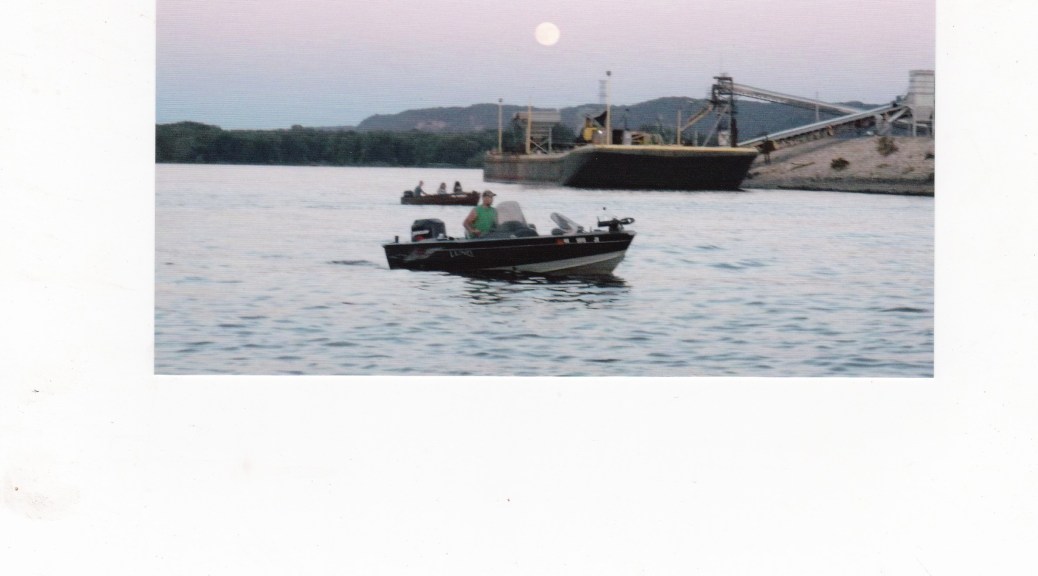
Before I met Husband, he lived in the country up on the ridge, where he was able to see lots of sunsets. Because of the tilt of Earth’s axis and its rotation, each night the sun goes down (* and the moon comes up) at a little different spot on the horizon. These photos were taken on the July 9 full moon by my friend Angela. In August the sun went down considerably to the left of that hill you see, and the moon also came up left of what’s pictured.

Tell about a memorable solar, lunar, or stellar event in your past.

Any baboons traveling to see the solar eclipse?


National Zucchini Day

Today’s post comes from Barbara in Rivertown

Last week after our t’ai chi class, one intrepid soul brought out her garden bag, to see if anyone would like some… what else?… ZUCCHINI. She was able to shed a couple of them, and proceeded to tell us that August 8 is “sneak some zucchini onto your neighbor’s porch” day.  I thought perhaps she’d made that up, but a little research shows that, indeed, Tuesday August 8 is National Zucchini Day, known in some circles as Sneak Some Zucchini Onto Your Neighbor’s Porch DayThis site states that “Desperate times call for desperate measures. It’s time to sneak over, under the cover of darkness, to your neighbor’s porch, and unload some zucchini…”

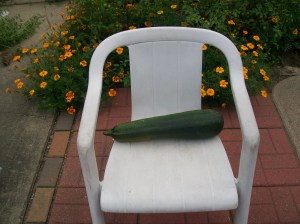
Those of you with veggie gardens know what I’m talking about. This year I have given zukes to half a dozen people so far; I think I’m caught up with our four plants at the moment, but more are on the way. I thought I was doing well when I discovered, on the ground back by the fence, a real “baseball bat”. I decided to leave it on the neighbor’s back stoop, with a note saying “Just kidding, I’ll come back for it”, because they have their own plants, and I want to keep them as friends.

Here are some fun facts about zucchini for the curious, found at

  • Zucchinis are 95 percent water, with just 33 calories in a medium-size squash.
  • One zucchini has more potassium than a banana, supplying more than 10 percent of your daily need.
  • Summer squash is rich in carotenoids, powerful cancer-fighting antioxidants that are mostly found in its skin. So be sure not to peel your squash. And buy organic to avoid pesticide residues.

I just checked the garden, and found a good sized green torpedo hiding on the ground… next year I’m campaigning for yellow squash – tastes the same in my book, and you can actually see them!

When have you sneaked around after dark, for any reason?

Crutches!

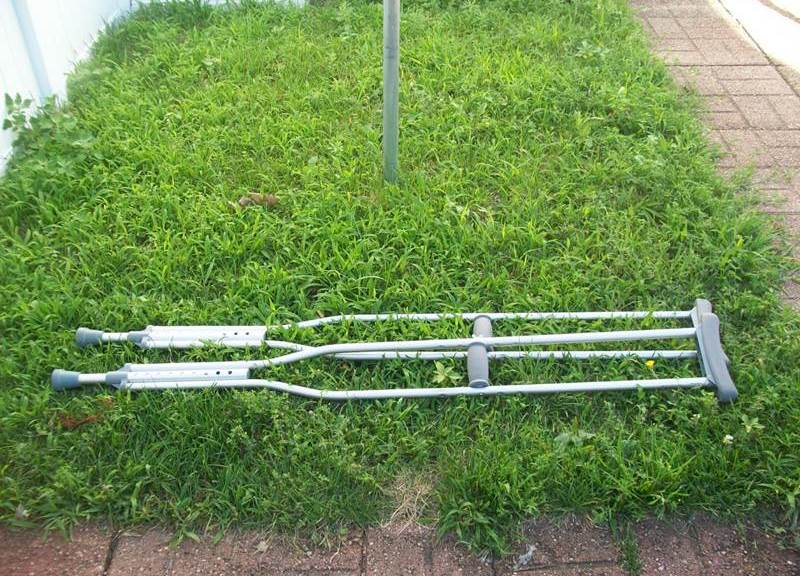
A week ago Friday, Husband went, able-bodied, to play volleyball at the Y. He returned hobbling on a right leg that had sustained, as it turned out, the rupture of its Achilles tendon. One Urgent Care and three visits to Winona Health later, his leg is wrapped and he has been on crutches all week. Luckily the location of the tear means that he will not need surgery… just three months of not walking on said leg as it heals. SIGH.

As I prepare to mow our (admittedly miniscule) lawn, I recall the days (just a week ago) when I had only my tasks on my plate. (Poor me.)

Have you ever had to get around on crutches?

If you were on crutches, what activities would you have to give up?


Complaint Department

I spent part of Friday looking up the online recipes for a new diet I’ve been trying, and printed out a few of the recipes for my collection. I finally gave up on one recipe, however, when I read that I should “In a small saucepan, whack honey with liquid and simmer till sauce thickens slightly.” I realized after reading the next sentence “Take off heat and whisk in mustard” that the author meant for us to “whisk honey with liquid”, not whack it. (!)

In the next paragraph I was told to “mix sugar with nest and chile powder”, but I’m on to them now, and after consulting the ingredient list, I understand that oddly enough, instead of nest, they meant lime zest.

I want to write to them with my rant – “What is wrong with you people? Have you no editor? Since I’m doing it anyway, how about if you pay me to be your editor?” but there is nowhere to write that would bring satisfaction.

When have you lodged a complaint with the appropriate party, and did you get satisfaction?

Outdoor/Indoor

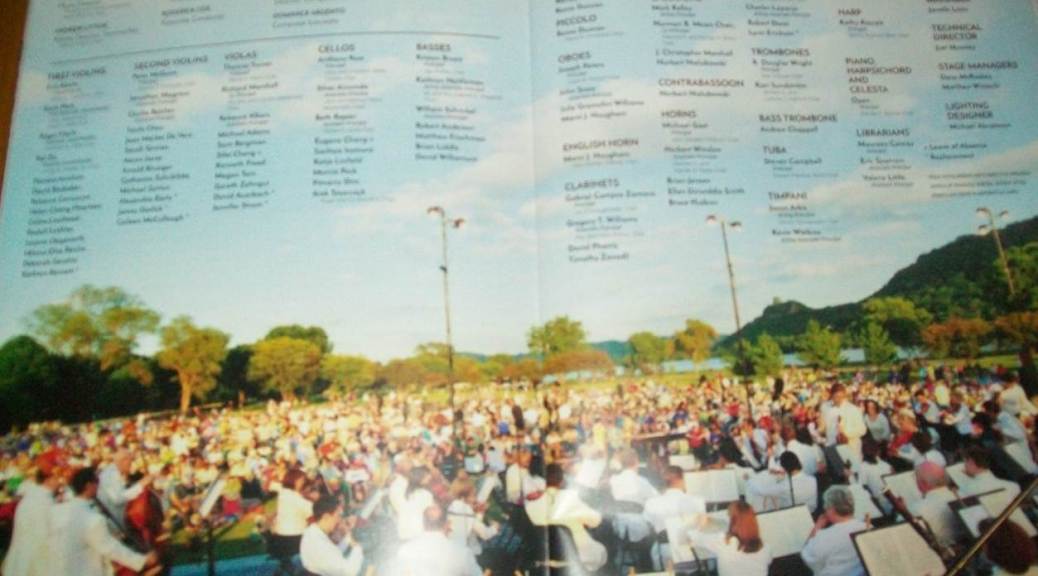
Thursday night we attended the 11th annual Minnesota Orchestra Concert down by Lake Winona, which officially opens the 2017 Beethoven Festival. It was a delightful concert, and got me thinking about some differences between Outdoor and Indoor Concerts:

Outdoor

  1. There may be a little rain an hour prior to concert, but hey, it blows over. (This has happened for the past two years.) The breeze makes the musicians find a way to secure their music to the stand.
  2. You bring your own chairs (or blanket), a picnic supper, and have a glass of beer/wine if you are discreet.
  3. The orchestra is seated on a platform, and you are on the ground below, so for the most part you can only see the string players. (It would be a good idea for the horns to stand when they have a prominent part, but I haven’t told them this yet.)
  4. A little girl in a green dress runs around (and around…) her parents’ chairs during the Tchaikowsky Polonaise (and beyond). Kids are swinging as high as they can on the adjacent playground, while the orchestra plays three of Dvorak’s Slavonic Dances.
  5. You can kick of your shoes and let your feet feel the grass.
  6. You get to watch a really cool sunset while listening to the music.
  7. You can hum along with John Williams’ Raiders of the Lost Ark theme and no one minds.
  8. If you see someone you know, you can wave wildly, and easily find them after the concert ends.

Indoor 

  1. Weather is not an issue once you are in the venue. Musicians’ music usually stays put on its stand.
  2. You have prepaid seating; refreshments can be purchased at Intermission, and must be consumed before returning to the auditorium.
  3. The venue is designed so that much of the audience is looking down on the performers, and can see most of the players.
  4. Children are regularly hushed and shushed throughout the concert, and will run around only at Intermission.
  5. It’s probably best to leave your shoes on your feet… they’re hard to find in the dark if you need them.
  6. The lights will go down when the music starts playing, and you will sit in the dark.
  7. If you talk or sing during the concert, you will most likely get stern looks from those around you.
  8. If you see someone you know, give a polite wave and hope they see you; perhaps you will find each other in the milling crowd at Intermission 

When and where was the last outdoor performance you remember attending?

Lyme’s

Today’s post is from Barbara in Rivertown

I found out early this morning that I have Lyme’s Disease. It is a relief that there is a reason for the red blotches, headaches, fevers, and lethargy I have been experiencing for the past few weeks. I will start a series of antibiotics this evening with dinner.

You’ve probably heard plenty about Lyme borreliosis and the ticks that carry it, often the tiny deer ticks. But just in case you don’t know much detail of what to look for, here are 11 of the common symptoms, according to a site called Daily Health Lifestyles:

  1. Rash
  2. Fever
  3. Headache
  4. Pain in extremities
  5. Lethargy
  6. Pink eye
  7. Memory issues
  8. Arthritis
  9. Droopy face
  10. Insomnia
  11. Heart problems

Wikipedia has this to add:

“Lyme disease is transmitted to humans by the bite of infected ticks of the Ixodes genus.[6] Usually, the tick must be attached for 36 to 48 hours before the bacteria can spread.[7] … The disease does not appear to be transmissible between people, by other animals, or through food.[7] Diagnosis is based upon a combination of symptoms, history of tick exposure, and possibly testing for specific antibodies in the blood.[3][9] Blood tests are often negative in the early stages of the disease.[2] Testing of individual ticks is not typically useful.[10]

I am glad there is an antibiotic to help me deal with this disease.

Do you have a tick/insect story to tell?

The North Platte Canteen

The North Platte Canteen

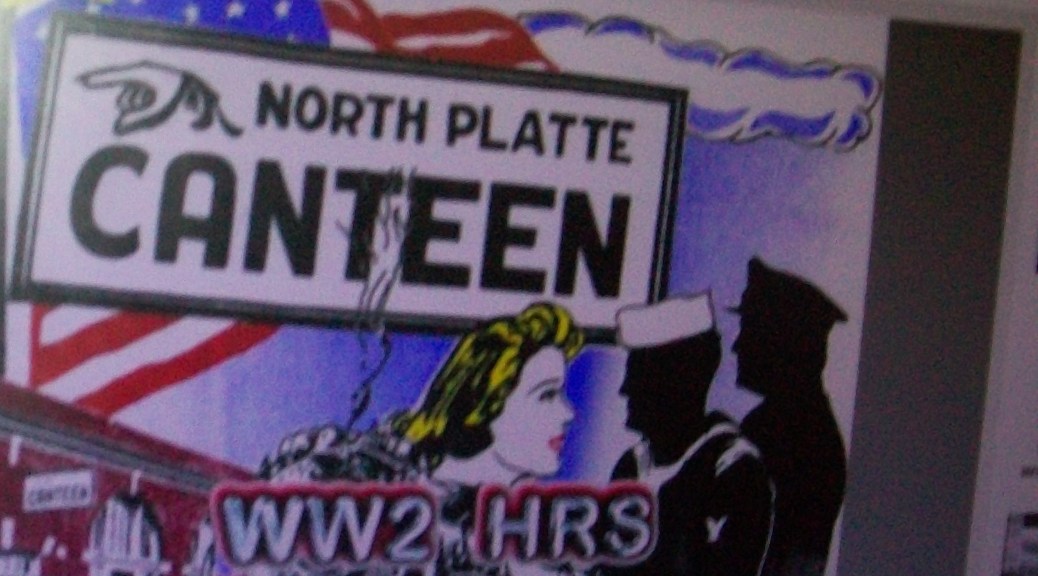
Imagine that it’s between 1942 and 1945, and you have enlisted in one of the armed forces – Army, Navy, Marines, Air Force, Army Air Corps, Coast Guard. You are traveling cross country on a troop train, perhaps headed to boot camp – maybe never been away from home before. Since you boarded, you have been sleeping in your seat, had no showers, and had only K-rations to eat. As you approach North Platte (pop. 12,000) in west central Nebraska, you are told that at the next stop, you’re not only allowed to get off for 10-15 minutes, but encouraged to do so while the train takes on water and fuel. You see the sign CANTEEN above the depot entrance as the train approaches the station.

When you enter the Canteen,  you see ladies serving at tables crammed with food – (from among) sandwiches, apples, small bottles of cold milk, coffee, cakes & pies, cookies & donuts, hard boiled eggs, sometimes even fried chicken. Women of all ages are serving, and the youngest ones are carrying baskets of cigarettes and candies out on the railway platform. One inside table has complimentary magazines (“Free to Service Men”) – Life, Look, Liberty, Saturday Evening Post, Readers Digest, comics, movie magazines.

You eat as much as you can in the allotted ten minutes – you are allowed take your coffee or milk on the train, as the cups and bottles will be collected by the conductor and returned to the Canteen. Before you leave, though, one of the ladies gives you a hug, and wishes you well on wherever your journey may take you.

What was the motivation of the North Platte population? (Of the hundreds of small towns along the troop trains’ route, this was the only one we know of to perform this service.) Shortly after Pearl Harbor, as Uncle Sam was entering the war, folks in North Platte heard a rumor that Nebraska National Guard’s Company D would be coming through North Platte on a west-headed troop train. Friends and family of the men, to the tune of 500 citizens, had come to the station with gifts for “the boys.”

As it turned out, it was the Kansas National Guard’s Company D, not Nebraska’s. After an uncomfortable minute or so, one young woman, Rae Wilson, said essentially – “Well, I’m not taking my cookies home,” and offered them through the window to the Kansas boys. This same woman then wrote a moving letter to the editor of the The Daily Bulletin, which included these lines:

“We who met this troop train… were expecting Nebraska boys. Naturally we had candy, cigarettes, etc., but we very willingly gave those things to the Kansas boys…  Smiles, tears and laughter followed. Appreciation showed on over 300 faces. An officer told me it was the first time anyone had met their train and that North Platte had helped the boys keep up their spirits.

I say get back of our sons and other mothers’ sons 100 per cent. Let’s do something and do it in a hurry! We can help this way when we can’t help any other way. “

Rae Wilson                           (who became the Founder of the Canteen)

Bob Greene writes in his book Once Upon a Town, “Most of the older women who worked in the Canteen had sons in the war. It was like a healing thing for them to work there.” (This book is also the source of Rae Wilson’s letter above.)

So it started as a small endeavor:  fruit and sandwiches, cookies and cakes. Ultimately, 125 surrounding communities participated, and a total of 55,000 (mostly) women. They met every train for more than four years, sometimes as many as 32 trains a day. On, i.e., a hospital train where the men could not disembark, the women boarded the train with baskets of sandwiches, apples, milk. The Canteen was staffed by volunteers who gave their own rations for the baking ingredients. It probably helped that these were rural farming communities, where things like eggs, flour, even pheasant (in season, mostly) for sandwiches were sometimes readily available.

For more details, see this link for a fascinating six-minute recap .  In the end, it is estimated that six million service men and women came through that Canteen.

When have you been the recipient of unexpected hospitality?

Alive Singing

Today’s post comes from Barbara in Rivertown

We were in the cities this past weekend for a family gathering, and managed to squeeze in the season’s last “Singing in the Light” event Sunday afternoon. This is led by my friend Barbara McAfee, a local singer/songwriter and voice coach. (She has given a couple of fun concerts with Claudia Schmidt, which a few baboons have attended.) It takes place in the Art Gallery (huge room) of the Hennepin Avenue United Methodist Church in Minneapolis, on maybe seven Sunday afternoons out of the school year.

I’ve written here  before about singing in song circles or community sings, which have been around in Minnesota in one form or another since WWI. The kind I am most familiar with involve song sheets or books, and requires a couple of people on guitar. While that’s very enjoyable, I’ve noticed that much of the time is spent looking at the lyrics we’re singing – we interact with people mainly at snack break.

The Oral Tradition, on the other hand, is singing without written music or lyrics to look at, and is done “a capella” – without accompanying instruments (Italian: “in chapel style”). The music is described as “songs, rounds, and chants from around the world — from the sublime to the ridiculous.” All ages, all abilities (don’t have to read music!), are invited.

It works like this:  someone (in this case Barbara) teaches us the parts via “call and response”, which we repeat, sampling them till we know it well enough to choose one. We move to that part of the room, then practice till we sort of know our part, and give it a whirl. After we get going we are invited to walk over to where they’re singing another part – heck, on some songs I was able to try out several – and move around the room. This goes on till everyone gets their part down well, and it sort of organically winds down or gets softer, and then that song’s done.

Meanwhile, all of a sudden there is this beautiful music, and we are making it. We are also looking at each other as we sing and walk around. It is the most satisfying kind of singing I have ever done, and sometimes brings me to tears. I wish everyone who loves to sing could get a chance to try it. I’ve never felt more alive while singing.

What is a regular activity of yours where there is eye contact with other people?

A Little Explore

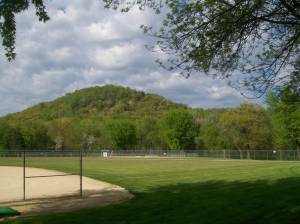
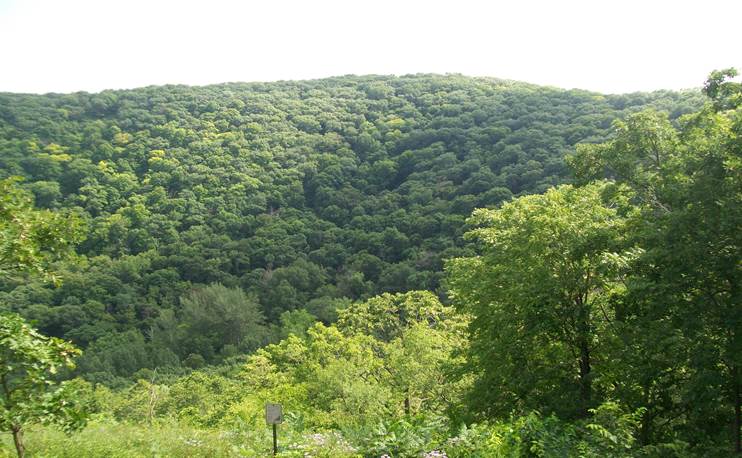
For our anniversary a couple of weeks ago, Husband and I took the day off and went out exploring. It is particularly beautiful right now out in the hills surrounding Winona, and we headed south and west, and ended up in a little town of 657 souls called Rollingstone. Had lunch at Bonnie Ray’s Café – cute place, with photos of the locals papering the walls, pretty decent food. We got to meet Bonnie herself – she was wearing a t-shirt that said something like “Rollingstone – Before the Song, Before the Band”. Then we walked around town and played cribbage on a picnic table in the city park, from which we had this view.

We drove on back roads toward Lewiston, and knew our way to Farmers Park, a gorgeous county park situated in a flat spot among the hills. It’s a peaceful place with multiple picnic spots, and an old fashioned playground with not only teeter totters, but also a real merry-go-round.

When we left, I suggested we follow the road you see in the top photo, up a rutted, winding path that brought us to a cornfield on the ridge. We made our way along one gravel road after another, trying to guess which direction at each juncture, and finally came to a county highway. By now we were so turned around we had no idea what would get us back to our Hwy 14. (And we have no smart phone.) Eureka! – I remembered a map I had picked up just that week, which showed a good bit of area around Winona; we turned left onto County Hwy. 23, made our way home.

Before (or lacking) smart phones, how did you manage to find your way when lost?

The Allure of Radicalism, Take 2

The following is the first guest post I wrote, back in the days when Trial Balloon blog was just a fledgling. I’ve updated slightly and given it a different question – only a handful of our usual readership has seen it before (I think).

———————————————————–

A few years ago when Husband and I were on a Minnesota stay-cation, we were honored to attend a memorial service for a man who had been a real “mover and shaker”, someone who was active in many arenas and really got things done. In addition to this, he was considered a “radical.” On a hilltop overlooking the gorgeous green valleys of Southeastern Minnesota in August, people told stories about this man for three solid hours – how he kept to his principles, questioned and at times defied authority, blazed trails, and worked incessantly for environmental and community-building causes.

I grew up in a household of mixed messages: Be Different (but not So Different That You’d Embarrass Us). In the late 60s and the 70s, there were so many ways to Be Different! You could blaze a little trail by trying out vegetarianism or marching in protest to the Vietnam War. Some of us left for the East or West coasts, or abroad, hoping to find something radically different, and of course we did. When ready to settle down in the late seventies, I came to the Twin Cities, hoping what I’d heard was true – there were Radicals in Minnesota. I’ve never been disappointed – the coastal hot spots had nothing on this state!

Most of us are now more subtle in our radicalism – there are hundreds of ways to be a little bit radical. I still enjoy getting people to raise an eyebrow by telling them, say, that I participate in a blog peopled by listeners to a former public radio Morning Show.

What would you like to do that’s a bit radical? (Or have you already done it?)