All posts by cbirkholz

Tain’t No Such Thing as a Free Lunch

Today’s post comes from Clyde

A colleague, science teacher/coach, posted this sign: “Tain’t No Such Thing as a Free Lunch.” He taught you have to earn what you get and pay for your mistakes.

Tisn’t always true. One colleague went from free lunch to free lunch, as do others.

What have been your free lunches?

My Life in the Petri Dish

Today’s post comes from Clyde in Mankato

My mail carrier on the North Shore used to joke about the range of mail I received. As a person actively involved in unions, I received a lot of liberal mail. As a pastor I received a lot of conservative mail. And, as a joke, students would fill in magazine subscription cards with teachers’ names. It was a bit of a hassle to stop these, but before I did, the hunting and fishing magazines supplied my name to ultra-conservative organizations. Sorry about that, Steve, but it is true. One of these promised to tell me the evils of public school teachers.

In my life I belonged to many subcultures. Small farm culture, neighborhood culture (three times), teacher culture, faculty room culture, North Shore culture, Iron Range culture, small church culture, lumberjack culture, union culture, University of Chicago culture, nursing home culture, taconite plant culture, team culture, coaching culture, railroading town culture, and many others, such small bar culture, which may surprise you. But I love small bars, especially the rural ones, especially in the north woods, of which there are many. In most of these cultures I was a sort of outsider, never quite at home.

When I write my short stories I try to use these many subcultures. It is fun to revisit some of them in my memory, some not so happily. Lumberjack culture and north woods bar culture are among my favorite things to write about.

I assume Babooners have belonged to many subcultures, too.

What have you learned from the culture’s to which you have belonged, willingly or unwillingly?

Rumble, Grumble, Mumble, Tumble, Jumble, Swumble, Crumble

Today’s post comes from Clyde of Mankato

A thunderstorm comes through rumbling and grumbling, trailing a fug of humidity.

Thunderstorms come through rumbling and grumbling. One after another. Humidity blankets us. The weather pattern of August, 2016. Except for that one loud clap, hitting the tall trees outside our apartment no doubt, which knocked a picture off a wall, we like thunderstorms, although enough is now enough. Rain falling off the roof outside our windows makes white noise for sleeping. Humidity we hate. We wilt.

My son and his then wife moved an adopted street dog from San Diego, land of very few thunderstorms, to Seattle, land of, well, need I explain? Oh, how that dog went wild over thunder! Rain confused him. He is safely back in San Diego. Our son loves the Seattle weather and his wife fell in love with it as well. Not the poor dog.

sunset-thunderstorm-2

Three years ago the weather pattern day after day was brilliant sunsets. Often with lightening in them. Not one good sunset this year, that I have noticed.

Assuming you have the wherewithal to live in two places, what two places in what part of the year would you choose for the weather?

Out of Steam

Today’s post comes from Clyde in Mankato

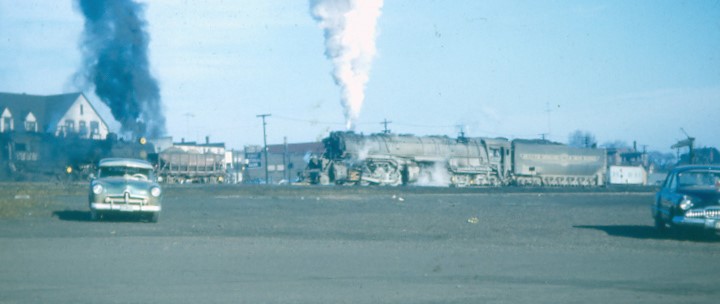
My mother took this picture in about 1954 or 5. It shows yellowstone mallets, among the largest steam engines ever built, right before they were replaced by diesels. This is in the railroad yards in Two Harbors. The ore docks would be behind my mother and me as she took this picture. I remember being there when she took it.

The end of the daily rain of soot on the town was appreciated after they were gone. But I missed their pulsing throb as I went to sleep at night, on those summer nights when the wind was right and my bedroom window was open.

Very few of these engines are left, none working. One sits just to the right of this picture. If you have been to Two Harbors, you have likely seen it. Another is in the wonderful train museum at the old depot in Duluth.

Are you a lover of trains?

Coffee Brake

Today’s post comes from Clyde of Mankato

I have given into the rampant coffee culture, an invasion from foreign lands such as the Middle East, so it is my guess that Trump and the Trumpeters do not participate. Coffee was brought to Europe by Asian invaders, it seems.

In my childhood coffee was this weak watery stuff, in my house more watery than most, my mother being that thrifty. She bristled at being called cheap, which she was. Coffee would also stunt your growth.

It took my a few years into my adulthood to start drinking it, then I stopped. Coffee was made in the faculty room, a place I learned to shun, and by midmorning was over-heated – the coffee and the room. Sandy has never been able to drink it. I learned to sip it to be sociable. My daughter had sworn she would never drink coffee, as did her husband. She did not even drink it to be sociable. Now they have this fancy-schmancy coffee system and thrive on it.

So about ten years ago I started making it occasionally, then almost every day. But I seldom buy it out and about; it is expensive, and I do not like dark coffees. Starbucks is battery acid to my pallet. Then my son, a devotee of coffee who has tried roasting his own beans, clued me into two temptations: 1) blonde coffees, such as Starbucks Veranda and 2) Trader Joes, especially their Joe and their Soft and Mellow. Thrifty, if I ignore the gas to go up to the Cites to buy it. (Thrifty I call myself, never cheap.)

I made a drip pot every morning. Every so often I would press coffee. My coffee has grown a little stronger and a little stronger. Then lust set in, fueled by my daughter’s fancy-schmancy coffee maker, which allows you to make a cup at a time if you wish.

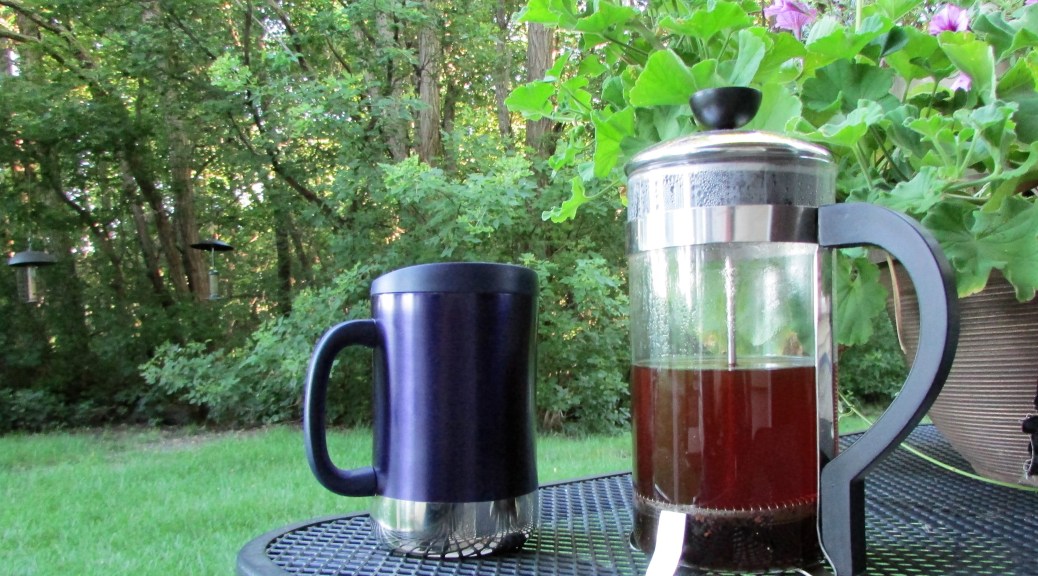
Both of my offspring extolled the virtues of grinding your own coffee. Temptation won. Last week I ordered a thrifty coffee grinder. I lust after a single cup coffee maker. However, I am finding that grinding coffee each morning and pressing it is very nice, especially out on the patio before the heat rises. Somehow each morning for the last week my blonde coffee gets a little stronger each day.

I am still coveting a the single-cup coffee maker. (But not my neighbor’s ass.) A cup at a time as I wish, easily done! Oh, my, I do sin.

However, I will have to hide the grinder this weekend. My sister and brother-in-law are coming this weekend. They go on tirades about their children and their dedication to coffee and how strong they make coffee and the money they spend. They are cheap for their children’s sake.

What do you hide from guests?


Pals, Buddies, Chums, Confidants, Allies

Today’s post comes from Clyde of Mankato

Steve posted this yesterday:

I continue to be fascinated by Liam [his grandson]. His buddy is Terrian, 7 years old, the next-door neighbor kid. Terrian and Liam, 6, can play for hours. Liam was next door doing that recently until a dispute broke out between Terrian and his parents. Things escalated until the parents sent Liam home.

My daughter wondered how her son viewed the fight. I enjoy the way she talks to him, always with genuine interest in what he’ll say . . . because he is not predictable. “I stayed off to the side,” reported Liam. “When kids do something like that, you just let it happen. And then you hope they learn from their mistakes.”

Liam and Terrian–not the names of my youth. Friendship does mean not trying to change the other person, does it not?

Childhood friendships are a constant source of literature and thought. Among the many movies, my favorite is The World of Henry Orient, about two adolescent girls in New York City. You can no doubt name many others.

Childhood friendships are very important, yet they seldom last into adulthood. I have nothing in common with my long childhood friend. He went into the Navy; I went to the University of Chicago. We entered two different universes. We stumbled over each other for awhile on Facebook. We were over two years apart in age. I was the younger. In our yKis Pixouth we roamed the woods on my hill together and shared many adventures, often staying overnight in a shack built by our two older brothers, who were long friends and grew very far apart by the time they were 25.

In truth my best childhood friends were Boots and Cleo. Cleo and Clyde–we had to be welded at the hip for life.


What did you learn from your childhood friendships?


It Is a Village, Though

Today’s post comes from Clyde of Mankato

I have been thinking much about community–what it is, what makes it, how we lose it, why it matters that we lose it. Community has invaded my fiction without my permission. This is a vignette from my stories about Northeastern Minnesota.

A place. Only a place. Indistinguishable from much of the boreal forest covering Northeastern Minnesota and adjoining Canada. A place, only a place, unless you looked at this place with the masterly eye of the original people who first roamed in small bands through the forest thousands of years ago. A Place: a low hill rich in game, with a level area above a clean-flowing stream, ample supplies of firewood, and many young cedars for poles, baskets, and other village needs.

It was many times a Lakota village for a season or two.

It was a village only once or twice for the Ojibwe, who, forced west by the European settlement of the eastern Great Lakes, displaced the Lakota out onto the prairie. The native peoples had astounding geography skills, which allowed them to remember favorite locations for their nomadic villages, but they were weak at geology. They were unaware of what lay beneath the hill and how to use it.

It was never a village for the fur trappers, first French and then English. The stream had clogged up, making it of no interest to the beaver.

It was not a village for the five men who came prospecting for iron ore. With their geology skills, they found the hidden wealth. Five men focused only on rocks for one week do not make a village.

It became a village once again when the first two dozen men arrived to open up the mine and by necessity begin a town. Soon followed more dozens of men, some to work the mine and some to attend the men who did. The third wave of men, accompanied by women and children, helped establish the mining office, a store with post office, boarding houses, and a dining hall.

Ten years later it was a large village, complete with several hundred residents, seven stores, two banks, two law offices, one doctor’s office, three churches, and a committee of village leaders to incorporate it as a municipality under the statutes of the young State of Minnesota, allowing them to plat and try to maintain muddy streets, provide a constabulary with jail, build a pine-framed city hall, organize a volunteer fire department, and grant the mining company and railroad all the exemptions and privileges they desired. The committee named the town for an eastern wealthy industrialist of dubious integrity but who had a proper British surname, unlike eighty percent of the residents.

After another ten years it had grown to a village of more than fifteen hundred residents who, despite some strident objections, added a brick city hall with jail, a larger fire hall with better equipment, a hospital, a small pine-framed elementary school, and parks, which at first were no more than rocky, weedy empty lots. It was a village because people gathered for their commonweal by assigning or gathering in the various roles that a village needs. United they were despite being divided into different heritages with different cultural norms, into different brands of Christianity, into opposing political points of view, and into social strata based primarily on occupation and nationality.

As a village it struggled, like all villages do, to serve the greatest good of the greatest number of people despite the interests of a powerful few. The library was a telling point for the village, opposed by those who saw it as a waste of tax dollars or waste of people’s time and by those who feared books as sources of dangerous ideas. A few years after the first small pine-framed library was built in the alley behind the city hall, it was replaced in the town center by a large-windowed brick and stone building, funded, along with its oak shelves and books, by Andrew Carnegie, who had made himself wealthy beyond the village’s imagination by processing their high-grade ore into iron and steel. His wealth was built with his skill, his ill-use of his employees from his mines to his blast furnaces, his intimidation of those who dared oppose him, and his manipulation of Wall Street, which has never cared what makes a village.

It was a village because most residents knew most of the others, because they gossiped about each other, by which is meant, among other things, knowing and tending to each other’s needs. Through gossip they knew what to help celebrate or who to help grieve. As a village they wove the strands of the web that bound them together, the strongest bonds woven in the hard times, of which there were many. Through boom and bust it was a village parenting each other’s children and finding pride in landmark events, such as their first high school graduating class of only two young women and one young man, others of suitable age having gone to work instead of going to high school.

It continued to be a village as it grew to over 4000 residents who survived the disaffections and deeper divisions that come with larger size. It was a village proud of its new brick and granite grade school and imposing high school on the top of the highest point in town, donated by the mining company. More and more students were graduating, more and more were heading south for a better jobs or to add to their education for a fuller life.

It was a village united behind their sports teams which played other mining villages, united in elation when their teams were victorious over the teams from their rival town ten miles to the east or untied in dejection when the teams lost.

It was a village when it proudly and naively marched boys off to wars, stunned but united in grief when the sad telegrams began to arrive, and bound in relief when men came home.

It was a worried village when the ore of their mine began to dwindle. The population started to fall, more young people headed south, and businesses began to close. As a village it stood through it all, taking the loss as too-personal when their high school closed, sending their young to the rival school ten miles to the east. To the village’s relief, the grade school remained, but only for a few years until the population dropped back to a few hundred residents, most of whom were beyond the parenting stage.

It remained a village after the downtown closed and house after house was abandoned, a village whose residents drove elsewhere to bank, to shop, to visit the medical clinic, to treat themselves to a restaurant meal, and to hire lawyers to write their wills.

It is a village still, a village of mostly retired people, more women than men, who gather to mourn the impending death of the village and to pass around photographs of children and grandchildren who live in distant large cities where people have no sense of what makes a village and why villages matter.

© Clyde Birkholz 2016

What has not endured that you thought would endure?

A Modest Request

Today’s post comes from Clyde of Mankato

A couple years ago I did a guest blog about parking issues near us. I can today report nothing has changed.

I am still parking a tiny Scion amidst the behemoths. Why are there so many monster trucks in this area? I call it Testosterone Town.

There are still 28 handicap parking spots in front of Scheels Sporting Goods and only two in front of Barnes and Noble.

It is still chaos in front of Target with the handicap parking right by the door at the busiest place where pedestrians stream right behind you, beside you, in front of you, and pretty soon over you. And my neck is worse making it harder for me to turn around to see.

Cub Food still has no cart corral near the handicap parking. The corral is still dead in the middle of the parking lot. I can report one change here. A few people without legal right think it is acceptable to sit in the vehicle, often a behemoth, with the motor running only half parked in the end handicap spot.

No one is listening to me.

Why don’t people just listen, you know?

Campy Summer Camp, Part II

Today’s post comes from Clyde of Mankato

The Fusing of Two Memories

When I worked at Camp House, my room was right on the shore of Lake George. Many mornings when I got up very early for work, a mist hung over the water. I fell in love with the mist and often rowed a boat out into it to lie back and drift in a slow circle in the calm air.

Once when I was very young, our family on occasion went fishing on Lake McDougal near Isabella. The boat ramp was beside a resort. One early wet foggy morning a little girl in a nightgown spun slowly in the wet grass with her arms outstretched.

When I wrote my collection of stories about Northeastern Minnesota, the two memories fused into this sketch.

Called by the Mist 1928, August

Prudence Patience, never called Patty as she wishes, is summoned awake before the dawn. It is not her mother who summons, nor her father, nor her three older brothers. Nor a human voice at all, a summons only she can hear, even in her sleep.

She pulls a long gingham dress over long blond hair and over her night dress. Next are wool mittens, knit by her other grandmother, not the grandmother who owns this lake resort managed by her parents. Next is her hat, her hat, with a big flower on the side but which she wears to the front, given to her by a guest in June. But no shoes—Prudence Patience is not a willing wearer of shoes in the summer.

In her bare feet she steps in silence down the stairs of the main lodge to the side door, the hinges of which creak when opened. Prudence Patience, a small nine-year-old, a “mere lady slipper of a girl” her father calls her, can ease through the door before the hinges reach their point of protest. “Mere lady slipper of a girl” is her father’s tease about her wildness as much as her slim body. Next, before she steps out into the cold northern air which attracts their guests, she has to slink through the screen door, which is below her parents’ bedroom. She knows how to grasp the spring to stop its elastic screech and how to ease the screen door back into its frame. On the lawn, she turns and walks backwards to see the tracks her dragging feet channel in the heavy dew. She knows her route so well she can do it backwards without turning her head. When she reaches the dock, her skirts are soaked, for which she has been often chided this summer and will be again before the mother and children move back into town for school—the school, where the mist will not abide.

It is the mist suspended between lake and clouded night sky which called her awake and invited her into its otherworld of no dimension.

Prudence Patience chooses the smallest rowboat, as she always does, for which she has been often chided and will be again, not for choosing the smallest rowboat but for using a rowboat alone. With short strokes of the oars she rows out far enough to be lost from the shore. She lifts the right oar into the boat and uses both arms to give several hard pulls on the left oar. The boat spins counterclockwise. She lifts the second oar into the boat and moves to the front seat to lie down in the dew with her head below one gunwale and her bare feet hanging over the other. In silence the boat drifts its slow rotation in the sodden air and mirror water.

Creatures of water live in the mist, she imagines, but she does not imagine their shape. The creatures of the mist are indistinguishable from the mist. Creatures of water live in the lake and are indistinguishable from the water. She wants the boat to ever spin, the mist to ever hover, the wind to never breathe, sounds to never speak. She wants to never leave here, to ever be here with dew and mist and lake and fog and rain.

The mist enshrouds her by condensing on on her clothes and hair. The mist condenses in her eyebrows and runs down her temples into her ears. O, let it fill her ears and melt into her mind! She will not move and break the spell! Her hands loll down beside the seat touching nothing. The mist condenses in her long pale eyelashes. O, let it run into her eyes like tears! She will not move and break the spell! She will dissolve into water. She will join the creatures of the mist and be unseen. She commands silence upon the lake, no sound of screen door or human voice or creature which will reveal east from west or south from north.

As she blends into the mist, she forgets to hold her spell to hold the silence. A loon vibrates its plaint from their nesting ground in the reeds near her dock. She exhales. She forgets to breathe in! Another loon calls from a different direction. The spell is saved! She is lost again!

She breathes in and surrenders to the empty moment. A fish jumps by her head, telling her nothing, nothing at all.

She drifts on in her circle. Or does not. It no longer matters. Time tendrils into the mist. Time condenses on her skin. Time drips from her feet. Mist and time condense in her eyes blurring form. From the stern of the boat a blue heron clatters its beak. She is indistinguishable from the mist! Being of the mist, she feels not cold, she feels not wet.

The mist and time condensing in her eyes cannot shield her from the increasing light. The screen door slams! Her father calls, “Little Lady Slipper, come back off the lake.”

It has ended. He can see her. The mist has arisen and will return as rain.

In the lodge her mother tells her to get out of her wet clothes and hurry back to eat. As punishment, she will help with the laundry. She always helps with the laundry. At breakfast Prudence Patience sits in silence, regretting her return to solid form, coddled and teased by her family, who will again laugh at her if she again tells them she became water and chose to live with the creatures of the mist and not the creatures of the lake.

©2016 Clyde Birkholz

Is the summer you a creature of sunshine or of the fog, dew, mist, and rain?


Campy Summer Camp, Part I

Today’s post comes from Clyde of Mankato

I am surprised by how often summer camp appears in movies. As a result I wonder if summer camp is a more common experience than I realize. Of course, here in the Midwest it is tied to church camps. How common is it on the coasts, in the South, on the prairie? I don’t know.

My favorite movie summer camp is very campy indeed, Addams Family Values. What a delight Christina Ricci is as Wednesday. “You sent us to camp. They made us sing.” In one of Ron Howard’s first movies, The Courtship of Eddy’s Father, he plays a boy who is sent to camp, falls in love, and runs away, which covers a few cliches. I suppose we could include Dirty Dancing in that list of movies. I had a few friends at the University of Chicago who had Borscht Belt experiences.

One summer camp is tied into my life, Camp House, near Brimson. In my childhood it was owned by the D.M. & I.R. Railway Employees Association. I was sent there in about fourth or fifth grade. I remember it cost only $12 a week as a result of funding by the railroad. I did not like it. There is a picture of me with my mother on the Sunday visit. I am not going to share that photo. I do not look happy. You see, my mother told me that I was staying for a second week. Somehow half of the $12 was being paid by the railroad or Employees Association. I do not think my mother could turn down a bargain. My sister attended as a camper once or twice.

Oddly, I returned the summer before my senior year to work as an assistant to the maintenance man, my first job. About him and that experience I could tell a few tales. My sister was a counselor during the four weeks of girls camping that summer. It was special to have her there. We were very close back then. We had many late night talks. I was surprised then and am surprised now that my father released me from helping with the haying. I made up for it the next summer when he went to Michigan for work and I did the farm alone.

The winter after I worked there, the Employees Association was disbanded and the camp was sold. It became a Lutheran camp and still is. My children attended it two or three summers and loved it. My daughter has gone family camping there twice with her children. Three generations are thus tied to Camp House. For three years my daughter served on the board that oversees Camp House and other Lutheran camps.

A common sub-genre of movies is about camp counselors, often as gathering a few years later. I have only seen part of one of those movies. It struck no chord with me.

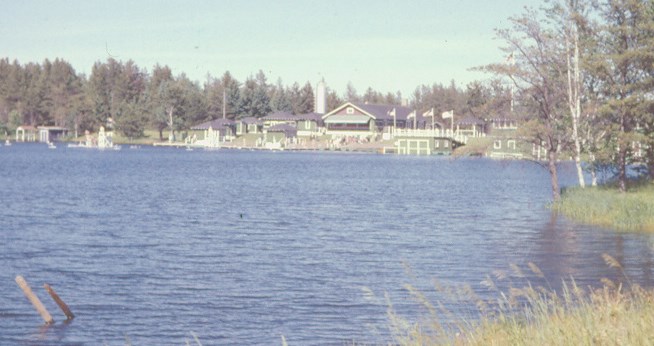
In the header photo, taken about 1955 by my mother, the building farthest the right on the lake is where I slept for ten weeks. Campy Summer Camp, Part II will reference that building.

Did you attend a summer camp, wish you had or wish you had not?