All posts by cbirkholz

Upbeat Up North

Today’s guest post comes from Clyde of Mankato.

For our second of two anniversary parties—two is excessive, I know, but you have to go where the crowds are—we drove up to Two Harbors, which proved to be a mostly foggy weekend on The Lake. Strangers we encountered, such as store clerks, made comment or even apologized about the weather. Not one friend said a word. Locals know and accept the beauty of The Lake in all her clothing.

Sandy and I like Superior in her dark and diaphanous gowns. We were in a fine mood ourselves from the party, which the weather only enhanced.

Do you take your mood from the weather?

HOPE

Today’s guest post comes from Clyde of Mankato 

Remember, Red, hope is a good thing, maybe the best of things, and no good thing ever dies.”

I suppose a few of you cannot identify that quote from Shawshank Redemption, a movie which portrays enduring hope as powerful, even when the only other option is despair, or maybe because the only other option is despair.

I do not picture myself as a hopeful person, but, as I think about the last fifty years, I see I often acted in hope. Because they are both about living in the present while preparing for the future, teaching and pastoring are hopeful acts. As is marriage.

Fifty years ago today Sandy and I stood in a church in Minneapolis and made promises to each other. The church, a substitute for a different church undergoing renovations, is named Hope. Two months later we joined a church in Dinkytown also named Hope. The coincidence of two churches named Hope struck us then and do me now. Without tracing why, I declare that hope is a thread woven through our marriage, not that I am offering anyone advice, mind you.

Pix 1

Hope is the thing with feathers that perches in the soul and sings the tunes without the words and never stops at all.” Emily Dickinson

Pix 2 (1)As I recall, I acknowledge with too simple a point of view, the two predominate political forces of 1965 were hope and hate. Many candidates and people who garnered public attention spoke openly with hate, and with its camouflaged cousin superiority. While I am more a moderate than a liberal, I too hoped we would put an end to hate as a political force, not by law so much as by a change in the hearts of a greater mass of common people.

So here we are in 2015. Need I identify to what we have returned? To which I answer with a voice from 1965, Martin Luther King, Jr. “We must accept finite disappointment, but never lose infinite hope.”

Ignoring the hate, where do you see hope?

All the News That’s Fit to Print in Blowers

Today’s guest post comes from Clyde of Mankato

Mr and Mrs. Harold White were the guests of Mr. and Mrs. Einar Rasmussen on Friday night. Mrs. Rasmussen served Swiss steak with pineapple upside-down cake for dessert. After dinner the couples drove into Wadena for dancing at the American Legion club.”

Hot news that story, is it not? Such items were once the staple of small town newspapers. As I recall, they were called “social notices.” Anything to fill space around the ads and the legal notices. (More on the legal notices later.) Who does not want to see their name in print?

Pix 1

My parents spent much of their childhoods and early married life in the central Minnesota town of Sebeka, home of the Sebeka Review, to which my parents subscribed after they moved away. Each Thursday they would read the paper and tell us stories, fully augmented by imagination, about the people mentioned, the kind of tales a newspaper would never tell. The Review published social notices by regions, one of which stood out in our childhood—Blowers Township. My sister got a kick out of the name, “The Blowers News,” which as a joke we always pronounced as you are pronouncing it now, unless you are up on your Otter Tail County geography. It is not bloo-wers, as in people who blow, but blau-wers, as if you were expressing pain with the ow, “oooww.”

Every week my sister read the Blowers social notices aloud. Over time we became acquainted with most of the few residents of this small very rural township. My sister plotted out friendships and feuds. She drew scandalous unfounded conclusions about what the notices really meant.

As for the social notices on our town, my parents’ comings and goings were hot news almost every week. The wife in the couple with whom my parents were socially active was the reporter of such tidbits. A common item would read “Mr. and Mrs. Lewis Birkholz were the guests of My and Mrs. ______________. After a dinner of chicken and dumplings several games of smear were played.” Mrs. ______________ was a devoted fan of passive verbs. In social notices women were always Mrs. His-First-Name Something, as if they had no first name.

If you do not know what smear is and how to pronounce it (Schmear), then you don’t know Northern Minnesota.

Another long gone item was a legal notice, the property tax reports. Each household was listed, by the man’s name of course, unless the woman was in some form single. After each person’s name was the amount of property taxes assessed and if paid or not. My father relished the anger he could express at how much more property tax the few farmers paid than the high-paid citizens in town. The newspapers made good money from printing those long reports.

Pix 2

Doing a bit of research, I learned something new about Sebeka. It is the birthplace of one-time Twins pitcher Dick Stigman, which I knew, but is also birthplace of Kenneth Arnold, the pilot who made the first widely reported sighting of a UFO, or a flying saucer as he called it.

Have you ever been newsworthy?

Adrift in the Driftless

Today’s guest post comes from Clyde in Mankato.

When Sandy and I moved from the North Shore, we were glad to have a new area to explore. We had run out of places to go, sights to see, roads to drive in the Arrowhead.

We quickly latched onto the southeast corner of the state, the Driftless Country. The drive along the Mississippi is wonderful, but the back roads provide more adventure: drives across the ridges or through the valleys or from ridge to valley to ridge to valley. Winding roads, abandoned churches, thriving churches, abandoned farms, thriving farms, hole-in-the-wall villages, along the Root River by bike or car, Lanesboro, and and the other villages.  Lanesboro


Along the Mississippi two favorites are the village of Old Frontenac and a delightful little cafe, sometimes tea room, in Lake City called the Chickadee Cafe.Bunnell House

I will share with you two quiet gems which you can tour.

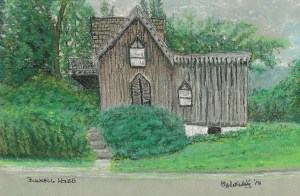
The historic Bunnell House, operated by the Winona County Historic Society, which I see now has performances. It sits in Homer, near Winona along the highway 61, The Great River Road.

Pickwick Mill

The Pickwick Mill, which sits in a small village on a winding drive up a valley from highway 61. It is near Winona but is operated by a private non-profit. When we were last there, it was still a low-priced, do-it-yourself tour, which made it peaceful to wander through the several dusty floors of the building and along its bubbling river and still mill pond. The tiny elderly volunteer on duty that day was pure charm. It was near closing time, but she told us to take our time. Her husband kept calling and asking when she would be home. She kept telling him to be patient. We felt pressured to leave. She told us with a smile, “He’s a useless old lump who needs to learn to take care of himself.”

The mill takes its name from The Pickwick Papers, just as a whim.

Are you a wanderer through space and time or are you driven by an itinerary?

Orgy on My Patio

Today’s guest post comes from Clyde in Mankato.

A few years ago my son gave me a book which summarized what we know about behavior of the myriad of American bird species. We know the easily observable, such as nests, eggs, migration. We do not know the more difficult to observe, such as territorialism, cooperativeness, life span, causes of death, and how monogamous various species really are. Studies suggest that, contrary to what is told, most species are not monogamous. When a clutch is analyzed, which ornithologists only rarely do, eggs usually have different fathers, which makes sense for the gene pool but destroys our anthropomorphic images of birds.

To study these behaviors for one species would require many hours of close observation of many individuals to describe the common behaviors.

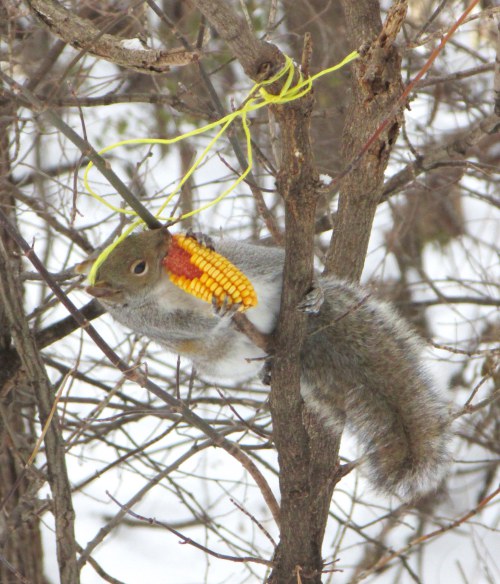
Despite all the time I have spent in the woods around squirrels and chipmunks, I know little about the domestic life of either species. But for three years I have watched a colony of squirrels by my patio. Squirrels are quick learners, very adept with their forelegs, and have good memories. They have memorized the superhighways, off-ramps, and local roads in the trees, which I can observe in the leafless winter. One squirrel learned to cut the twine holding an ear of corn. I then put small ears of corn in a suet feeder. She became very adept at manipulating the corn to extract kernels, food which is hers and hers alone.

Second pix

Because they have accepted my presence on my patio, I have observed much mating behavior in birds and squirrels in the last three days. The second round of parenting has begun. Yesterday several small birds courted and mated in the trees, and a pair of squirrels tumbled and rolled in the grass a dozen feet from me before consummating their fervor, several times.

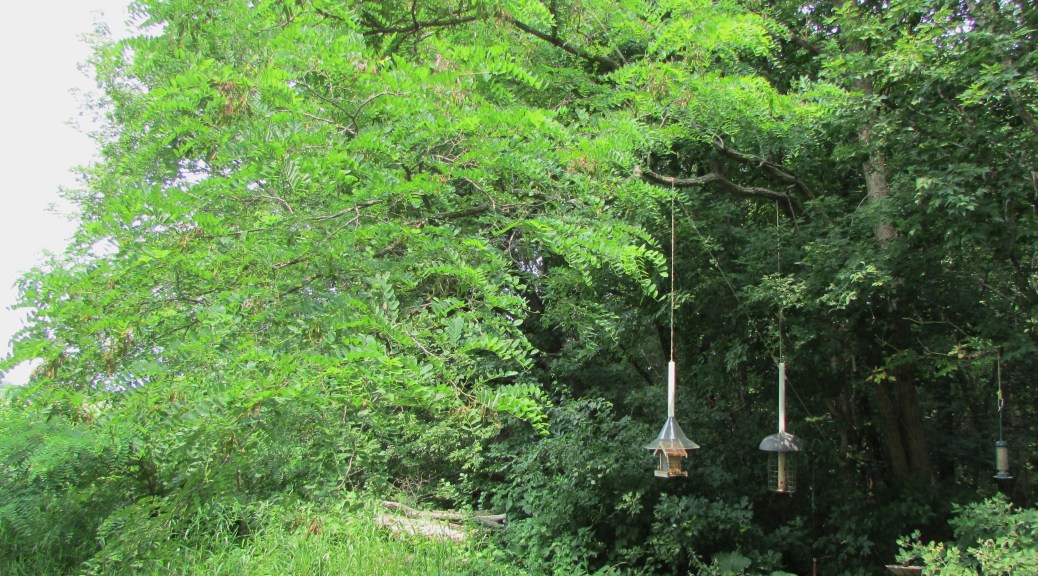
Above them a second pair of squirrels courted on a large tree limb, the limb shown in the header photo. One squirrel, male I presume, cornered a second squirrel, female I presume, at the farthest end of the many branches on the limb. They faced each other down for a minute or more. She could have easily dropped three feet to the ground. She did not. Instead she jumped to another branch. He found where that branch joined the tree and backed up to sit there. She leaped to another branch. He back up again. This happened several times until she had backed him up by the ropes, where no more branches grew from the limb.

They stared at each other from eighteen inches apart for another minute. The next courting move was—pun intended—anticlimactic. She ran right over the top of him and into the canopy. He followed in—pun intended—hot pursuit. Go ahead: anthropomorphize this behavior.

If I had the resources and time, I would sit in the great art museums of the world to study the art and to observe the passing humans and their reaction to the art. Fifty years ago I did this in the Chicago Art Institute. Most people’s reaction to most art was indifference.

If you had the time and resources, what would you sit and study, or ponder?

The Oracle on Has Left the Building

Today’s guest post comes from Clyde.

So Dale is on sabbatical, bless him.

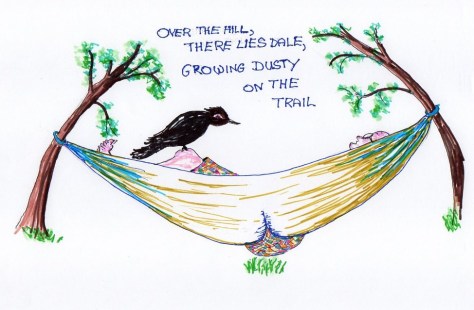
Sabbatical is an Old Testament word and concept. In Leviticus God orders that every seventh year the land is to be given a solemn rest. I doubt that happened very often. Giving up a year of food does not seem possible. In Deuteronomy God says every sabbatical year, seventh year, you are to forgive all debts and make special efforts help the poor. I doubt that happened. So, you see, a sabbatical is supposed to last a year, but, please, no one tell Dale.

Dale in Hammock

The day of rest, the Sabbath, is based on the same word. A couple guest blogs back I mentioned Minnesota’s attempt to pass blue laws, which perhaps would have made Sunday more of a day of rest. I hate it as a law, but I appreciate the concept of Sunday as a sabbatical.

When a pastor takes a sabbatical, she/he is sent off with a blessing ceremony. Our lead pastor is on a three-month sabbatical. During his ceremony his stole (the long cloth that drapes around the neck and down the front) was hung over the pulpit, which seems vaguely funereal, or as if the stole is pointing a finger at him saying “get right back here and do sermons for us to ignore.”

Sabbatical seems a wise concept, for both the land and the people. It implies a rebirth, new growth, re-creation. Our modern use of the word recreation is such a small application of the word. Recreation is important, of course, but is is far from re-creation.

The concept exists in many cultures, such as the Aborigines’ walk-about, which, too, is a small word for a large concept. The Navajos and other American Native peoples have ceremonies designed to re-create a person.

Often I have tried to re-create myself and failed. I always end up the same person I disliked before, which is home turf for us Lutherans.

I am a little afraid of a re-created Dale. What will the nicest guy we know become?

How would you re-create yourself?

The Wrinkled in Time

Today’s guest post comes from Clyde.

A warning: do not ever give me wife any of your prized canned goods. She will turn them into a decoration.

Several people over the last thirty years have given her canned jellies, pickles, vegetables, salsa, and mixed concoctions of uncertain origin and purpose—not one of which we ever opened, even the mystery jars. They held a prized place long past their rot-by-date. Surely it is the effect of reading too many Country Living magazines, and its fifty clones. In the perfectly-circular orbit of these magazines and their TV equivalents, old things are decorations, if not in their natural state, then in some re-purposed form.

Lamp Window

For all those thirty years I have shook my head in puzzled bemusement at this, an internal shake of the head only, being the wisely silent partner in our interior decorating. Over those same thirty years, and a few years before that, we collected a variety of household objects de fonction which were the working elements of my childhood. They were not collected to give me the warm glow of nostalgia, which some have, but to be objets d’art, to provide ambiance and grace, or color or poise or form or whatever are the components of interior design.

Rain Lady

It is hard to imagine any objects of current manufacture being used in interior design in 2053 or on the The Antiques Roadshow, 2113. What will the magazine of 2053 be called? What word will hold the charm that the word country does today? I suppose by then suburban will hold a certain cachet, depending on where people will be living, assuming that they are, living that is.

But why is: if old things are perceived as prized decorations of beauty and interest, why aren’t old people?

Spring Went Sproing in 1965, Part 3

Today’s post comes from Clyde of Mankato 

In the spring of 1965 my world went as topsy-turvy as did the politics and weather of Minnesota. Do you think the picture is a scene from the The Graduate? My world did not go quite that tupsy-turvy in the spring and summer of 1965..

I have related before on this blog the speed and folly of our rapid courtship. What I want to address is a few large changes in that period of history. First I will remind you that on our wedding day I was an infantile 20 years old; she was a mature 25, the adjectives expressing how people perceived our age difference. What strikes me now as I recall that spring and summer, is what a watershed were the years between Sandy’s gradation year, 1958, and mine, 1963.

In Sandy’s big-city high school graduation class going directly to college was uncommon. Few of her women classmates went to a four-year school. Sandy was in about twenty weddings of classmates between 1958 and 1960, with most of the brides pregnant, which was a large social sin at the time. Almost all of those marriages ended in divorce.

Sandy’s life choices were the big three: teacher, nurse, secretary. She chose the later, not conceiving how she could afford to attend college in that time of little support or encouragement for female students, or co-eds, as they were called then in that derogatory manner. The married women never expected to work outside the home, which almost all of them eventually did. Most of the husbands took unskilled jobs, which they had planned to do, or learned a trade from their fathers. At age 25 Sandy was on the brink of spinsterhood.

In my small-town class, despite being one of the least motivated classes in the school’s history, about one-half of my class went to college, about one-half of that one-half were women, several in nursing or teaching, but others choosing other career paths. Only three or four of my classmates, as near as I know, were pregnant for the wedding.

In weddings for her classmates and mine, the husband was zero to seven years older. A younger husband was very rare. Many assumed that our marriage was doomed, both for the speed of our marriage and for the age-difference. Sandy’s classmates did not know how to deal with me. I gather that the same age difference, 20 and 25, is still regarded as a peculiarity only if the man is the younger.

Throwing Rice

Larger cultural changes were occurring in that five-year gap, too, such as the Viet Nam War and the active objection to it. Civil rights arose. Sandy’s class had one African-American, in a school now dominated by non-white students. My class had one Native-American student. The decade of the 60’s scorned the values and styles the decade of the 50’s. The country turned hard left.

The gap has created some interesting disphasia (my coined word) in our life. When Sandy became pregnant at age 30, which she was not supposed to be capable of doing, the medical world was full of angst at her old age. Our children were born when most of her classmate friends had children starting junior high. Proceeding cultural changes have widened the gap. All but one of her classmate friends have great grandchildren; our grandchildren are age 2, 10, and 12. I know little about my classmates, but they seem to have grandchildren of an age similar to mine.

Her classmates have remained in a narrow world and remained staunch knee-jerk Eisenhower Republicans. Has there been a greater shift in presidents than between lethargic hands-off old Eisenhower and inspiring progressive youthful Kennedy?

All of this change seems to have impacted women more than men. I saw this directly when I was a U of M student. I had none of the interests of the other male students, such as drinking and pursuing co-eds. As a result, I had several friends, whom we called re-treads instead of co-eds. These were women who had married young, often one or two years into college. Now 10-15 years later, they were back in college or had started college. I suppose most of them have since died. They were a fun lot with which to share coffee at Coffman.

How are you disphasic?

Spring Went Sproing in 1965, Part 2

Take a couple seconds to study the photograph in the header. What do you think it shows, besides a depot and railroad tracks?

This is downtown Mankato’s view of the Minnesota River. You don’t see the river, you say. No you do not, thanks to 1965.

If you drive the roads near the Minnesota River between Minneapolis and Mankato, you will come to signs sitting higher than your car that tell you how high the water was in the 1965 flood. It was a corker. It devastated Mankato and North Mankato, or so I am told or read. I did not move here until 1997. The result of that flood was an ingenious system to prevent any additional floods using a three-mile long seawall on both sides.  

Seawalls 2

The water has reached the seawall only twice since I have lived here. It has prevented much damage, but in the process it has hidden the river from the two towns. You can get to the river in two parks at the ends of the seawalls, but even there the river is not a significant presence. Decorah, Iowa in a similar way ignores its river. Here we ignore it so successfully that even when it does reach flood stage, we just drive over the three bridges without much of a thought, not that we get much of a view.

This is the the Minnesota River, the first significant tributary of the Mississippi, the site of Glacial River Warren, which was once a monstrous flood.

Seawalls 4

The Army Corps of Engineers did provide a gap in the seawall into which they can insert a water-tight piece. On the inside of the seawall is a bicycle and walking trail. I used to it ride to work, but I only seldom met anyone on it.

Seawalls3

The railroad tracks along the outside of Mankato seawall says that the two towns never have much respected the riverfront. Oh, how we all wish we could go back to the pioneers and say, “Don’t settle right by the rivers; move up to higher ground. It WILL flood.” I would like to say many things to the pioneers, but first thanks, and then ask many questions about their experience. 

What would you ask or say to the pioneers of Minnesota?

Spring Went Sproing in 1965, Part 1

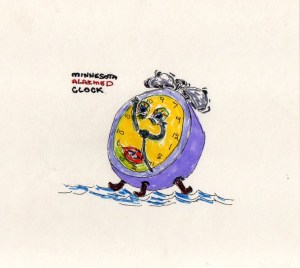
In the spring of 1965 Morey Amsterdam was in the Twin Cities for a gig, which must have been during the height of his fame. While he was here, he wrote a one-liner about Minnesota that has hung in my mind ever since:

“Minnesotans are people who have snow in their driveways, have water in their basements, are missing the roof to their houses, don’t know what time it is, and can’t buy paint on Sunday.”

The last two parts you may not appreciate if you were not here in ’65. The legislature overdosed on stupidity pills that year. They did not pass a law to define when Daylight Savings Time started. As a result every city set its own time, which among the many cities of the Twin Cities made chaos. That was one of the reasons Congress passed a national law for uniform DST, which the logic-benders of Arizona ignore.

MN alarmed Clock

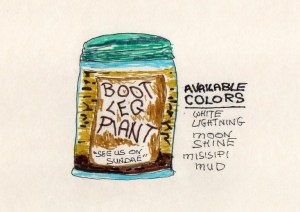
While they legalized the sale of liquor on Sunday, the legislature also outlawed the sale of many items on Sunday, such as hardware. That law stood up in court for about .321 seconds. Boone and Erickson were doing riffs on bootleg paint and high-speed nuts and bolts runs from Wisconsin. Perhaps the lawmakers were right; a Sunday reprieve from the contagious frenetic pace of modernity would not be a bad thing.

Bootleg Paint

Spring ’65 was, of course, also a time of floods and tornadoes. I was working at the University of Minnesota medical school as a sub-lowly lab tech. On the evening that the tornadoes tore through the northern suburbs, I was working late, not sure why, what with my insignificance, but there I was. The janitor on my floor of Diehl hall, a person who was otherwise impossible to find, invited me to join him and some others on the roof of the highest floor of Mayo Hospital, which at that time was about as tall a building as you could find outside of the Foshay Tower. It was up on that roof that I lost my innocence.

I lost my innocent belief that you could trust other people’s observation, and by extension, my own. Person after person called into WCCO radio, to which we were listening, to report tornadoes. No one called from the northern suburbs where the tornadoes were, because they could not. Many called from places we could see clearly to report nonexistent funnel clouds, such as over the Sears Tower, where a bright shaft of light was streaking down through the clouds.

If I were to serve on a criminal journey, I would mutter to every eyewitness, “Yeah, right.”

When have you or someone else’s observation been proven wrong?