All posts by cbirkholz

Unidentified Lying (around) Objects

Today’s guest post comes from Clyde in Mankato.

As I have explained before, for my wife Christmas is a six-month season. She often buys gifts in the summer, stores them away, and then rediscovers them, usually under our bed, often after Christmas.  Last week she found two objects of clouded origin and unknown purpose.

Sticks

Her initial recollection of when and where she purchased the objects led me down the wrong path in trying to discover what they are. So I put the photo up on Facebook and asked for explanations, encouraging the submission of smart-ass answers. My son re-posted in his Facebook page, from where, as I expected, came the answer. He has many professionally-creative Facebook friends of wide background and interests.

One of the answers, from one of my friends, was in Japanese. I do not know if Kazuki was right or not. Maybe. My two favorite smart-ass answers were 1) a Zanfir flute/pipe and 2) this link from one of my son’s friends.

This evening I will explain what they are. I bet during the day someone will correctly identify them. They are, by the way, nifty little devices. If you know the answer, you know the answer.

What mysterious objects have you run across in your life?

Rotten to the Core

Today’s guest post comes from Clyde in Mankato.

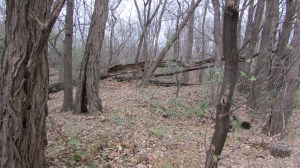
I sit at my comPhoto #1puter and look out my apartment window into the woods at the top of a ravine in Mankato and see this.

Look at that mess. Nature is just untidy, disorderly. It needs a correcting human hand. No, you say? But then you are not the son of a man who was a pioneer born a century too late.

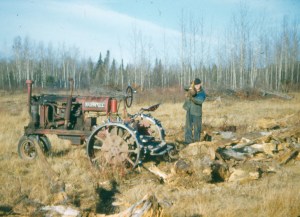
Photo #2

This is my father having fun. You cannot recognize it, I suspect, but I know he is smiling. It is one of only two or three pictures of my father smiling. Was I born with the same urge or did I learn it at our tractor’s knee? Nurture/nature? Is it a male thing?

Earlier this week just to get outdoors, I stepped into the snarled pile. I pushed at one of the upright pieces of tree trunk in a desultory way. It toppled to the ground. The itch was in my palms. With a back nearly as decayed as the trunk I just toppled, it would have been wise to walk away. I pushed at three more with my foot and found them as badly rotted. The itch was in my palms. Beside me was a deep ravine, already full of rotted trunks and dead brush.

I suspect from watching my father that many of the pioneers had a lust to reduce nature to human terms. Many of the first pioneers just kept moving on and doing it over and over again. This is a topic on which I have read extensively. I am sure you can see why.

Forty years ago I took a class on literature of the North Woods, which is not a large body of work, not much of it very good. The best piece we read was Robert Treuer’s The Tree Farm, which is a book well worth a read. Here is a part of a paper I wrote for that class.

On his tree farm Treuer must walk the edge between nature wild and nature cultured; he must keep the wilder aspects of nature at bay without destroying nature or allowing nature to destroy or reduce him. The dangers of the North Woods are survived if the necessary precautions are taken. It is not a nature that threatens to rise up and destroy us with alarming ease. If we dress and build appropriately, the cold can be kept out. With some care the storms can be withstood, the rapids can be run, and the bears will not eat us. Nevertheless, past history and current news tells us that lives can be lost or ruined if one forgets the rules or tempts nature too much. We live in this region to live with nature and survive it while keeping it as natural as we can.

So too in our day-by-day lives we want that nature within the right bounds. We move to the country but we cultivate a lawn. We mow that lawn right up to the edge of the woods, always feeling the urge to push out a little more and tame another few square feet. One summer’ neglect, however, will find the weeds back at our door. Two summers will return it all to brush. It takes constant effort to keep nature within the bounds we prescribe without losing the nearness to nature we reached out for when we moved here.”

Photo #3

I scratched my itchy palms. Today the snarl looks like this, all accomplished without using a single tool.


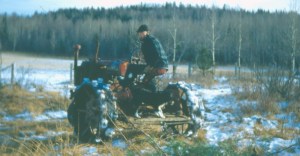
When done with the deed, I felt as my father did in this Photo #4photograph of him going home after a day of clearing land, pipe in mouth, satisfaction on his face. (Don’t miss the dog riding on the tractor platform.) My son’s photographer friends find this image iconic, say that it represents a larger moment in time than 1957 (ca.) and more than just my father.


What makes your palms itch?

Good to the Last Drop

Today’s guest post comes from Clyde of Mankato.

In an effort to save a couple bucks, I bought a can of Folgers Coffee. Not a can actually, a plastic. Can we call it a plastic? If the English can call a can a tin, I declare that we can. Usually I buy coffee in a bag, the better stuff.
Coffe Bag


As far as taste goes, it was an error to buy the plastic. As far as economics go, it was a wise decision, but barely. My mother would have been proud of me. Frugality, punctuality, individuality—the three virtues of Adeline Anne, bless her departed self.

As I opened the plastic, I wondered how farmers would have survived the last century without coffee cans. In our neck of the woods, Duluth’s own Arco brand was the most common. The one pound cans were particularly prized, but that caught my mother at odds–to pay more per ounce for her coffee to have the size of can she and my father wanted. Life is full of dilemmas.

They were everywhere on our farm. Grain scoops, chicken feed scoops, clothes pin holders, grease containers, egg baskets, retainers of nuts and bolts and screws and washers and cotter pins (wonderful word that–cotter pins). In the garden they were watering cans and baby plant protectors. In the house, holders of my mother’s mammoth assortment of buttons, crayon container, coin collector, shoe lace storage (odd ones left over when one broke because they could be used to tie plants to support sticks; my mother was cheap), sewing kit, flower pots, and many more uses. The wonder is that we had that many around, considering how weak my mother made their coffee—frugality again.

Now, of course, I have this plastic, which will be empty in a few weeks. However, I cannot think of a storage use for it. I could keep my cotter keys in it, except I gave up all my cotter keys three years ago. We live in a smallish apartment and have eliminated all the stuff we can, which means we have little to store, and no business keeping a plastic in which to store nothing.

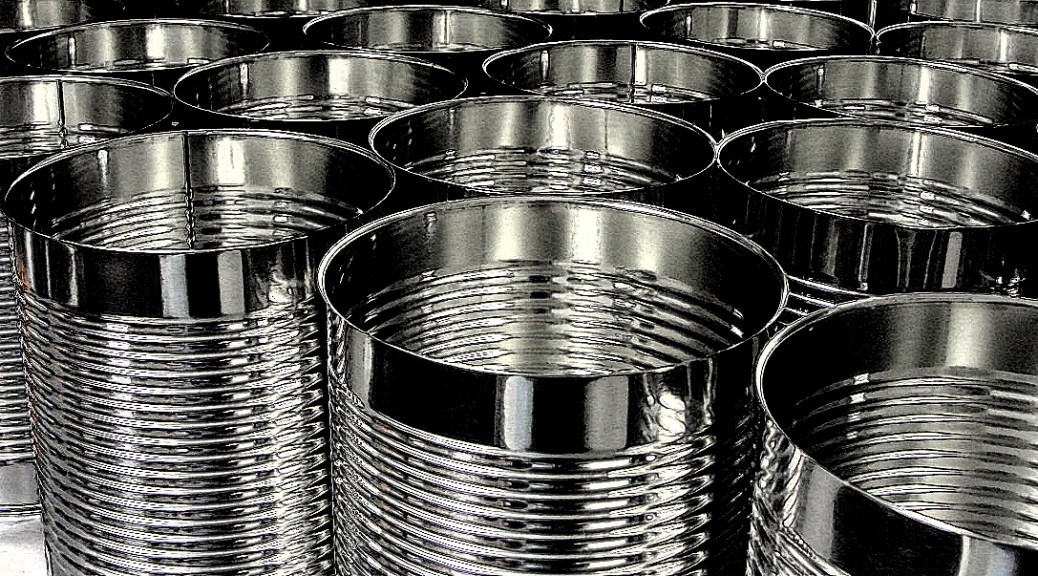
I also have these perfect little tins, which I acquired by ordering an expensive tea. I say tins because tins of tea sounds much more elegant than cans of tea. (Do not, please, tell Adeline Anne I used to order expensive tea instead of buying Lipton’s.)
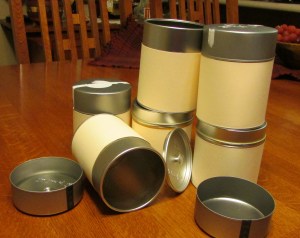
Tins for Blog

Are not these tins perfect for storing cotter keys or lots of other things? Well, if I stored cotter keys in them, then they would have to be cans. Nope, haven’t found a use yet. But I am keeping them, so help me. Maybe I will go out and buy some cotter keys.

The plastic, is of course, an environmental error as well, unless I can find a permanent use for it. Now that I think frugally about it: I am going to be cremated.
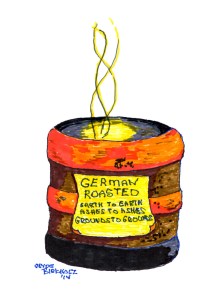
Coffe can

Maybe that’s the true meaning of good to the last drop.


What would Adeline Anne think of your spending habits?

 

Baby-Faced Leader

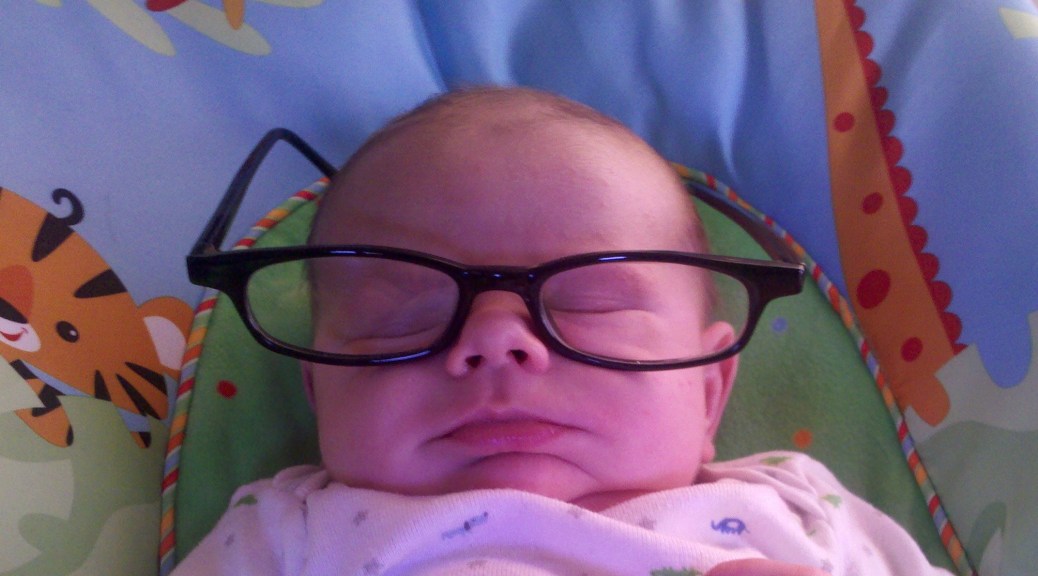
I got chided on facebook for saying my grandson looks like Winston Churchill. I responded with the old joke that all babies look like Winston Churchill, which only got me in hotter water.

I will let you decide: does he look like Churchill?

Fortunately, which you cannot tell from this photo, his personality is quite the opposite of Churchill’s, who, by all testimony, was a very difficult human being.

Did Churchill look like Churchill as a baby? This is close as I could get.

pix 5

I did an image search to find baby pictures of the great man, and it turned up a host of human and animal lookalikes.

What is interesting is that one of the greatest, most charismatic leaders of history had such a baby face. We now understand that the normal human brain is wired to have a strong positive emotional response to babies and the characteristics of babies. Was that all part of his charisma and power or did he have to overcome it? He was such a polished speaker, who knows what rhetorical art he crafted.

pix 6

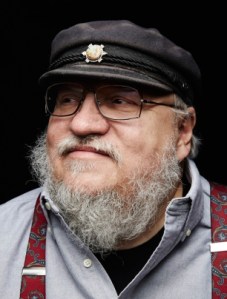
I look like a desert hermit, or like George R. R. Martin, but my bank account does not look like his. By the way, for $20,000 to go to a wolf sanctuary, Martin will write you into and give you a grisly death in the next installment of Game of Thrones.

What role does your face fit?

Sweet Adeline, Surprisingly

Today’s post comes from Clyde in Mankato.

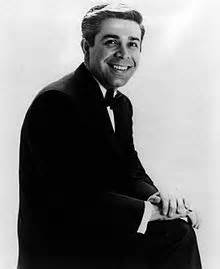
When Harmon Killebrew died two years ago, I mourned a bit for my mother. She was a dedicated and savvy baseball fan. It occurred to me that Harmon’s death took away the last popular cultural link to my mother, who greatly admired his play and demeanor.

Then a few days after that my wife asked me, “Who was the Italian singer your mother was so gaga over?” “Jerry Vale,” I answered. Ah, there was one more pop culture link to my mother.

However, Jerry Vale died last weekend.

th

Now to describe my mother as gaga over anything seems a large stretch, but in fact she was exactly gaga over Jerry Vale, not dissimilarly to Elvis fans. When I was in junior high I was puzzled and embarrassed by her response to a Jerry Vale song on the radio, which was quite common on KDAL radio in the late 50’s and early 60’s.

My mother’s name was Adeline, but no one ever called her Sweet Adeline, not even my father, who could be quite tender and loving to her, in deep contrast to his normal pattern of behavior. My mother turned into some other person when Jerry Vale sang, a person I never otherwise saw. It was not only his voice, but she freely admitted it was also the handsome face. Today I realize how delightful and just simply human was this sharp contrast in her character.

Ten years ago my son, who loves and collects all forms of music, told me he had discovered the perfect Italian crooner. He wondered if I had ever heard of Jerry Vale. I treasure that moment of the wheel turning all the way around.

http://youtu.be/3CL7sl3udiE

My father also had his contrast in character that embarrassed me back then. Looie was usually a coarse, harsh, angry, insensitive man, exactly like the father in my novelized version of my childhood. That same man loved to dance. He danced (meaning the old time dances like waltzes, polkas, and schottisches) with great relish and accomplishment.

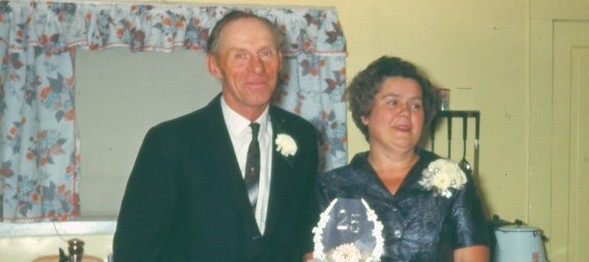
Anniversary 2

A group of people in our neighborhood, Knife River Valley, held monthly dances in an old school house. My father’s favorite was the broom dance, a form of musical chairs while dancing. If you were left without a partner after the music stopped, you had to dance with the broom. My father’s turns with the broom was graceful, in tempo, and unselfconsciously funny. Oh, how embarrassed I was! Luckily I later grew old enough to be left home alone or with my sister.

What unexpected contrasts did your parents have in their character? Or you?

Southern Discomfort

Today’s guest post comes from Clyde.

Twice in one day I received eye pings, that is discordant visual images it took my brain several seconds to recognize and decode.

The first happened while driving in Mankato; the vanity license plate in front of me read “M MORT.” What? Then I realized it was on a hearse, a Mankato Mortuary hearse no doubt. But isn’t “M MORT” just sort of a small “ewee”? Do they have another one called “M MINKY”?

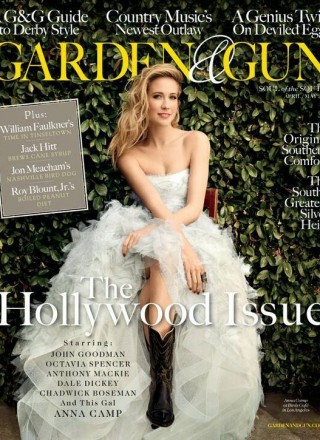
The second happened about an hour later in Barnes & Noble. I was staring off into empty space; not into space actually but into the magazine rack a few feet away, which is by-and-large the mental equivalent of empty space. I read as the title of a magazine Garden & Gun.

What? Was this real? Had I misread? Nope. I looked closer and saw a subtitle “Soul of the South.” Hmm. The entire complicated cultures of the ten or so states of The South find their soul in gardens and guns? I do not like sweeping generalizations about nations, cultures, peoples, regions, but gardens and guns are a big miss for my experience of The South. But see it’s for real.

Then I looked lower on the cover and it read “The Hollywood Issue.” Now that’s more than a bit discordant. Has Hollywood ever represented The South as anything but tired old cliches? Or The Midwest, or New England? To Hollywood has The South ever been much beyond hillbillies, plantations, bigotry, and threatening ignorance?

What was on the cover? But of course, a woman showing cleavage.

Cover Garden & Gun

Anna Camp, whoever she is. Another actress of whom I have never heard, but I am ignorant in this regard. In a wedding dress–is that what that is–and cowboy boots. How did cowboy boots become Southern, anyway?

I scanned through the magazine. It is actually very slick, high-concept, visually very well done. It had few pictures of either guns or gardens. It did, however, have an extensive article with high-quality photos on how to make moonshine.

It was all too big a brain cramp for me. I went and scanned through Mad Magazine–much more in my frame of reference.

What would be your “_____________ & ____________” title of a magazine on The Midwest?

Three Cheers for Russian Artists Whose Names Just Will Not Stick in My Head

Today’s guest post comes from Clyde.

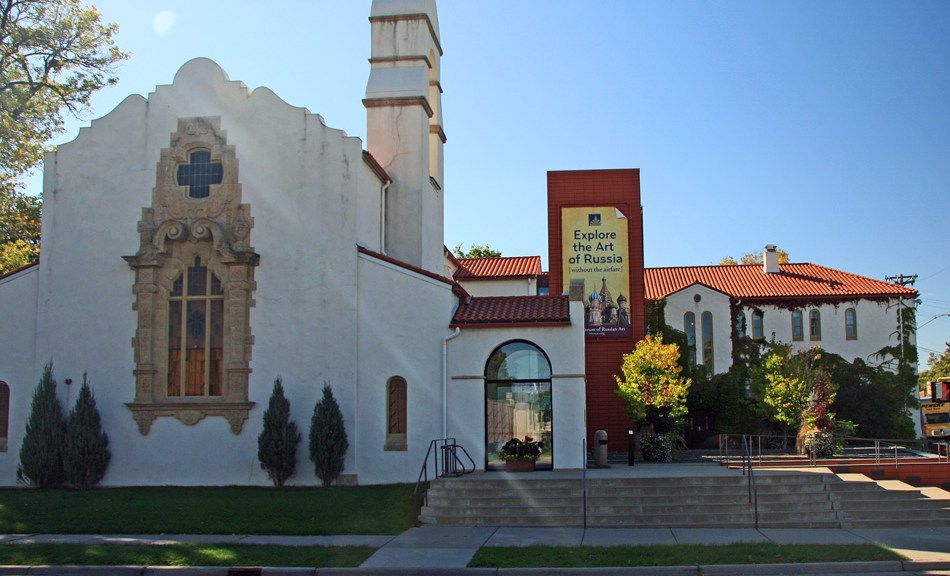
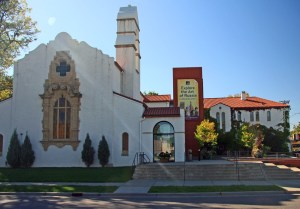
Sandy and I went to the Museum of Russian Art recently, We went not only for the art itself, but so she can feel good about the Russian half of her heritage despite the recent behavior of Vladamir Putin. (I call this the MoRA half of her roots.) The museum is the perfect size for two old limp-alongs like Sandy and I.

TMORA

The MoRA has two fine exhibits right now. As one who works in dry media, like graphite, charcoal, and pastel, I throughly enjoyed the secondary one in the basement. And Eva Levina-Rozengolts’ story is compelling.

But the primary exhibit, which just opened, is spectacular.

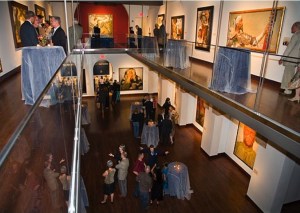
It is the story of Raymond and Susan Johnson’s collecting of Russian art. The exhibit displays only a fraction of their large collection, which focuses primarily on late 20th Century Russian art. For this part of the museum Sandy has her Nordic Lutheran heritage covered because she has a strong connection to Susan Johnson’s family. (I call this the Mora half of her roots.)

facility

The placards for the art pieces explain Raymond Johnson’s collection process. He has made 81 trips to Russian and visited many of the artists in their homes. I find his taste in art stunning, but then I have long favored Russian arts of all sorts, even before Sandy and I married 49 years ago. Not only for his sake, but for the prestige of this under-appreciated museum, I hope his heavy investment proves to be rewarding in the same way that the Art of Institute of Chicago’s early investment in Impressionism paid off.

However, in any case, what an adventure he has had! I do not often envy the wealthy their lives, but I am jealous of and very grateful for what they have done.

If you had the money to built an impressive collection, what would be on your museum?

Three Cheers for Admiral Sir Robert Lambert Baynes

On our recent trip to Seattle on a delightful rainy, foggy day we took the ferry out to an island called San Juan Island, stopping along the way at three other islands in the group called the San Juan Islands.

San Juan Islands 15p

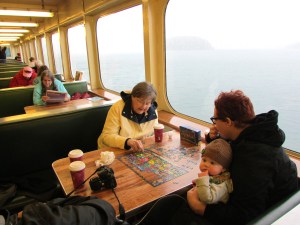
The San Juan Islands mark one of the places on the map I have looked at with longing. I was so enthralled by the two-hour ride I did not even bother with the couple dozen jigsaw puzzles constantly under progress on the ferry.

Ferry 01p

San Juan Island was delightful, better than I had hoped. Perhaps best of all was discovering a little know moment of history. On both ends of the island are a National Historic Park. The north end is called the British Camp; the south end the American Camp. The park remembers what is called either The Pig War or The Pig and Potato War. (I prefer the lilt of the second name myself.) For a full explanation you can consult Wikipedia.

The essence is that after the 49th parallel was made the border between Canada and the United States, with the exception of Vancouver Island, the exact boundary through the San Juan Islands could not be determined for lack of a clear map. Great Britain and the United States agreed on what the boundary should be like but had to wait to see what line through the San Juan Islands would best meet those conditions. San Juan Island was left in limbo and had settlers on it from both countries, peacefully until the day of the pig.

A British settler had a pig which kept getting into the potato garden of an American settler. One day the American had enough and shot the pig. The American then offered the Brit $10 for the pig; the Brit demanded $100. Both sides bristled. Sabers were rattled. American troops landed. Their leader declared he would make it another Bunker Hill, seeming to forget that the U.S. lost that battle. The leader of the British forces, then titled Rear Admiral Robert Lambert Baynes, who later went on to great prominence and a knighthood, was ordered to attack. He refused, explaining that two great nations do not go to war over a pig. For a few days the two sides tried to goad each other into starting a fight, but soon became friends. For a dozen more years, waiting for a peaceful decision, settlers and pigs from both nations lived together in peace, and the two nations had token forces, more comrades than enemies, on both ends of the islands, the sites of the two parts of the National Park.

Vancouver 05p

Eventually, by international arbitration the U.S. was awarded the island. The island is worth a visit today for several reasons. One, for a beautiful view of Vancouver Island.

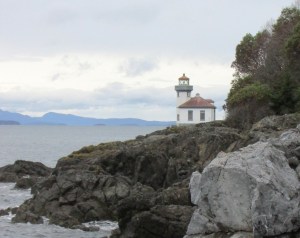
And a very picturesque lighthouse, The Lime Kiln Point Lighthouse.

Lighthouse 01p

But one thing is missing from the island, a statue of the noble Admiral Sir Robert Lambert Baynes. We put up statues for great fighters. Why not for a great non-fighter? There is a code about statues of military leaders on horses, the number of feet the horse has off the ground telling us if the man was wounded or died in battle. I think Sir Baynes should be shown sitting on a camp stool drinking a cup of coffee.

How should you be posed for your statue?

Somewhere In Time

Today’s guest post comes from Clyde.

I love serendipitous juxtapositions. Last month a book and a picture careened into my life at the same moment.

3 (2)

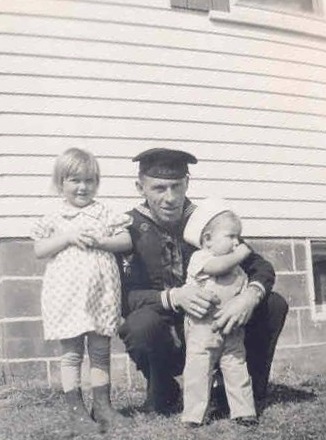
This is the picture. I’m with my father and my sister, and he is just home from the war.

The book is Hamlin Garland’s memoir Son of the Middle Border. Today an unknown author, Garland was one of the writers who inspired my interest in literature and writing. His rather stolid and overly political fiction reflects the life of my mother’s ancestors and her own life. Because my mother’s family history is set in northwest Iowa, his writing would also touch the history of a few other Babooners.

Another way to describe Garland’s early fiction is as the tale of the hard life that Laura Ingalls Wilder wanted to tell, except her daughter urged her to make them children’s stories (who could argue with that decision). Garland’s childhood oddly parallels Wilder’s. He was born in West Salem WI, which is near LaCrosse. His father then moved them to Hester, Iowa, for a brief period and another brief period in Burr Oak, Iowa, where the Wilder family also lived briefly. The Garland’s moved on to a homestead north of Osage, Iowa, or to say, southeast of Albert Lea. From there the Garlands moved to Ordway, SD, long since gone, near Aberdeen.

When Garland’s first book Main Traveled Roads was published in Boston in 1891, it released a storm of criticism because people believed that the life of the Western farmer was full of joy and reward and not dirt, hard work, and deprivation. Garland was an outspoken activist traveling through the country, urging land and economic reform. His early fiction is driven by a point of view called “naturalism,” which portrays humans as caught under the control of powerful impersonal forces, such as weather, plagues, economics, genetics, politics, and random chance. Stephen Crane of Red Badge of Courage, whom Garland encouraged and supported, wrote to a similar point of view with better narrative skill.

I had my mother read Main Traveled Roads when she was about 60. She understood it fully on instinct. She told me of how the details of early Iowa farm life were the details her father told her about his childhood, which were not unlike her own childhood. People sometimes think my childhood was hard, but I do not think so, nor does my sister. We know how hard it once was.

Garland’s memoir begins with his first meeting with his father. Garland was almost four years old when his father came home from the Civil War. It was their first meeting. As I read that opening chapter, I paused to reflect as I often have, that the two great untold stories of America are the lives of the women while the men were off to war and the adjustment men had to make coming home. William Wyler’s The Best Years of Our Lives tells that story very well. Almost every man in the cast and crew was a war veteran, including Harold Russell, who lost both hands in the war. He won the Best Supporting Actor Oscar.

Home From the War ORIGINAL

Just as I was contemplating all this, my sister sent me that photo of the two of us with my father. But there are a couple of things you don’t know yet about that image. One is that it is my first meeting with my father. I was born while he was away at war. And the second is that the version you’ve seen has been adjusted. The original photograph was shot at a distinct angle.

My mother took the picture. She took two others that day with my siblings, one of which is as tilted as this. I have a thousand pictures taken by my mother. Only these are off-kilter. I always assume we are seeing her own emotions in that angle. Obviously, With photoshopping it is possible to straighten that picture. How prosaic it is without the tilt.

What do you view from a unique perspective?

The Long and (Very) Winding Road

Today’s guest post comes from Clyde, who actually wrote this as a comment on Trail Baboon on Monday, December 16, 2013.  But I thought it deserved more of a spotlight.  

This exquisite puzzle is a piece of twisty writing that really challenges the reader to follow.
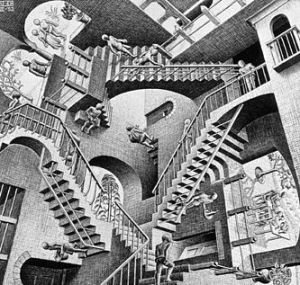
If you think you’re up to it, try reading it aloud and see how far you get. Like an Escher print, you may find yourself doubling back on the trail in a way that seems physically impossible, and yet it is happening.

Here’s Clyde:

Escher's_Relativity

I am often confused with myself, which I find confusing. I think I am who I am and then I find out I am someone else. Then next time I think I am someone else but find I’m me. It’s me I like best, but often I would like to be someone else, but not the someone else I am, but want to be a different someone else, someone bold and exotic with hands that work. But the someone else I am am, sometimes, does not have working hands either. The am I am I am sometimes ashamed of. What I do like is that the me who I am when I am the someone else that I am doesn’t look much like the am I am, so if I chose the right day, I can go out as the me who I am and no one knows who I am. But it may be a day when no one recognizes me as the someone else that I am, sometimes people do know me. Sometimes not.
When I was younger, people in all places from Two Harbors to Chicago wanted to call me Chuck. But the Chuck me moved to Oregon and went on to great success, so maybe I should have been Chuck. Then I do not think I would be on the Trail, or maybe I always was on the trail, a deviant synapse of Fearless Leader’s frontal cortex off in the woods somewhere, which, Fearless Leader, does not look at all like a jungle. So are we really who we think we are? Baboons. Or just two-dimensional reflections of the grayer, more insecure part of Dale? Are people really who they seem in radio? Is anything real in public radio? I mean, that “public” part probably makes people very private or perhaps too public. But I digress. I did one day off in the woods in the back left there run into a Holden Caufield, but was it HOLDEN CAUFIELD, or just holden caufield?
Today I am the me who is on the woods. Lost perhaps. Maybe not. Maybe . . .

Where do you go to find yourself?