Clouds. I am addicted to clouds. Not ICloud or Dropbox or Mozy. No, the things up there in real space, not in etherspace. The white, gray, blue, pink, purple, yellow, orange things. The puffy, stringy, tiered, tumbling, feathery things. The spring, fall, summer, winter things. The gay, brooding, ominous, exhilarating, majestic, mysterious things.
I got this addiction when I started pastels. Delightful and fulfilling it is to paint clouds in pastel. You layer on the dust, push it around, coloring your fingertips. If it goes right, which it often does for clouds, in a few minutes you have the top portion of the painting completed. Wise you are to make the sky the major portion of the painting.
Then came, sorry to say, the digital camera. I can shoot and shoot clouds and pick out the best. At least the theory was to pick out the best. Pretty soon I was keeping all the pictures, printing most of them, on the premise that any view of clouds might work in one picture or another. First I had a file called “Clouds.” Then I had files labeling clouds by colors, forms, moods, seasons.
Just when I thought I was getting control of my addiction, we went to Seattle, which is Sin City for the cloud addict.
We went to Seattle Center, site of the Space Needle, beneath which lies the Experience Music Project. I did not see its broken guitar architecture. I saw how it reflects clouds.
We went 5400 feet up to Paradise on Mt. Rainier. After I took 57 pictures of the clouds, I needed heavy detox.
For twenty years now my son and I have dreamed of making a documentary. We would go to China and find plants that manufacture distinctly Western or American items, such as Easter, Christmas, Halloween, and patriotic items, or any other item that is alien to their ancient culture. We would interview the workers, asking them to guess what the items represent or are for. We would ask them how they feel making things of mysterious purposes, what they judge about us from our artifacts. Today with all the cross-world media, they might know too much for this to be that humorous any more.
Of course, our fun documentary could easily turn into something very serious and sad. One of my favorite Henny Youngman one-liners was how he opened a fortune cookie and found the note “Help, I’m being held prisoner in a fortune cookie factory.” Now it does not seem quite so funny.
I remember a few old jokes or urban legends about line workers getting their revenge in various ways, such as the story of a new Cadillac that had a pesky rattle in it. Finally after a few thousand miles on the car, a mechanic took off the door panel and found a nut with a tag on it reading “I hope this rattle drove you nuts, you rich S.O.B.” There is the Wayne Kemp song sung by Johnny Cash One Piece at a Time.
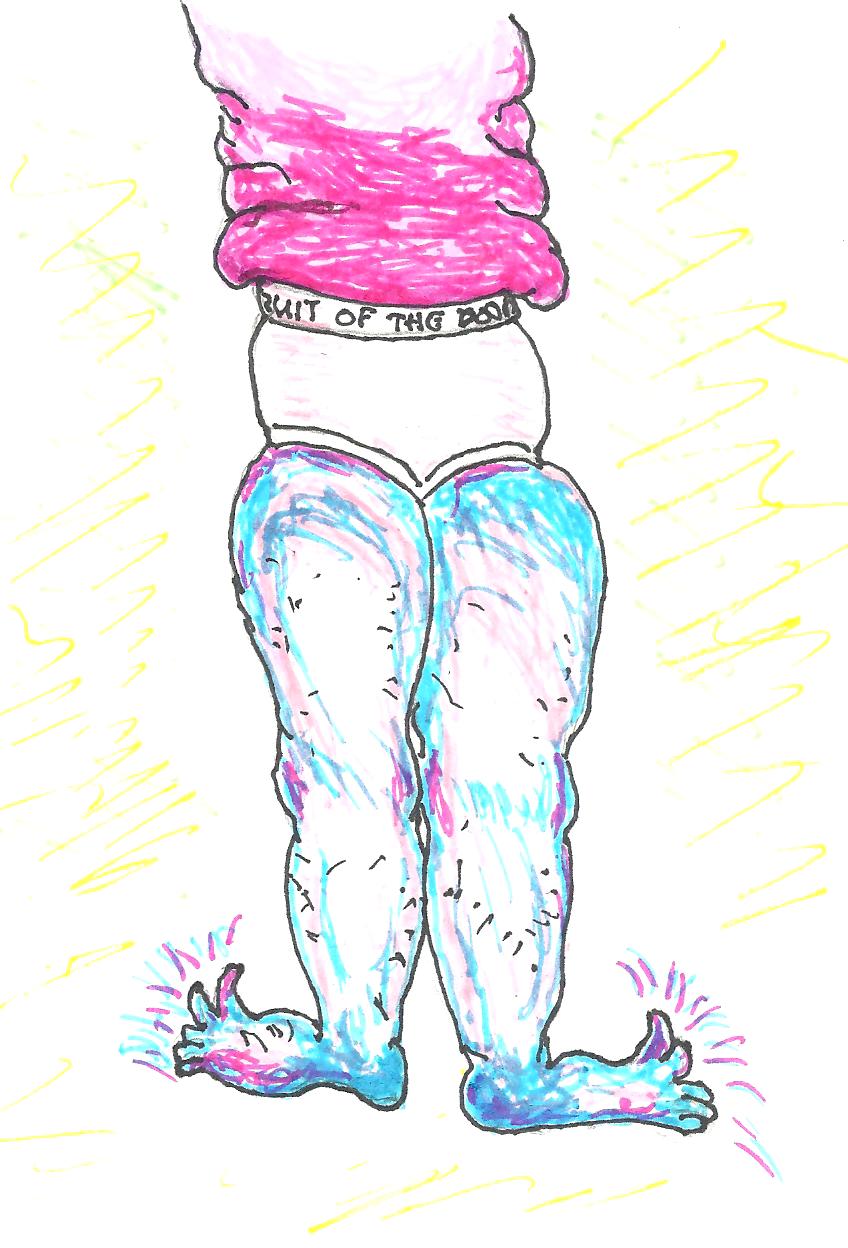
What brought all this mind was my recent underwear purchase from Target. I bought two six-packs of extra-large Fruit of the Loom jockey shorts, made in Honduras. Each package contained two nested sets of three shorts, a pair inside a pair inside a pair. In one of the four nested sets, I discovered that the middle pair was size large and not extra-large. (I will let you guess how I discovered this.)
I suppose I can imagine ways this happened by accident, but I prefer to think some Honduran line worker occasionally sneaks a smaller size into the middle of a set of three and mutters to him/herself, “Take that, you rich Yanqui hijo de puta.” It is, you must admit, a sneaky attack on the soft underbelly of America.
Because I am right on the border between large and extra large, his scheme did not quite work on me. One wearing and washing and I cannot really tell the difference. Sorry, compadre. I kind of wish it had worked better for you.
Have you ever sent (or received) a clandestine protest?
So we got moved into the apartment across the way—clock, socks, and peril. And look at the mess that resulted.
Oh, what a tangled web …
… we weave.
It’s not my fault. All those wires are the result of everything being wireless now. I call it my wirelessness-mess. How does wirelessness require all these wires?
Reminds me of when our company tried to go paperless. Or when the State of Minnesota started requiring payment in electronic funds transfer. Oh, the paper it consumed setting up that process and tracking it in our files–paper files, of course. (Does the State track it in paper at their end, too?) Part of the paperless failure was mine. I simply cannot edit on screen. But the wirelessness-mess is not my fault.
It started with the phones, a slippery slope ending in a massive tangle of wires: a base phone plugged into the phone connection and a transformer plug-in (you know the thing about transformer plug-ins: they want to cover two outlets) and two remote phones with transformer plug-ins. We’ll come back to the phones.
Then it was the TV and Internet system, now wireless: a base plugged into the TV connection and a transformer plug-in and two remote phones with transformer plug-ins. That’s on top of plugging in the TV and the DVD player and connecting the DVD player to the TV.
The computers add their tangled web, too: connections between and plug-ins for the computer, monitor, and printer, which in our cases is a transformer plug-in. Now both computers use a powered sound system requiring another wire into the computer and another transformer plug-in.
Back to the phones. To save money, we switched to a cell-phone house line. But it turns out that our cell phones and that house phone do not get a very good signal in this building. So they give us a little unit, like a mini-cell tower, to amplify the signal in our apartment. But it plugs a line into our TV/Internet modem, and line to a windowsill, and, of course, a transformer plug-in.
In a smaller apartment all these things end up on top of each other. Then there has to be a place to charge the cell phones, cameras, and iPod. I am so glad the chargers have become universal. Plus our most recent ones do not try to cover a second outlet.
A good friend of mine believes that one day our electricity will come wireless. Can you imagine all the wires that wireless electricity will require?
We speak, by far, the language with the most words in it. The Germans manage to converse precisely, thank you, with something like a fourth or a fifth of our lexicon.
We have lots of words we do not use, and a few I could do without. Ampallung has now become an English word, but we could do without that word in all languages. (I was going to provide a link to an explanation of this, but everyone I found is too graphic.) It is a piercing through the penis. Everyone say “Ewwww.”
Some words we do not give their full and proper due. Coprolite, meaning a fossilized turd, is a word of which we could make much greater use. Start naming, to yourself only please, all the people you have known who are living coprolites.
But I still think some words are missing. We need a word for:
That stuff, ragged, messing stuff, that is left when you tear a page out a spiral notebook. It is the bane of teachers. I required kids to cut off the ragged edge of such pages before they turned them in and to be careful not to drop that stuff, ragged, messing stuff around the room. I always wanted a word for it. I called it froo-froo, but that’s a stolen word. I used to hold contests to name that stuff, ragged, messing stuff. It never worked. My turkey-drawing contests worked but not that one.
That stuff, stupid, cliched, never-dying stuff that gets sent to you over and over again in emails. Or at least between women. I have only rarely received such stuff, stupid, cliched, never-dying stuff from a male friend. My wife gets 4-5 a week, and everyone sending to her knows she does not like them and that I throw them all out before she opens her mail every 4-6 weeks.
A tree standing alone isolated from other trees. Why, you are asking, do we need that word? I am not sure. I have just always wanted it. Any tree standing alone draws my eye, evokes some response from me.
Here are some solitary trees, uncharacteristically clumped together:
The Witch’s Tree
This one was near our house
The Honking Tree
A grand-daughter’s depiction
It is trees all alone in a field which have a power over me. I used to watch for the half dozen of them in the too-often-repeated drive from the Cities to Two Harbors. The only famous one of those is now gone, cut down by vandals, the Two Harbors Honking Tree, which was actually in Larsmont. This picture is by one of my very favorite students.
(We could use a word to describe the soul of the person who cut it down.)
Apparently in the right circumstance, I am not alone in being drawn to solitary trees. I have drawn many such trees. And my grand-daughter has my obsession. She draws this picture over and over again.
Share your ideas for words that should be added to or removed from the English language.
I have been watching a lot more television lately, some of the bowl games and a few shows on HGTV and the Food channel. Most evenings my wife has been visiting my art room/office where the bigger TV is to watch some holiday specials, such as on Hallmark channel. She watches the shows, when she is awake, and I notice the ads.
I have some observations:
We are expected to choose an insurance company on the basis of how stupid, irritating, and over-repeated are their commercials.
As usual children are smarter than adults.
Perky women with big eyes and red-dyed semi-messy hair are the gold standard in advertising spokespersons.
We are fat, have too much stuff, and spend money we don’t have.
Women can boss, nag, or control men, but men cannot do any of those things to women. One of a few examples: the Walgreens ad where the woman crushes her husband’s sugared donuts to bits. It’s good that she did because that donut must have been very stale. This is not a pro-male or anti-female rant. I just notice the pattern.
Apparently men deserve this because men in ads are so often childish and driven by their appetite for greasy food, beer, and big-screen TV’s.
Speaking of beer, people in beer commercials are the antipodes of everyone sitting in beer taverns drinking beer. Are those people watching those ads as they drink? Do they think about that contrast? Should I go tell them?
All the ads for tablets, readers, and cell phones disappeared after Christmas.
Many women apparently take a picture of themselves in their underwear before they lose a bunch of weight.
Does Marie Osmond make a good model for health and beauty with her botoxed lips and over-lifted face?
Attention Food Channel – cooking is neither a race nor a competition!
The louder the spokesperson shouts in a commercial the more dubious are the claims.
Twenty years ago (Can it be 20 years?) when my partner and I started working together, we got into a fun argument about how to find a spot in parking lots.
The Clyde Method: find the first empty spot that looks about as close to the door as you are likely to get.
The John Method: drive around to find a spot as close as possible to the entrance.
Do you use the Clyde Method or the John Method for parking?
Our debate was over which of us had a more efficient method, which of us wasted more time: my longer walk or his longer drive. After three of four years of this, I was driving across Massachusetts, the eastern half of which is a full parking lot, when I heard WGBH public radio doing a report right to the heart of the matter. A graduate student in math at MIT was looking for a thesis project. He and his wife had the exact same difference in their parking methods and same debate. He developed a sound method for measuring it and found a mathematically-sound answer to the question. As it happens his model has applications for measuring and improving traffic flow and parking.
Wonder what his study found? I’ll tell you at the end of the day—maybe.
Today my parking quandaries are focused more on handicapped parking. My wife has a tag, which is in its way more of a problem than a solution. It was wonderful when we went to visit our son in California, and maybe now when we go to Seattle. Before we had the tag, we were with him in San Diego years ago visiting all the wonderful sights of that city, all with huge parking lots, when he declared that his parents were at that awkward in-between stage, old and slow moving but not yet old enough for a handicapped parking tag.
My problems with handicapped parking are fourfold, all exacerbated by my bad back which makes it impossible for me to turn my head very far:
Handicapped parking is always at the busiest place in the parking lot, right by the entrance with heavy foot and vehicle traffic.
Handicapped spots almost always require you to back out; they have that post with the blue sign at the front of them.
Many of the other people who park in those spots simply should not be driving anymore. So you have to be ready to dodge them.
Many of those who park in the spots have large vehicles, some because they are wheelchair vans, but many are just large vehicles.
A neighbor of mine says that at the local car dealership where he works the most popular sale is for extended cab full-size pickups, often to those with handicapped parking rights. Because I drive a small Scion black box, I frequently have to back out blind into unseen busy foot and vehicular traffic. Scary.
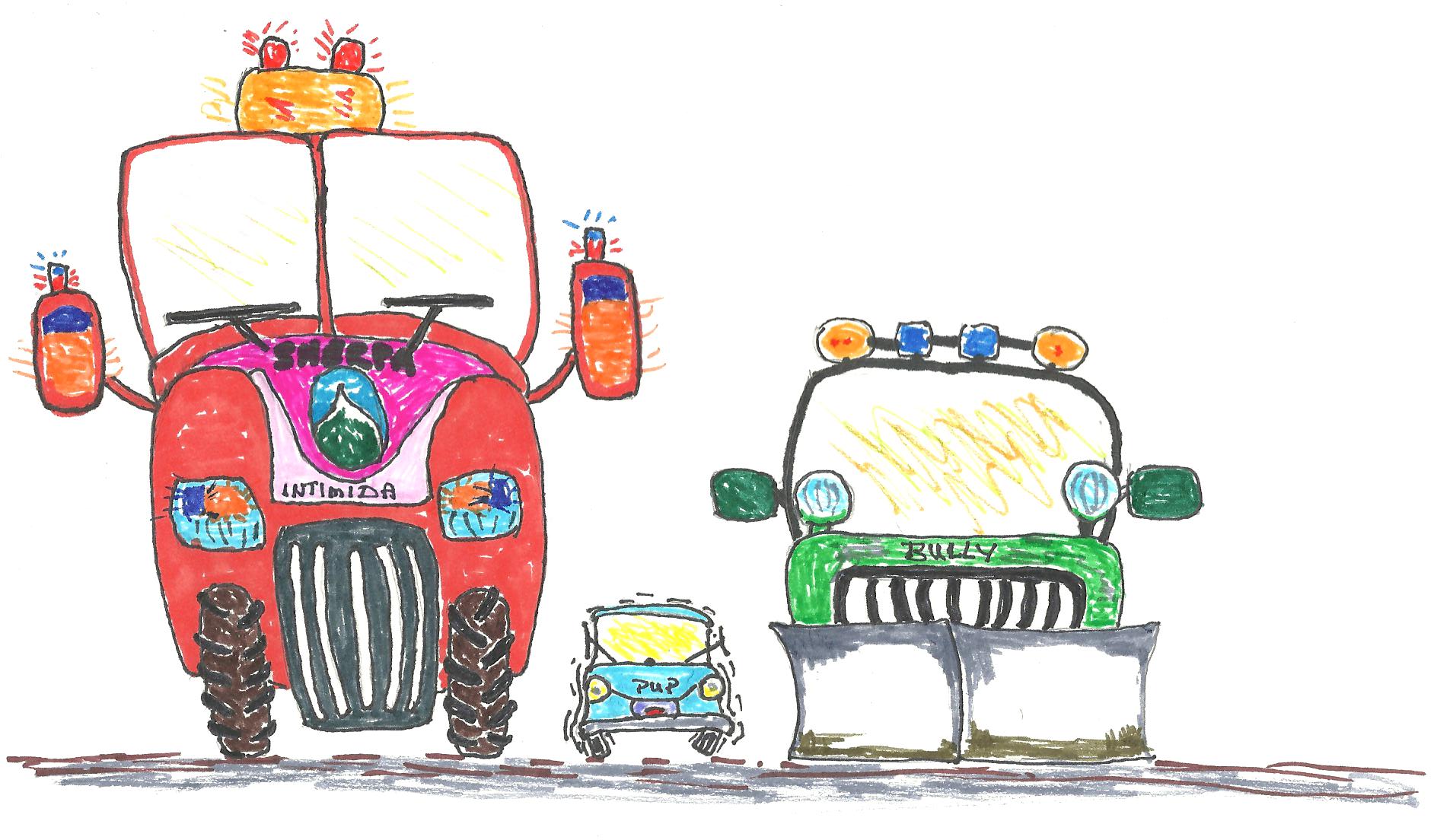
I have a problem leaving parking spots almost anywhere in a busy lot because of the tunnel vision caused by so many Intimida-look-alikes, many of them in the winter with snow plows. I usually drop my wife and her walker at the door and then park far out in the lot with my car facing out. Sometimes my waif of a car still ends up hidden between two bullies.
There is another problem with handicapped parking only a few places have solved, which does not effect us. The cart corrals are out in the middle of the parking lot. So what is then the benefit of the handicapped parking? Some people just leave the cart right there, and it often rolls into a parking spot, blocking it from the next handicapped driver to come along. I have seen some non-handicapped people just leave their unloaded cart in an empty handicapped spot. Two new large busy parking lots have been built here, neither of which provided a cart corral by the handicapped parking. As usual in America it is the appearance of things that matters more than the actual results.
But I have a moral question for you to solve for me. You would be surprised how often this occurs. Some parking lots have very large numbers of handicapped parking spots, often many sitting unused on a busy day. I pull into a busy parking lot with several handicapped spots available. However, also right by those spots is a non-blue spot.
Which should I take?
To which community, the handicapped or the non-handicapped, should I try to be fair?
I have hit on a sure-fail marketing scheme, without even participating in a meeting that never ends, well, except for the one in my mind.
I am going to market a set of CD’s called “Sounds to Edit By.” It would hold the following discs, all of which I must confess I own and find perfect for editing:
One hour of falling rain with thunder in the distant background.
Haydn Symphony 101, “The Clock”
“Inner Voices” by R. Carlos Nakai (Navaho flute music)
Haydn Symphony 94, “The Surprise” (I keep missing the surprise)
Gregorian Chant
“In Concert: Credence Clearwater Revival.” (This is to clear the palette.)
Plainsong Chant
“Enya” (I borrow it from Sandy) (No, really; it’s hers, not mine; really.)
“Canyon Consort” by Paul Winter
One hour of ocean waves
I realize that my potential audience is small, maybe just me and Robin, Bonnie L., and an astounding number of my former students who are editors and writers of various forms.
But who would have thought there was such a large consumer base for high-priced coffee that, to me, tastes much like battery acid! Or that people would buy bottles of water at 10,000 times the cost of a glass from their tap! Or that karaoke would still be slowly lingering to its eagerly anticipated death! So maybe my idea would work. A post script: I would add to my box set one last CD I don’t own containing only “Amazing Grace” played on bagpipes.
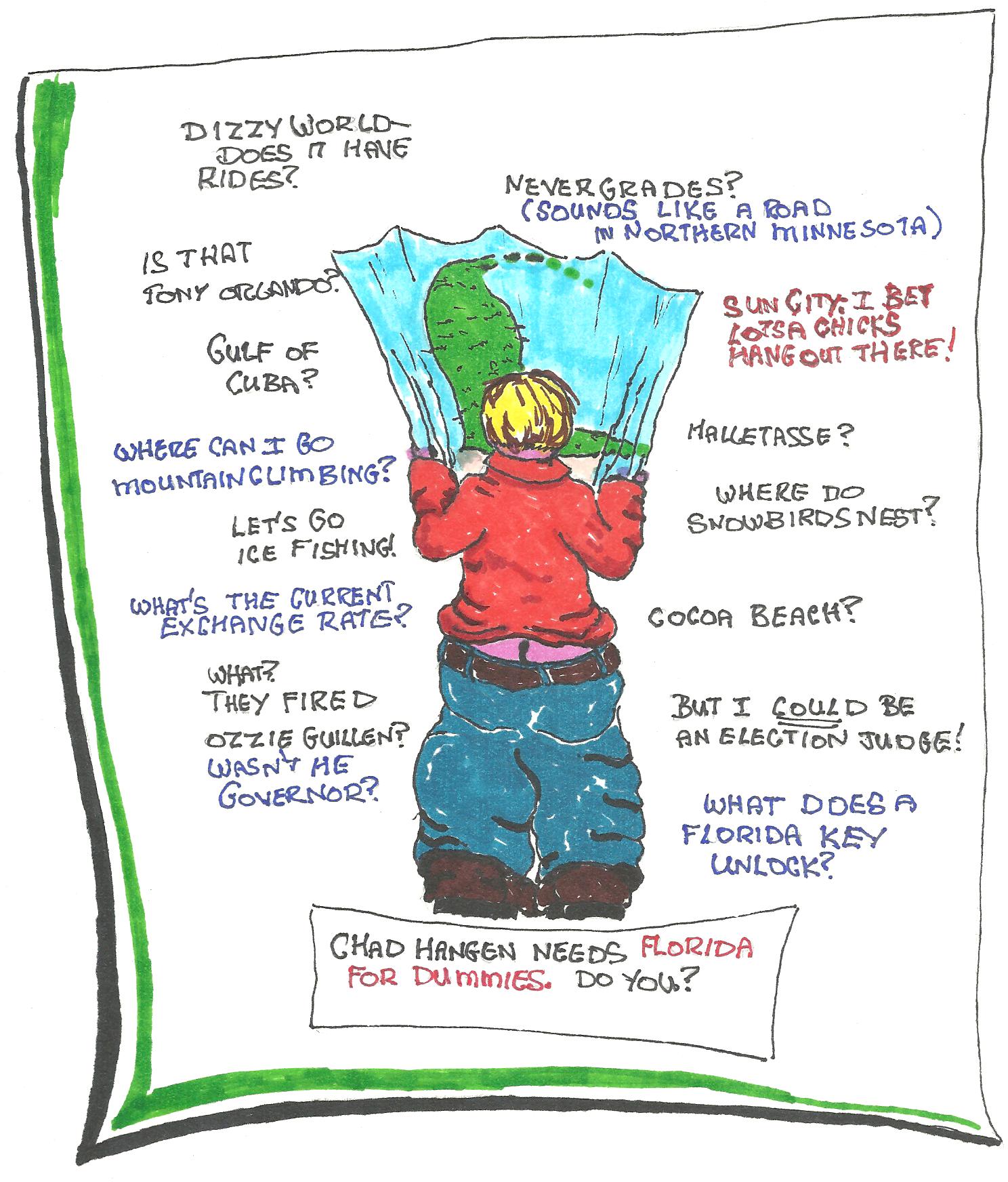
Browsing pointlessly in our pointless public library yesterday, I spotted a book title that jumped out at me: “Florida for Dummies.” Go ahead, write your own punchline.
But there was a success I would have never foreseen, the Dummy Books. Do they hold meetings trying to analyze their potential audience:
“Someone who listens to Limbaugh?”
“Well, no, not that dumb; has to be able to read.”
“Voted for Sarah Palin?’
“And watches ‘Dancing wit the Star’.”
“And is a NASCAR fan.”
“A Cubs fan for sure.”
“No, a Yankees fan.”
Maybe they just envision Homer Simpson and Jessica Simpson.
But more power to them; not that we English teachers would ever approve of writing concisely and precisely, using graphic elements effectively. I have used a couple of the books, maybe three or four, to quickly overview a topic. I thought of some I could write:
“Intelligence for Dummies.” But on which end of the spectrum am I an expert?
“Editting for Dummys”
“Left-Handedness for Dummies,” meaning for right-handed people.
“Baboons for Dummies”
“Lefse and Cardboard for Dummies” (How to distinguish between them)
“Living with Germans for Dummies” (And who else would?)
“Michele Bachmann for Michele Bachmann”
What Dummies book do you need? What Dummies book would you write?
I recently stumbled across a little-known Thurber cartoon. I haven’t seen it almost 50 years.
The cartoon shows a distinctly Thurberian man wearing a bowlerhat and a startled look as he half reclines on a chaise lounge, as so many Thurber people do. Seated next to him is a young woman with hanging hair and and enraptured look saying “Have you fordotten our ittle suicide pact?”
I had an English course in college in which the instructor took us off into analysis of comedy, which, as he well knew, is a futile question. It is almost impossible to explain what makes us laugh, why things are funny. I presented this cartoon as an example of inexplicable humor. I do not know why I like this joke so much. The problem in the class was that the instructor did not think it was funny, nor did many of my classmates. Several people, in those touchy 1960’s, thought it was sexist.
We soon discovered that there was wide range of taste in humor in the class. Also, we got into that fuzzy region of trying to separate wit from comedy, from humor, from burlesque, from bombast, from camp, from satire, etc. We arrived at no real answers, but, oh, my, what a good class that was.
Isaac Asimov wrote a short story called “Jokester” (in Earth is Room Enough,1957) in which a scientist tries to find out where jokes come from, how they start. He discovers that they are implanted in human society by a superior alien race which is using them to study human psychology. Think about that a minute, just how much comedy does show about us. In Asimov’s story the moment the scientist discovers this truth, the aliens remove all the jokes and human life becomes bleak.
When I directed plays I was quite good at inventing humorous business, especially for a melodrama done in the Two Harbors band shell, the first of many we did in the mid 1980’s. I took a basic Samuel French-published melodrama and localized it. Instead of the heroine saying “He deserted me in the wicked city,” she said, “He left me in the wicked city of Superior.” You may have to be from the Duluth area to get that. We even did a drawn out version of the Groucho Marx “walk this way” joke that was very funny.
We made lots of fun of Duluth. “I had to go to Duluth . . . once” [Long deep sighs of sympathy from the whole cast, including those not on stage who stepped out to sigh and some plants in the audience who arose to sigh. We even once did it with all in perfect unison.]
One joke we could never make work. The line from the hero was “I am going to go way out west.” We wanted to add to that. “I am going to go way out west to ________.” We could come up with nothing funny. We tried Clover Valley (east of Duluth), Floodwood, Brainerd, Fargo, and several others. We had him point east or say “Bayfield.” There must be a joke there, but we could not find it.
My own favorite was having the heroine cry great sobs at the front of the stage while begging sympathy from all the women for the evil the villain had done to her. She then wrung out water from a sopping wet handkerchief she was oh so carefully handling while daubing her eyes.
As you can tell I like broad dumb humor. “Airplane” is one of my favorite movies. And I do like wit, the wry turn of phrase or events, as well as offbeat oddball humor, such as Thurber cartoons. I do not like physical humor or humor based on someone’s embarrassment or jokes that belittle, which is why I gave up network television 30 years ago. I must reluctantly admit that I do not find many of the classic pieces of comedy funny: Chaplin, Laurel and Hardy (just get the damn piano up the stairs, would you?), Abbot and Costello, W. C. Fields.
Now your turn. I’ve let you into the dark places of my psyche.
What makes you laugh? What does not make you laugh?
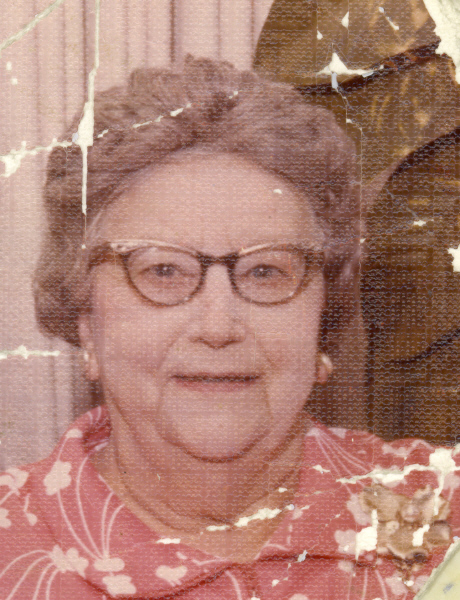
Edith was widowed in about 1924 with four young children when her husband dropped dead at the age of 36 of a heart attack. Fortunately his life insurance covered the cost of the house, but only that. She survived with the magic she could do with the stove. She cooked for many rich families and made it through the Depression mostly by running a bootleg bakery, “bootleg” in the sense of unlicensed. And, oh, how she could bake.
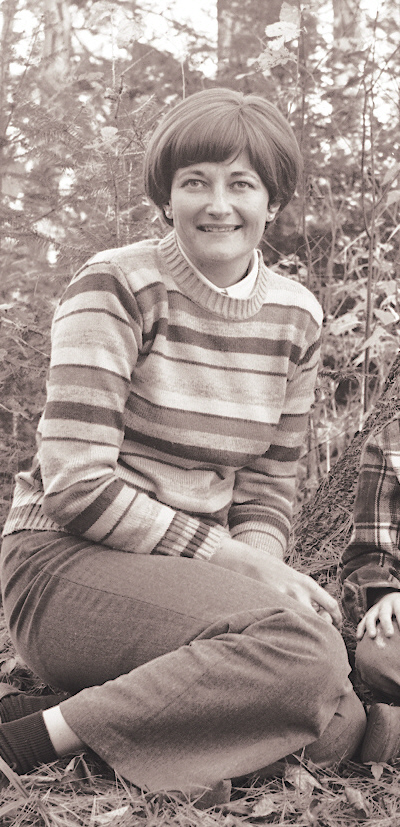
Edith
She had a son shot down over Germany in WWII and another son came home deaf. When her daughter ended up in a bad marriage and badly crippled from arthritis, she took them into her home, now doing all her magic in a tiny kitchen she had built upstairs. She shared her upstairs bedroom with her two grand daughters, one of whom is my wife.
She was described as always upbeat, giggly, and girlish. In her early fifties she seemed to have developed a sort of mild senility, which made her delightfully, charmingly dingy. I could tell thousands of stories about this, such as the fact she long carried around a piece of paper with my name on it because otherwise she called me Claude. Here are a few stories, in which you will notice forty years of widowhood had made her confused about sex.
My wife, the world’s most beloved human being, was packing for our honeymoon, including all the negligees she had received in her 13 bridal showers. Gramma Edith kept pulling them out of the suitcase and telling her to save them for something special.
She once told my wife not to undress in front of me because one day we may get divorced and then my wife would be walking down the street and see me and say, “Oh, no, I undressed in front of him.” After that she called several times in tears insisting she did not think we would get divorced, including more than once in the middle of the night.
In our poor but fun college years we would go over to the house to wash our clothes and take my mother-in-law for an outing. Edith would fold our clothes and take out and hide all the negligees. So I called up Edith and told her that Sandy was sleeping naked. She demanded that we come right over and get them. She would also hide food for us in the laundry, and once hid butter in my wife’s purse, which fell out of the purse when my wife was paying for groceries on our way home. My wife did not even try to explain. The clerk carefully ignored it, perhaps because my wife was purchasing such a modest amount of basic stuff.
Edith once ran short of apples for her famous apple pie, so she substituted watermelon pickles. She did not think we would notice. She made a famous torte, the recipe for which she stubbornly took to her grave.
Generation Two: Mugs, the Crip
Marguerite became pregnant at age 19 and rushed into a bad marriage, giving birth in March of 1940 to my wife Sandy. Four years later after giving birth to a second daughter, she developed severe rheumatoid arthritis, which over the next 42 years dissolved the bones in her hands and feet and gave her terrible pain. But she refused to let it limit her and not once in anyone’s memory ever complained. She went to everything she could at the Courage Center, where she hung out with the other “crips,” as they liked to call themselves.
Mugs
She once took an assertiveness class, from which she was excused for her assertiveness. In my college years she spent many months at the U of M having her knees and hips replaced, among the first to have the operations. She and I had lunch together every day while she was there and became close friends. She spent the rest of her time there seeking out those who needed an encouraging friend.
It was my—is “pleasure” the word—to do her funeral, at which I told many of other inspiring stories about her I am not telling here.
Generation Three: Sandy, the Most Beloved Being on the Planet
In my wife’s yearbook,despite a very difficult childhood, it said by her picture “Everyone wants to be like Sandy.” Everyone loves my wife. Everyone. Loves her.
Sandy
Our friend Lori recently went to one of my wife’s many doctors and told the doctor that she knew Sandy. The doctor acknowledged that she should not talk about another patient but told Lori how Sandy inspires everyone in the office, that after Sandy had been there no one complains about anything for the next few days. My wife goes there with her progressing lupus and five other illnesses and greets everyone by name in her perky manner. Sandy asks about their joys and problems, about which she has learned over her many visits. The doctor has to argue with my wife to tell her symptoms because then she would be complaining.
In June one morning I rode my bike through the industrial park and saw an arresting sight. In a large parking lot about 75 cars were parked near the entrance to a manufacturing plant. In a distant corner of the lot were two cars parked side-by-side. One was a perfectly maintained BMW Z4. The other was an old Dodge Dart, a rust-bucket rattletrap. I spent the next couple of miles guessing how these two cars ended up in their shared isolated position.
I could imagine several stories.
I forgot about it until two days later when I rode by to see the same placement of cars. This time it struck me that Pixar would make a movie out if it, in the style of Lady and the Tramp. The two cars would be in the alley behind an import garage sucking on radiator hoses simmered in 5-10 motor oil flavored with herbs de Peugeot as they sipped on chilled canisters of penetrating oil. Their union would result in six bouncy little Vespas and a mo-ped.
Three days later, I rode by the scene again. This time I imagined a murder mystery in the style of Three Bags Full or Thereby Hangs a Tail but as seen through the headlights of a car, not the eyes of sheep or a dog. Using pure German rationalism, the BMW would solve the mysterious murder of a VW beetle by a black stretch limousine. The Dart would be the BMW’s snitch in the style of Stuart Margolin playing Angel in The Rockford Files. They were holding a meeting in the parking lot for the Dart to tell the BMW that the VW was an industrial spy.
Circumstances kept me from riding by the parking lot for more than six weeks. But now the BMW was alone and has been on every ride since. Hmmm? In fantasy or real life, I bet there’s a story to be told.











 Trail Baboon