All posts by cbirkholz

Metrics Confounded Compounded

Today’s guest post comes from Clyde.

When science and math people put on a strong push for adoption of the metric system a few decades ago, Isaac Asimov jokingly proposed we needed some other metric units. He proposed several, the only one of which I remember was the Milihelen, which is the amount of beauty it takes to launch one ship. When I worked as a lab tech, my lab mate and I, in response to Dr. Asimov, invented many of our own, especially on Friday afternoons. Most of them I have forgotten, or am unwilling to repeat. Two of them I have included below. I got to thinking we could use a few right now. So here are my offerings:

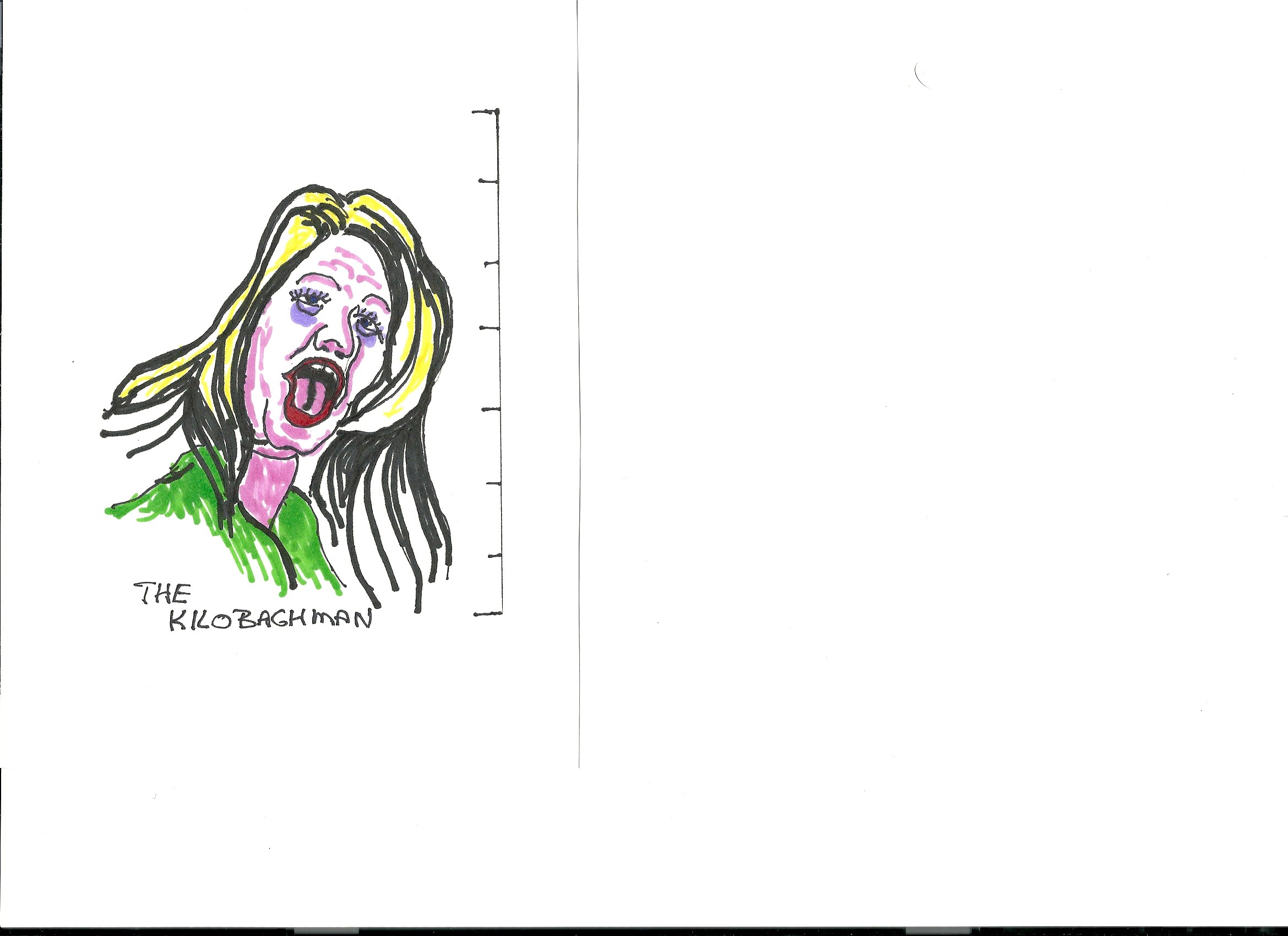
  • The kilobachman could measure so many things. Lets say dishonesty and insensitivity.
    • The microcheney equals a common everyday lie.
    • The decabeck describes a thumb skewed ten degrees from opposable.
    • The macromartha is 1,000,000 hours of pointless media time.
    • The unbiddenbidenbabble is 15 seconds of careless comment.
    • A mccain mile is the distance is decent man goes to find the larger view. (But the mccain mile has some potholes, the depth of which are measured in decapalins).
    • A Yankee penny equals $1,000,000 of player salary.
    • A nanodale meters the speed of cleverness.
    • The Connelly Constant expresses an ever-lighthearted point of view.
    • The Clyde Constant expresses an ever-lightheaded point of view.
    • A decacoffeesnort is a small bit of humor.
    • A kilocoffeesnort is too crude to discuss.
    • A kilobartholemew reports on the contents of TGitH’s closet.
    • A squarerenee measures yard space turned into garden.
    • Dynohollies express Utube searching skill.
    • Hemisemidemiquibbles are needed to measure rudeness on the Trail.
    • Gusgrits measure the rate of a Northerner’s adjustment to Southern life.
    • The lurker curve is a line below which are hidden unknown wonders and a too-quiet goatherd.
    • A decakilobaboon is a 100-post day on the Trail.
    • Centiblevin equals a ten degree forward nod of the head from boredom.
    • Thirteen duorhondas helped out with Steve’s tree.
    • A centitim equals 100 typing errors.
    • A megahurts measures fibromyalgia pain level.

    • OMGdro’s number: number of pointless text messages sent everyday in America (6.022 ×10 to the 23rd power).
    • Potatoes cubed is what I am working on for supper.
    • An angstdrum holds 120 gallons of fret and worry.
    • Kilowhats measure, well . . . some folks just don’t get it. At all.
I could not think of a good measure for basic human goodness, which says something about me, the state of the times, the media, or all of the above.

What would you name the unit for human decency/kindness/generosity?
(Or anything else I missed.)
Kaffe Kvetch

Today’s guest blog comes from Clyde.

I am living in a coffee time warp.

Twenty years ago because of my many sensitivities I had to give up coffee. Not caffeine, but coffee. At the time my idea of a cup of coffee was Hills Brother dribbled into a stained mug from the office coffee maker.

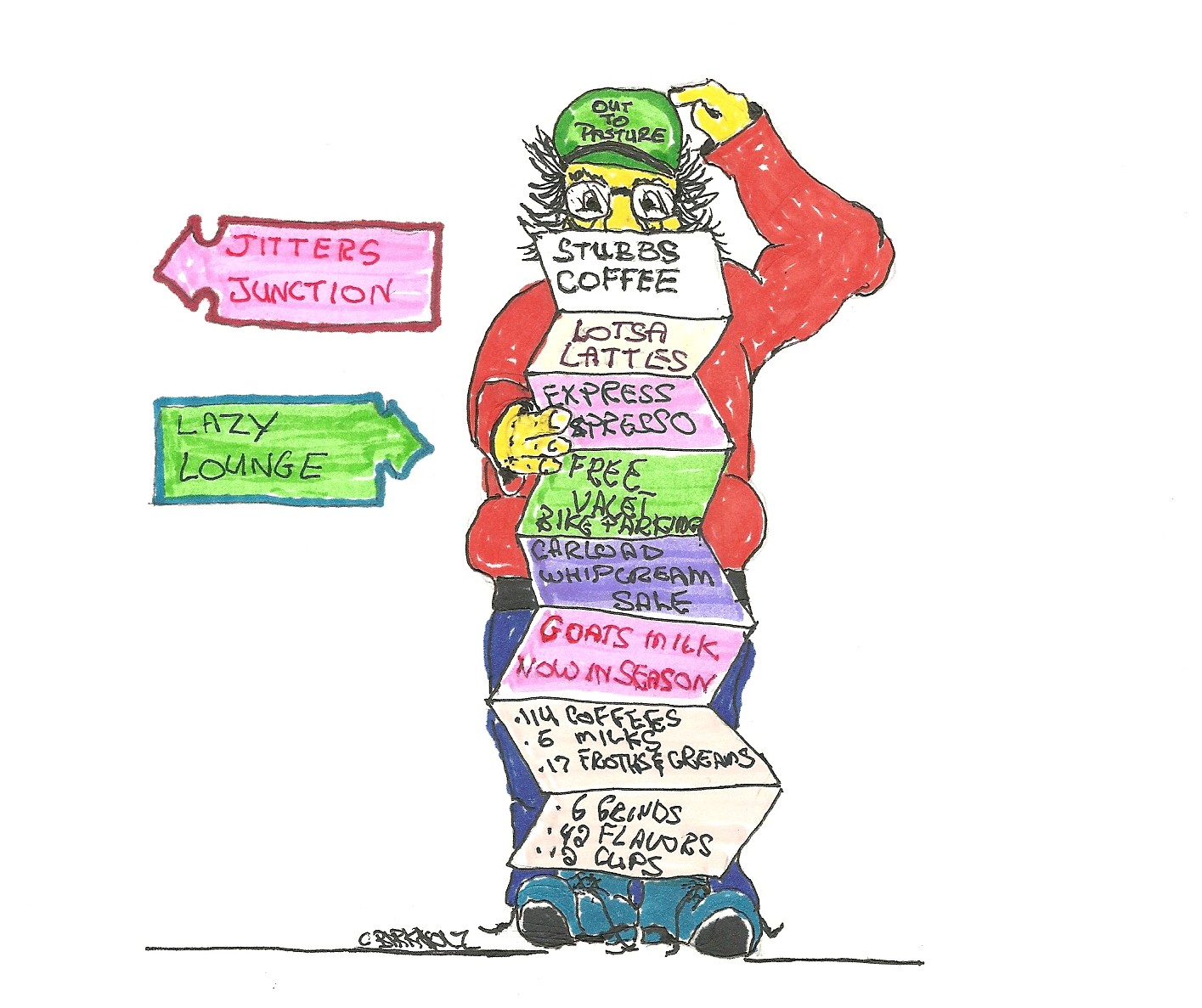
Because of changes I made in my diet or maybe just changing body chemistry, I can now again drink coffee, which is the basis of afternoon dates for my wife and me. However, I find myself a babe in the coffee shop. While I look in awe and confusion at the choices, Hutterites walk right by me and glibly order complex coffee drinks.

Country of origin, color, grind, white additives, flavor additives. Hot or cold. Kind of cup. Heavens, it’s even now a moral geopolitical question. And all that specialized vocabulary: latte, cappuccino, macholatte, espresso. The servers even have a special title (and their tips, as opposed to their pay, have moral dimensions). I just wanted a cup of coffee, which I want to order by size with English words! How naive of me!

So I decided when we are not producing movies or running summer camps for goats, we Babooners should operate a virtual coffee house. But what would we call it? I know the trick is to get the right name. The Dunn Brother’s went local here and has became Rivendell Cafe. My daughter’s hangout in Redwood Falls is the Calf Fiend. One here in Mankato is called the Coffee Hag. So maybe Connelly’s Cuppa. The Coffee Poole. The Appalatte Trail. Blackhoof’s. Caffeine Congress. comeinansitawhilewhydonya.

What should we name our virtual coffee house?

Ancient Greek Rock and Roll

Today’s guest post comes from Clyde.

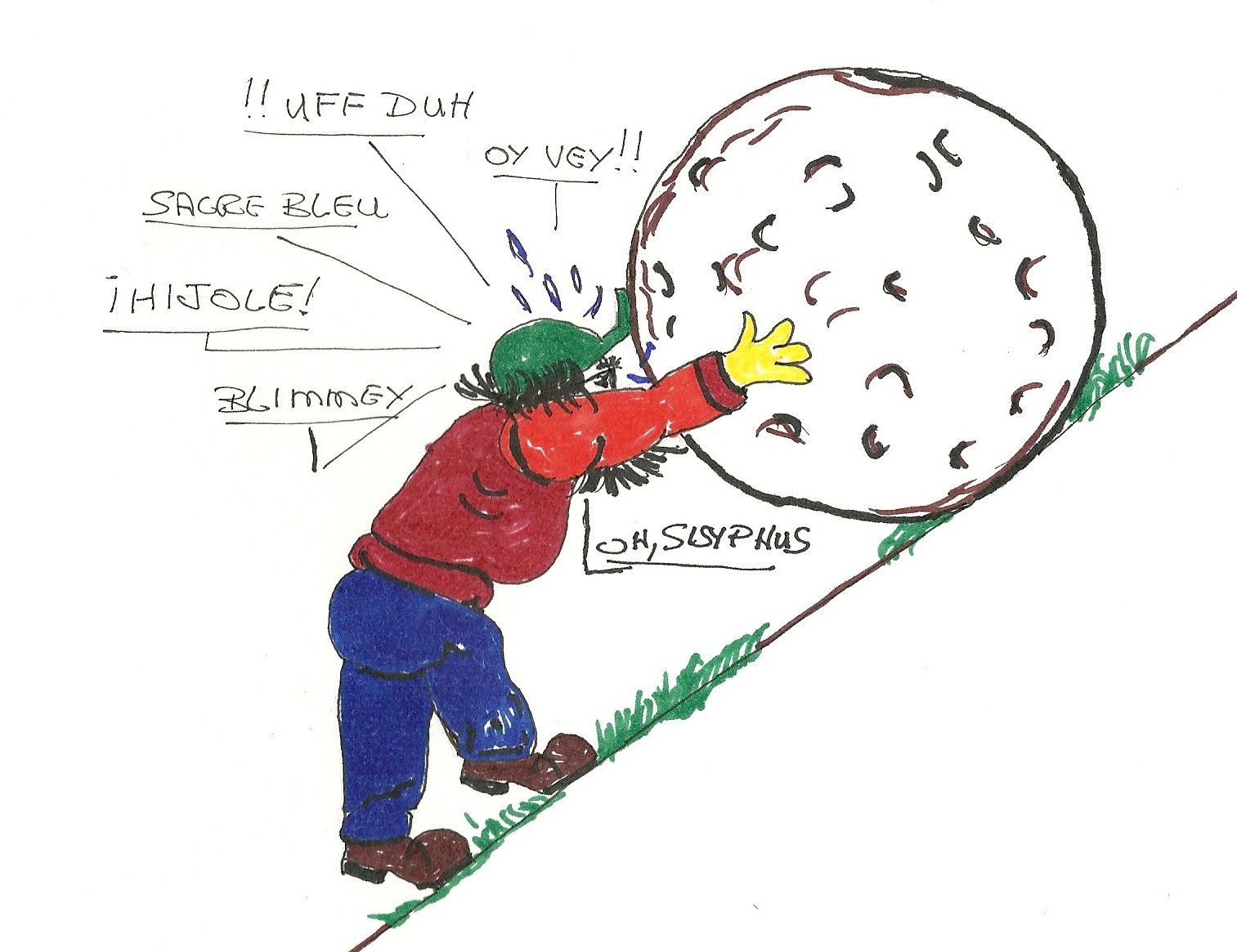
Sisyphus was a man in Greek mythology assigned the punishment of rolling an immense boulder to the top of a steep hill. At once it rolled back to the bottom, from where he had to push it back up, only to see it roll down again. Endlessly, eternally, up and then down the hill. It is one of my favorite images from mythology.

Who has not felt like Sisyphus?

We tend to think of Sisyphean tasks as onerous. But not necessarily. An example for me was sermon-writing. When I was a pastor, I had a weekly process I followed, which led me through a seven-day cycle of inspiration, creativity, and soul-searching. Struggle, too, but that made the climb meaningful. I am about to give my last sermon, or maybe I gave it already, depending on two factors out of my control. Either way it was a good climb which I did about 700 times, counting all special services as well as Sundays. I have a friend who has done it over 3400 times, as I estimate it.

School teaching was another example for me. I would spent a year pushing the boulder up the hill, that is, getting my students to where they should be at the end of the year. Three months later I would come back into the classroom to meet the rock at the bottom of the hill. Not that I am complaining about that. It was a joyous and rewarding thing to get them to the end of the year, with many a struggle along the way. Life comes in many cycles, and that was one of the best in my life. Until, with my low threshold of boredom, I had done it just too many times. Twenty years ago I met a strong, vibrant, and life-filled woman who pushed that rock up the hill 54 times, claiming, and I believe her, to have loved every trip up the hill. She did it exactly twice as many times as I did.

Why had I burned out on a nine-month climb and I did not on a seven-day climb? Hmm?

Life is full of the unappealing hill climbs, such as housework. You clean and it gets dirty again. My own particular bane is making beds.

At this age I have discovered that my primary Sisyphean tasks have shrunk from nine months or seven days to 24 hours. Such is aging; tasks get more personal and come in shorter spans of effort. Also, now there seem to be a few boulders to push up each day, such as pain-management, keeping the filtered water bottle filled, following this blog, and forgiving myself for stupid mistakes.

How would you be punished or rewarded in a Greek myth? For what?

Inflated Superstition

Today’s Guest Post comes from Clyde.

I had four flat bike tires in eight days. Then a week later my wife said, “Well, you haven’t had a flat in a few days.” I gritted my teeth, but did not answer her. Why did she have to say THAT?

I am a strange contradiction in a way. I have some education in and a strong reading interest in the sciences. And I’m a Christian, well a Lutheran, which is the next thing to a Christian. I have some education in and a strong reading interest in religion. While those two things are supposed to be in conflict, they should together rid me of all superstitions. Nevertheless, I have had one and only one superstition my whole life, but I can never shake it. It is the fear that words will make the opposite so. You know the “knock on wood” superstition.

When someone says something I fear may make the opposite happen, I do not knock on wood. I mean, that would be just stupidly superstitious. I would, however, never say that I had gone for awhile without a flat. (I just checked this minute–no flat. Pshew.) I might even say something like “Yep, bet I’ll get another flat” hoping my words will prevent a flat. (Just checked again on the bike tires. Still okay. But bet I get one, nudge, nudge, wink, wink.)

I have a perfectly logical explanation for why I had the flats. God’s out to get me. No. Don’t be ridiculous. First, the streets and sidewalks, which is where I do almost all my riding, have quite a bit of glass on them this time of year before the city gets out with street sweepers. Second, when I put the bike away last fall, I made a note to remember that both tires were worn down, which is the number one way to get flats. I did remember the worn tires when I started riding a few weeks ago. But this is April. You know, tax month. I am SURE I will owe A LOT when I get them back from my accountant. A LOT. (Nudge, nudge, wink, wink.)

I had no choice but to buy new tires. So now I’m sure I won’t . . .

Well, let’s just not say it.

What are your superstitions, perhaps in spite of yourself?

Wait, Wait, Don’t Sell Me!

Today’s guest post comes from Clyde.

As my wife’s permanent chauffeur, I spend much time in medical waiting rooms. Even though I have learned to bring my own entertainment, I have informally cataloged what is provided as reading and viewing material.

One clinic provides nothing because they believe that the reading material spreads germs. Two have taken out play areas for children on the same principle.

As a casual observer of marketing, I notice how the marketers have, as they will, found the captive audience. A few places provide the standard array of magazines, usually with a plastic cover over them on which are imprinted ads for the company which paid for the magazine.

Much more common is to devise ways to market medical services and products, almost entirely drugs, to the captives. Or is that victims? Let’s say patients or impatients, as is maybe more often the case. The two favorite media are TV screens and medical-interest magazines. The technology is slowly expanding. It usually extols the virtues of the organization holding you prisoner. Ads for drugs are also slowly creeping in.

I scan the medical-interest magazines before reading my Dickens or Hardy, two authors I read in waiting rooms because it takes an environment such as that to make them interesting. Most clinics contain two types of such magazines: a general medical health publication, or ill-health as I shall explain, and a magazine aimed at the focus of that waiting room, such as arthritis or neurology.

The content of these magazines has made two things clear. 1) No disease is real until someone famous gets it, or as second-best, the parent of a famous person. 2) There is a myriad of diseases of which I should be terrified, things of which I have never heard, which get catchy names as if Madison Avenue named them. Did it?

Overstatement is standard fare, especially on the cover. For instance one magazine on its cover suggested that all Boomers have a mysterious disorder called HepC, which turned out to be hepatitis C. The reason, as I read inside, is that we all, it seems, shot up drugs, shared toothbrushes, and participated in orgies. I guess I wasn’t invited.

The purpose of these magazines is ads for drugs, with long legal statements in very minute print, too small for most of the patients in the waiting rooms to read. Another Madison Avenue decision? The listed side-effects are more terrifying than anything Stephen King would dare write. All the ads tell me to ask my doctor about the drug, meaning to prescribe the drug. I tried to talk my wife into taking a list of the drugs in with her and asking her doctor about each of them. My wife has no sense of fun.

Doctors hate ads like that, and they hate articles which tell people that they have the latest dread disease. But I am quite sure the management of the clinic or hospital is placing them there and not the doctors.

The slowest passage of time known to humans is that spent in waiting rooms. People need distraction, but the content of the TV screens and the magazines seems to me so contrary to what people really crave or to the purpose of the visit.

What would you put in medical waiting rooms to distract and or comfort people?

No Size Fits All

Today’s guest post comes from Clyde.

I am not the man I used to be. My doctor told me so.

Well, it was her nurse who told me that I have become a lesser man. The way she said it was, “Your height is 5 feet 10 inches.”

I said, “Really?”

She said, “I’ll check it again. You’re 5 feet 10 AND 1/8 inches.” Ah, me! Phew! That 1/8 made me feel better.

Since my height for most of my life was 5 feet 11 7/8 inches, it is not a stretch, pun intended, to say I have lost two inches in height. Because I always claimed a height of 6 feet, it is only fair that I now claim a height of 5-10. I lost most of that height in a short time, less than a year. Ah, me! I think I’ll call myself a Settler. Maybe gravity suddenly became stronger in Mankato. Maybe my load of care is getting me down. Now I really am in depression. It has to be something the Republicans did. “They’re turning me into a Newt!”

Don’t you think I would have noticed? That it would have been harder to get things down from shelves, for instance. Harder to reach light bulbs. I am a typical male: I don’t see the thing right in front of my face unless you point at it. Wait a minute, it was harder to reach light bulbs. It should now be easier to reach down to the floor, but it’s not. Ah, me! Go figure.

Another bad thing is that I am now ten more pounds overweight, even though I have lost weight. Ah me!

Then I noticed that the cuffs of my pants and pajamas are getting frayed. One could say I’m dressed in drag. I told the launderer he should have spotted it and told me, but he has lint for brains. Now I really have a problem; I cannot buy off-the-rack anymore. I have a rather odd body. Despite having once been 6 feet tall, I had a 30 inch inseam, which is the bottom end of rack-sizes for my waist. I seem to have a 29-inch inseam or closer to 28 perhaps. Ah me! I could take up sewing.

Wait! A friend just sent a picture of fourth graders in the Two Harbors of my youth. All the boys had the cuffs of their jeans turned up three to four inches. Could we bring back that style, please?

What style do you want to bring back?

Sunday in Savannah

Today’s guest post comes from Clyde.

Every New Years Day, which it is when I am writing this, I remember our first trip to Savannah.

A school district southwest of Savannah hired me to come do a workshop from 8 a.m. to 1 p.m. with the faculty of an elementary school on the Friday after News Years Day. Now think about that. A Friday morning after New Year’s Day. I was suspicious, but the principal, a charming woman with one of those endearing Georgia accents told me it would be fine. (Does any state have a wider range of accents than Georgia?)
If I flew to Atlanta and came back on Monday, it was cheaper for two tickets than one alone coming back Saturday. The district agreed to pay the two tickets and two nights stay.

Savannah Home

My wife and I flew down on New Year’s Day, which wasn’t as hectic as I expected. It was a pleasant drive down from Atlanta. The next morning, I went looking for the school. It was difficult to find in those pre-Google days, when GPS was in its undependable infancy. I always allowed myself ample driving time on mornings like these, fortunately. I drove west on a state highway through Fort Stewart, which I had not noticed on the map. When I got to where, by the map, I planned to turn south, I was not allowed to do so because it would take me through military gates. It took awhile to find how to get around the fort proper. Then I asked for directions; no one could help me because no one who worked in gas stations or who came in as customers had lived there very long.

Now I was really suspicious. Why was a faculty coming in on this odd Friday where so many people lived temporarily? By stories told to me by former students, I expected most of the faculty were Army wives, who had been home for the holidays and now had to come back for this Friday instead of coming back on Sunday. I stumbled upon the school.

Downtown Savannah

The principal told me, yes, most of her faculty were Army wives. She also told me that the school board had been angry with the faculty when they wrote the calendar the previous spring, which is how this day came to be. All three elementary school faculties would be in the group. The secondary teachers had their own workshop. Wow! Was I going to have a fun morning or what! If I were in the faculty, I would be angry and not a willing participant.

The workshop was very participant-active; about 65% of the time they would work on tasks instead of listening to me, which would make the day terrible if they did not comply. I began with some fun loosing-up activities, to which they fortunately responded. At coffee break they told me their grievances, but that they had decided not to hold it against me.

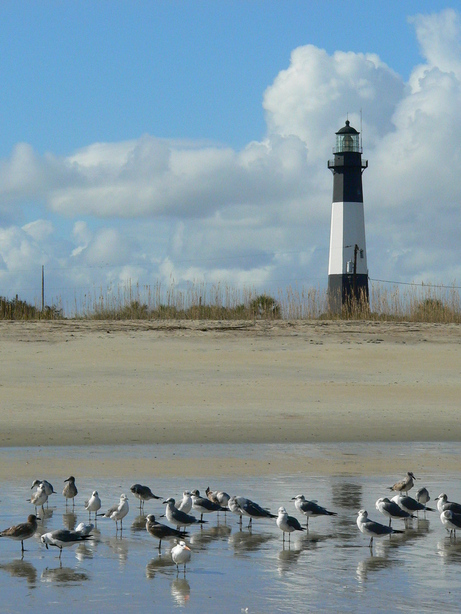
Tybee Island

The five hours flew by. They laughed, did the work, posted their work on the walls, and gave me high reviews for the day, among the highest I ever received. Afterward the principal and teacher leaders took me out to lunch. The principal, with a bit less of that charming accent, told me she had lied on the phone, that she expected open rebellion. As one of the teacher leaders said “I guess we just turned the other cheek.”

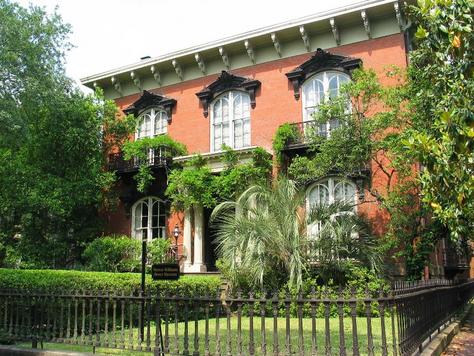
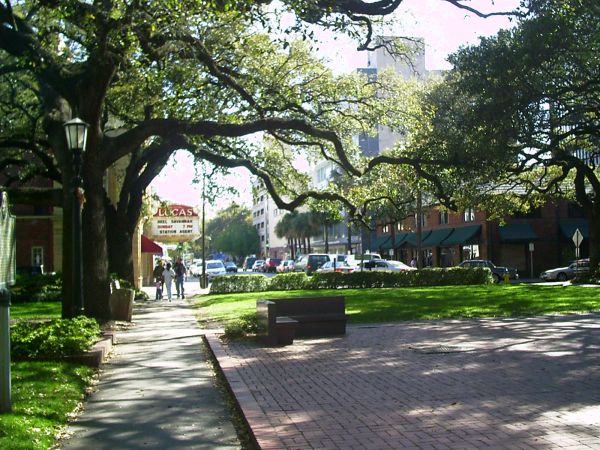
That afternoon and for two days, my wife and I discovered Savannah. We walked the squares, rode the buses, toured old homes, strolled Tybee Island beaches, ate wonderful meals. We were blessed with two other trips to Savannah when the Savannah Schools hired me after hearing about that first day.
Ah, Savannah!

When have you seen someone turn the other cheek gracefully?

Confessions of a Birthday Scrooge

Today’s guest post comes from Tiny Clyde.

I have a birthday this month, never mind which day. And don’t go wishing me happy birthday anyway.

“Every idiot who goes about with [Happy Birthday] on his lips, should be boiled with his own [birthday cake], and buried with a [birthday candle] through his heart. He should!”

If I could have my way, which I cannot, of course, my birthday would be ignored. It’s not anything about growing old. I do not grasp how one day of aging is more significant than any other. As a matter of fact, I go through each year saying I am older than I am. If you ask me how old I am on January 10, 2012, I will not remember and have to subtract years. So I will subtract 1944 from 2012 and say I am 68. Each December I am surprised to realize that I am not as old as I always say.

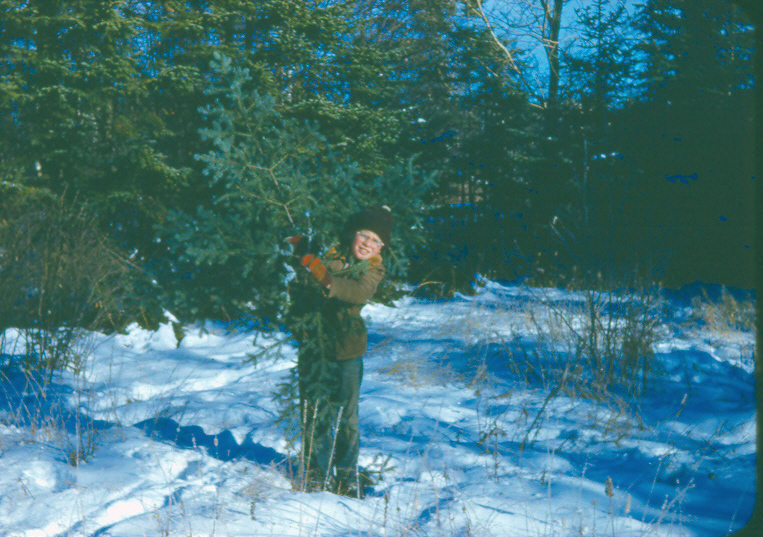
My birthday problem starts as a child. It was a ritual to put up our Christmas tree on my birthday, which I was expected to consider a gift. From about age ten the gift included the task of going into the woods, selecting the tree, cutting it down, and putting it in its stand. I am not claiming I had a bad childhood. I had a very good childhood, except every year on my birthday. The standard joke was to say that I was being allowed to open one Christmas present early. My mother loved standard jokes. She wore many a standard joke down to the nub, ground it to powder, and still repeated it. I am still not sure that it was always a joke. In any case, the wrapping on my present or presents was Christmas wrapping, a simple economic measure. My mother loved simple economic measures even more than she loved wearing out the same jokes each year.

A few days before Christmas (some unspecified number) is about as bad a time as there is to have a birthday. My granddaughter’s birthday is December 25. So far she has not felt slighted, but when she becomes a sulky teenager, that may change. But I think my date is worse because people, me especially, make a point of overdoing her birthday–in proper birthday wrapping.

My sister’s birthday is March 27, which happens also to be my wife’s birthday. Now think about it. Is there any better time for a girl to have a birthday, even though it may fall on or very near Easter? Think of all the spring clothes she can be given, or, as in my sister’s case, have made for her. So my sister’s birthday was a feast of presents. You know how those girls are—they consider clothing actual presents. Then on my nineteenth birthday, my sister further buried my birthday under familial distractions by getting married that day.

My childhood birthdays happened at a time when I had already received everything needed for the winter. It was also a time of the year of limited money in our family, as opposed to the spring when more money was at hand. We also had a seldom-seen and difficult grandmother who doted on my sister because my sister had been given her name. She would write on the letter with my sister’s presents how in the rush of Christmas she had simply forgotten my birthday.

Dickens, Of Course

Now, (nudge, nudge, wink, wink) I’m not carrying a grudge, especially against my sister, with whom I was as a child and teen extremely close and with whom I still have a close bond. It’s simply that I joined the parade years ago and decided to ignore my birthday too.

(Before I ask the question of the day, I do want to clarify that I would not swear to any of the above under oath. Not one word of it.)

What’s your favorite quote or scene from Dickens’ “A Christmas Carol”?

Over the River

Today’s guest post is by Clyde.

When we were raising our children, we lived in Two Harbors and my parents lived above the east end of Duluth, only about two miles from Hawk Ridge. Among the four ways we could drive to their house, our favorite was to take the Seven Bridges Road.

Here is YouTube of a song about the Seven Bridges Road:

In winter the Seven Bridges Road was plowed only part way up the hill. Thus for our traditional Thanksgiving Day drive to my parents house we would always take the Seven Bridges Road, assuming that it would ere long be closed. And a family tradition was born to sing as we passed over each of the seven bridges “Over the river and through the woods to Grandmother’s house we go.” As our children matured, one would always ask, “What’s another popular Thanksgiving song?” A question which still lacks an answer.

Why is that? Why are there not many popular songs for this second most American of holidays? Everything seems right for songs: the season, the purpose, the mood, the many items associated with the day. But no songs have arisen.

Also, serious writers of serious music, i.e. classical, often embody popular songs, i.e. un-serious songs, in their serious music. Have I missed it, or has no one used Lydia Maria Child’s “Over the River and through the Woods” in this way?

Another mystery: Her poem which provides the words to the song was called “A Boy’s Thanksgiving Day.” Why is her poem of her childhood memories called “A Boy’s Thanksgiving Day”?

Here are her words:

Over the river, and through the wood,
To Grandfather’s house we go;
The horse knows the way to carry the sleigh
through the white and drifted snow.

Over the river, and through the wood—
Oh, how the wind does blow!
It stings the toes and bites the nose
As over the ground we go.

Over the river, and through the wood,
To have a first-rate play.
Hear the bells ring, “Ting-a-ling-ding”,
Hurrah for Thanksgiving Day!

Over the river, and through the wood
Trot fast, my dapple-gray!
Spring over the ground like a hunting-hound,
For this is Thanksgiving Day.

Over the river, and through the wood—
And straight through the barnyard gate,
We seem to go extremely slow,
It is so hard to wait!

Over the river, and through the wood—
Now Grandmother’s cap I spy!
Hurrah for the fun! Is the pudding done?
Hurrah for the pumpkin pie!

Why the dearth of Thanksgiving songs?
Go ahead. Write one.

Circular Tourism

Today’s guest post is by Clyde.

“A penny saved is a penny earned” is a frequent litany in the kitchen.

Which would perhaps irritate the three children, except the mother also says it every time she adds another penny to the broken teapot sitting high in a glass-fronted cabinet.
If it is a war-time lead penny, still in common circulation at the time, she says, “A lead penny is still a penny earned.”

The collection of pennies is closely watched until they have 105 of them. The expenditure of that $1.05 is carefully planned by the children, a project they complete in collaboration.

One hundred and five pennies buys three sets of View Master reels. A set can be one, two, or three reels, but a pack of three is preferred. They can be purchased at either drug store or the dime store, which is never called by its real name, The Ben Franklin.

As the pennies mount, which takes a few weeks, they study their options. None has any interest in the cartoons or the other things so obviously aimed at children. They only want historic sites, geographic wonders, or world or national travel sites. When tourism becomes an “industry” in northern Minnesota, reels for Duluth and the North Shore start to appear in the selections, which confuses them. How can the Aerial Lift Bridge or Split Rock Lighthouse, which are so familiar and near, rank with the Eiffel Tower?

Over the years they collect and regularly view London, Paris, Rome, New York City, San Francisco, the Rhine, Yellowstone, The Grand Canyon, the buildings and monuments of Washington D.C., Carlsbad Caverns, Mammoth Cave, Niagara Falls, Dawson City, Plymouth, Mt. Vernon, the time of the mastadons, the Everglades, Angel Falls, the Field Museum, the Louvre, and on and on until they become living-room-braided-rug-world-travelers.
The excitement of planning the next purchase is as great, or maybe greater, than viewing the reels themselves.

The appeal is not only in the magic of the stereoptic effect, but also in how the small black viewer pressed to your eyes shuts out the here-and-now and takes you away for as long as your index finger holds out pulling down the lever to spin the reel.
A penny saved is a travel adventure earned.

If you had a magic View Master, what seven pictures from anytime and place would it show?