
Today’s guest post is by Clyde.
I collect graveyards.
Cemeteries are full of life, not human life, but plant and animal life. They reflect human history, culture, vanities, and foibles. People intend tombs and markers to enshrine power, success, or wealth, but over time such efforts fade to a sort of sad satire. Maybe that is only my viewpoint. Cemeteries are retreats, calm and restful, often set off in quiet and lonely places. Here on the prairie, they were usually placed on land of no farm use; thus they preserve land shapes and plants from the pioneer era.
I have visited hundreds in many states. Perhaps, for whatever reason I do not know, my most memorable, which I visited several times and more than once used as a place in which to compose a sermon, are the half-dozen ragged, rugged little graveyards scattered across the forest 30 miles or so north of Two Harbors. So much fun to pronounce the lyrical old Finnish names on the tombstones, once you have half-mastered the art. Only a Finn fully masters that arcane skill.
I will tell you about five cemeteries in particular.
Most Historic: Rural Lebannon, CT.
Although this one has strong competition from Salem, Massachusetts (both have those wonderful tall thin old stone tombstones like an Edward Gorey drawing), this one wins because it also has the tomb of Jonathan Trumbull, who was essentially secretary of war during the Revolution. Now inactive, the cemetery is hidden away down a lonesome rolling side road. A friend of mine has done a 30-year study of the growth of lichens on the tombstones and surrounding rock wall. The dates on the tombstones help him plot lichen growth.

Quirkiest:Across the Minnesota River from Nicollet.
This is a well-maintained active prairie cemetery surrounded by cornfields in a Welsh area. It’s peaceful to walk a secluded cemetery with the eternal sound of rustling cornstalks. In the older section of the cemetery all the names are Welsh, all except in one corner is a man named Zimmerman. My theory is that one night some Germans sneaked in and buried a relative.
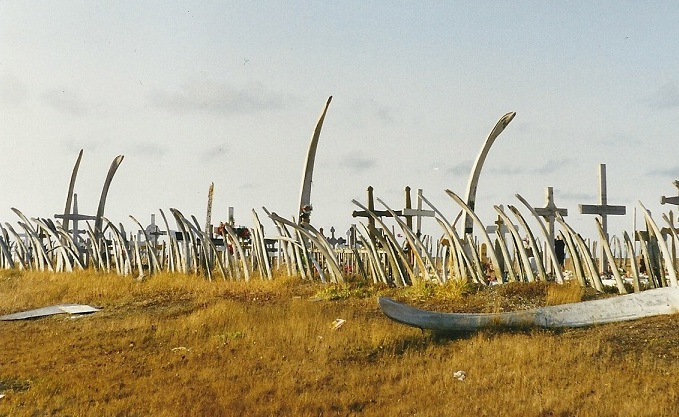
Most Unusual:Point Hope, Alaska.
On the tundra outside of this Inupiat village, the most westerly point on the American continents, is a native cemetery, the fence of which is composed of whale ribs. But outside that fence, “outside the pale,” which is what that term means, are several lone graves. When a member of the tribe dies, the elders decide if the person is worthy of being buried within the ribs, or, sometimes, the person chooses not to be included.

Most Poignant: On a bluff above the Minnesota River near Nicollet.
This still active but hard-to-find cemetery has a nice view overlooking the river valley; however, it is for one tombstone that I name this cemetery. The tombstone, a ten-foot tall obelisk, is a lesson on the fragility of children and the dangers of childbirth 100 years ago, common lessons in historic cemeteries. On one side the obelisk names a man who lived for about 70 years, dying in the 1920’s. On a second side it names a woman of the same last name who died in her early twenties in the 1880’s. A small unmarked stone lies seven feet out from the obelisk. On the next side is a second woman of the same last name who died two years later, again with a small stone seven feet out. On the third side is woman of the same last name who outlived the man by a few years; no small stone is present. Draw your own sad conclusion.

Most Frequently Visited: Calvary, Mankato.
A large very well-maintained cemetery on the wooded bluffs of
Mankato a mile from my house. I enjoy bike riding the paved roads of this cemetery in the early morning. The master caretakers who tend Calvary keep all the many trees trimmed to eight feet off the ground, which makes the early morning sun shinning under boughs onto the green grass an energizing mileau in which to ride, especially while listening to “Pipedreams.” Many a lesson can be learned here about human vanities and pretensions, both in the cemetery and among the million dollar homes which have been built next to it in the last decade. I am remind me that Thoreau said that our homes are just an doorstep to a hole in the ground.
I have, now that I think about it, only visited cemeteries in the daylight. John Muir, as a poor young man bumming around the US in the mid 1800’s, slept in cemeteries because then the police and other people would not bother him.
Would you sleep in a cemetery?




 Trail Baboon