NASA has issued an “all hands on deck” call for assistance in finding possibly threatening asteroids and developing plans to confront them. This “Grand Challenge” acknowledges the power of crowd sourcing to solve difficult problems. If two heads working on a conundrum are better than one, two billion heads applied to the same stumper are a great marketing opportunity for your brand.
The deadline to respond to NASA’s Request for Information is July 18th.
That’s coming up fast – almost as fast as a careening out-of-control asteroid bent on Earth’s destruction! So you’d better get started on your schematics. Get out a sharp pencil and a big piece of paper. All you have to do is design a system that will …
“… capture and de-spin an asteroid with the following characteristics:
- a. Asteroid size: 5 m < mean diameter < 13 m; aspect ratio < 2/1
- b. Asteroid mass: up to 1,000 metric tons
- c. Asteroid rotation rate: up to 2 revolutions per minute about any axis or all axes.
- d. Asteroid composition, internal structure, and physical integrity will likely be unknown until after rendezvous and capture.
Simple, eh? Maybe so.
The beauty of crowdsourcing is that there are brains out there that will see this problem from just enough of a skewed angle to come up with an approach that no one else could think of.
The ugly of crowdsourcing is that millions of others will mimic each other with the same obvious but impractical and flat-out dumb idea.
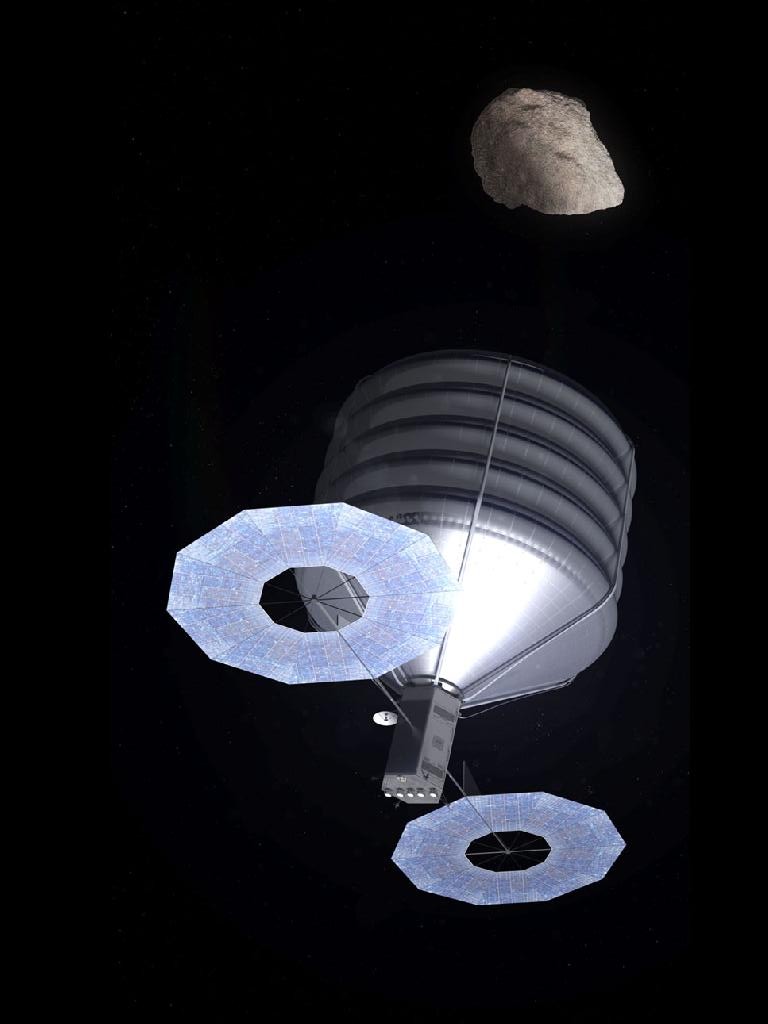
NASA has given us a head start, releasing this image of one possible approach to creating a super-sophisticated space vehicle that could capture and transport a speeding space rock.
The idea has its roots in childhood play. It can’t be a coincidence that it looks so much like this extremely simple ball-in-cup game. Who didn’t play this as a kid? Or as an adult?

My problem with this approach is that I hated the ball-in-cup game. I found it incredibly frustrating and ultimately (because I couldn’t do it), boring.
I would never go this way with the Grand Asteroid Challenge. I’d go back to the solutions we tried on the hot, muggy, buggy nights of my youth and launch a giant sheet of super-sticky double-sided Asteroid Fly Paper. NASA could partner with 3M on this one. Building a thin but tough, mobile, super-sticky landing strip and putting it in the path of an onrushing asteroid wouldn’t be simple, but I believe it would be extremely satisfying. And the larger you make your sheet of Asteroid Fly Paper, the greater the chance you’ll get the asteroid you don’t expect – the one that wasn’t on your radar.
Once they’re trapped in the goo, we can examine freshly humbled space rocks to our heart’s content.
And no, I don’t know how we’ll get them off the paper, or even get close to them without getting stuck ourselves. That would be a DIFFERENT Grand Challenge.
How would you capture and control dangerous asteroids in space?