
First things first – thanks to the guest bloggers who made my week-long holiday possible. Jacque, Steve, Beth-Ann, tim, Chris, and Anna kept Baboon land lively through the week and set comment records. Thanks for the wonderful writing and fun discussions! Clearly the baboon tribe can thrive without a leader.
Speaking of that, today is Autonomy Day, an official holiday in the Åland Islands. I love the name – “Autonomy Day”. Not quite “Independence,” but close – the sort of thing that might be made available to an 18 year old if they have a history of making good decisions about piercings and tatoos.
The Åland Islands are a collection of rocky outcroppings with enough strategic importance to put them in a perpetual tug-of-war between Sweden and Finland.
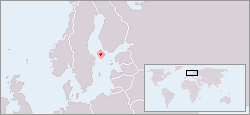
I’d never heard of the place before today, so I’m no expert and of course I’ve never been there, but I love Wikipedia’s serpentine description of Åland Islands status:
They are situated at the entrance to the Gulf of Bothnia and form an autonomous, demilitarised, monolingually Swedish-speaking region of Finland.
What? Swedish speaking but a region of Finland? Not only that, but Swedish speaking by law. But how can a place be autonomous and also a region of some other place? Both Sweden and Finland strike me as particularly fine places to visit, so the Åland Islands could be like their love child, combining the best qualities of both, right? Or they could be the children of a messy, bitter divorce, torn between resentful parents.

Apparently there were hard feelings during the Åland Crisis in 1917 and 18 when the custody battle was especially intense. Swedes argued that the Åland Islands were culturally Swedish. Finland contended they were geographically Finnish. Oh, and the Russian Revolution had an influence on the discussion, which became heated. The tussle was even expressed on maps of the day, which makes the terrain sound like a political issue alternately described by Fox News and MSNBC. Again, from Wikipedia:
On the Swedish map, the most densely populated main island dominated, and many skerries (small rocky islands) were left out. On the Finnish map, a lot of smaller islands or skerries were, for technical reasons, given a slightly exaggerated size. The Swedish map made the islands appear to be closer to the mainland of Sweden than to Finland; the Finnish map stressed the continuity of the archipelago between the main island and mainland Finland, while a greater gap appeared between the islands and the archipelago on the Swedish side.
But as a result of all this back and forth, we have a rocky sea-land situated between two great nations, politically autonomous and perpetually demilitarized, culturally Swedish and technically Finnish. And somewhat ambiguously mapped.
Switzerland with surf? Sounds like a fun place to visit, but what an odd history.
Describe a time when you had to unravel a case of divided loyalties.






 Trail Baboon