All posts by Minnesota Steve

Gimpy old guy who loved Minnesota and yet left to live closer to his daughter and grandson. I enjoyed three mild winters in Oregon, then we all moved to Michigan. After two years there, I'm back in St. Paul. This is my fourth home in six years. I don't figure on moving again.

What a Bargain!

Today’s guest post comes from Steve Grooms.

The first time I saw Crocs clogs, they were priced at about $50. I don’t often pinch pennies, but I thought, “Those are just a bit of plastic. In no time, somebody’s going to rip that design off. I can wait to buy a copy.”

That’s just what happened. A few years later I saw knock-off Croc clogs being sold in the funky general store in Cornucopia, Wisconsin near the cabin I used to own. The Croc copies sold for $10. I bought them.

I was amazed at how comfortable they were. They weigh less than a pair of sox, and they are as comfy as an old bedroom slippers. When I suffered some medical reversals, the old faux Crocs became the only footwear I owned that still fit. I calculate that I have worn those clogs 2,200 days, give or take 300 days. I got my money’s worth!

I’ve made one other buy in my life that might have been a better bargain.

Dog people often talk about “the dog of a lifetime.” The notion is that most dogs are just dogs, but now and then we find a dog so remarkable it becomes the dog of a lifetime.

Actually, I might have had four “dogs of a lifetime.” Wonderful dogs, all.

Danny carried himself with the gentle dignity of the Dalai Llama. Spook was the most honorable dog I’ve met or even heard of. Katie was similarly fastidious in conduct, plus she was the most loving dog I’ve known.

And yet Brandy was special, even when viewed in the context of such amazing dogs.

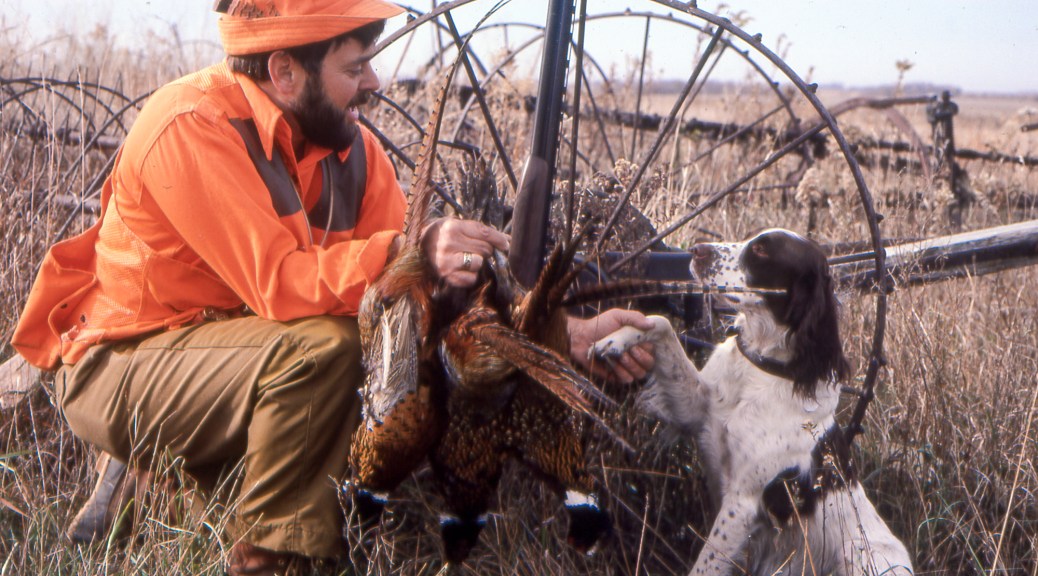
She and I were soul mates. We brought a foolish, prodigious style to the sport we loved. Some of our hunts took on epic qualities that only another dog hunter could appreciate. I filled two books with lessons she taught me about pheasants, and many good stories remain to be told.

Brandy was a bargain. She lived over fourteen years. Every day of her life she gave me unqualified love, loyalty and passionate partnership. I paid something less than a penny a day for that, which maybe makes her the bargain of a lifetime.

Have you ever bought something that turned out to be both a treasured possession and a great bargain?

Lost & Found

Today’s guest post comes from Steve Grooms.

After living 38 years in my Saint Paul bungalow, I decided to move closer to my family.

I spent half a year last winter and spring preparing my home for sale. The job would have been impossible without the help of several people who contribute to this blog site. They helped clean and paint my home. They loaded decades of junk in a pickup and took it to the dump. And they boxed up a few precious things so I could ship them to Portland.

We finally ran out of time. There was still work to be done when my friends said goodbye the last time and turned their attention toward their own homes, their own families and activities for Memorial Day.

That’s when things fell apart for me. The folks who would run the estate sale wanted me out of the home so they could organize the sale. I still needed to box up more stuff and ship most of it to Portland. And I needed to fill my station wagon with a few things I’d drive to my new home.

When my home hit the real estate market I had to keep leaving while groups of potential buyers toured it. Seven groups came through the first day the home was listed for sale. I sat in my station wagon from a discrete spot up the block, waiting for them to leave so I could go back to packing.

I expected it would take from four to six weeks to sell my home. But 30 hours after going on sale I had two parties offering to pay more than my asking price for the home.

That was wonderful, but it meant that instead of having many weeks to pack and leave I had two days! That would have been difficult for someone young and fit. For a senior citizen with health issues the overnight sale of my home created a crisis. On my last day I limped with boxes of stuff between home and my car in a thunderstorm. It was one of the worst days of my life.

Many things I meant to take to Oregon never got packed because I ran out of time. I didn’t realize how severe my losses were until I got to Portland and discovered how many useful or beloved things had failed to make the trip. The box of precious family photos ended up in a landfill in Minnesota. I forgot to bring my warm coat. My favorite Christmas memorabilia didn’t show up after the move.  Molly, my daughter, grieved the loss of the Christmas box, although she understood I had left Minnesota in near panic.

Last Thursday Molly and Liam came over to my new apartment. I mentioned that there was one last box I hadn’t opened after the move. Parked on a high shelf, it was too heavy for me to bring down. From its weight, I guessed the box held books.

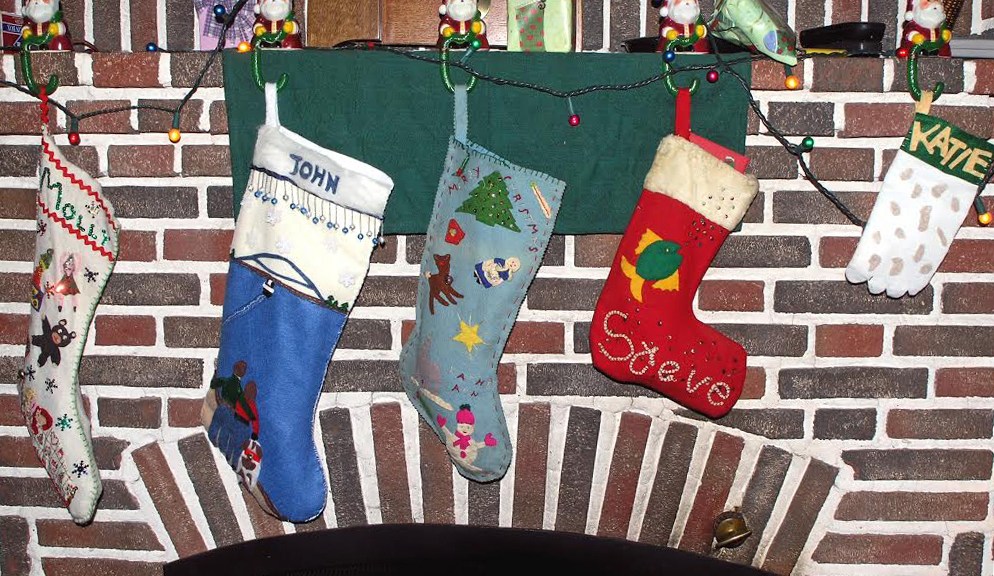
Liam and I were in the living room when Molly called to me in a strangled voice. I rushed to the bedroom. The mystery box was on the bed, flaps open. Molly was holding a Lunds shopping bag that had been packed in May by one of my baboon friends, probably Linda or Barbara. That bag held our old family Christmas stockings. Tears streamed down Molly’s cheeks. She wasn’t able to talk.

The red stocking was made for me by my dad in 1956 when we lived in Iowa. A plump green fish swims near the top of the stocking and exhales a bright spray of sequin bubbles. My name is written below, the letter shaped from red and white pipe cleaners.

My erstwife’s childhood blue stocking was there too. Kathe’s mother sewed this stocking by hand when the family still lived in New York City. She decorated it with a reindeer fawn, a Christmas tree and a little girl dressed for Swedish folk dancing.  Stitched letters proclaim “Merry Christmas Kathe Ann.”

While my former wife was not artistic or crafty, she had a gift for making charming Christmas stockings. There in the Lunds bag was the stocking she made for Molly in 1983. The white stocking sparkles with sequins and carries several iconic Christmas objects: a teddy bear, a dancing girl and a goofy jack-in-the-box. At the bottom of the stocking a six-year-old girl sleeps lies in her bed, her arm thrown over an orange kitten. The little girl is, of course, Molly. We gave the kitten to Molly just before Christmas.

When Molly first saw the exuberant kitten, she said, “Wow, that’s one froshus cat!”  And that is how Froshus got his name.

When she finally could speak through her tears, Molly said, “Nothing else matters. The other stuff you lost doesn’t matter. I didn’t want you to know that it broke my heart to think we’d lost these. And here they are.” The old stockings now hang on Molly’s hearth, waiting to be filled by Santa.

Merry Christmas, baboons.

What precious object would you dread to lose?

Aww, Man, Don’t Say That!

Today’s guest post comes from Steve Grooms.

When I was a grad student I developed a hernia low on my tummy. A hernia is like when a body part meant to be an “innie” decides to poke its head outside and live as an “outie,” creating a tender bulge. Hernias need to be repaired, so for the first time in my life I would need surgery.

When I asked for help at the University of Minnesota Hospital, nurses ushered me into the office of the most famous man at the University, heart transplant surgeon John Najarian. Dr. Najarian promised to fix my hernia. That turned out to be the first in a series of lies told me by my doctors. The University Hospital was a “teaching hospital,” I later learned, meaning Dr. Najarian was probably a dozen feet from me during the actual operation, supervising the cutting and stitching done by a team of wannabe surgeons.

My response to the anxiety of surgery was typical for me. I decided to become the perfect patient. I would respect every directive from my doctors, winning the affection of my doctors with my cheerful compliance.

Exactly the opposite response was chosen by my hospital roommate, a man I’ll call Frank Higby. Frank was a stocky, pug-nosed character from northern Minnesota who had a potentially fatal stomach ailment. Frank talked nonstop, stabbing the air with the cigars he chain-smoked. Cigars were perfectly legal in hospitals of the time.

Frank despised doctors. When told he had to fast before taking an enema, Frank sneaked out of the room in the night, roaming dark hallways until he found the kitchen. He returned with several slices of banana pie and a bag sandwiches. When I asked Frank why he had so much contempt for doctors, he replied that he had been a caddy in Rochester, Minnesota, when he was a kid. “I got to know those sonsabitches when they didn’t know someone was watching them. What a scummy bunch of phonies!”

Nurses told Frank and me that we each had to take three exams: a lung x-ray, a heart exam and a proctoscopic exam. Hospitals in those days were compensated based on how many procedures they performed, so they routinely called for as many tests as they could. When the nurses left the room, Frank rolled his eyes in terror. He said he’d suffered a proctoscopy once before. He called it “the worst experience of my life” and vowed he would rather die than have another. This did nothing to ease my own concerns about the next day.

On the day of our exams, nurses led barefoot Frank away in a skimpy blue hospital gown
that didn’t cover his butt. Although he didn’t look quick, Frank shocked them by breaking free and scooting out of sight in that large building. I learned this from a breathless nurse who came to our room looking for him. After she left, Frank dashed in looking like a cartoon mouse running from a cat. Wheezing heavily, Frank grabbed a phone and called the Pinkerton Detective Agency. He begged them to protect his anus by “sending your eight biggest goons down here.”

Minute by minute, it was growing harder for me to act the perfect patient. About then I had a conference with the man who said he’d be my anesthesiologist. My life would literally be in this man’s hands, so I hoped he would like me.

My anesthesiologist turned out to be a cross-eyed Korean with a thick accent. I tried to bond with him by making good eye contact, but that was difficult because his eyes were cattywampus like the headlights of a car after a front end collision. One eye pointed left and one pointed right. I couldn’t tell which eye I should make contact with.

My anesthesiologist wanted to know what kind of drug trip I wanted to take during the operation. That was unsettling. I thought he was the one who should be telling me how I’d travel through lala land. Instead, he described three different drug trips, giving me more detail about each than I knew how to handle.

Desperate now, I said, “Gee, it is amazing that you know so much about all of these forms of anesthesia! I suppose you have experienced them yourself?”

The cross-eyed Korean drew himself up with offended dignity. “I should say not!” he barked. “I am a Man of Science. I would never expose myself to unnecessary risk!”

When has someone said the wrong thing to you?

Recalculating A Life

Today’s guest post comes from Steve Grooms.

Like Dorothy who was whisked away from drab Kansas to exotic Oz, I daily confront the complications of living in a new and strange land. I keep learning that things I thought were a normal part of the world were actually regional characteristics. For example, Midwest roads and streets are laid out in an orderly grid, crossing each other at 90-degree angles in predictable intervals. As a Flatlander, I took that grid structure for granted. I was amused but also reassured by Minneapolis’s alphabetical street names (Colfax, Dupont, Emerson, Fremont, Girard, Holmes).

That is not the way it is here. Where I now live, land is either Steep Stuff or Valleys. Virtually all development, including roads and streets, is concentrated in the valleys. But because the roads tend to be short and forced into certain angles by the lay of the land, roads and streets cross each other at all kinds of wild angles. What seem to be major roads peter out or wander into oblivion.
This is another way of saying that streets and roads in the West interact in all sorts of crazy ways. And it is another way of saying that it is a challenge to navigate here, especially if you are a Flatland-bred senior citizen.

I would not be capable of driving to my medical clinics or car repair shops or grocery stores or my daughter’s home were it not for the new woman in my life. I am utterly dependent on her to function in this city. Without her help, I would be a confused prisoner of my apartment, incapable of venturing past the gates of this gated community.

This new woman is the voice of my GPS unit. If I have to pick up prescription refills, I type in the address of the pharmacy in my GPS. Then this woman talks me through the trip to that place, turn by turn. She tells me how far I have to go before the next turn, and she counts down the distances with precise and predictable instructions.

I don’t know much about her. She sounds exceptionally sure of herself, and she is perfectly consistent. She isn’t bossy, although she does seem a wee bit put off when I fail to follow her instructions. When she gives me directions but I am impudent enough to do something different, her voice alters slightly and she mutters that she is “recalculating.” Soon she has a new set of directions based on my defiance of her original plan. I would hate to play poker with her, for she knows her own mind totally and betrays little emotion.

I’ve learned how to interpret her instructions. For example, when she tells me I’m two-tenths of a mile from the next turn, I understand that the turn is about two city blocks away. I can’t overstate my dependence on this woman. If someone stole the GPS from my Outback, I couldn’t leave my apartment for days until I got it (or her) replaced.

Who do you trust?

To Sleep, Perchance to Dream

Today’s guest blog comes from Steve Grooms

Dreams have a curious power to move us, convincing us that they are authentic even when they obviously are not. I occasionally wake up smiling and feeling the world is perfect, only to realize that my happiness is based on a pleasant dream, and that dream was pure bunk. As I lie there the euphoria of the dream slowly drains away.

Dream theorists have wildly divergent explanations for dreams. Some believe dreams represent ways the brain incorporates new knowledge. Freud thought dreams were caused by the unconscious (and much of the unconscious was driven by sex). Some modern researchers believe dreams are part of the process by which the brain processes the complexity of life.

One of the latest developments in dream theory is the creation of computerized data banks of vast numbers of dreams. One researcher, for example, has 30,000 dreams in his data base. Having so many dreams to study makes it possible to see patterns that could not be seen with less data.

It turns out that there are common themes in dreams. One of the most ubiquitous storylines is finding one’s self naked in public. Another “favorite” involves taking a test for which one is not prepared. I’ve had both of those dreams. I once dreamed I was returning a borrowed saucepan to my next door neighbor, only to realize that I’d forgotten to put on clothes. And I have had three dreams—nightmares, really—in which I had to take German exams for which I hadn’t studied a bit.

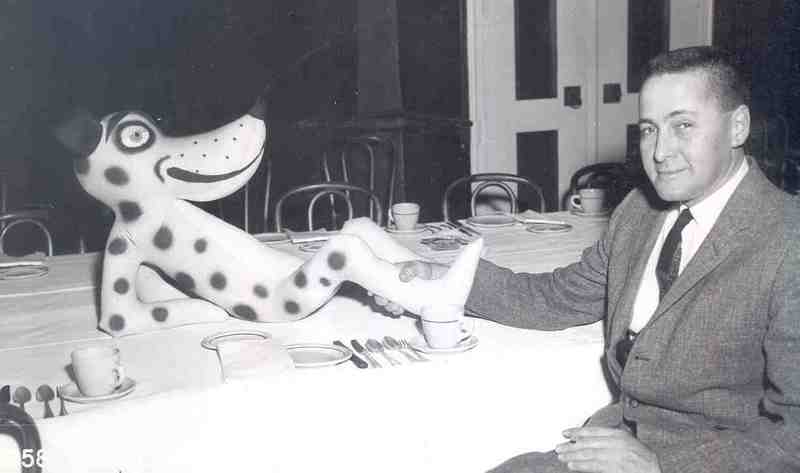
Another common experience, especially among creative people, is solving a puzzle or inventing something in a dream. Musicians have created whole compositions in dreams, compositions they could retrieve upon waking. My father was a stuffed toy designer. His first major success as a designer was a dog that came to him in a dream. “Cheerup” (a sort of silly beagle or basset) made my dad famous.

gvg w cheer-up

People vary in terms of how seriously they regard dreams. My own conclusion is that dreams are entirely whimsical and illogical. Or at least mine are. I once lost a dear friend who regarded dreams as holy truths from another world. When she learned how I saw dreams, she quit speaking to me and the friendship died right there. And I sure goofed when I casually mentioned to my daughter that I’d had a dream in which I had a tryst in a hay loft with elfin Olympics skater, Tara Lipinsky. Molly howled in outrage, “She’s young enough to be your daughter!” I could only sputter, “Molly, it was a dream! I didn’t do anything!” “Daddy,” huffed my daughter, “that is SO inappropriate!” Since then I have judiciously failed to mention several dreams to Molly.

00000magazine cover

My favorite dreams are those in which I can fly. Dreaming of flying is surely second only to the actual experience of being a bird. Have you had such a dream? If so, do you have to flap to get airborne? (I do.)

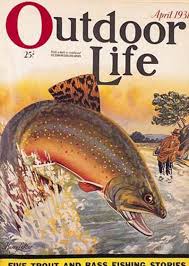
The most wonderful dream I ever had is hard to describe. In that dream I checked out rumors about a sportsman’s club in north-central Minnesota that maintained a trout stream so well that it held trout as mighty as trout routinely were in the early 20th century before Europeans came along to exploit them. In my dream, I visited that club’s lands to see this incredible stream. As I passed through the club house and entered the land the club kept, I realized I had gone through a wrinkle in time. All of our fishing gear was gear that anglers used in the 1920s: long bamboo rods, canvas vests, creels made of woven wicker. And, yes, the stream was filled with huge trout. We had been transported to an earlier time.

The most stunning thing, though, was the look of the dream. Outdoor magazines in the 1920s and 1930s often had covers that loosely reflected Art Nouvea effects, especially that super-saturated wild colors favored by illustrators. And suddenly I realized that this land I was in was actually in the style of Art Nouveau. I was dreaming in an artistic style!

What patterns have you found in your dreams?

A Quiet Family Christmas

Today’s guest post comes from Steve Grooms, and was first offered on Trail Baboon as a comment at the end of the December 25th entry. I thought it was worth re-posting for everyone to enjoy. Steve writes:

The topic of “family” brings up the fact that I’ve been anxious for my daughter. Molly and Liam visited me a year and a half ago, and the trip was stressful. Liam was terrified by the plane and then unable to relax in his new surroundings. Molly got tense about that, and the two of them fed off each other’s fears.That trip was saved by all the toys I borrowed from kind Baboon ladies, and it did end up being a good trip.

Molly and her husband John recently made a difficult decision to fly from Portland to upper Michigan for Christmas with John’s parents. Jack, John’s father, is in perilous health. He has advanced diabetes, and he has recently fallen seven times hard enough to break bones. His most recent fall was last week. Liam and his grandfather have never met. The feeling was it would have to happen this year, or it might never be possible. After the most recent fall, Jack has been confined to a nursing home. Jack would be allowed a brief trip home to meet Liam and open presents.

John’s parents live in an interesting place, in a 100 year old home that overlooks the St. Clair River. Canada is across the river. Huge freighters are always moving through.

Molly wrote to say that Liam was an angel on the flight. And then she described Christmas: What follows is Molly’s letter:

We had a truly magical day. Ice floating down the river, one flow carrying a great big snowy owl, my first ever to see in the wild and absolutely breathtaking. The Kelleys have never seen one either so I feel so lucky.

Freighters ran up and down the river and Liam slept til 11, waking just as Jack arrived home with Nancy and the boys. Jack confided to Jamie yesterday that he feared Liam would be afraid of him. He doesn’t look good these days. I coached Liam to give him a warm welcome and tell him about the freighters he’d seen. Liam immediately did so and it was so wonderful to see him eagerly and sweetly engage Jack all day. He also went out of his way to tell Nancy how nice his air mattress bed is and thank her for all sorts of cookies and kindnesses throughout the day.

Overall, Liam was an absolute delight – opening presents and relishing them, playing on his own quietly for an hour at a time, chasing or being chased by his favorite and much adored uncle around the house, delighting in the two inches of snow that fell throughout the day and shoveling with feverish industry. John, Liam and I walked up to the Port Huron lightship and back in time to watch the Coast Guard cutter, the Hollyhock, undock just feet North of the house and head up into the lake to bring in more buoys.

I went upstairs to rest for an hour, at which point the tree fell over, narrowly missing Liam and John who were putting together a train set. After that excitement things settled down again. Dinner was delicious – Swiss steak followed by cookies and a session of Lego building and listening to KSJN carols.

The whole day was unplanned, unstructured, nothing monumental and no single “Oooohhh Ahhhh” gift. And none needed. It was perfect and so special to experience it with my wonderful child. I am so impressed with his good nature, his delight in others and his flexibility. Taking a page from his book today, I went with the flow, like the ice down the river.

Describe your most memorable Christmas.

Lick Your Wounds

Today’s guest post comes from Steve Grooms.

Let’s imagine that life has beaten you up lately, and now you hurt. Maybe the Powers That Be at your office decided to erase a favorite application off all the hard drives and force you to learn a new one. Maybe someone said something unkind when you were at a vulnerable moment. Or—if you are like me—maybe you said something incredibly stupid, or you sent out a tasteless group email that you desperately would like to suck back now.

Band-Aid_close-up

For many of us, taking one of life’s little blows isn’t a great challenge. But sooner or later you are going to experience a cluster of indignities in a short span of time. Maybe you clash with your teenager and then have a flat tire on the way to work. Maybe you try on last year’s pants and find you can’t even get the zipper up now, as you have supersized your butt, and a day later you learn your taxes are going to be audited.

Just imagine that you are hurting. You need to do something profoundly comforting because you are stuck in a bad place. You need to lick your wounds.

What do you do?

Do you lose your pain by throwing yourself into company, maybe going to a party you’d hoped to avoid because now you know that forcing yourself to be social will fix what is wrong? Do you whip out your phone and call the one person on earth who will never let you down? Or are you more inclined to hide from the world, retreating into a quiet place where you surround yourself with things you trust to bring you peace of mind?

What activity will cure you now? Do you read? If so, what author or book can you trust to make you feel better? (This is a time I often re-read books from favorite authors.) Is there a particular location that will soothe you? What music will you put on, or do you prefer the purity of silence?

I am told that some folks can make themselves feel better if they dress up. Ha! My normal clothing is extremely unstylish. When I feel blue, I’m apt to lower my standards, going from a comfy sweatsuit to an OLD comfy sweatsuit that is so threadbare it would make a stranger worry whether I could afford my next meal.

Perhaps you turn to food if you need to feel better? What food? Something sweet? Something your mom used to cook? How ambitious do you feel when you are repairing a bad mood? Many folks turn to alcohol at such moments, and I don’t need to mention how risky that is!

Some folks know they can wash away a bad mood by soaking in the tub. Others go for a
run or take a long hike in a beautiful place. Some grab a dog and lose their pain by making the dog happy.

A woman friend was prone to depressions. Her cure was to clean her home. When Beth was down she would grab a vacuum cleaner and suck all the dirt out of her environment, running the machine nonstop for several hours at a stretch. If sufficiently disturbed, she would wash everything in her home “larger than a paper clip,” including the walls and the underside of furniture.

What do you do when you need to lick your wounds?

Whaddaya Know?

Today’s guest post comes from Steve Grooms.

During most of my life, I have been trying to acquire the knowledge that would permit me to function as effectively as I want to. I learned years ago how to cook perfectly done hard-boiled eggs, for example. But that knowledge wasn’t original. I learned from others.

My search for knowledge took a strange turn when the internet became so central to how we live. Now it is usually not important to know much at all, if only you know how to tease answers from the internet with cleverly written Google search strings. It is still nice to know things, for you might not even know enough to do a search if you are totally clueless. And yet if you know just a little, you can get the rest from a computer.

It is obvious that we now live in a brave new world where knowing things isn’t all that important if you just know how to acquire knowledge. Are you a rotten speler? Well, all you really need to know is how to spell words well enough that your spell-checker can figure out what you meant to say. As I remember grade school, a lot of precious time was spent memorizing multiplication tables. Now I use my computer’s calculator to handle the most basic math, such as how old am I? Or how about the arcane calculations needed to divide up a luncheon check, with tips? It used to be that only a few people had that skill, and they might get invited to lunch a lot, but most folks can divide a check and figure the tips with apps on their telephones.

In spite of all of that, I think I’m aware of a few—very few—things I know that I learned all on my own and which might not known by anyone else. Unique knowledge. What a strange concept!

Years ago I worked out a technique for keeping celery in my fridge in great eating condition. Celery used to die a revolting death in the fridge before I got around to eating it. No more. (And I’m in such a generous mood, I’ll share this.) You buy a head of celery. It will come in a plastic bag that is shot through with little holes. Chop off some of the messy top material of the head, but then very carefully carve off a small slice at the base of the head (like you would cut the base of a Christmas tree before putting it up in a bucket of water). Tear off two or three paper towels and soak them in water. Wrap the celery head in the wet towels, then pop the whole mess back in that bag full of holes and store it low in the fridge. Within a day your celery will be in better shape than when you bought it, and you might be able to keep it this crisp and tasty for a week or so.

I made several original discoveries when I spent so much time reflecting on pheasants. Depending on how you count, I have written about pheasants in four books. Much of what I said had been written by someone else somewhere else . . . much, but not all of it.

One of the issues I pondered is the difficulty of getting a good closeup photo of a wild rooster. You might think with telephoto lenses this would be easy, but it is quite the opposite. Pheasants are shy. They live in dense cover that obscures them. It is all but impossible to get their portrait.

And yet some photographers do it, and I finally figured out how. In spring the vegetation isn’t as thick in pheasant country as it is in fall. Roosters gather harems of hens, and part of that process is that they strike showy poses to impress their hens. A springtime rooster might sit in the open trying to look magnificent, even with a human photographer nearby snapping photos of this.

And yet there is a problem. A springtime rooster putting himself on display will be so horny that the naked facial tissue around his eyes be engorged and exaggerated. That is, his face looks nothing at all like it will look in fall when people hunt him. I finally realized that every gorgeous closeup portrait of a rooster I had seen was a photo obviously taken in spring. I made the mistake of noting this and then sassing all those photos of springtime roosters.

roostercover_2

I got my just deserts. When I revised my first pheasant book, the publisher was proud to find a great photo of a rooster that could go on the cover. You already know what it looked like. It was a spring rooster with engorged wattles that was on full sexual display. I begged the publisher to not use a photo I had mocked in my last pheasant book, but they were determined to stick with the photo they had picked.

Do you know something that nobody else knows?

Choosing Toilet Paper With Old Grudges

Today’s guest blog comes from Steve.

I look silly, actually. Every time I go to buy paper towels or toilet paper I stand in the supermarket aisle in confusion, staring at the brands.

“Okay, so who makes ‘Viva’? Kimberley Clark, it says here. But do I hate Kimberley Clark? Or is it Scott Paper I hate?”

Toiletpapier

Sooner or later I remember that I hate Scott Paper. In the early 1980s, Scott took a belligerent stand in defiance of federal pollution controls on paper plants. Scott went on my “corporate bad guys” list, and I stopped buying Scott Paper products. There is no reason for me to bury that old grudge now, for I have alternatives. I’m sure Scott Paper has fretted about their curiously lame sales in the Mac-Groveland area. Ha! I hope they understand that putting profits ahead of the environment caused me to boycott them.

The first time I boycotted a product because of higher values it was mighty easy. That first boycott happened was when progressives all over the country learned we should not buy grapes. In the late 1960s, migrant workers toiled in appalling conditions to harvest agricultural products. Cesar Chavez, a farm labor leader, eventually organized a nationwide boycott of grapes. My participation in the boycott didn’t bring the grape farm industry to its knees because I never bought grapes before the strike. Still, I felt virtuous as I bypassed grapes in my grocery store. And the good guys won that one.

Buying gas is more challenging. I used to buy all my gas with an Amoco credit card. Standard Oil was famous for placing gas stations on choice intersections with high traffic, so if you had a Standard Oil credit card you were never far from a gas station when your fuel meter was close to “Empty.” Because I traveled widely in unknown country when I was a freelance writer, it meant a lot to me that I could easily find gas when I needed it.

Then in March of 1989, the Exxon Valdez clobbered Bligh Reef in Prince William Sound. Legend has it that Captain Joe Hazelwood was sleeping off a bender at the time, but the truth is that the ship’s radar was broken and had not functioned for over a year. Crude oil flooded the Sound. The deadly toll on salmon, otters, water birds and seals was a ghastly spectacle on the evening news for months afterward.

I haven’t bought a drop of Amoco gas since that day. After drifting from brand to brand, I determined to buy my gas from a new company with a clean record. This company even featured a green corporate logo. My new gas supplier became BP. And you all know how that turned out.

I was anguished in 2010 when Target betrayed me. I had respected Target because it reinvests corporate profits in the local community. As someone who has worked for wolves, I appreciate Target’s contributions to the International Wolf Center. Everybody has to fill grocery carts with cheap stuff now and then, so we might as well buy it from a corporation that gives back to its local community.

Then we all learned, during the gubernatorial election of 2010, that Target’s corporate office donated money to a group that passed it on to Tom Emmer, a hard-right conservative and staunch opponent of gay rights. That was a dagger to my heart. Where was I supposed to buy cheap crap? K-Mart, the destroyer of small town America? K-Mart, the corporate abuser of employee rights? I just couldn’t!

Ultimately, I fear my values-based boycotts are foolish and self-indulgent. It is hard to find large corporations that behave well enough that they actually deserve our support. If we think a mega corporation is a good citizen, we probably haven’t done our homework. How many of us do our banking with companies that didn’t betray normal banking values a decade ago? Still, I cannot escape the compulsion to drag social ethics into my consumerism.

What do you boycott or support with your purchases?

Rainbow TV

Today’s guest post comes from Steve Grooms

It is fun and instructive to consider the social messages hidden in TV commercials. The people who make commercials concentrate so hard on making the big sell that they often send other messages that are more interesting than the main one.

color-bars_large

In earlier discussions here on the Trail we noted that it now seems that men are fair game in ads, often being depicted as buffoons. Women are usually presented as wise and adult. That, of course, is a total switch from the way gender was presented in the earlier days of television. Women then were shown as silly, empty-headed shoppers whom their husbands tolerated because they were attractive.

I easily remember when African-Americans never appeared in commercials. When that became controversial in the 1970s, blacks began showing up in ads, especially if the ad featured several white faces with maybe one dark one among them. Happily enough, over the years blacks have appeared in so many commercials that I think few audience members pay any attention to blacks in ads now.

I was puzzled the other day when I noticed that relatively few Hispanics are shown in commercials. That seems odd, particularly in view of how politically important that demographic has become. Then I remembered that Hispanics have many Spanish language channels. Madison Avenue must feel that is where Hispanic actors should be prominent in commercials.

The issue that has intrigued me most is the still-touchy area of interracial dating. I have carefully watched commercials, hoping to spot the first one to show romantic partners of mixed races. To my surprise, in one week earlier this year I saw interracial relationships featured in two prominent commercials. Both are still running.

The first one that I noticed was a State Farm commercial that showed an Asian man partnered with a light-skinned African-American woman. And indeed, they have a child in a stroller. This is the ad where a mime tells the couple about a great Sate Farm policy. The infant in the stroller says, “Am I the only one here who finds it weird that the mime is talking? Freaky!”

http://www.youtube.com/watch?v=kAPxKiKlBUA

Just days after seeing that commercial I saw a romantic, impressionistic commercial for Apple iPhones with cameras. That ad has many quick cuts, one of which presents an attractive young couple posing for a photo together. A Caucasian male is apparently dating a light-skinned African-American woman. Apple has a similar ad running now with a couple that very well could be biracial, but both young people are so Goth in appearance that nobody could say what races they represent! You have to look fast – it’s at the :46 second mark.

http://youtu.be/NoVW62mwSQQ

It was fun to see two commercials that were not afraid to show relationships crossing
racial lines, but I told myself that I would probably not live long enough to see a commercial with a black man married to a white woman. That flaunts the most potent racial taboo of all.

http://youtu.be/kYofm5d5Xdw

Well, I was wrong. There is a commercial now running for Cheerios in which a white woman is in a relationship with a black man, and they have a child. The ad cleverly pulls its punch by not showing the black guy and white woman in the frame at the same time, but that did not save it from controversy.

That ad by Minnesota’s own General Mills has ignited a firestorm of bigotry.

In spite of the controversy, General Mills defends the ad and continues to run it. I wonder how long it will be before this controversy seems odd to us all. And I wonder how many years it will be before we see a gay couple in a commercial.

Have you seen something interesting in a television commercial lately?