All posts by Minnesota Steve

Gimpy old guy who loved Minnesota and yet left to live closer to his daughter and grandson. I enjoyed three mild winters in Oregon, then we all moved to Michigan. After two years there, I'm back in St. Paul. This is my fourth home in six years. I don't figure on moving again.

Two Old Sails

Today’s guest post was written by Steve in St. Paul.

The wind was gusting between 30 and 40 miles an hour. That didn’t bother me, sitting in my van at the stoplight, but it threatened to blow away the two old women struggling to cross the street ahead of me. They were spinning about and clutching each other in panic as gusts of wind sent them this way and that.

I lowered my window and yelled, “Do you ladies need a ride?”

Without a moment’s hesitation, they began struggling toward the car. They barely had the strength to open the van’s doors against the force of the wind.
Once inside, both ladies giggled uncontrollably like a pair of drunks. They couldn’t believe how helpless they had been against the wind.

“Can you take us all the way to Snyders?” asked the one in the front seat.” We need to renew our medications.”
“Sure,” I said. “That’s just a bit downwind. If you’d just held your skirts open, you would have blown to Snyders in seconds.”
“Well bless you young man, you saved two old nuns,” said the one in front.
“You were just about to become two old sails,” I said.

Wind_Nuns

We were at Snyders by then.

“I’ll give you a ride home when you’re done,” I offered.
“That would be wonderful,” they chimed.

When I returned, the nuns struggled again to get in the car. They were still laughing merrily.

“We really appreciate this,” said one. “Sister Elizabeth is 87 and I’m Sister Constance Marie. I’m 83.”
“You need to pork up if you’re gonna walk in this kind of weather,” I said. “Unless you each put on couple dozen pounds or so, you are going to blow to Wisconsin.”
“I believe God sent you,” said Sister Elizabeth.
“Then God has a sense of humor,” I said. “God should have sent you a sweet Catholic boy instead of a chubby old atheist.”

Giggling like schoolgirls, they gave me directions to their nunnery.

“You might not believe in God, but you obviously have him in your heart,” said Sister Constance Marie.
“It would be nice to think I’ve got God somewhere in me. Based on the rules, the way I understand them, I’m not a candidate for getting into Heaven. I need to start piling up good deeds or I’ll be let there on the outside, pounding my fists on the door and whimpering.”
“Oh, I don’t believe that,” said Sister Elizabeth.
“Anyway,” said Sister Constance Marie, “you helped two nuns. That counts twice as much.”
“And you helped us two times,” said Sister Constance Marie. “That’s the equivalent of helping four nuns.”
“And we would have had to change busses,” said Sister Elizabeth, “so as far as I’m concerned you get credit for six good deeds today.”
“Well, let’s hope the Great Scorekeeper is as generous as you are. If I gave rides to nuns every day for the rest of my life, I’m not sure I’d balance out the naughty stuff I’ve done. But I’ll settle for a six-nun day. That’s a good start.”

The nuns were still laughing gaily as they struggled toward the front door of their residence, holding each other for support as the wind buffeted them about.

Have you ever done a favor for a stranger?

What Will I Be When I Grow Up?

Today’s guest post comes from Steve Grooms.

When I was a kid I felt a breezy, uninformed optimism about the process of growing up. I assumed it would flow naturally, evenly, always moving toward a higher state of consciousness. I assumed that I would experience some tricky teen years and maybe endure challenges in my 20s. But I took it for granted that I’d be all grown up by 30 or (worst case scenario) 35. Then I’d have four or five decades to enjoy being a grownup before the little candle of my soul was snuffed out.

That optimism began to wear thin when I hit my 30s and still felt like a work in progress. I feared there was something wrong with me in my 40s because I still pursued maturity like a greyhound chasing a tin bunny, never catching it . . . hell, never getting near it!

Which one is the most mature?

Becoming a parent while I was still flagrantly immature was interesting. When you have a kid, you sometimes have to act like a grownup. I often felt like a fraud at such moments. I wanted to sneak out to the apron of the stage and confess to the audience, “I’m not really an adult, but I gotta play one from time to time.”

Somewhere along the line I sensed I wasn’t the only one still trying to grow up at 40, 50 or 60. One of my best friends is about twenty years older than I, and she routinely experiences breakthroughs in personal growth as she pushes 90. I now understand that most people continue to grow and mature as long as they breathe air. Some of that feels good and some of it stinks, but it seems to be one of the unavoidable realities of life.

I might be more aware of this than most folks, for my life blew up in my face when I was 57, and I suddenly didn’t have any idea of who I was or what I would do when I grew up. I “got” to experience my teen years all over when I was actually in my AARP years, with all the terrors and bizarre rewards of dating. I was plunged into a crash course in self-discovery. It has been fascinating and often harrowing.

Because of this blog piece, I’ve been contemplating changes that I’ve made lately. Without going into tedious detail, I believe I’m much more humble. I’ve always had strong opinions and no shortage of them. Most of my life I was “humble” in the sense of not arrogantly spouting off with my excellent opinions. I now understand that my opinions are often based on crummy data, lazy analysis and wishful thinking. Where I used to act humble, I now am humble because I know many of my pet convictions are just crap. I am doing a better job of keeping quiet when I see people doing dumb things. If they want my wisdom, they can always ask for it. I listen better now.

I continue to be curious about what I will be like when I grow up . . . if I ever do, which seems mighty unlikely after all these years!

What does it mean to be ‘grown up’, and how can you tell when you get there?

How Do You Define a Minnesotan?

Today’s guest post comes from Steve Grooms.

I’ve been a Minnesotan for over half a century. During much of that time if I told a person from elsewhere where I lived, that person would struggle to remember something–anything–about my home state. After an awkward silence, the nearly invariable response was: “Minnesota? Gets cold there, doesn’t it?”

So no wonder I feel grateful for Garrison Keillor. In 38 years of Prairie Home Companion broadcasts, Keillor has rescued Minnesota from anonymity and gone a long way toward defining the Minnesota culture. Although Howard Mohr wrote How to Speak Minnesotan, I think of Garrison as the godfather of that book, having created the awareness of Minnesota culture that permeates Mohr’s book.

The issue of Minnesota culture comes to mind now that the State Fair is over and we begin to feel its absence. Any list of the qualities that define a Minnesotan should start with our fascination—our obsession, really—with this fair. Other states have fairs. The mighty state of Texas has one that runs 24 days, and yet the Minnesota fair beats it in total attendance. No state is quite as proud of its fair as Minnesotans are of ours.

If you didn’t get to The Fair this year, I suspect you are feeling a sense of loss. Possibly even something closer to failure. Nothing defines Minnesotans quite like the obligations we assume.

A less appealing side to the Minnesota personality is our smugness. Minnesotans are too modest to brag, and yet if you scratch them you don’t go very deep before finding the conviction that the Midwest is the most wholesome part of the nation and Minnesota is the best state in the Midwest. By quite a bit!

The most complicated topic in Minnesota is our relationship to weather. We pay more attention to weather and talk about it more than folks anywhere, and yet our attitudes are so complex they almost defy explication. We have, for example, a love-hate relationship with winter that is uniquely Minnesotan.

This blog post itself, in fact, is very Minnesotan.

We are fascinated by our own culture and all the ways we differ from other areas. But the more we Minnesotans talk, the less interesting we seem. I liked this topic a lot when I started with it, then I grew increasingly unhappy, and now I’m wondering why anyone would read all the way to the end, which you almost have.

Maybe you’re still going because you’d feel a little guilty about quitting early? Don’t want to hurt my feelings, even though I would never know the difference?

How very Minnesotan of you.

How do you define a Minnesotan?

Nothing We Do For Children is Ever Wasted

Today’s guest post is by Steve Grooms

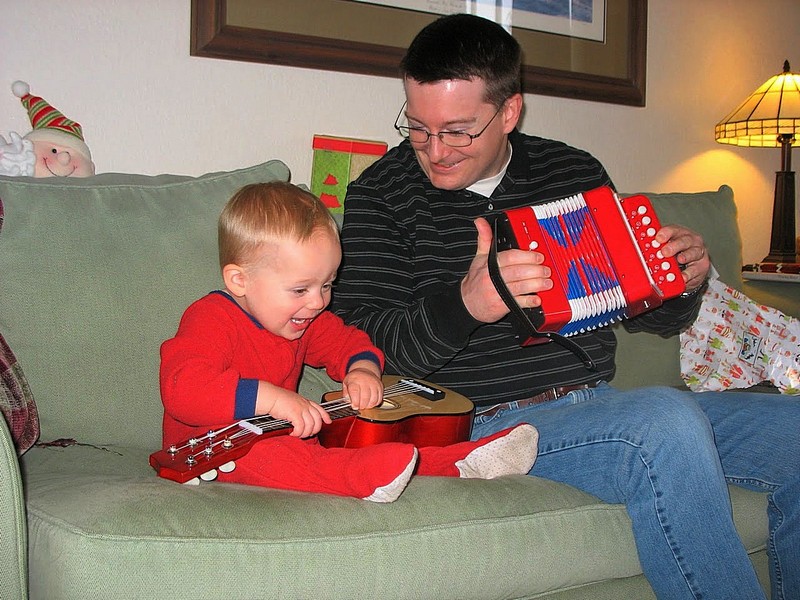
I just received an email letter from my daughter. Molly lives in Portland with husband John and Liam, the world’s coolest grandson.

Hi Mom and Dad,

It seems we spend much of our parenthood trying to recreate the joys we ourselves experienced as children. I can’t tell you how many times I’ve had high hopes for some outing, only to feel like it’s just not quite enough in Liam’s eyes. With that background context, I want to share that I’m so touched by the impression our local Highland Games made on him. As a child, I adored the Macalester Scottish Country Fair, going with you and with friends year after year. I was therefore disappointed when we took Liam to our local Highland Games. Honestly, they don’t measure up in my eyes to those I remember from my early years. The biggest hit from the visit for Liam appeared to be the bus ride to and from the parking lot.

Molly and Steve go fishing

Imagine my delight when day after day following the games Liam requested “bagpiker music” and danced in a fair approximation of the Scottish Highland Sword Dance. Many of his imaginative outings now involve, “going to the Highland Games to see the bagpikers.” We brought up some pipers and drums on my internet radio last night. Liam marched around the house with a small tambourine and his drumsticks, playing his own salsa version of “Amazing Grace” and “Scotland the Brave.”

Liam and dad John have a jam session

I share this because every time some reference to the Games comes up (which is almost daily) I miss you both keenly and feel I should express how much I appreciate all you did for me back then. Even if I was too little to know or appreciate it and even if I was in a sour mood, I believe I am a better mother because I was exposed to so many things that were important to the two of you. I am a better person for having a wide range of interests and an active love of new things and adventure. I commit to raising Liam–whether he appreciates it at the time or not–similarly.

I love and miss you both, Molly

Anyone who knows me will already know that this letter had me grabbing for the tissue box!

What shared family activities did you most appreciate as a child, and what childhood memories are you helping to create today?

One Of A Kind

Today’s guest post comes from Steve Grooms.

My home is unusual in several ways, starting with the fireplace. It is so ugly that I have often thought about replacing or remodeling it. My home is feminine, with soft curves everywhere: in the roof, in the sidewalks, in the round-top front door, and elsewhere. But in a home where everything is Marilyn Monroe curvy, the fireplace is straight as a ruler. Most fireplaces are wide at the base and then they taper gracefully above the mantel. My fireplace is a straight column, like a big tombstone. Most fireplaces have some kind of mantel for visual relief, but not mine. It is just a big pile of bricks.

According to legend, the fireplace was designed by the architect of the home, Joe Lutz, a man who designed this house for his own family. Joe was a bricklayer as well as an architect, and very proud of it. I’ve been told that Joe sat cross-legged for almost a day on the living room floor, fiddling with bricks to design the fireplace. There are six ways bricks can be combined in construction—six and not five or seven. Joe Lutz finally created a design that would combine all six of those bricklaying techniques. So my fireplace isn’t just a fireplace; it is a showcase of the bricklayer’s art.

Because of its history, I’ll never change the fireplace. It meant a lot to the man who designed my home, and I’m compelled to respect his intentions. I am only the current custodian of this home, and the only appropriate program for me is to be humble about making big changes in the place. The fireplace has rights that are greater than my rights.

And it is one of a kind. I’ve got the only one like it in the world.

US Highway 2 cuts across northern Wisconsin, running east and west. It’s a famous road. Not famous is the tiny town of Oulu, which lies just north of US 2. If you want to go to Oulu, you drive a bit east of Brule to Oulu Rock and follow the big blue arrow on it to Oulu.
Oulu was created and is mostly inhabited by folks of Finnish ancestry. They have names like Aho, Lampinen, Kohlemeinen, Reinikainen and so forth. The town doesn’t have much going for it. Its one unusual feature is a glass-blowing gallery. Other than that, Oulu is another tiny unincorporated Wisconsin town just like a thousand other such tiny towns.

And yet there is one other distinctive thing, something in which Oulu’s residents take great pride: the Oulu Rock.
A very long time ago, people needed a way to spot that little road that runs north from Highway 2 to Oulu. Citizens of Oulu placed a large rock at the intersection and painted the rock white and blue, the colors of the Finnish flag. And they painted “Oulu” in large letters, with an arrow to point the way.

Not long ago, the Wisconsin Highway Department informed the folks of Oulu that their rock had to go. Highway design specifications require the erection of a standard highway sign to point the way to Oulu.
The highway bureaucrats were unprepared for the ferocity of Oulu’s response. They didn’t want no frickin’ highway sign and they didn’t need one because they already had a frickin’ rock. Almost nobody ever wants to go to Oulu, to tell the truth, and if they do want to go they probably know the way already! The Finns of Oulu told the highway department folks just where they could stick their standard highway sign.

The highway department countered with all the predictable arguments. They argued for the virtues of standardization. They said a reflective sign would be easier to read than a rock. They said they operated under mandates from the legislature and didn’t have the power to make an exception like this. They said The Law demanded that Oulu accept a highway sign. End of argument.
Cynics say you can’t beat city hall, but Oulu beat the Wisconsin Highway Department. Civic pride and Finnish obstinacy crushed the bureaucrats and their boring laws. When Highway 2 was widened recently, the Wisconsin Highway Department even helped move the rock a few feet north. And it is there today, proudly pointing the way to Oulu.

No other town in Wisconsin has what Oulu has. There are a thousand unincorporated villages in the state, but only Oulu has a highway rock. It is one of a kind.

What have you encountered that is absolutely original . . . one of a kind?

Ah Yes, I Remember It Well

Today’s guest post comes from Steve Grooms

My artistic friend Sue has no difficulty describing the earliest memory of her life. Sue remembers looking through the bars of her crib at flowers on the bedroom wall. The wallpaper flowers were “funny,” she recalls–lumpy things with ugly colors. Such deformed flowers could only be somebody’s idea of a joke, and Sue laughed out loud. She had seen real flowers, so elegantly formed and suffused with vivid color, while these ugly blobs were nothing like that. By working with old photos and family lore, Sue has dated that memory to a time she was two or three years old.

Some folks simply cannot retrieve early memories. A friend once told me he has no memory—no memory whatsoever—of anything before his last years of high school. I find that spooky. Most people remember events from when they were four or five. One of my friends insists she has a clear memory from when she was two. I’m skeptical, and yet I don’t rule it out. Scientists tell us that children have memories from their earliest years, but as they age children lose those first memories, replacing them with later ones.

When my daughter Molly was a toddler, her daycare mom, Julie, talked with her about a woman who lived nearby. Julie once took her daycare class to visit that neighbor, and she mentioned this when Molly was about three. “I know,” said tiny Molly. “Her dog is Samson.” Julie was gobsmacked. When Julie took Molly to the neighbor’s, Molly was an infant, so young she hadn’t begun talking, and yet she remembered Samson. Molly no longer has that memory.

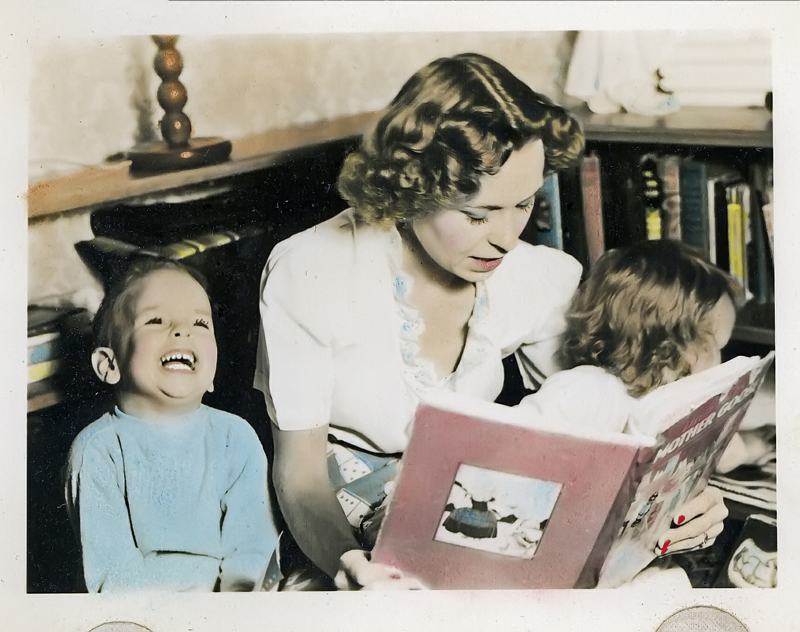
My earliest memory was set in the upper half of an old duplex in Manchester, Iowa,where my mother, my sister and I lived during WW II.

The duplex where Steve’s family lived during the war – the scene of the very first memory
I was two or three years old at the time, most likely three. My mother was using a metal key to wind the strange little cuckoo clock in our living room. The clock had a pendulum and a fat painted bluebird that wagged left and right.

“Where’s Daddy?”
“He’s at The War, Stevie. Daddy is a soldier and he is at The War.”
“Why doesn’t he come home?”
“He has to be a soldier now.”
“I miss my Daddy.”
“He’ll be home after The War.”
”But when?”

This is the exact spot along the Maquoqueta River where Steve caught his first fish.

That memory surely predates my recollection of catching my first fish. My father is part of this memory, so he must have been on leave or (more likely) this happened in 1945, shortly after he came home from Japan. Our family was enjoying a summer day in Tirrill Park in Manchester. The park is bordered on the west side by the Maquoqueta River. My father set me up with a fishing rod, baiting my hook with a worm. Against his repeated instructions, I walked up and down the bank rather than sticking to one spot. Then I caught a fish, a white crappie. Several years ago I returned to Tirrill Park while researching the book I was writing about my parents. With no effort I walked to the spot where I caught the crappie.

It is harder to describe the time my grandfather bought me a “drumstick” (one of those ice cream novelties). I was four at the time. I had eaten a drumstick before, but only one. Drumsticks, like most nice things in life, seemed to my child’s mind like magical and random events. When my grandfather bought that drumstick I suddenly realized that drumsticks were a normal part of the world; you could have one at almost any time if you had money. Life was more orderly and predictable than I had understood. Joy was repeatable, at least potentially.

My only clear memory of kindergarten took place on the first day of school. I was five. Toward the middle of the day Miss Carlson ordered the kids to take a nap. I rolled out my rug next to the rug on which Susie Stoever was trying to sleep. Perhaps I should mention that Susie was a blond cutie with a pug nose. I stretched out on my rug, my head near Susie’s face. Disgusted, Susie swapped ends so her feet were at my head. I switched so we were again head-to-head. We repeated that sequence several times before Miss Carlson dragged me off to the cloak room, that gloomy overgrown closet where we stored our coats and galoshes. And there I napped alone. On my first day of school I was busted for sexual harassment!

Some of my early memories have ideas or discoveries attached to them. When I was in first grade, a kid in my class named Andy Williams (same name, but not the singer) stood before the class to deliver a report. Up on the wall above Andy was a picture of our president: Harry S. Truman. Sitting in my seat (on the far right hand side of the class, three rows from the front) I suddenly realized that that was Andy up there talking, not me. “Hey, that’s Andy! That is not me! He is Andy and I am Steve. HE has to give a report and I do not!” It was my discovery of how each human being has a separate consciousness and a separate experience of life. I leaned back with a smile as Andy quavered his way through his report.

This last memory is my favorite, and it too is hitched to an epiphany. On a rainy spring night, I was in my crib in the little bedroom that my sister and I shared in the years right after the war. I was four or five. As cars moved north along Carroll Street, their headlights shone through our cottage’s picture window and made a spot on my bedroom walls. While the cars were distant that spot would move slowly, but as the cars passed us the light would suddenly whip around the bedroom walls with startling speed. Similarly, the tires of the passing cars hissed as they rolled along the rainy street. That hissing became louder as the cars got near us and then reached a crescendo of Doppler Effect just as the autos went by us and the light spot was zipping around. I clutched the bars of my crib and gloried in this show of light and sibilant sound. “This is beautiful!” I thought. And then I thought, “There is such a thing as beauty.”

Do you have any favorite memories from early in your life?

Let Them Talk

Today’s guest post comes from Steve.

When my daughter graduated from college with no job prospects, she decided that living in a nice place could be a good a start on her new life. The job would come in time. A college friend, Jessie, had parents in Portland who bought a brand new apartment for Jessie in a nice neighborhood. If Molly could pay her share of the rent, which was quite affordable, the two young women would not need to settle for one of those falling-apart roach-infested apartments that are so much fun to talk about twenty years later. They took the deal.

Things went reasonably well. The two young women dealt with the usual roommate annoyances for three years. Then Jessie announced she was fed up with cohabitation and wanted her own apartment. Molly wasn’t sorry. Jess was more self-centered than a “Seinfeld” character.

Molly helped Jessie lug her heavy stuff into the moving van. A surprise visitor during this process was Louise. Louise was the neighbor who was forever complaining about little neighborhood housing code violations. If someone left a car on the street three days without moving it, Louise was sure to call and complain. If someone failed to observe recycling protocols strictly, Louise would blow the whistle on them. Louise was the neighborhood snoop and the outspoken voice of its conscience. She had fierce opinions about right and wrong, and she wasn’t shy about expressing them.

Molly was sweating like a pig as she wrestled Jessie’s dresser into the van while Louise watched. Louise cooed, “We are all SO sorry to lose you and Jessie!” Molly decided to pretend she believed that. Then Louise added, “We all thought you and Jessie were such a cute couple!”

Molly groaned inwardly. Louise (and she probably wasn’t the only one) had decided that two pudgy single women living together with no boyfriends hanging about were a lesbian couple. Molly felt insulted by that, although that was embarrassing to her since she has nothing against lesbians. And after all, what could she say? “Aww, hell!” thought Molly, “It’s just Louise!”

What Molly finally did say was, “Well, I guess there comes a time when you have to recognize that the end has come to something, even something nice.”

Jessie moved. Molly, who could not afford the whole rent herself, moved into a new apartment.

Molly got her romantic hopes up when, months later, a new young man came to work at her firm. Brian was as gorgeous as a male model. “He’s so handsome,” Molly thought, “he has to be gay!” And, alas, he was. Brian was the gayest man she had ever met.

That didn’t prevent a great friendship. Brian enjoyed Molly’s sense of humor, and she liked his company. He began dropping by her apartment after work and staying overnight. Brian took delight in introducing Molly to some aspects of gay culture in Portland. Brian called Molly his “fag hag.” He said that term referred to a woman who was a trusted friend of a gay man. When he took Molly to a club in a seedy part of town, a club where men danced provocatively and threw off all their clothes, both Brian and Molly had something to watch that appealed to them.

Some people simply do not function before their first cup of coffee in the morning. Early in the morning Brian was comatose, shuffling about like a zombie, incapable of speech. On those occasions when Brian slept on Molly’s sofa, the next morning she would drive them to work, stopping first at the local Starbucks shop.

That was where they were one summer morning. Brian, quite apart from not talking, wasn’t even making much of an effort to stand up. He was draped all over Molly, letting her keep them both upright as they waited in line to place their orders.

And then Molly saw Louise standing a few feet away . . . Louise from her old neighborhood. Louise had a look of utter horror on her face.

”Oh, great!” thought Molly. “Now Louise knows why the cute lesbian couple broke up. She has figured out that Brian is my new boyfriend. Louise has to be thinking that I was cheating on Jessie with this hunky young man, and that caused us to break up. I could explain things to her. I could tell her that Jessie and I are not gay. I could say we were never a couple. I could tell Louise that I wasn’t betraying Jess with Brian because, well, Brian is the gayest man in Portland. I could . . . awww, hell, it’s just Louise!”

Molly waved to Louise but didn’t speak.

Have you ever let a misunderstanding … stand?

Teaching My Daughter to be Cynical

Today’s guest post comes from Steve Grooms

It should not have surprised me. When my daughter Molly began to talk, she started telling her mother and me the same things we were always telling her. Kathe and I talked to Molly almost nonstop, and much of the time we were explaining the world to her.
I should have expected that Molly would begin explaining the world to us.

“All these lights along the road?” Molly would say, her voice rising as if to form a question. “They put them there so the cars don’t bump each other in the dark.”

One day Molly spotted a poster of Garrison Keillor—Garrison with his distinctive face and beard. “When you see a face that looks like that,” Molly said to me in a helpful tone, “then you know that it is Garrison.”

We took Molly to a Lebanese restaurant one night. She was silent, her eyes wide as she took in the novelty of a restaurant that didn’t serve American food. She finally said, “It is a good thing they have this restaurant. All the people fighting the war . . . when they get tired they can come here and have their own kind of food.” Molly was responding to the fact that every night’s TV newscast featured film of civil war in Lebanon.

While explaining the universe to us, Molly almost always added her stamp of approval. She described the world as a place that was laid out in a pleasant and logical way. “They always put the cookies in the same place in the grocery store so kids and parents can find them.”

I used to reflect on the word she used so often: “they.” “They” made sure that water came out of our taps—hot and cold—when we twisted the handles. “They” put Christmas lights up at our shopping center. “They” made our world, and Molly appreciated their work. Beaming with contentment, my daughter savored the comfortable life that “they” had created for just for us.

This delighted me for years. Then I began to worry.

Yes, “they” had created a world that served our needs and delighted our senses. But “they” were not to be trusted. Sometimes “they” did things for selfish or even evil motives. Sometimes they lied. Molly needed to temper her pure trust in them. My sweet daughter needed an injection of cynicism.

Perhaps only another Midwestern parent would understand what this cost me. I adored my daughter’s unalloyed trust in her environment. Something in me balked at introducing her to the venality of human nature. And yet it had to be done. Without an appreciation of how deceptive others could be, my daughter would be vulnerable to manipulation. I had to teach a trusting child to be cynical, at least a little bit.

But how? I chose to introduce my daughter to cynicism by picking on a fat target: children’s commercial television.

One day when we were watching a cartoon show sponsored by a line of toys, I told Molly that people who wanted to sell stuff created commercials that made the toys look better than they are. “That truck probably broke right after they filmed that commercial,” I said. I showed her how tricks in film technique made the toys seem more dramatic than they were.

Molly was aghast. But she soon got in the spirit of things. When we saw other commercials, she would seek my approval by suggesting ways the sponsors might be lying to us. She began finding fault with what “they” were doing.

One morning when she was about six I went into Molly’s bedroom wake her up to face another day at school. My daughter lay on her back, eyes closed, arms splayed out like Jesus on the cross. When I rubbed her tiny chest, she spoke in a sleepy mumble. From the corner of her room the clock radio was blaring morning news.

“Daddy? What is the very best thing for you when you get up in the morning?”

Like any sensible parent, I was terrified by that question. She had been thinking about some issue and had a very particular concern. I wanted to be careful with the answer to this question, for this was not a harmless random question.

“Why, Molly,” I finally said, “the very best thing about getting up in the morning is that I get to see you and Kathe again.”

“Oh, they lie! THEY LIE!” said Molly, eyes still closed. “That just shows how they lie. On the radio they just said, ‘The best part of getting up is Folger’s in your cup!’”

What is the best part of getting up?

Confirmed Rebel

Today’s guest post comes from Steve.

I’m not sure why my parents sent me to confirmation classes. Ours was not a very religious family. While my parents rarely felt moved to attend church services themselves, they had a fuzzy notion that it would be good for my sister and me to go, and so they sent us.

I have vivid memories of all the ways I conspired to avoid going to church. I learned to fake a fever (if you spin a thermometer fast enough in your mouth, the temperature goes up). I would always lie in bed deep into Sunday morning, hoping my mother would forget me, emerging when it was too late for her to order me to church.

My best ploy involved my “Sunday go to meeting pants,” the formal trousers that I only wore to church. One day my grandmother gave me a discarded library dictionary, a musty, leather-bound monster so heavy I barely could pick it up with two arms. I arranged my Sunday pants in a pile on top of the radiator in my room and put the dictionary on them. If Mom ever caught me on a Sunday morning and insisted that I go to church, I’d disappear into my room and come out with pants so horribly wrinkled that no homeless guy would wear them. “Look, Mom!” I’d cry, my voice ringing with disappointment, “I can’t go to church in THESE!” My mother purely hated ironing. This gimmick always worked.

But I didn’t need to dress up for Confirmation Class, so the pants couldn’t save me. I think I was 14 the year they taught that class. That was a bad time, a time when I was convinced I was one of life’s big losers. Since I didn’t think much of myself I could hardly expect anyone else to respect me. Worse, I was beginning to resent what seemed like arbitrary edicts from my parents. I’d always been a sweet and compliant child—you could call me a disgusting little apple polisher around all authority—but now I was beginning to see the world with my own eyes.

Confirmation class was not intellectually demanding, and I didn’t mind it much. We mostly chased each other around the big old brick church in noisy games of tag. When the teachers caught us and sat us down for bible lessons, I found those lessons curious but innocuous.

To celebrate our impending graduation from Confirmation class, our minister—who shall remain nameless here, although I am tempted—joined our class one evening as a sort of visiting celebrity. The minister was in a genial mood, entertaining us with funny stories. He was a dry old Scotsman who was mostly famous for interminable Sunday sermons so boring that the statue of Jesus sometimes went to sleep.

The first started with a question. “Catholic nuns wear those big cloaks that have their heads hidden under a cowl,” he said. “But did you ever wonder what a Catholic nun looks like underneath that cowl?” I never had given a moment’s thought to what nuns wore, and I was beginning to find this story creepy. “One night I visited a nun who wasn’t expecting company, and I caught her without her cowl. And guess what? She was bald as a billiard ball underneath! Bald as a billiard ball!”

I felt like the wind had been knocked out of me. This was the first time in my life I had encountered naked bigotry. I was shocked that this nasty, gossiping old man was the minister of my church.

The minister next plunged into the evolution controversy. “You probably have heard of this man Darwin and his screwball ideas,” said the minister. “Well, I don’t know about you, but I am not related to any monkey!”

That was totally confusing. Related to a monkey? Once again I felt disgust for the minister, but this time it felt better. Apparently there were people who thought differently from him. Somewhere in the world there was a guy named Darwin who said things that outraged my minister. Cool! I had an ally. I looked forward to learning more about this Darwin.

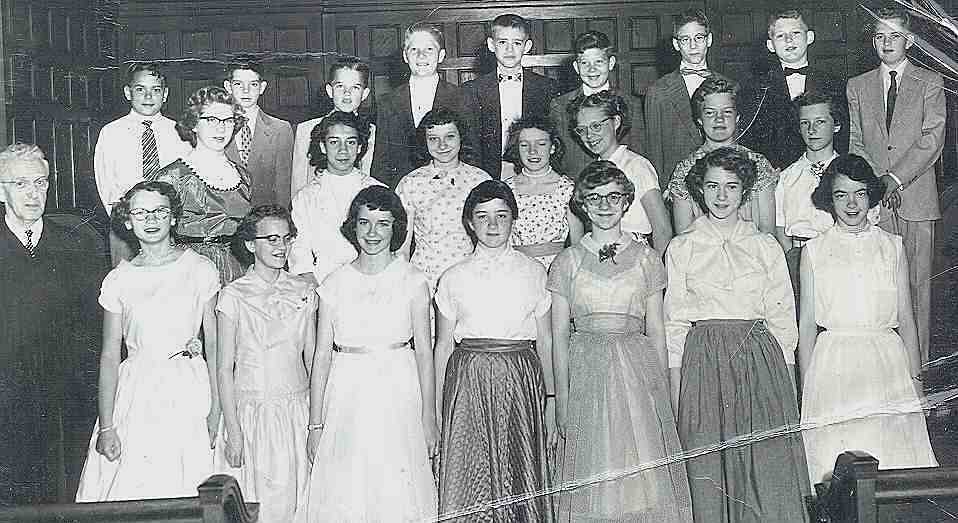
Here is a picture of the Confirmation Class of 1956. I’m the chubby dweeb just behind and to the left of the minister. What a smile! You’d never guess that I was at this moment struggling to hide my contempt for the first authority figure to spark rebellion in my heart. That ember of independent thinking would glow quietly for several years before it burst into flame, but it all started here.

Was there ever a time when you suddenly realized that you needed to rebel from authority?

Clean Up, Clean Up!

Today’s guest post comes from Steve.

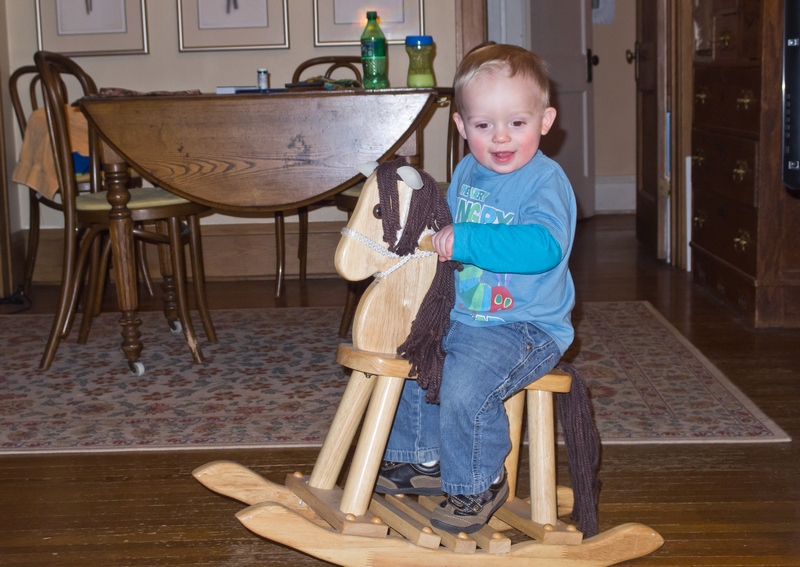
In the interest of candor, I must admit that Liam’s four-day trip to visit his grandfather has not been all pleasant. Liam, just two years old, was terrified by the airplane that flew him from Portland to Minnesota. For complicated reasons, my daughter Molly stayed at a nearby motel rather than camping out in my home. Liam hated the motel. He sobbed at night, unable to sleep in strange surroundings, partly because he had an ear infection that flowed openly. All of Molly’s love and patience could not console him. We learned a difficult lesson. Liam, at this age anyway, is not a confident traveler.

Molly would show up at my home each morning with hollow eyes. Liam’s eyes were red and puffy from another bad night. “Hello Grampa,” he’d say softly, running to give me a big hug.

That’s when the Baboon angels—those Trail Baboon women who loaned us toys—would appear on hushed wings to work their magic.

I’d say, “Liam, you know this is a funny house, a real funny house. The Toy Fairy flies here to leave surprises for you. I happen to know that the Toy Fairy came again last night. If you walk around, you might find some new toys!”

Liam would disappear, walking gingerly as if he were concerned about spooking the toys and causing them to flee. He would reappear toting or pushing some new toy, perhaps a rolling musical popper, a dump truck or a kid-sized plastic shopping cart.

All the toys loaned to us were chosen with the wisdom of an experienced mother. All got played with and enjoyed. I can’t name them all and wouldn’t try, but every single toy was a hit. Liam is enthusiastic about transportation at the moment, so cars, planes and trains all triggered a strong response.

If things ever got a little slow and Liam became restless, I would call him to me. “Liam, I can’t be sure, but I think I just saw that goofy Toy Fairy again! Do you suppose she left you more toys?”

The toys saved the trip. Molly had expected that we would need to drive from museum to zoo to library to aquarium in order to entertain Liam. Instead, he spent all his hours gleefully pushing little cars on my coffee table, putting the baby doll down “nighty-night” and herding plastic animals in and out of a red plastic barn. We didn’t waste precious time driving around, and this arrangement maximized the contact between Liam and his doting grampa (who got to develop a great many distinctive sound effects for internal combustion engines, to say nothing of all the different animal sounds).

The highlight of the four-day trip was a birthday party at my nephew’s home in Saint Louis Park. The party included 16 people. Liam is a party animal. He adores people, the more the better. He went about interacting with everyone, offering toys to them and occasionally running back to Molly or me to give us monster hugs, his head laid affectionately on our laps.

When my nephew brought out a bag of foam blocks, Liam delighted in making stacks of them so he could knock them down. Soon the bag was empty and 100 foam blocks were strewn all over the living room floor.

At Liam’s daycare in Portland, they teach kids to take care of their own messes. They sing a little song (“Clean up! Clean up!”) while teachers and kids put each toy back where it belongs. One of the teachers occasionally shouts “Hel-LOOOOO?” at the kids to get their attention so they will get stay on-task. Liam has embraced the clean-up ethic. He cheerfully put toys away at my home.

At the party, adults were laughing at the chaos Liam had made of the blocks when we were startled to hear someone singing in a pure, sweet, high voice. Liam was picking up foam blocks to chuck them into the big plastic bag they came in. He carried on singing and chucking until all 100 blocks were back home.

Clean up! Clean up!
Everybody! Everywhere!
Clean up! Clean up!
Everybody do your share!

And occasionally, in a voice that was clearly not his own, Liam would bark out: Hel-LOOOO?” To him, it was part of the song!

Life isn’t perfect, and there were difficult moments in this trip that Molly and I had dreamed about for over a year. But life gives us flashes of unanticipated joy to balance out the challenges. On this visit, any time little negatives cropped up we would hear the gentle flutter of angel wings and another collection of toys would magically appear.

Have you been involved in an enterprise that was unexpectedly saved by an angel?