Today’s post comes from marketing whiz Spin Williams, a wheeler-dealer who is always in residence at The Meeting That Never Ends.
The economy is picking up! It’s a world full of great opportunities for smart people who are willing to embrace risk and do deals. But it’s also important to know when to walk away.
Case in point:
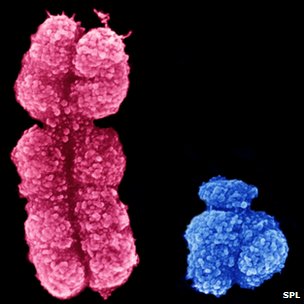
I’m not at liberty to say who made the offer, but during a recent new business discussion at The Meeting That Never Ends we heard from a very well-known genes manufacturer who was shopping around the famous Y chromosome for a possible takeover.

Naturally, we considered it. The Y is a well known brand name in the chromosome industry, making up a significant portion of all the chromosomes out there. It comes in second only to the X chromosome, which is the runaway market leader. In fact, the X is so reliable and effective, it has a 100% market penetration. Some people love the X chromosome so much, they have two! But there is a foothold – around half the population has at least one X and a Y. It was a bit disappointing to us to learn that very few people have two Y chromosomes, and we noted that as a possible marketing goal, should we decide to do the deal.
Doing our due diligence, we discovered that the Y was for sale because its maker has come to the realization that the chromosome is almost worthless, having been shown through scientific studies to contribute very little to any sense of individual well-being or overall usefulness. Most organizations considering a takeover would have walked away at this point, but my experience has shown me that marketing is more powerful than science. As proof, I offer the fact the we still have a tobacco industry! The value of any particular thing is in the eye of the beholder, and there is solid survey information to indicate that most Y chromosome users love and defend it simply because they already have one, and not because of any inherent benefits it may bring to the table.
And there’s a sizable portion of the chromosome-consuming public that doesn’t understand the product and doesn’t know which brand it prefers.
So in spite of the Y chromosome being inferior, we felt certain we could develop a marketing plan that would boost brand loyalty and make the Y seem more fresh and hip than it does today. Whether we would get to a point where X-only consumers might actually feel some envy for those with a Y was hotly debated at the meeting, with one side expressing certainty that such envy was impractical and impossible, and the other group adamant that Y envy pretty much drives all decision making by X’s. It turns out one of the side effects of having a Y is an outsized enthusiasm for the supposed benefits of Y-ness that X’ers don’t generally seem to share.
Similarly, it was the Y-freindly crowd that was all Gung-ho for immediately pulling the trigger on this deal and sorting out the consequences later. The double-X’s in the room were feeling less impulsive, constantly asking ‘How do we monetize this?’, ‘Where’s the benefit?’ and other fun-stifling questions like that.
Because there was no getting around this fundamental conflict, we walked away from the deal. First, though, we made a surprise bid for the X chromosome, thinking a seller in the mood to divest one of His low-performing properties might take the bait on an unexpected left-field offer for the most popular genetic product in the world.
That was a non-starter, but we all had a good laugh over it.
What does it take to get you to switch brands?

 Trail Baboon