Category Archives: History

Hidden History

Today’s guest post is by Cynthia in Mahtowa, and was inspired  by Reneeinnd’s July 12th blog “Overlooked Overlook” and Happy Valley Steve’s comment about “not noticing history.”

At our little long-time book club we recently read Prudence by David Treuer. The story takes place midst WWII somewhere in northwest or north central Minnesota with characters from Chicago who own a resort on a lake near an Indian reservation and a German POW camp.

germanpowcampmap

A German POW camp? In Minnesota?

None of the group had heard of such a thing. Did Treuer make it up? As it turns out, a Google search confirmed that there were indeed German POW camps in Minnesota – at least 15 of them.

Many other states also had them. Some 400,000 POWs were brought to the US to farm, work in factories, log or do whatever wasn’t getting done with American men fighting in the war. Most of the Germans were prisoners from North Africa, sent to the US by the British who no longer had room to house the number of prisoners they were capturing.

Two relatively recent MPR stories documented the camps: In March Tracy Mumford interviewed David Treuer about his novel. He grew up on the Leech Lake Reservation near Bemidji and had heard stories of a nearby camp. One of the stories told was of two prisoners trying to escape south via the Mississippi River in a row boat .

A second MPR story reported that in October, 2002 some of the former POWs and their families came from Germany to camps “to remember, learn and reconcile.”

Why had I never before heard of the camps in any of my (Minnesota or American) history classes?

Along this same line of “overlooked history,” our club also read The Assassination of Chief Hole-in-the-Day by David’s brother Anton.

2012_0406_images_05b_curio

Bagone-giizhig, known in English as Hole-in-the-Day the Younger, was a charismatic and influential chief who played a key role in relations between the Ojibwe and the U.S. government in Minnesota. Yet he won as many enemies as friends due to his actions during the U.S.-Dakota War of 1862 and his claim to be the leader of all Ojibwe. In 1868, Bagone-giizhig was assassinated by a group of other Ojibwe from Leech Lake. For many years the real reason for this killing remained a mystery.“

I have lived most of my life near the Fond du Lac Indian Reservation. I have had Ojibwe classmates and friends. We had Minnesota history in sixth grade.

Were we taught about this famous chief and I just don’t remember? Or, was it never included in our textbooks?

Other history I learned as an older adult are the hangings of the Sioux warriors in Mankato and the black men in Duluth. Not to mention the Dakota Conflict itself.

What history has been overlooked in your education that you wish you had known earlier?

A Late Great Morning Show Revival

Today’s guest post comes from Sherrilee

At Blevins Book Club last weekend, a small pocket of us were reminiscing about some of our crusty old favorites from The Late Great Morning Show.  Most of us are still Radio Heartland devotees, but don’t hear the oldies but goodies as often as we’d like.

So it’s time for a LGMS revival!  If we pull together a list of titles, Mike will get them organized and we’ll have a rousing couple of hours of songs that elicit some of our great memories from over the years.  After we get the list to Mike, he’ll let us know the date and time.  No guarantee that he’ll be able to find all our titles and I’m assuming we’ll come up with way more titles that can fit into a couple of hours, but I think we should give it a shot.

I’ll start us off with two:  The Mary Ellen Carter by Stan Rogers and Canned Goods by Greg Brown.

What song do you miss from the LGMS?

Sleight-of-Brand

Curious advertisers ask –  “Is it possible to draw attention to your product by starting a conversation about something else entirely?”

The rest of us, who have been marinating in a marketing stew for most of our lives, answer “Where have you been living?”

Much advertising is based on this.

Until yesterday, I would have argued that this technique took hold sometime in the last 80 years or so, pushed forward by the creation of radio and television – two mediums that offer great advantages and even greater rewards to liars and deceivers.

But I was proven wrong while scouting about aimlessly on the Internet, when I stumbled across the odd marketing approach of a window shade merchant in Yonkers, NY around the turn of the 20th century.

The American Carpet and Upholstery Journal described it this way in 1902:

William Welsh, dealer in window shades, matting, oil cloth and linoleum, 5 North Broadway, Yonkers, N.Y., is a rather daring and novel advertiser. He makes use of a 6-inch space, in a good position, in the Yonkers Statesman, and always fills it with a semi-facetious matter, which is no doubt looked for and read by the subscribers of that enterprising daily.

While this style of advertising is generally considered bad, as Mr. Welsh conducts it, the effect is undoubtedly good.

Screen Shot 2015-05-31 at 10.05.45 AM

Welsh goes at his customers again and again from various odd angles, trying to get their attention with a barrage of words. Today’s advertisers use swimsuit models for the same purpose, but that wasn’t permitted in the Yonkers Statesman of 1902. Regardless of the chosen topic, he always brings it home to the real point – WINDOW SHADES.

Cold Chunks

Politically speaking, we have been lambasted, garroted, buncoed, gold-bricked, solar-plexed, sandbagged, knocked out, our picture turned to the wall, and otherwise treated with brotherly love and now we feel that we are not as other men – and to show our distinction we will have to wear a badge, but not one bought with the people’s money. It happened this way: Last fall, when the political bosses were fishing for suckers the bait looked tempting, and we swallowed the hook and were landed. Now, there would be no kick coming from lus if the bosses had not shoved whole chunks of cold political harmony down the back of our neck, remarking at the same time, “Peace be with thee, brother.” We are under the impression, from the chill it gave us, that it was not a “peace” of cold political harmony that went down our back, but the whole lump. Now the reaction is great, and our political temperature is 106 under the collar. There are sudden changes in some other things besides the weather, but no so with our WINDOW SHADES. They are always the same – A No. 1.

WM. WELSH, 5 North Broadway, Yonkers

Even when the talk is small and light, the payoff is as usual.

Surprising!

We met a friend of ours, this morning, who did not ask us if we liked this kind of weather, or if it was wet enough to suit us, or when we thought it would clear up, or even remark that we are having a wet spell. Now, this must seem surprising to you, but it is a fact; there are a few people in the world who think that some other people know when there is a wet spell without being reminded of it every few minutes in the day.

Now, we wish to say, right here, that we know when we are having a wet spell, and we also know when we have enough. The next time we have a dry spell we shall mind our own affairs and peg away at our WINDOW SHADES.

We have a large stock of Oil Cloths, Linoleums, Mattings, White Beds and Bedding:

 WM. WELSH, 5 N. Broadway, Yonkers

We forgot to say that the man who didn’t speak to us about the weather was deaf and dumb.

Like re-hearing a well-loved joke, you already know the punch line, but the fun is all in getting there.

Recall a character from your life who only wanted to talk about one thing.

Speeches That Didn’t Change The World

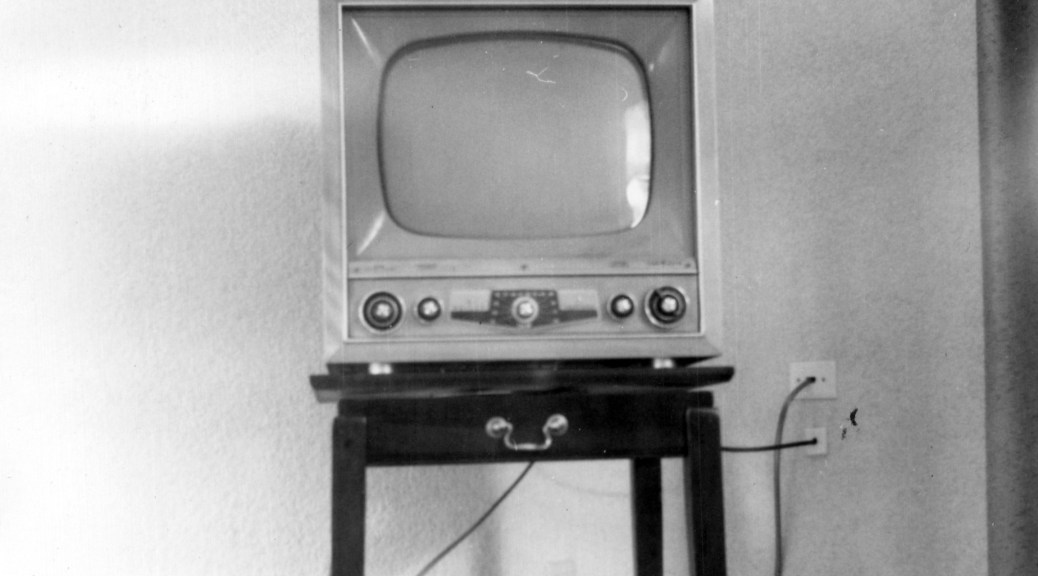
Today is the anniversary of Newton Minow’s “vast wasteland” speech.  It’s a landmark in the history of broadcasting because Minow had just been elevated from his position as just a guy with a name that sounds like an idea for a fish-flavored soft cookie, to the the exalted chairman of the Federal Communications Commission, appointed to lead the regulatory agency by President John F. Kennedy.

Minow was talking to the 1961 convention of the National Association of Broadcasters and he didn’t mince words as he challenged his listeners to watch a day of television from the moment of sign on,  when the programming started, to sign off, when it stopped.

Yes, children, there was a time in history when the television stations would actually be quiet at the end of a day.

Minow argued that “a vast wasteland” was on display.

“You will see a procession of game shows, formula comedies about totally unbelievable families, blood and thunder, mayhem, violence, sadism, murder, western bad men, western good men, private eyes, gangsters, more violence, and cartoons. And endlessly commercials — many screaming, cajoling, and offending. And most of all, boredom. True, you’ll see a few things you will enjoy. But they will be very, very few. And if you think I exaggerate, I only ask you to try it.”

The speech was a challenge to broadcasters to change their programming approach and do their work in the public interest. Wikipedia claims it was selected as one of twenty five “Speeches That Changed the World,” which is a ridiculous claim.

Minow didn’t change the world.  Broadcasters pretty much ignored him and went about their business.  When Gilligan’s Island debuted three years later, the shipwrecked boat was named after Minow.

Years later, Minow said he was really advocating for providing more choices for viewers, and in 2015 we can see that technology has certainly taken care of that.   But the broadly uplifting and ardently educational medium he imagined at the time did not materialize outside the creation of Masterpiece Theater and Sesame Street.

If Minow did anything at all in 1961, he merely predicted the empty, miserable, disappointing future of broadcasting.

When have you said the thing your audience didn’t want to hear?

Bad Day for Gasbags

We’re dipping into the archive today to re-visit a Trail Baboon post from two years ago.  Did you realize that next month this online conversation will have been going on for five years?    That’s just an eye blink in the vast span of human history, but it represents a prodigious amount of tippy-tapping on various keyboards throughout Baboon-land.  

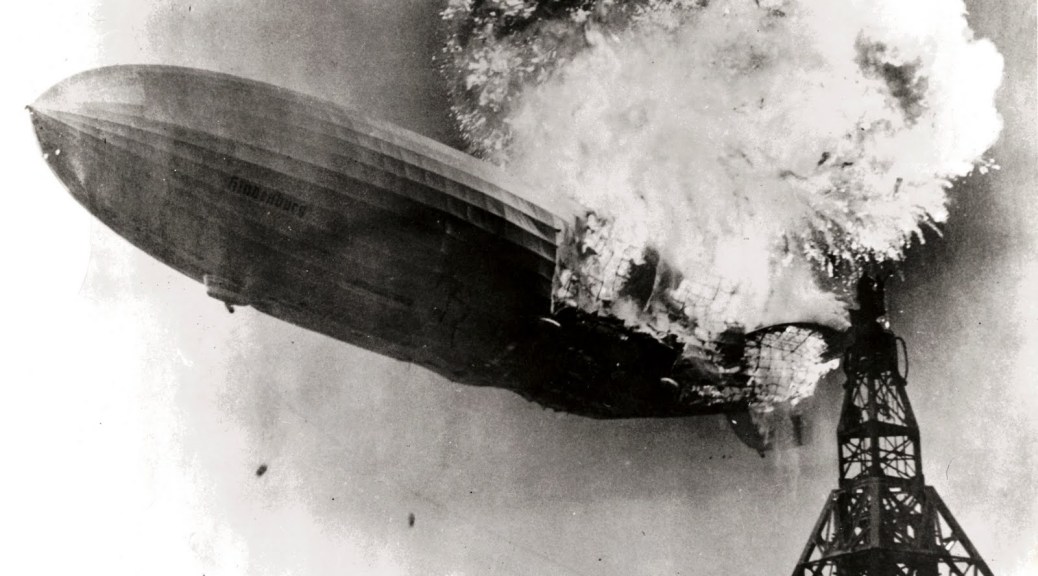
Today is the anniversary of two cataclysms, the Sack of Rome in 1527 and the explosion of the Hindenburg in Lakehurst, New Jersey in 1937. Both were sudden and somewhat unexpected, though there were hints of what was to come – Rome had been sacked before (in 410) and a string of other hydrogen-filled airships had already crashed and burned.

Still, one always hopes for the best and an optimistic soul is surprised when things turn out otherwise.

In our time, the Hindenburg is a better-known calamity, but only because there isn’t compelling footage of the Sack of Rome.

Historians say the Sack of Rome marked the end of Italy’s High Renaissance, and significantly pushed forward the protestant reformation. The Hindenburg disaster called an abrupt end to the development of rigid airships – most certainly those filled with hydrogen.

So it goes.

Although we try to prevent catastrophic events and want to have some positive influence over the great changes that sweep over our world, it often feels that we are stuck in the role of an interested, but powerless, observer. Perhaps this explains the popularity of parallel-world games like Minecraft, where one can start from scratch and construct an environment with just a few elements, an assortment of building blocks, and a blank canvas.

You could take advantage of this technology to try to build a make-believe world without Kings, Armies, Popes, Nazis and New Jersey. But you’d still probably need gravity, fire, hunger, ambition and hydrogen.

Things might turn out pretty much the same.

Is there such a thing as creative destruction?

Macy’s Doth Murder Sleep!

Thanks to Linda, who gave us all a lovely gift in the comments section of yesterday’s post with a link to Clyde’s excellent Thanksgiving Day essay from 2011. Sometimes the oldies are golden indeed!

I’m going to take a cue from Linda and do the same for Black Friday, in part because the newest B.F. trend seems to be finding a way to make it easy on yourself – witness the uptick in people who hire surrogates to stand in line for them.

In this post from 2010, we explored the Shakespearian potential of the annual Black Friday drama.

MACBETH
Methought I heard a voice cry “Sleep no more! 
 Macys does murder sleep,” the innocent sleep, sleep that knits up the ravell’d sleave of Ladies Charter Club Cashmere Crew-Neck Sweaters, only $39.99 before 10 am on Friday alone!

LADY MACBETH
What do you mean? Who was it that thus cried?

MACBETH
It was the owl that shriek’d, or some Tribune. The Star, perhaps, or the News of Duluth, formerly the Herald. It was a sorry sight.

LADY MACBETH
A foolish thought to say a sorry sight. Such sales will make us mad! Summon again the page!

MACBETH
All great Neptune’s ocean will not wash this ink clean from my hand. I am afraid to think what I have seen. Look on’t again I dare not.

LADY MACBETH
Infirm of purpose! 
 Methinks the doors are already open and the surfeited clerks do mock their charge with snores. Give me the plastic daggers. I’ll gild the aisles of Macy’s withal; 
 That which hath made them drowsy hath made be bold; what hath pinched them hath given me fire. Hark!

What is your greatest shopping drama?

A Sure, Steady Hand

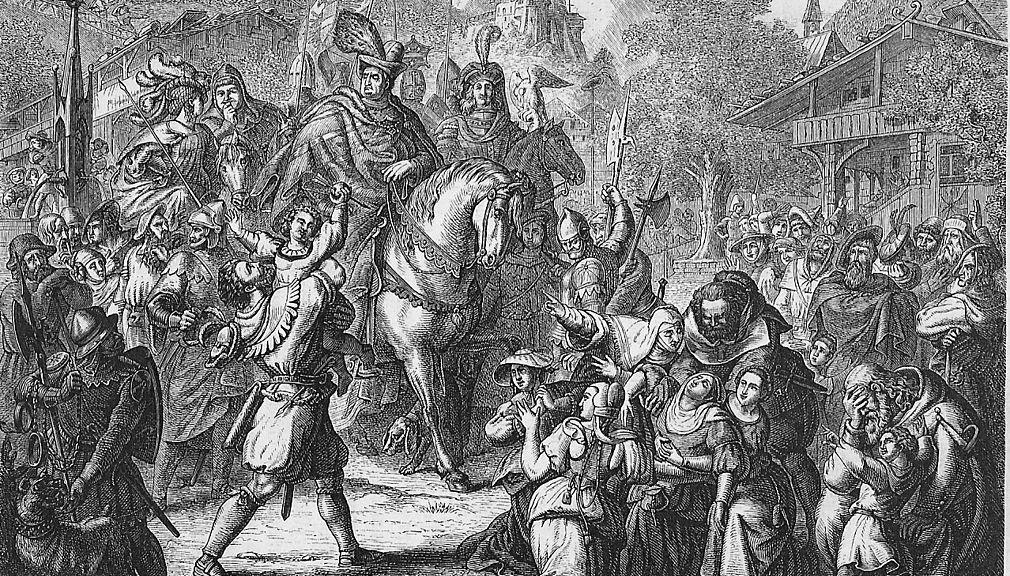
Today is the anniversary of the day in 1307 when William Tell famously shot an apple off his son’s head at the command of a brutal overlord,  Albrecht Gessler.

I know in the story this was all was done under duress and that Tell and the boy had no opportunity to object. But I still think that as the target of a foolish stunt, no 21st century child would stand idly by (literally) while dad lifts the crossbow.

An unquestioned faith in ol’ pops’ abilities is rare these days, at least in terms of modern popular culture.  There are very few father figures on TV who are reliable and/or competent in any area. Doofuses and failures, most of them.

So if the William Tell story unfolded today, I suspect there would be some push back from the offspring. And as long as we’re totally making things up, I am also quite certain the argument, if it happened, would be framed in a lame verse.

My son, stand straight with posture firm.
Don’t slouch or wriggle, lurch or squirm.
I’m widely known as quite the shot
and if you stay upon your spot
I’ll cleave the apple quick and clean
where it is balanced on your bean.

My father dear, though you mean well
this plan of yours, I think, doth smell.
It’s hubris, pure. And pride to boot
that makes you think that you can shoot
a fruit that’s perched upon my gourd.
One flinch by you – I’m with the Lord!

Hold very still, with eyes tight shut,
Before you can say “Hey, dad, what …?”,
I’ll put an arrow to my bow
and aim the missile, then let go
and through the apple it will flit
Before you can say “Holy split!”

I don’t think mom would be too pleased
if, as you let that go, you sneezed.
I know you sometimes scratch an itch.
I’ve seen you sleeping, dad. You twitch!
You blurt, you fart, it’s all abrupt.
Am I to die if you erupt?

Don’t worry, son. I’m cool and calm.
My mind’s at peace. My soul’s a psalm.
I’ll shoot it straight and true, I know.
We shouldn’t over talk it, though.
Just know that I’m not known to fail
When fruit, with arrows, I impale.

Are you a good shot?

Don’t Fence Me In

Today is the birthday of famous movie cowboy Roy Rogers, who we think of as a fixture of the wide open western expanse even though he actually entered the world at Cincinnati, Ohio.

Though it’s hard to imagine two forms of entertainment that are more out of fashion today than musicals and westerns, Rogers excelled at both. His work with the ensemble Sons of the Pioneers is a source of fond musical memories for me, although I don’t have many warm feelings towards hay, saddles, guns or cactus.

Born Leonard Slye, Rogers was a Hollywood creation, although he did seem to play well with horses. In this video clip, Trigger steals the show and Roy lets him, which strikes me as both kind-hearted and practical.

Though I didn’t think this was allowed, you can watch full Roy Rogers movies on Youtube, where there’s something for everyone. In “Sunset in the West”, Roy and Trigger deal with a hijacked train that’s full of guns, which ought to have equal appeal to those rail-loving new urbanists and the N.R.A., though for different reasons.

There aren’t many celebrities today with the kind of broad appeal that can span the political, musical, sartorial and behavioral boundaries we draw around ourselves. Roy Rogers had that quality, though I’m sure his solid relationship with Trigger helped.

Who is the Roy Rogers of today?

Vote, Rinse, Repeat.

Today’s post is actually a partial re-posting of Congressman Loomis Beechly’s glorious 2012 Election Day address, which catapulted him into the slightly brighter spotlight of extremely localized acclaim.

I’m repeating it because Congressman Beechly often repeats himself, except when he’s saying something so completely off the wall and unexpected you have to wonder about his sanity.

The address is historic primarily because it drew an all-time Trail Baboon high water mark of 141 comments – mostly the result of Baboons using the response section to hang out and do “live blog” commentary with each other about the returns as they came in.

Here’s how it looked:

Screen Shot 2014-11-02 at 9.50.26 AM

I try not to tell you what to do, but if you think reviving that plan is an appealing idea, act like a free American and follow your heart.

Here’s the Congressman’s post: 

Greetings, Valued Constituents and Miscellaneous Voters,

My apologies for this message directed at a mass audience on what is a day of personal choice. I want to urge you … YOU, specifically … to go to the polls and vote your conscience today, even if you don’t have much of a conscience to begin with.

We must all make the best of whatever meager resources we’re given.

But whatever you do, don’t do nothing! Those who have tossed away their franchise in an expression of political ennui are the most heartbreaking and miserable of creatures. Why? They have squandered their most valuable possession, and will have no right to complain for the next two years.

Think about that. Two years without complaining? I don’t know anyone who can live that way!

And don’t be like Hamlet, who was an undecided voter right up to the end because he couldn’t concentrate on anything for more than two seconds.

Don’t believe me? Who could forget his famous Polling Place soliloquy?

To vote, or not to vote. I’m still an equestrian!
The weather is colder than a frozen scupper
that wheels barrows of contagious portions
and gendarmes against a tree of bubbles.
And through composting, befriends them.
or by proposing, spend them: a guy, asleep
No more; and not a peep, of our lost weekend!
The smart fakes, and the cow’s unnatural socks.
They flash that hairdo! ‘Tis a constipation
without to be wished. a guy’d die to sleep,
and sleep, purchase a Dream; Sigh. There’s the tub!

I wish I understood Shakespeare. That was mostly gibberish to me, pretty much in the same way politics is nonsense to a lot of ordinary people. But not understanding what is going on doesn’t keep me from seeing a Shakespeare play every now and then. So go out and vote, even if it leaves you feeling like poor Hamlet – like you need to climb into the tub and wash it off at the end.

Sincerely,
Your Congressmen
Loomis Beechly.

That’s pretty much how I remember Beechly’s address from two years ago, but edited, enhanced, and with the highlights polished up a bit – much in the same way candidates refine a stump speech to get a response from their loyalists.

It’s a technique that works great for most politicians right up to the moment the speech becomes stale and tired and the exhausted candidates get bored. At which point we place half of them in office to continue on the same cycle for several years.

What does Election Day mean to you?

Just A Fragment of Your Imagination

The news has been too full of war, disease and baseball.

Fortunately, the mystery of Amelia Earhart is always there to distract us when things get a little tedious. And this week the plot thickens with the revelation that a fragment of aluminum that was discovered 23 years ago is pretty much almost certainly identical, nearly, to a piece of metal that was attached to her plane to cover a window that had been removed during a stop-over in Miami in the weeks leading up to Earhart’s disappearance.

Fascinating.

The aluminum was found on a coral atoll called Nikumaroro in the South Pacific, about 400 miles from the place Earhart and her navigator, Fred Noonan, were really trying to reach. The theory is that Earhart and Noonan managed to land and were able to send distress signals for a succession of nights until the plane was washed into the sea, where it may still rest, submerged but largely intact.

And if by chance the attention drawn to this battered metal shard should bring a few investors forward, particularly some who have exceptionally deep pockets and would like to finance the next Nikumaroro expedition in the summer of 2015, well, so be it.

If it turns out that the Earhart mystery is really about to end, my condolences to all the people who believed one or more of the vast assortment of other fantastic, fabricated fates for our “First Lady of the Air” – that she survived and somehow lived out her days as a suburban housewife in New Jersey, that she was captured by the Japanese and became Tokyo Rose, or that she was abducted by aliens and still rules a distant Earth-like planet.

The truth is precious, but often boring. That’s what makes imagination so special.

Last call for improbably Amelia Earhart scenarios! Going once … going twice …