Category Archives: The Baboon Congress

Sky Blue Pink With A Heavenly Border

Sorry for the late posting today, baboons. Today’s guest blog is by Jacque.

The autumn skies are spectacular, especially at dawn and dusk. There is a point immediately after the sun sets on a clear day, when the light is dim, all silhouettes crisp. The exclamation point is the moonrise looming over the nearly night sky. Several weeks ago, driving home from work each evening at dusk, beautiful sunsets were strutting their stuff. Gorgeous shades of pink, yellow, orange, blue, and lavender spread across the western horizon. The car was headed westward, so each evening I saw the whole thing, start to finish. What a beautiful drive home.

It made me think of my late father and his favorite color. My sister, our friends, and I were obsessed with determining our favorite colors. We experimented with all the colors from the Crayola box. We also polled our parents and neighbors, persistently asking, “What is your favorite color?” Mom’s was orange. Dad’s was Sky Blue Pink with a Heavenly Border. Wow. Nobody could top that one. And he would show us this color at sunset.

“Look. There it is!” he would say, pointing west to the horizon.

So in September, when the sunsets were so lovely and I was making my way west towards home, I began to think of him. This prompted me to write a blog, with a picture of a sunset, of course. I had to carry my camera everywhere, so I could pull over and catch the color for the blog.

It took weeks. The sunsets were suddenly bland. The camera broke. I had to buy a new camera, learn to use it, and catch the just right sunset. I waited for days for the proper color and scene. It was tough. I took many pictures which were colorless, uninspiring, just not Dad’s color. Finally I found one that would do, even though it does not have quite enough Heavenly Border.

Then one morning, as I headed out to walk the dog I saw it again on the mailbox in the form of Morning Glories:

The beautiful sunset inspired memories, pleasant thoughts and a photographic binge. I learned new skills after the colors made me spend money on a new camera so I could share it with you. You just never know what a sunset will inspire.

What does color do for you? Do you have a favorite?

Guilty Pleasures

Today our guest post comes from Steve.

The difficulty of talking about guilty pleasures is that people have such different notions of the concept.

Many women will purr and confess that a chocolate delight from Just Truffles is their guilty pleasure. I’m sorry; that is not a guilty pleasure! That’s an indulgence . . . and a particularly aristocratic one. People who try to pass that off as a guilty pleasure are suggesting that even when they succumb to a sybaritic craving they have exquisite taste.

Nor is it a guilty pleasure when your two-year old daughter expresses her adoration for “macky cheese,” painting her face and torso with what comes out of those boxes, including powdered ersatz cheese in a shocking shade of orange. She can’t have a guilty pleasure because she just doesn’t have informed taste.

No, a guilty pleasure is something that you know is schlock, and yet you find it irresistible. It is some kind of compelling treat we are ashamed of enjoying. Some remarkably cultured women are suckers for bodice-ripper romance novels. A liberal who enjoys “Gone With the Wind”—with all that Southern claptrap and racial stereotyping—is slumming in ways that reek of a guilty pleasure. And there are so many more: Karen Carpenter’s music, gossip shows on TV, vampire novels and any Hostess or Little Debbie pastry treat.

I have several authentic guilty pleasures. The one I can talk about (with some blushing) is the TV reality show, Survivor. I’m currently following the twenty-third season of it, and I have scarcely missed an episode from those earlier twenty-two years.

Don’t lecture me about how awful that show is. I know, I know! I’m the guy who has watched over 200 episodes! All that stuff about the “tribes” is painfully cornball. The jungle music is gauche. The shows are heavily edited to control audience responses, so you can’t trust your eyes. When Jeff Probst reads the Tribal Council votes, the order of the votes has been carefully arranged for dramatic effect. Most contestants are immature peacocks. The shows are as phony as an email from a Nigerian prince.

And yet I watch. Every week. Why do I watch? Three reasons.

First, Survivor episodes are mostly unscripted. So much TV is stale and predictable that I thrill to something that has a touch of real life to it, even if “reality” is as hokey as it is here.

Second, the challenges are almost irresistible watching. Under the pressure of challenges, cool contenders sometimes melt down and habitual losers occasionally find grit that nobody would have guessed was in them. Challenges that feature an ability to deal with pain often produce the most unlikely heroes. As silly as the Survivor game is, it showcases people performing under stress, and that always has the potential to be interesting.

Finally, while it is not ethical to conduct many kinds of experiments with human beings as subjects, that happens on every episode of Survivor. The show is like a fiendish laboratory where people are put under cruel pressure and tested weekly, with results that are as instructive as they are unpredictable.

The single salient lesson I draw from all those silly shows I’ve watched is that most of us are our own worst enemies. Over and over, contestants fail in the game because they cannot escape their essential personalities. The bossy woman proud of being a leader offends everyone and gets voted out. The accomplished liar gets tangled up in his stories. The guy who sees himself as a “warrior” in tune with his own primal energy becomes an object of derision. The calendar model with implants assumes her looks will reward her, but she inspires seething hatred among other women and is given the bum’s rush.

In the exit interview, contestants always claim to be proud of the way they played the game, never mind that they just lost. What they say is, “I had to be true to myself.” They apparently don’t see that they have stuck with their usual strategy for dealing with the others, even when that wasn’t working for them. Those who do well in the game usually are able to pick and choose the way they interact with others. So the game isn’t entirely silly. I think it instructs me every week about effective and dysfunctional ways of pursuing one’s life goals. But still, it is a guilty pleasure!

Do you have a guilty pleasure?

Circular Tourism

Today’s guest post is by Clyde.

“A penny saved is a penny earned” is a frequent litany in the kitchen.

Which would perhaps irritate the three children, except the mother also says it every time she adds another penny to the broken teapot sitting high in a glass-fronted cabinet.
If it is a war-time lead penny, still in common circulation at the time, she says, “A lead penny is still a penny earned.”

The collection of pennies is closely watched until they have 105 of them. The expenditure of that $1.05 is carefully planned by the children, a project they complete in collaboration.

One hundred and five pennies buys three sets of View Master reels. A set can be one, two, or three reels, but a pack of three is preferred. They can be purchased at either drug store or the dime store, which is never called by its real name, The Ben Franklin.

As the pennies mount, which takes a few weeks, they study their options. None has any interest in the cartoons or the other things so obviously aimed at children. They only want historic sites, geographic wonders, or world or national travel sites. When tourism becomes an “industry” in northern Minnesota, reels for Duluth and the North Shore start to appear in the selections, which confuses them. How can the Aerial Lift Bridge or Split Rock Lighthouse, which are so familiar and near, rank with the Eiffel Tower?

Over the years they collect and regularly view London, Paris, Rome, New York City, San Francisco, the Rhine, Yellowstone, The Grand Canyon, the buildings and monuments of Washington D.C., Carlsbad Caverns, Mammoth Cave, Niagara Falls, Dawson City, Plymouth, Mt. Vernon, the time of the mastadons, the Everglades, Angel Falls, the Field Museum, the Louvre, and on and on until they become living-room-braided-rug-world-travelers.
The excitement of planning the next purchase is as great, or maybe greater, than viewing the reels themselves.

The appeal is not only in the magic of the stereoptic effect, but also in how the small black viewer pressed to your eyes shuts out the here-and-now and takes you away for as long as your index finger holds out pulling down the lever to spin the reel.
A penny saved is a travel adventure earned.

If you had a magic View Master, what seven pictures from anytime and place would it show?

Deeply Grave Issues

Today’s guest post is by Clyde.

I collect graveyards.

Cemeteries are full of life, not human life, but plant and animal life. They reflect human history, culture, vanities, and foibles. People intend tombs and markers to enshrine power, success, or wealth, but over time such efforts fade to a sort of sad satire. Maybe that is only my viewpoint. Cemeteries are retreats, calm and restful, often set off in quiet and lonely places. Here on the prairie, they were usually placed on land of no farm use; thus they preserve land shapes and plants from the pioneer era.
I have visited hundreds in many states. Perhaps, for whatever reason I do not know, my most memorable, which I visited several times and more than once used as a place in which to compose a sermon, are the half-dozen ragged, rugged little graveyards scattered across the forest 30 miles or so north of Two Harbors. So much fun to pronounce the lyrical old Finnish names on the tombstones, once you have half-mastered the art. Only a Finn fully masters that arcane skill.

I will tell you about five cemeteries in particular.

Most Historic: Rural Lebannon, CT.
Although this one has strong competition from Salem, Massachusetts (both have those wonderful tall thin old stone tombstones like an Edward Gorey drawing), this one wins because it also has the tomb of Jonathan Trumbull, who was essentially secretary of war during the Revolution. Now inactive, the cemetery is hidden away down a lonesome rolling side road. A friend of mine has done a 30-year study of the growth of lichens on the tombstones and surrounding rock wall. The dates on the tombstones help him plot lichen growth.

The Welsh Section

Quirkiest:Across the Minnesota River from Nicollet.
This is a well-maintained active prairie cemetery surrounded by cornfields in a Welsh area. It’s peaceful to walk a secluded cemetery with the eternal sound of rustling cornstalks. In the older section of the cemetery all the names are Welsh, all except in one corner is a man named Zimmerman. My theory is that one night some Germans sneaked in and buried a relative.

Most Unusual:Point Hope, Alaska.
On the tundra outside of this Inupiat village, the most westerly point on the American continents, is a native cemetery, the fence of which is composed of whale ribs. But outside that fence, “outside the pale,” which is what that term means, are several lone graves. When a member of the tribe dies, the elders decide if the person is worthy of being buried within the ribs, or, sometimes, the person chooses not to be included.

The Obelisk

Most Poignant: On a bluff above the Minnesota River near Nicollet.
This still active but hard-to-find cemetery has a nice view overlooking the river valley; however, it is for one tombstone that I name this cemetery. The tombstone, a ten-foot tall obelisk, is a lesson on the fragility of children and the dangers of childbirth 100 years ago, common lessons in historic cemeteries. On one side the obelisk names a man who lived for about 70 years, dying in the 1920’s. On a second side it names a woman of the same last name who died in her early twenties in the 1880’s. A small unmarked stone lies seven feet out from the obelisk. On the next side is a second woman of the same last name who died two years later, again with a small stone seven feet out. On the third side is woman of the same last name who outlived the man by a few years; no small stone is present. Draw your own sad conclusion.

Most Frequently Visited: Calvary, Mankato.
A large very well-maintained cemetery on the wooded bluffs of
Mankato a mile from my house. I enjoy bike riding the paved roads of this cemetery in the early morning. The master caretakers who tend Calvary keep all the many trees trimmed to eight feet off the ground, which makes the early morning sun shinning under boughs onto the green grass an energizing mileau in which to ride, especially while listening to “Pipedreams.” Many a lesson can be learned here about human vanities and pretensions, both in the cemetery and among the million dollar homes which have been built next to it in the last decade. I am remind me that Thoreau said that our homes are just an doorstep to a hole in the ground.

I have, now that I think about it, only visited cemeteries in the daylight. John Muir, as a poor young man bumming around the US in the mid 1800’s, slept in cemeteries because then the police and other people would not bother him.

Would you sleep in a cemetery?

Overheard Conversations

Today’s guest post is by Edith.

Earlier today I was waiting for a city bus at a bus stop in downtown Minneapolis after making a nice haul at the 25¢-a-book-sale. A few years ago, people would just wait for their buses in silence, but now there are a few people who, naturally, yack on their cell phones while they wait. I don’t try to listen to their conversations, because most of them are boring. I mean, how many times when I’m shopping at Target do I want to hear, “Yeah, I’m at Target right now, picking up paper towels” or at a bus stop, “I’m waiting for the #5 bus”? But today, I’m pretty sure I overheard the logistics of a crime-in-progress.

A ordinary-looking woman crossed the street to get to the bus stop. She had a suitcase and was talking on her cell phone. I heard the fairly normal cell phone line, “I just made the copies at the library and now I’m at the bus stop and I think I’ll make it there on time.” Yawn. Then I heard, “You’ll have to meet me at HCMC at 4:00 and I’ll pass off the suitcase and the money.” My ears pricked up. Whoa! What sort of shady deal was this?

Unfortunately, right at that moment, my bus pulled up and I got on. The woman must have been waiting for a different bus because she did not board the bus I was on. But I’m still wondering, “Why does she have to “pass off” both a suitcase and money at HCMC? Was she talking with a friend or was this some sort of undercover “business” dealing?

What suspicious activity do you think was being planned in that conversation I overheard?

An Ode To The Nematode

Today is my birthday, and I am determined to relax, no matter how much work it takes.
Fortunately I have great help from people like my good friend Jim of Clark’s Grove, who wrote today’s guest post. With a few forthright words about nematodes, Jim has helped me understand my true role in the universe and has placed my birthday in its proper context. To anyone who says “host” is not a decent job description, I say, ‘Pal, we’re all hosts.’

Here’s Jim’s post:

I suspect that many people know a lot about something which is not widely known by most other people. I am thinking about unusual information that might be gained through professional training, or from involvement in a hobby, or by somehow gaining access to unusual information. I happen to know quite a bit about nematodes, a group organisms that I think are a mystery to the general public. My knowledge of nematodes came mostly from my study of these organisms as a graduate student. I would like to share some of the information I have about these very significant and severely overlooked creatures with the hope that you will share information about something that you think has been largely ignored.

Nematodes, which are also known as round worms, are the most numerous multicellular animal on earth. There are some single celled organisms that outnumber nematodes, but nematodes have exceeded all other animals with more than one cell when counting the total number of individuals. If you removed all the soil and water from the earth and left the nematodes, the large populations of nematodes found everywhere would show you where the soil and water was previously located. Most nematodes are very small, only a millimeter or two in length, although you might have seen some of the larger parasitic ones that are several inches long in the stools of your pets. Some whales contain parasitic nematodes that are more than 20 feet long.

A Nematode with a Nematode Inside.

Nematodes parasitize just about everything including all kinds of animals and a wide range of plants. People suffer from many kinds of nematode parasites; including pin worms, hook worms, and the worms that cause trichinosis which you can get if you don’t do a good job of cooking pork. In fact, there are even some nematodes that are parasitic in other nematodes. If you look closely at the picture I provided you will see two nematodes because this is a picture of a nematode with a parasitic nematode in its body cavity. I came across this parasitized nematode during my study of free living nematodes found in soil. The drawing was done with ink on scratch board following instructions for making nematode drawings that came from a famous nematologist, Gerald Thorne. Thorne was very devoted to the study of nematodes which he was sure would be found in soil samples from the moon. He was certain of this because he knew they are found everywhere on earth.

I got started in nematology by doing a research project on plant parasitic nematodes, some of which can severely damage plants. However, most of my efforts in nematology were centered on the taxonomy of a group of free-living nematodes which led me to discover and describe a dozen new species of nematodes. Most people who work on the taxonomy of larger organisms would not expect to discover such a large number of new species. When it comes to nematodes, it is not hard to find numerous new species because most of the existing species have not been described.

I have attempted to dazzle you with some information about the wondrous group of organisms called nematodes. You probably weren’t aware of the huge number of these organisms hidden in soil and water everywhere and also found as parasites in or on many animals and plants. In fact, you might have harbored or still be harboring some of them, yourself. I think I was infested with pin worms when I was a kid. In those days many school children suffered from infestations of these very small worms. I wonder if you have information about something that is unusual or not well known to the general public.

Are you familiar with something that is being ignored?

The Truth Cop

Today’s guest blog is by Steve Grooms

America was in the seventh year of its war with North Vietnam in the fall of 1971. That fall I was a graduate student in the University of Minnesota. I wasn’t sure what degree I was seeking or what I’d do with it, once I’d graduated. I mainly had to maintain official student status so I wouldn’t be drafted to join the war.

I had hated this war since its start. Every night I shook with fury as various national leaders went on television to lie about the “progress” of the war. Every year, more and more people died—young and old, Vietnamese and American, civilians and soldiers. Every year, the official logic for the war looked more insane.

I finally decided that my hatred of the war might provide a plan for my life. The American public was not getting the straight story about Vietnam. Maybe I could become the sort of pioneering journalist who would show all my docile countrymen how wrong the war was. Even better, perhaps I could become a columnist with a courageous voice who would write op/ed essays showing my readers how stupid they were to believe the lies the U.S. government was feeding them about the war.

And so I decided to switch my major from American studies to journalism. I had a lot to catch up on, for I had never yet taken a journalism course. Unfortunately, I had a late registration date, so all desirable courses in writing and editing were filled before I could sign up for classes. In fact, the only promising course still open was “Public Opinion and Propaganda.” At least that course would relate to my intention to use journalism to open the public’s eyes to the madness of the war.

Things didn’t go as planned. That class shocked and confused me in a way no other event in my long educational history had done.

The first shock was learning how silly I had been to think I could educate people by telling them the truth. The first section of the course showed how diligently people protect their pet beliefs from anything that challenges those beliefs. One study we read showed that people have at least eleven different strategies for denying information or views that they don’t want to hear. Eleven! Although to tell the truth, any single one of those mental tricks will usually work to keep unwelcome facts or views at a distance.

For example, if new facts threaten the values people already hold, people have no trouble ignoring the new facts. Or they might encounter information they don’t like and simply forget it. Or they might misremember things so badly that they think that the new facts actually support their preferred view of things. Or they might summarily dismiss unwelcome views because they came from a suspect source. And so it goes.

The lesson was hammered home over and over: People are going to believe whatever they choose to believe.

Before I had been in the course for a week I could see that the world needed another angry young man with a typewriter about as much as it needed more communicable diseases. I wasn’t going to win the hearts and minds of fellow Americans with all the predictable liberal cant I planned to publish. People would never thank me for telling them my version of the truth. ”Oh, so this war is actually a tragic and murderous mistake? Gee, I wish I’d heard earlier, but thanks, Steve, for finally straightening me out!”

My first response to my new sense of public opinion and propaganda was a practical one. I dropped the silly plan to become a crusading writer. My graduate school major went from “journalism” back to “damned if I know!”

And yet the most significant impact of the course on me had less to do with an occupation and more with character. My course taught me that people were amazingly wily and energetic when their pet beliefs were threatened. But I was a “people” too! I had a belief structure, too, that I was surely defending with all the techniques I’d been studying. Like everyone else on earth, I was a shyster and a con man who could lie and forget and spin and misremember things so I wouldn’t experience the discomfort of doubting my own preferred version of truth.

Since 1971 I have tried to live with the uneasy fact that much of what I believe in—including things I passionately believe in—is probably not true. Of course, one can know that without knowing which core values and facts are bogus. Now I live with a sort of Truth Policeman in my head who knows every sly trick I use to protect my preferred way of seeing things. He cuts me no slack, that dirty copper! He catches me when I resort to mental tricks to preserve my comfort zone of faith.

And yet I have come here to praise him, not bury him with a lot of whining. It is healthy to be asked—or forced to—defend one’s pet beliefs. When I sense myself wanting to believe in something, I automatically become skeptical. The more I want to believe something, the more likely I am to be lying to myself. Oy weh and ish da! This kind of self-doubt can mess up your mind.

Ultimately, I’m not sure this kind of self-awareness can make a person better at seeing the truth. It is surely more realistic to hope that wisdom and self-awareness about these issues can makes us a bit more humble about all those things we think we know about the world.

Have you ever encountered a gifted teacher, special course or singular event that shook up your personal values and caused you to re-think pet beliefs?

Two Nordic Bachelor Farmers and Their Tractors

Today’s guest post was written by Clyde.

In my childhood the few farmers of southern Lake County shared equipment and work. Many of those farmers were characters worthy of being remembered. Two of them were Nordic Bachelor Farmers.

The Swede

Ole, his real name, I promise, lived in the valley below us up a side road of a side road of a side road in a small house. I always wanted to get into that house, to see if it was as neat and precise as were his barn and garages and to see if it had any frills. I never made it in.

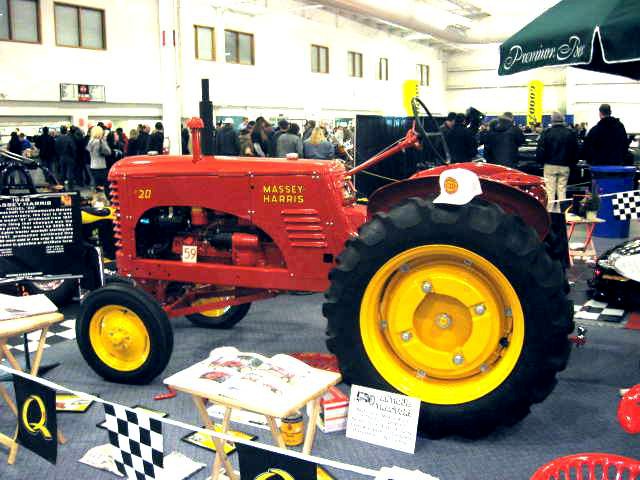
1948 Massey-Harris

In our early years on our perch above the valley, before the trees got too tall, we could just see his farm. It was three miles away, but by road it was seven miles. Ole owned a threshing machine. We would trade work or oats for him to come to our farm with “the separator,” as we always called it. Ole would putt-putt along at a much slower speed than necessary in his 1940’s era red and yellow Massey-Harris tractor towing the machine to and from our farm. Ole never rushed anything. Never. Ole never got excited. Never. Ole would talk . . . but . . . seldom . . . softly . . . with lots of . . . pauses.

He was slight of frame with massive hands at the end of long dangling arms. He always wore a cap, except when he came awkwardly into our house to eat. I waited for that moment when he stood at the door wiping his feet, cap in hand, calling my mother “Missus.” Powdermilk Biscuits would not have cured his shyness, nor given color to his pale skin, which somehow never tanned or burned, nor given thrust to his receding chin.

It was his head I waited to see. He had classic male-patterned baldness, and, here is what I awaited, five large bumps on his head. I do not know why he had them. They seemed benign, and he lived into his late 70’s. But what child could not be enthralled by those bumps!

The Norwegian

Noble—yes, that was his name—was my father’s best friend. And as opposite of my father in temperament as a man could be. He had been a Lake Superior fisherman until the coming of the lamphrey. He switched to farming, with which he needed much help from my father. I liked his name, and he did have a serene Nordic unpolished nobility. But I liked his brother’s name better, Sextus, which always made me giggle. Noble was short, stout of frame, and walked with small slow careful steps. He always bent his upper body forward and furrowed his brow as if deeply worried, which he was not.

Oh, how many stories there are about his kind, gentle, and implacable nature. For instance he once brought back 50 wild yearling steers off the Montana Range, and trustingly left a gate open, letting them escape. We got back 49, one of which died.
One was found as far away as Beaver Bay.

One day when he was about 50 years old sitting drinking coffee at our house, calling my mother “missus,” he casually mentioned that he had married the week before. My parents snorted coffee. It was a women we knew—brusque, demanding, fast-moving, and intolerant of incompetence. It proved to be a lasting, loving, and happy match.

After I moved back to Two Harbors, I often saw Noble. Once I mentioned to him that my backyard had a large pile of firewood which was too punky to burn in our fireplace. He agreed with my suggestion that it would burn in the large barrel stove in his garage, fashioned for him by my father.

Fordson Model F

One Saturday he showed up with a hay wagon pulled by his 1930’s era Fordson tractor, famous for its durability and utter lack of power. Noble had three tractors, one a powerful International Harvester, but he loved to use that old putt-putt Fordson. As he backed it down into the low spot in my yard where the wood was piled, I told him that I did not think it had the power to pull out the load. He thought a moment and said, “Yup, yup, probably not,” and started to load wood. Halfway through the job we went in for coffee. He took off his hat, wiped his feet carefully, and charmed my wife, calling her “Missus.”

As you can guess, the Fordson would not pull out the load. He did not get mad; he just laughed and said, “Yup, yup, you were sure right about that.” He drove the 11 miles home and 11 miles back the next day with the IH, which pulled it out easily.

That was, sad to say, my last meaningful contact with that exemplary man. But I picture him every time I hear the term “Norwegian Bachelor Farmer.”

Who do you know from Lake Wobegon?

G.O.A.T. Notes

Today’s guest post comes from Barbara in Robbinsdale.

It’s a very creative group of Babooners here on the Trail, and we sometimes use words not found in your standard English dictionary. So Jacque and I (back in April) put together a little Baboon dictionary, ultimately dubbed the G.O.A.T. (Glossary of Accepted Terms). I’ve been keeping track of some real gems that have appeared since then, and here’s what y’all have been adding to the mix. If you’re a newcomer, it may help explain some (but certainly not all) things. And if you’re an old hand, it will serve as a reminder of how we talk ’round these parts.

Baader Meinhof – defined by the Pioneer Press’ Bulletin Board as “encountering a piece of previously unknown information twice within a 24 hour period.” (It’s surprising how often this comes up.) See Joy of Juxtaposition for clarity through contrast.

Blevensing – going on and on about something, as the Austin Lounge Lizards (et al.) do in the chorus of the song, Old Blevins: “Blah blah blah blah blah blah blah…” and as follows: “Niblet is sometimes described as “long-suffering”… Imagine having to spend your days listening to [Mr.] T, blevinsing away…” (See Out to Pasture in upper right corner for more on Niblet and Mr. T.)

Cannardly – a more elegant way to express mixed ethnic heritage, as in: “He said he was Cannardly – so many different ethnicities that you can hardly tell…”

Ectopic – out of place, as in: “Ectopic comments are always welcome!” which followed: “Ugh, I … meant that reply to go under Beth-Ann’s comment.”

Fusspot – a very fussy person, as in: “Fusspot is a term created by my husband, who is much more of a fusspot than I am.” See also Troublespot, and Lucy in Peanuts for the variation, fussbudget.

Hooby – either a cross between a hobby and a hubby, or a hobby that’s a hoot… as in “become involved in a hooby or something that is real…”

Incumbent bike – a bike that’s going to stick around for another 2, 4, or 6 years.

Ingrown narcissism – self-regard that has become problematically internalized, as in …“if we stop for ice cream we may not have enough money to pay for Timmy’s operation to fix his ingrown narcissism”.

Jamicized: to be clothed in your jammies, as in: “There is an ice cream truck that frequents our neighborhood. We do not patronize that [ice cream] truck (partly because sometimes he comes around after we have called it a night and are jamicized, thank you very much).”

Joy of Juxtaposition – a confluence of references to something that was already in your knowledge base; see Baader Meinhof for clarity through contrast.

Latent utility – usefulness in the future, and a reason to keep an item, as in “There are the remaining painting and carving supplies, which I may one day use, and I consider latent utility useful.”

Pawlenty (verb transitive) – to hide something from the public, and then do what you want, as in: “the masses don’t realize until after they’ve already been pawlentyed.

Punctuational – on time for the blog, and keeping track of it throughout the day, as in: “Didn’t we tell you how important it is to be punctuational?”

Rojak (roh-jark) – a Malaysian colloquialism meaning a mix or a salad, also used to describe language, e.g. using several languages/dialects in a single sentence. See also Cannardly.

Schaumkessel – a German word for boiling or foaming kettle, or a relative who acts like one; as in this interchange: “My maternal grandmother was a Schaumkessel…” “Do you know what Schaumkessel means? It has such a cool sound.” “I think it means boiling or foaming kettle… and she kinda was….”

Snort – short for “That made me laugh so hard I’m snorting coffee (or some other beverage)”. Also a baboonish substitute for LOL or ROTFLOLAWM (see New Acronyms). Snort could be an acceptable short form of the TBB’s mission statement.

Spedition – a shopping expedition that include ice cream, as follows:
”When my son was younger and had to accompany me on errands I started to call them expeditions thinking it would make it easier to jolly him into going. The name was shortened to speditions. At one point I upped the ante and offered ice cream to make the journey sweeter. Then with an elephantine memory my son proclaimed the definition of a spedition included ice cream every time. ”

Spiritual tithe – a fine paid to a good cause, as in: I even ENJOY paying my library fines because I feel as if it is my spiritual tithe to an (almost) holy space.

Storage brains – the (often older) family members who recollect the family’s historical information, “Unfortunately all storage brains… have died so we have not much more than she could find in public records.”

Troublespot – those relatives and acquaintances who have been difficult or naughty. “It would be really unfortunate to be a fusspot and a troublespot all in the same day.” (See also Fusspot)

Wikiwalk – a “pernicious online phenomenon”; specifically, an unintended, possibly long and convoluted journey through the internet, as in: “today you are a lost soul on an endless internet search on into the time tunnell where minute turn into hours and the days go by without any indication that you were ever there. a little you tube video, a piece of information from the wikipedia archive on the topic.. off into the vast amounts of miniscule detail folks have assembled on whatever the topic.”

New Acronyms:

OFTLOW – oh for the love of wool

ROTFLOLAWM – rolling on the floor laughing out loud and wetting myself

TTFN – ta-ta for now (from Winnie-the-Pooh)

WOT – way off topic

What language would you like to be able to speak, and why?

Pen Name de Plume de Jour

Today’s guest post is by Clyde.

I just read From the Fair, the delightful autobiography of Sholom Aleichem, the Yiddish author of the Tevye the Milkman stories and many others. If you like Fiddler on the Roof, you might like to get a deeper feel for the world of Tevye and his village. You might also like to read the original stories, which are if anything more charming than the musical. He writes the autobiography in third person, even though he repeatedly makes it clear it is his own real life story, which adds another dimension to the narration.
Reading the book has inspired me to get back to work on my long-neglected fictionalized story of my childhood, wishing I had anything like his narrative gift.

Aleichem, whose life was contemporaneous with Mark Twain, was often called the Yiddish Mark Twain, to which Twain responded, “Tell him I am the American Sholom Aleichem.” They shared much in common, such as an allegorical pen name. Twain’s name means essentially “safe water” in steamboating terms. Solomon Naumovich Rabinovich chose the name Sholom Alecheim because it is both the common greeting in Yiddish and a blessing of peace upon another person. Their chosen names also have a sonorious ring to them.
Both men were mostly self-taught, were raised in poverty in backwater villages, survived many family tragedies such as the death of a parent in childhood, made and lost a couple of fortunes due to bad investments, and were very successful public speakers. Both were brilliant at characterization, were masters of dialogue especially dialects, and did much to invent the literature of their culture.
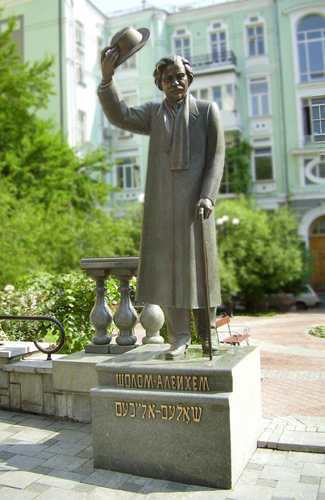
I have included a photo of the statue of Aleichem in Kiev. It is wonderfully ironic that Russia and Kiev honor him this way, considering how the tsarist regime treated Jews and that Aleichem had to hide when he lived in Kiev because he did not have a license to live there, as required of all Jews.

Unlike Twain, Aleichem was deeply religious and superstitious. For instance, his tombstone in New York City lists his death date as May 12a, 1916 because he was afraid of the number thirteen. He died too young before finishing From the Fair. The abrupt ending is unsatisfying, but well, L’Chaim to his life and all of ours.

If you were to use a pen name, what would it be?