
Today’s guest post comes from Clyde.
I love serendipitous juxtapositions. Last month a book and a picture careened into my life at the same moment.

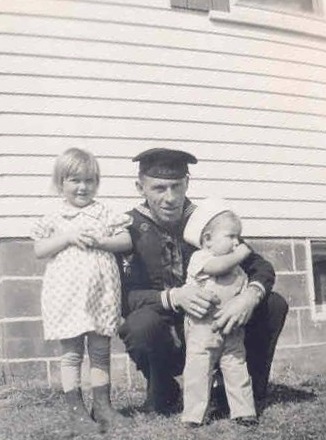
This is the picture. I’m with my father and my sister, and he is just home from the war.
The book is Hamlin Garland’s memoir Son of the Middle Border. Today an unknown author, Garland was one of the writers who inspired my interest in literature and writing. His rather stolid and overly political fiction reflects the life of my mother’s ancestors and her own life. Because my mother’s family history is set in northwest Iowa, his writing would also touch the history of a few other Babooners.
Another way to describe Garland’s early fiction is as the tale of the hard life that Laura Ingalls Wilder wanted to tell, except her daughter urged her to make them children’s stories (who could argue with that decision). Garland’s childhood oddly parallels Wilder’s. He was born in West Salem WI, which is near LaCrosse. His father then moved them to Hester, Iowa, for a brief period and another brief period in Burr Oak, Iowa, where the Wilder family also lived briefly. The Garland’s moved on to a homestead north of Osage, Iowa, or to say, southeast of Albert Lea. From there the Garlands moved to Ordway, SD, long since gone, near Aberdeen.
When Garland’s first book Main Traveled Roads was published in Boston in 1891, it released a storm of criticism because people believed that the life of the Western farmer was full of joy and reward and not dirt, hard work, and deprivation. Garland was an outspoken activist traveling through the country, urging land and economic reform. His early fiction is driven by a point of view called “naturalism,” which portrays humans as caught under the control of powerful impersonal forces, such as weather, plagues, economics, genetics, politics, and random chance. Stephen Crane of Red Badge of Courage, whom Garland encouraged and supported, wrote to a similar point of view with better narrative skill.
I had my mother read Main Traveled Roads when she was about 60. She understood it fully on instinct. She told me of how the details of early Iowa farm life were the details her father told her about his childhood, which were not unlike her own childhood. People sometimes think my childhood was hard, but I do not think so, nor does my sister. We know how hard it once was.
Garland’s memoir begins with his first meeting with his father. Garland was almost four years old when his father came home from the Civil War. It was their first meeting. As I read that opening chapter, I paused to reflect as I often have, that the two great untold stories of America are the lives of the women while the men were off to war and the adjustment men had to make coming home. William Wyler’s The Best Years of Our Lives tells that story very well. Almost every man in the cast and crew was a war veteran, including Harold Russell, who lost both hands in the war. He won the Best Supporting Actor Oscar.

Just as I was contemplating all this, my sister sent me that photo of the two of us with my father. But there are a couple of things you don’t know yet about that image. One is that it is my first meeting with my father. I was born while he was away at war. And the second is that the version you’ve seen has been adjusted. The original photograph was shot at a distinct angle.
My mother took the picture. She took two others that day with my siblings, one of which is as tilted as this. I have a thousand pictures taken by my mother. Only these are off-kilter. I always assume we are seeing her own emotions in that angle. Obviously, With photoshopping it is possible to straighten that picture. How prosaic it is without the tilt.
What do you view from a unique perspective?









 Trail Baboon