Miracle on a Ball of Ice

There is a standard type of story often seen in movies where a character is set up as a sure failure – the kind of engaging but doomed loser who faces insurmountable odds and will, under normal circumstances, succumb to a much stronger opponent.

And yet … for reasons that are inexplicable, our hero emerges victorious in spite of it all. We love these tales of amazing, unlikely underdogs.

Add to that list the tale of Comet Lovejoy, a recent discovery by an amateur astronomer in Australia – Terry Lovejoy. Already we are ahead of the game – our sky spotter has a perfectly charming and appropriately seasonal name. My guess is that a comet named after amateur astronomer Neil Grudge-Spite would not get the same kind of global press.

Lovejoy detected the comet in late November – early enough for scientists to train several space based detectors on the object, to track its certain demise as to streaks towards the sun. Here’s one description of the expected chain of events as posted on a Navy website dedicated to Sungrazing Comets just days after news of Lovejoy’s solar approach was announced:

“Welcome to the beginning of the end of Comet Lovejoy’s billions of years long journey through space. In less than 10 hours time, the comet will graze some 120,000km above the solar surface, through the several million degree solar corona, and — in my opinion — completely evaporate. We have here an exceptionally rare opportunity to observe the complete vaporization of a relatively large comet, and we have approximately 18 instruments on five different satellites that are trying to do just that. “

Here’s the amazing part – the comet skitters around the sun … and EMERGES! The comet watchers are dumbfounded. You can see video of the approach and escape here:

And here is the same skeptical Navy observer quoted earlier, delightedly eating crow:

“I don’t know where to begin. I simply don’t know. What an extraordinary 24hrs! I suppose the first thing to say is this: I was wrong. Wrong, wrong, wrong. And I have never been so happy to be wrong! For the past two weeks I have been saying that Comet Lovejoy would not survive perihelion in “any appreciable form”. When I said this, I envisioned that we would see some very diffuse component maybe last a few hours after perhelion, but not much else. I was spectacularly incorrect!
Last night, between 7pm and 8pm (ET), the SDO team blogged and tweeted live the passage of the comet through SDO’s extreme ultraviolet AIA camera. Not long after the first images were made available came the announcement that the comet was seen plunging into the solar atmosphere. I expected this, but was nonetheless delighted. What I did not expect was that a short time later it was seen to re-emerge!
Somehow it survived being immersed in the several million-degree solar corona for almost an hour …”

Lovejoy, our hero! And here’s the victory parade – a shot of the comet’s tail taken from the International Space Station by Commander Dan Burbank, who called it “… probably the most amazing thing I’ve seen in space ….” The glowing green tail of the comet Lovejoy, emerging just ahead of the sun from behind the Earth’s horizon.

Who’s your favorite underdog?
Baboons on the Housetop

Many thanks to the Trail Baboon readers and writers who gave me some extra time to combine work with holiday rituals this week. Steve, Joanne in Big Lake, Barbara in Robbinsdale, Jim in Clark’s Grove, and Beth-Ann made my Christmas brighter with their engaging guest posts.

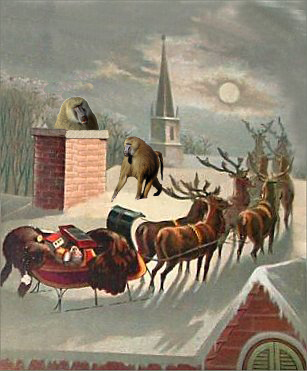
But this morning for the sake of entertainment the contrarian side of my brain started imagining the opposite sort of scene to the tune of Clement Moore’s famous “A Visit From St. Nicholas,” which needs to be parodied regularly anyway as part of our holiday tradition. Unfortunately time has run out, so I’ll have to rely on you to supply the final lines:

On the night before Christmas, our house was in ruins.
Invaded, it seems, by a pack of baboons!
Though our stockings were hung by the chimney with care.
The baboons pulled them down and tossed stuff in the air.

They were covered in fur, from each head to each toe,
But their rumps lit the room with a fierce crimson glow.
They dismantled our tree in a riotous scene
Leaving pine needles piled under branches of green.

All the snowmen and angels were pulled from their shelves.
The baboons were unkind to our reindeer and elves.
What they did to our ornaments – that was obscene!
Left untouched, by the way? Our nativity scene.

But their eyes were ferocious! Their noses were flared!
Did I mention their bottoms were wickedly bared?
Every gift was torn open and played with and busted.
Baboons in the house really shouldn’t be trusted.

And as they were leaving with screeching and whooping
(I’m sure in the yard I’ll find several were pooping)
I didn’t lament all that savaged décor
Because that’s not what Christmastime ought to be for.

And here is the place where I’m stymied. I’m blocked.
The muse is gummed up like a Christmas tree, flocked.
So get out your pens. Write it florid or terse,
and end this short poem with just one final verse.

The Ho, Aglow

Today’s guest post comes from Beth-Ann.

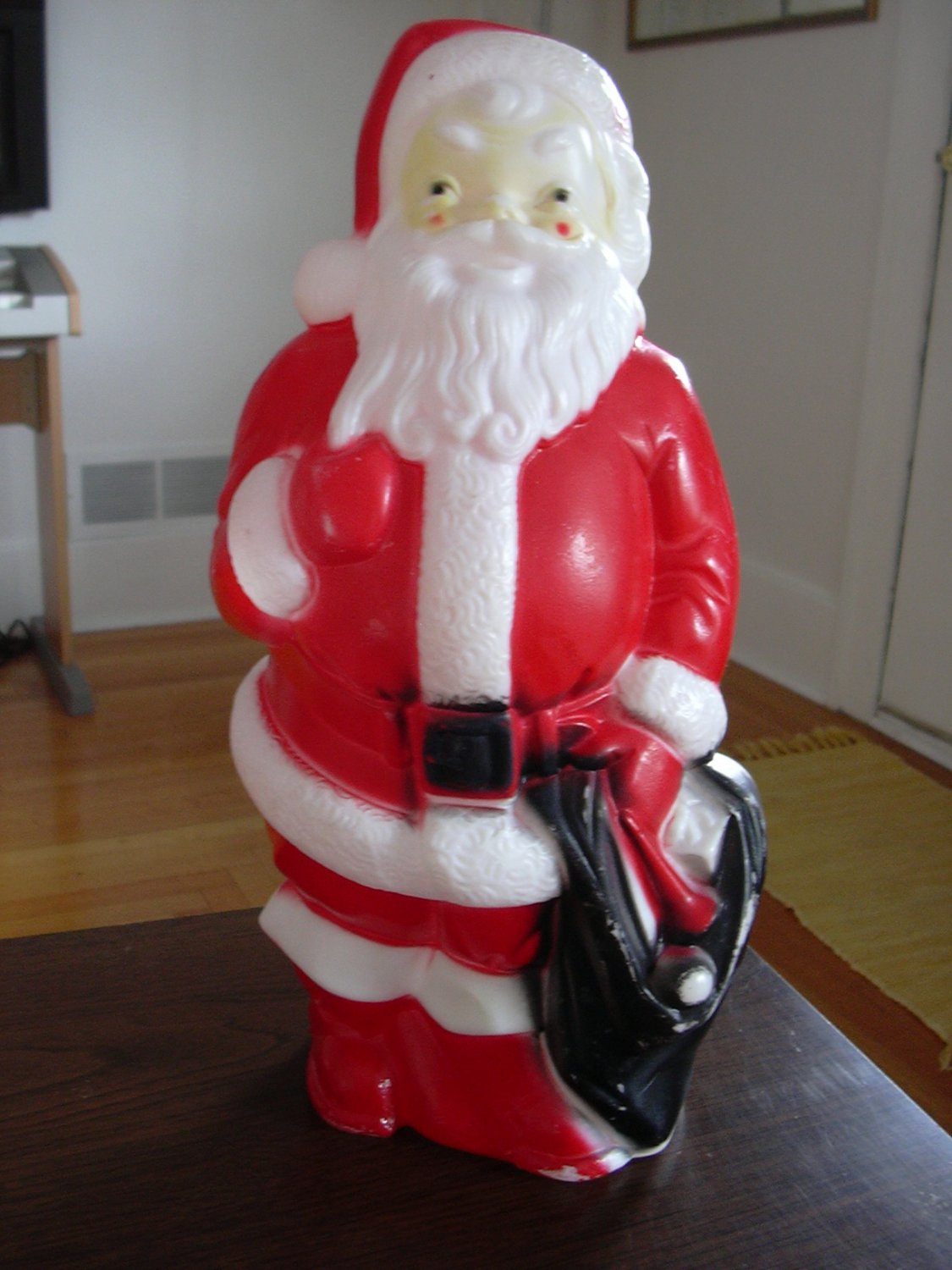
When my son was in kindergarten he insisted that we needed a lighted lawn decoration for Christmas. He lobbied incessantly and eventually overcame my aesthetic, traditional, and practical objections to planting lighted extruded plastic in front of our house to mark the nativity of the Lord.

On Thanksgiving weekend with coupon in hand we headed off to the late, great Frank’s Nursery and Crafts. The purchase required a lot of negotiation. My son’s vision was much gaudier and even at half price more expensive than mine. Finally we agreed that a hard-bodied light up Santa with a sack would join our family. We took him home, put him on the front steps of our townhouse, and at dusk ran his cord inside and turned him on. Clearly we were the spirit of commercial Christmas incarnate.

My neighbor still recounts with horror that she heard a noise that night and saw Santa rolling around our driveway. It had not occurred to me that all those other light-up Santas, Frostys, and Holy Families with and without animals had been anchored down.

Picture Him In Bungee Bondage

After some research I put together some bungee cords and attached Santa to the porch railing. My son was concerned that little children would be worried that Santa wouldn’t come to visit them since he was tied to our porch.

The oft told tale of my pre-school aged brother referring to St Nicholas’ helper as The Ho-Ho man led us to eventually refer to our light up figure as The Ho as in “Did you remember to plug in the Ho?” During junior high when snarkiness reigned we began to refer to him as Santa in bondage. For a while he had a penguin companion, but The Guin proved not to be as bright as The Ho and was forced into retirement when his light bulb no longer lit.

It won’t surprise you that since my son has left home and The Ho is in my sole custody I am devoted to him. He is tied up every December 1st and I make sure the Ho is aglow most evenings. He is terribly unfashionable and approaching retro at this point and I have to admit we have indeed bonded.

What holiday tradition were you initially reluctant to accept, yet now embrace?

The Hazards of Homestead Maintainence

Today’s guest post comes from Jim in Clark’s Grove.

I admire Scott and Helen Nearing, who wrote about their self-reliant life style in a book called “Living the Good Life”. They built their own house and raised most of their own food. Like them, I raise some of my food, but unlike the Nearings, I didn’t build my home. And although I try to do most my own repairs, most of these projects do not go smoothly.

A recent effort at taking care of a broken light fixture is a good example of what can happen. One of the three fluorescent bulbs in a light fixture would not stay on. I tried to solve this problem by replacing the flickering bulb, and the new bulb stayed lit for a while and then the problem returned – an indication that the fault was in the fixture itself. The next step was to turn the light off and look for loose wires. I knew some of the wires might be loose because I am the person who installed this light in the first place. But after a long struggle, the bulb still would not stay on. I thought I might be dealing with a faulty ballast so I returned to the store where I bought the light to get a replacement. The clerk said he was sure that he was selling me the right part.

The Fixture

Taking the fixture apart the second time became more complicated because now none of bulbs would light up and I couldn’t tell if the switch was in the off or on position. I ended up making many trips to the basement to find the correct circuit breaker, and after finally re-taking thing apart I discovered that the replacement ballast did not look at all like the one in the original light. In short, it looked like I would need to cut a very large number of wires and might have a lot of trouble getting them properly reconnected.

I decided right then that I am much better at installing new things than I am at repairing old ones.

The new light looks great, and I’m feeling surprisingly self-reliant, though not in the sense the Nearings intended. I relied on myself to declare defeat when the repair job became too complicated, and I relied on myself to decide to go out and get a new fixture.

Many of my other attempts at doing my own repairs have resembled this less than smooth effort. I suspect the Nearings would not have been so quick to buy a new product to fix an old problem. They were intent on insulating their lives from the culture of consumption, and I was intent on not spending the rest of my life struggling with this one stubborn device.

What happens when you do your own repairs?

Solstice Song Circle

Today’s guest post is by Barbara in Robbinsdale.

Light is returning, even tho’ this is the darkest hour
No one can hold back the dawn.
Let’s keep it burning, let’s keep the light of hope alive
Make safe our journey through the storm.
One planet is turning, circle on her path around the sun
Earth Mother is calling her children home.

I sang this song over the weekend because it was the 3rd Saturday of the month, which means there’s Song Circle. This month it fell right before the Winter Solstice.

Song Circle is a group of aging hippies (and some younger, regular people) who meet monthly at various homes to sing together, led by a couple of folks with acoustic guitars and the occasional concertina, tambourine, or drum. The only requirements are a voice you’re willing to use, and showing up. There are other attractions as well – there is a plentiful supply of snacks, and in June and December there is a not-to-be-missed potluck. Once we’ve settled into the comfiest chairs we can find, we go around the circle as we take turns choosing the next song.

Talk about variety! We sing mostly from a spiral-bound book called Rise Up Singing, edited by Peter Blood et al, and with a forward by Pete Seeger (and there is a whole stack of the books available if you don’t own one), that provides the song lyrics, source, and chord progressions for the guitar-literate. There are hundreds of song lyrics, neatly organized both by title (if you’re lucky enough to know it) and topic. (A lot of the ones we sing were played on The Late Great Morning Show.) Of course, someone will always pop in with new song sheets that stretch our abilities and the skill of the guitarists. Depending on how many people show up on any given evening, we will get around the circle for two or three requests apiece.

December is particularly rich, with so many holiday songs to choose from, and there are extra booklets of Christmas songs, from the ridiculous to the sublime. This time I picked the above Light is Returning (lyrics by Charlie Murphy, tune: “original”). The words by themselves seem to indicate a quiet ballad, but no, it has a rollicking, boppy beat to it and sounds best sung with a throaty gusto. I also requested In the Bleak Mid-winter (but not too slow, please), and Bob Franke’s Thanksgiving Day as we were heading out. There was no need to stick with December – someone also chose an old Stan Rogers that I’d never sung.

I’m happy that we sing to celebrate Christmas and Hannukah, and especially glad to give a nod to the Winter Solstice. I am relieved that we’re almost there, and that even though the coldest days are still to come, the pendulum is about to start back in the other direction. Soon enough there will be more light, rather than less.

Share your favorite Winter Solstice songs, stories, poems, and customs.
If you don’t have any, you can create your own! Start here with an idea and give others the chance to help you develop it.

The Ties that Bind

Today’s guest blog comes from Joanne in Big Lake.

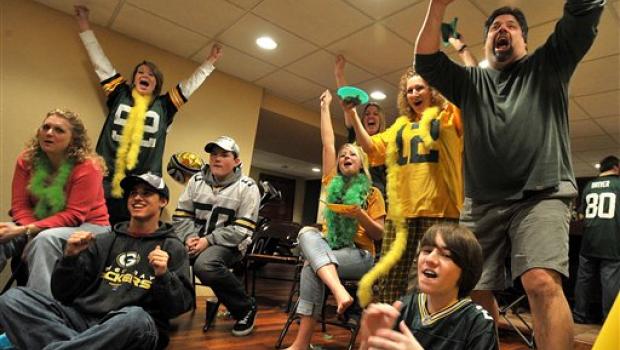
Like peanut butter and jelly, cookies and milk, beer and peanuts – football and holidays seem to go together. And sometimes, it’s a good thing.

I grew up in Green Bay, WI during the Lombardi era of football. Bart Starr, Ray Nitzchke and Paul Hornung were my heroes and the Packers ruled the field with a passing and running game that few teams could equal at that time. With little else to do in Green Bay (besides drink beer), the Packers gave the town a common pride and heritage. They also gave a good reason to be with family or a way to start conversation.

Packer Fans, But Not Joanne's Family

Being terribly shy and awkward in high school, I figured if I was good in sports and could talk intelligently about football, that boys might pay attention to me. While that may not have panned out; at least I had fun, enjoyed being in sports and was a fairly good athlete.

Now sports are a starting point for conversation and feeling together. My oldest son may not share the details of his life with me, but we cheer on the Packers together, I learn about his Fantasy Football team, trash talk the lame Vikings and exchange opinions of other teams. My two younger boys are in karate with me; so we share our love of martial arts weapons, how to improve our katas/forms and practice sparring with each other During karate tournaments we watch, analyze and pick apart competitors; marvel at the top performers’ skill and are bedazzled by fancy weapons for sale.

At family gatherings for the holidays, there’s usually a TV on with a game playing.

Understand, I love my family dearly, but I don’t see them that often. After exchanging the latest news of jobs, kids, injuries, illnesses and household projects – there’s not much else to talk about sometimes. But sporting events provide a special bonding experience that helps lay the groundwork for more meaningful conversation. Booze helps, too. My siblings aren’t alcoholics by any means, but they do enjoy wine, beer and other spirits – far more than I do.

Don’t get me wrong – I am not enamored of sports, the overpaid athletes or the overriding need to win. There’s far too much emphasis on sports in schools and playgrounds. I don’t read the sports pages or keep up with any team – well, maybe the Packers since they’ve got a great season so far. But the special bonding of rooting for the home team, cheering a great play, booing a bad call or admiring the athletic feats of strength and skill make holiday gatherings more fun. Maybe not every time or with every family, but it certainly works a lot of the time.

Sports on TV smooth over childhood sibling rivalries, the favored child stories, who tattled on whom, “I couldn’t believe you dated him” and other mild dysfunctions of growing up in a typical, loving family. I realize this group of baboons is not highly interested in sports – but you probably have to deal with friends or relatives – and perhaps feign interest in sports with those who are caught up in that web of competition and outrageous media coverage.

Has a sports event help you connect with others? What other things belong together?

Memoirs of a Teen-aged Flock Sucker

Today’s guest post is by Steve.

I got my first “real” job when I turned 16. My dad, a top executive at his factory, didn’t want to be accused of nepotism, so he arranged for me to work in an allied business that he never dealt with. The business where I worked was a silk screen processing plant.

Our work was to use squeegees, screens and paints to emblazon various products—t-shirts, sweatshirts, pennants, caps—with college logos or mascots. After we had screened a design on a shirt or whatever, that object would be covered with wet paint. We would then send it down a long conveyer belt under a bank of heat lamps. All those lamps made the shop as hot as a steel mill. There was a concern at the time that sweating too much would deprive our bodies of precious salts, so we spent a lot of time around the cooler belting down water and eating fistfuls of salt tablets. Workers occasionally fainted, dropping gracefully to the floor by their work stations.

I remember when Gina went down. Gina was a skinny Italian girl with a hooked nose and saucy mouth. She looked like a pocket rocket version of Cher. On the day I started working in Silk Screen Processing my dad pointed out Gina, saying, “Keep your distance from that Dago girl. She’s already had one kid out of wedlock.” His warning, of course, just inflamed my interest. Our production manager—an excitable man—happened to be nearby when Gina swooned and hit the floor. Gene knelt over Gina, babbling wildly about how she needed air. Then he suddenly noticed that his hands were up under Gina’s blouse, unhooking her bra. With a scream, he lurched to his feet and fled the building. That incident became just one more reason the workers held him in contempt.

A raw ink design on a shirt looks cheap, so most of our sweatshirts had ink designs that were flocked to make the design fuzzy and elegant. Flock is a curious product, sort of like thousands of tiny short hairs, and in your hand it feels like a handful of dust. After we had dumped several cups of flock on the wet paint of a sweatshirt, the shirt was filthy because of the excess flock. All those tiny hairs settled deep into pores in the shirt and refused to leave.

That’s where I came in. My dad designed a Rube Goldberg machine that was basically two Hoover vacuums, one upright and one upside down. These two vacuums met face-to-face with perhaps three quarters an inch of space between them. My job was to fold a sweatshirt, hold it tightly and then run it back and forth between the two roaring Hoovers. Two minutes of sweeping a shirt between the Hoovers would clean it up almost like new. I’d throw the clean shirt in a big bin and reach for the next flocky shirt. I could never get ahead. The faster I cleaned the shirts, the more dirty ones they would stack by my machine.

It was unpleasant. The Hoovers roared at such a volume that I could not listen to music or converse with the workers around me. The machines were hot, plus the effort required to drag the shirts back and forth between the whirling beaters was exhausting. Sheets of sweat ran off my chest and back as I worked. But the greatest sacrifice involved with working on those Hoovers was boredom and isolation. I couldn’t say a word to anyone all day.

And you know what happens when you run a Hoover over a loose rug: the beaters eat the fabric, the fabric gets wrapped around the belt, and the machine seizes with a sick whoop that often means the belt is broken. And if the fabric in question is a white sweatshirt, as most of ours were, now it would be ruined with black rubber skid marks. To keep shirts from getting sucked into the Hoovers, I had to pull and stretch them to keep the fabric taut. We only screened enough sweatshirts to fulfill each order, so if I spoiled a shirt or two we would be forced to set up an emergency run of that design to replace the ruined ones. Guess how popular that made me with the workers who had to replace shirts I had spoiled with my Hoovers?

There was a final twist. Because I was “the boss’s son,” I was terrified of being seen as a slacker. Typically for me, I over-compensated by attacking my job with a ferocious effort, suffering in silence while forcing myself to smile with the fixed grin of a corpse. The bosses couldn’t find anyone else who would do that job. After a day or two on the Hoovers, anyone with half a brain quit. Not me. I got to suck flock off sweatshirts all summer long for three summers in a row. At the end of that time, shaking with rage, I asked the production manager what I had done to cause him to keep me on those damned machines for three years. “You were fast and you were always smiling,” he said, “I wanted to keep you happy.”

The only good that came of all of this was my determination to get a college education. I wasn’t sure I was smart enough to do college work. Nobody in my family had ever been to college, and I had hardly distinguished myself as a scholar in high school. But having sampled the delights of factory work, I was ready for a change. After sucking flock off sweatshirts for three years, inorganic chemistry didn’t seem so formidable.

What is the worst job you ever had?

The Oldest Chickadee on Earth

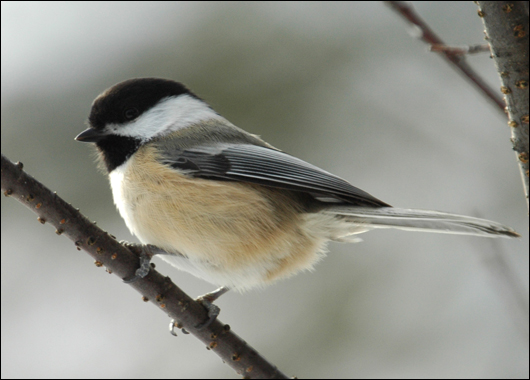
I had the pleasure of talking with ornithologist Michael North on KFAI the other day. He bands birds in Cass County in Northern Minnesota, and on December 9th he captured a black-capped chickadee he has seen before – nine years ago to be exact. The first time he saw it, Michael determined the bird’s age to be about two years, based on the shape of the tail feathers. He says after a year in the world, the tail feathers of a chickadee go from sharp-edged to rounded. I think life does that to all of us.

Not THE bird, but one very much like it.

It is unusual for a chickadee to live so long, and Michael North determined that this particular bird was the oldest chickadee on record at 11 years, 6 months. You can hear our interview here, along with a song made up just for the occasion by the stellar and chickadee-friendly artist Claudia Schmidt.

We don’t often think of a chickadee’s small life as having an arc, but imagine what that bird has been through, somehow surviving through all the hazards of life in Northern Minnesota for well over a decade. Not to mention making it through 11 winters without a snowmobile suit or alcohol to assist. We don’t know how much longer this bird will survive, but at the moment it is the Oldest Living Chickadee on Earth. That is quite an achievement. I can only guess what trials have been met and what calamities have been surmounted. I suppose there was a hungry cat somewhere along the way, and a sharp-eyed hawk. But so far, none of the normal things that can do in a chickadee have done a thing to this one.

What might be in the autobiography of the Oldest Chickadee on Earth?

Ask Dr. Babooner

Dear Dr. Babooner,

Just today I ended a 9-year involvement with someone – a relationship that was troubled from the start and tumultuous throughout. I admit that I was the aggressor. I invaded this person’s life because, frankly, I thought they had given their love to a dictator. I had decided that some regime change was in order, and I expected to be welcomed with open arms. Instead, I was attacked and resented, and now that I have finally decided to withdraw, I’m dismayed to hear how much my departure is appreciated and how thoroughly I will not be missed.

Nine years is a long time to spend on something that leaves such a bad feeling, but I can’t undo it. I can only move on. Even friends and acquaintances who watched this situation go through its various phases seem to regard me with trepidation, as if the newly-freed me is anxious to lurch into another intense involvement. Honestly, nothing could be further from the truth. I can’t afford a new adventure right now, emotionally or otherwise.

Part of me is sorry this is over. Part of me wishes I had listened at the beginning and not become involved. Part of me hopes that a messy aftermath will bring the too-late realization that I was a positive influence, overall. But that would be wishing ill for someone I thought I was helping. At least that’s what I told myself I was doing. Parts of me thought that, anyway. As you can tell from all these parts I’m describing, I’m a little broken up.

And then there is the uncomfortable fact that we are both still “on the scene”, so to speak, inhabiting the same world. When our paths cross in the future, as I’m sure they will, I intend to behave with calm dignity where once I only wanted to elicit shock and awe.
I don’t know what to expect in return.

Dr. Babooner, what is the best policy if one’s goal is to get along with one’s exes?

Conflictedly,
Won’t Miss Drama

I told W.M.D. that when it comes to complicated relationships, post-involvement amnesia is a great fence-mending strategy that can work sometimes, but only if the other party also has it. On the negative side, amnesia makes it possible to slide into an identical entanglement in the future. But that’s just one opinion.

What do YOU think, Dr. Babooner?

Bunches of Shame

Sensational journalist Bud Buck has been looking for shocking stories in the grocery store. And when Bud looks hard enough, he always finds something.

The depth of the daily heartbreak faced by a typical grocery store banana is hard for an ordinary person to fathom. We, at least, maintain the pretense that all humans have equal value without regard to their condition. Of course we don’t treat each other this way, but at least we say the right words. Woe unto you, however, if you’re a banana. Because things are much worse. For you, the world is a much harsher, infinitely more judgmental place.

On a recent trip to my favorite nearby food outlet, this reporter was appalled to discover that virtually ALL the bananas on display in the produce section were clearly underage. These bunches were far too green to be taken home. Certainly any sensible person feeling compelled to peel a banana at that moment would look at these rookies and would find them unappetizing. And yet here they were, clearly marked for sale out in plain view. Don’t get me wrong – I’m not a prude. But timing is everything!

Across the store, meanwhile, the evidence was plentiful that a small, separate band of banana bunches had taken terrible casualties at their remote outpost at the head of the cereal aisle. These experienced bananish citizens had done everything in their power to hold on to the territory. Some fell off their hooks. Other bunches were brutally ripped in two! Many of their number had become extremely yellow there was nothing left for them to do but retreat to the bottom of the display, bruised and defeated, though still proud. It seemed unlikely that anyone would give them another shot.

My observation – non-banana-centric shoppers tended to bypass BOTH these versions of the valiant fruit, preferring only to lavish their attention on perfect, like well-formed, bright yellow, unblemished fruit. How long can we afford to be so picky?

For the bananas sake, I’m begging you, please! The widening disparity between “Not Yet” bananas and “Too Late “ bananas is growing. The “Not Yets” have to listen to dismissive and snide remarks that they are ‘too, too green.’ The “Too Late” bananas are laughed at and largely ignored. Meanwhile, we’re not creating enough “Right Now” bananas to satisfy the voracious need. The whole banana industry relies on them to further the “fresh” “yellow” brand that we’re still building. Its failure is a depressing example of what we call “Bunches of Shame.”

This is only an excerpt, of course. Bud goes on for quite a while. But his angle is clear – he’s trying to ignite a class war in the produce section.

How can you tell if fruits and vegetables are ‘ripe’?