Beer Bottle Lamp

It struck me as appropriate for Black Friday, an orgy of unfettered purchasing, that we get a guest blog about making the most of the raw materials that surround you.
Today’s post is by Jim from Clark’s Grove.

As an impoverished student I learned to do a lot of improvising. In those days I got by with shelves made from boards and cement blocks which were also found in many other student apartments. I even had a guide to living as an impoverished student that gave all kinds suggestions for living cheaply. It gave a recipe for cooking a tasty chicken dish to serve on special occasions, along with instructions on making your own beer, and talked about using colorful cloth to cover worn out sofas and other things.

Most of the improvised things from our student days have been replaced by items that cost a little more and don’t need to be covered with colorful cloth. The lamp made from an over sized beer bottle is no longer in use. The board and block shelves were replaced by less rugged shelves made with 2 by 2s and boards and those shelves were finally replace some that were purchased at a furniture store.

We are still making use of some used furniture that we refinished during our student days. One of these items is a Hoosier cabinet that we bought for next to nothing at a back street auction house. We painted this cabinet and used it for many years before stripping it and giving it a coating of polyurethane. We even found a source of hardware that matched the style on the cabinet and replaced a broken latch. This cabinet has a lot of interesting features and is still in use for storing dishes and other things in our dining room.

There are some other pieces of refinished used furniture that we are still using. Most of these refinished items came from relatives. They include and old arts and craft styled oak kitchen table. The legs of the kitchen table were not refinished and still are covered with the old wood finish and decorative stripes of green paint. We are also using a refinished dresser that might be made of maple and a small refinished table made from some kind of fairly good looking wood. An old oak dresser has been stored for many years in our basement waiting refinishing, but I doubt that I will get around to working on it and I think it will end up as a donation to the Salvation Army.
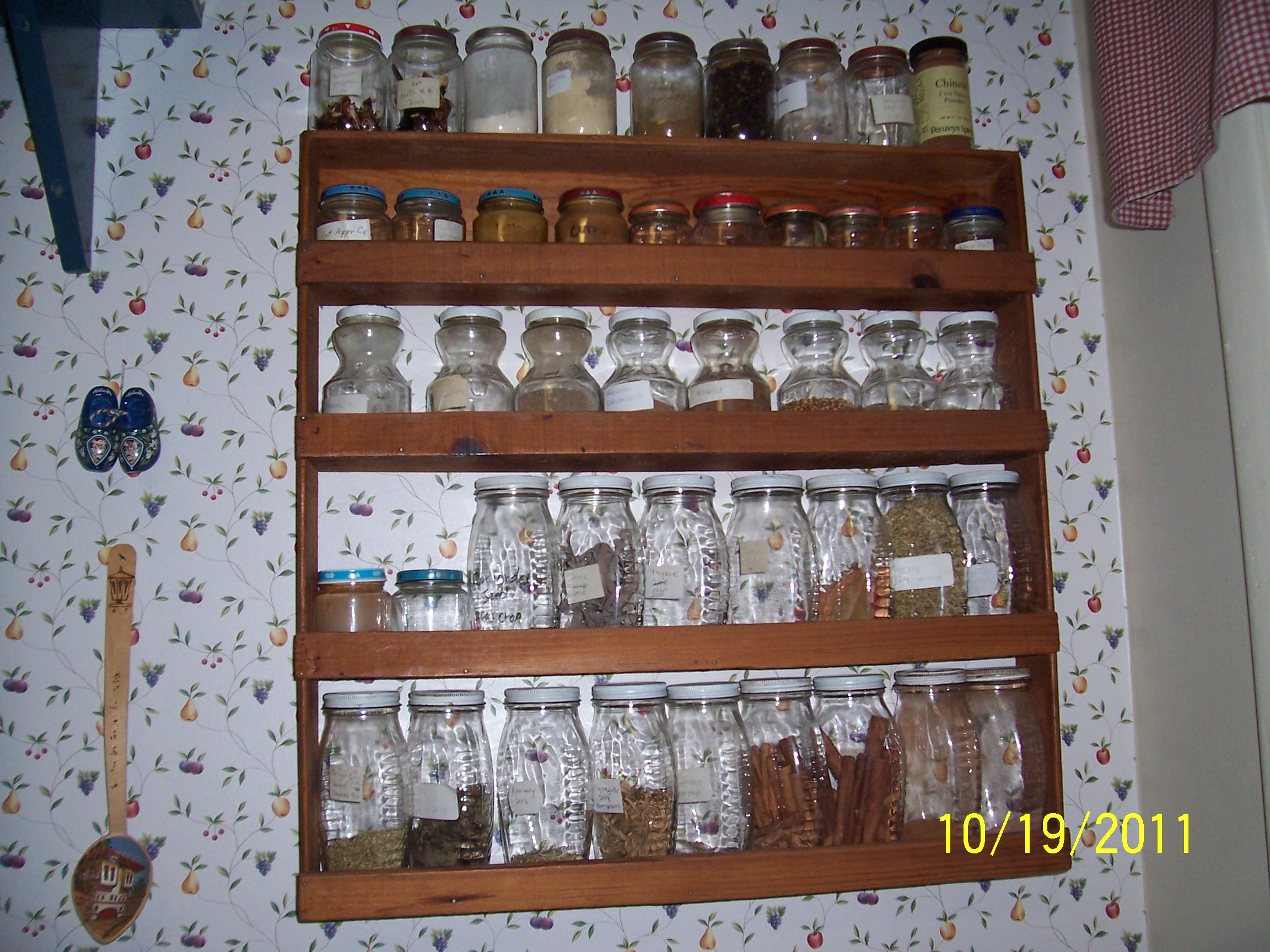
The most treasured remnant of impoverished student days is a homemade spice rack still being used in our kitchen that is seen in the picture. It was made from some rustic wood slats that came from an old wooden orange crate and is filled with sets of recycled glass jars of various kinds. This is one of the few times that my tendency to hoard all kinds of things, including used jars, paid off. It isn‘t a highly attractive item, but it has a ‘folksy’ look that keeps it from sticking out like a sore thumb. It could use some new better looking jars with better looking labels on them. This spice shelf is a well liked reminder of the days when we didn’t have much money. It can never be replaced.

What is your favorite piece of re-claimed furniture?

Over the River

Today’s guest post is by Clyde.

When we were raising our children, we lived in Two Harbors and my parents lived above the east end of Duluth, only about two miles from Hawk Ridge. Among the four ways we could drive to their house, our favorite was to take the Seven Bridges Road.

Here is YouTube of a song about the Seven Bridges Road:

In winter the Seven Bridges Road was plowed only part way up the hill. Thus for our traditional Thanksgiving Day drive to my parents house we would always take the Seven Bridges Road, assuming that it would ere long be closed. And a family tradition was born to sing as we passed over each of the seven bridges “Over the river and through the woods to Grandmother’s house we go.” As our children matured, one would always ask, “What’s another popular Thanksgiving song?” A question which still lacks an answer.

Why is that? Why are there not many popular songs for this second most American of holidays? Everything seems right for songs: the season, the purpose, the mood, the many items associated with the day. But no songs have arisen.

Also, serious writers of serious music, i.e. classical, often embody popular songs, i.e. un-serious songs, in their serious music. Have I missed it, or has no one used Lydia Maria Child’s “Over the River and through the Woods” in this way?

Another mystery: Her poem which provides the words to the song was called “A Boy’s Thanksgiving Day.” Why is her poem of her childhood memories called “A Boy’s Thanksgiving Day”?

Here are her words:

Over the river, and through the wood,
To Grandfather’s house we go;
The horse knows the way to carry the sleigh
through the white and drifted snow.

Over the river, and through the wood—
Oh, how the wind does blow!
It stings the toes and bites the nose
As over the ground we go.

Over the river, and through the wood,
To have a first-rate play.
Hear the bells ring, “Ting-a-ling-ding”,
Hurrah for Thanksgiving Day!

Over the river, and through the wood
Trot fast, my dapple-gray!
Spring over the ground like a hunting-hound,
For this is Thanksgiving Day.

Over the river, and through the wood—
And straight through the barnyard gate,
We seem to go extremely slow,
It is so hard to wait!

Over the river, and through the wood—
Now Grandmother’s cap I spy!
Hurrah for the fun! Is the pudding done?
Hurrah for the pumpkin pie!

Why the dearth of Thanksgiving songs?
Go ahead. Write one.

A True Friend

Today’s guest post is by Edith.

Some of my favorite books are the Frog and Toad books written and illustrated by Arnold Lobel: Frog and Toad are Friends, Frog and Toad Together, Frog and Toad All Year, and Days with Frog and Toad. If you have never read these, or have never read them to a child, you are missing out on one of the most delightful friendships in the literary world.

Here is an excerpt from from one of my favorite stories: “Spring” in Frog and Toad are Friends.

Frog ran up the path to Toad’s house. He knocked on the front door. There was no answer. “Toad, Toad,” shouted Frog, “wake up. It is spring!”

“Blah,” said a voice from inside the house.

“Toad! Toad!” cried Frog. “The sun is shining! The snow is melting! Wake up!”

“I am not here,” said the voice.

Frog walked into the house. It was dark. All the shutters were closed. “Toad, where are you?” called Frog.

“Go away,” said the voice from a corner of the room. Toad was lying in bed. He had pulled all the covers over his head. Frog pushed Toad out of bed. He pushed him out of the house and onto the front porch. Toad blinked in the bright sun. “Help!” said Toad. “I cannot see anything.”

“Don’t be silly,” said Frog. “What you see is the clear warm light of April. And it means that we can begin a whole new year together, Toad. Think of it,” said Frog. “We will skip through the meadows and run through the woods and swim in the river. In the evenings we will sit right here on the front porch and count the stars.”

“You can count them, Frog,” said Toad. “I will be too tired. I am going back to bed.”

Toad does go back to bed and is very adamant that Frog should not wake him until “half past May.” Frog, however, does not want to be lonely that long and cleverly figures out a way to convince Toad to get up that day. The story ends with this sentence:

“Then he and Frog ran outside to see how the world was looking in the spring.”

I relate to Toad. I love how he says. “Blah” in this story because although I may not say “Blah” very much, I sure feel like saying it. But Frog hauls Toad out of bed to find joy in the springtime and in that I find an example of a true friend who will not let his friend wallow in bed in a dark room when spring is bursting to life outdoors. I like how Frog and Toad just enjoy doing ordinary things together and revel in simple pleasures and how they think of ways to make the other happy.

What are some of your favorite literary friendships?

Whitey

Today’s guest post comes from Beth-Ann.

There is an albino squirrel in my neighborhood. My inner geneticist sent me to check him out to confirm his pink eyes and complete lack of pigment.

Most white squirrels are not albino. They have a pigment defect known as leucism. They cannot produce melanin, but because they do produce other pigments their eyes are colored and not pink.
Albino squirrels are rare not only because of the unusual nature of their mutations but because their associated vision problems and poor balance interfere with the needed squirrel life-tasks.

I am not the only one fascinated by albinism. In many traditional societies people with albinism were thought to be prophets and seers; while other societies isolated those without pigment because they were so different. Melville’s Moby Dick was inspired by a real albino whale.

I am equally fascinated by organisms of unusual colors.

I love talking to the sheep farmers at the State Fair about black sheep. Traditionally black sheep were shunned because their wool had little commercial value since it couldn’t be dyed. Now crafters actively seek naturally colored wool. Did you know that white sheep have pink tongues and black sheep have bluish black tongues?

Every year I journey to the Farmers’ Market to buy blue potatoes, purple and yellow carrots, and golden beets. I once made a salad with 5 colors of peppers and 4 colors of potato. I am glad that the seed catalogues arrive at my townhouse annually even though I have never had a garden. I peruse them in search of more unusual vegetables for my imaginary garden.

Whitey and I want to know, “How important is color in your life?”

Chester Gould’s Birthday

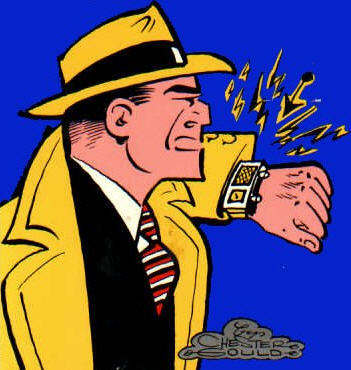
Today is the birthday of a guy with one weird imagination – the cartoonist Chester Gould, creator of the character Dick Tracy. Gould was born on this day in the year 1900.

I remember reading this comic strip as a kid and losing my way in the complicated parade of eccentric characters (Flattop, The Mole, Diet Smith, Mr. Intro) and strange plot twists. The relentless pressure of producing a daily comic strip for over four decades does not promote careful storytelling.

The part I remember best about Dick Tracy was how Chester Gould introduced unusual gadgets and devices into the strip, giving us the Two-Way Wrist Radio in 1946, which he upgraded to the Two-Way Wrist TV in 1964. Preposterous! Until five years ago, I was certain people would never be able to carry TV’s around in their pockets.

If we accept the idea that Chester Gould’s “space period” Dick Tracy was way out in front of our development of technology, expect to see magnetic levitation as a common method of travel across wide distances (Air Cars) and easy commuting to the moon (Space Coupe)! In fact, the story line had Dick Tracy’s adopted son (Dick Tracy Jr.) marrying a lunar resident (Moon Maid).

I admit I always liked the idea of magnet-powered travel. If it works for metal shavings on Wooly Willy, why not the rest of us?

Of course if Gould was a 100% correct predictor in everything he drew, men would have embraced the bright yellow trench coat long ago.

What’s your favorite comic strip?

Say (I’m not) Cheese!

The moon has finally been given its closest close-up ever – a technicolor shot that shows all its ridges, pockmarks and wrinkles in startling detail.

The magazine Wired says the map was created with a camera that you could hold in the palm of your hand.   If your hand was orbiting the moon (along with the rest of you) by going round and round over the poles. Probably not worth the trouble, since being thrust into such an inhospitable situation would make the size of the camera in your hand the least amazing detail of your airless, murderously cold, suddenly off-planet world.

The different colors are an alarming feature of this shot. They depict elevation with the white sections being highest.  Altitude then descends through the red, orange, green and blue areas, all the way down to the lowest of the lowlands – shown in violet. I don’t mind it that the moon has different elevations, but to see it looking like a hippie’s tie dyed bandana is unsettling.

Standard moonly gray goes well with all the settings on Earth and with each outfit in every wardrobe. That’s why our “traditional” moon is welcome everywhere as a nightlight or a backdrop. The gaudy moon we see in these new photos clashes horribly with … everything. You have to wonder if we would feel differently about our moon if it really had this electric beach-ball look.

And that complexion – Oh My! It seems as though Mr. Moon has not been spared a single cosmetic trauma. It makes me happy to have an atmosphere!

Would you sit for a close-up portrait, knowing it would show every flaw?

H.B., G.L.

It’s Gordon Lightfoot’s birthday today. He’s 73.

I enjoy “The Wreck of the Edmund Fitzgerald” as much as anyone can relish the re-telling of a terribly tragic event happening to other unfortunate people, but I think my favorite Lightfoot song is this one.

He refers to “an old time movie ’bout a ghost from a wishing well” as if that’s a standard film genre that everyone has seen to the point of fatigue. But I can’t think of a single movie with a ghost that comes out of a wishing well. Not one. Can you?

Speaking of the point of fatigue, I sometimes wonder what it’s like for musicians to perform their hits over and over and OVER AGAIN. Here’s Lightfoot doing the same song 27 years later, a few weeks after suffering a transient stroke that temporarily diminished his ability to play. And his voice has clearly lost its richness, but the song still has power.

This later, weaker version may be better in that it’s easier to picture Lightfoot as a ghost with that thin frame and quavery voice. This Lightfoot would easily fit through the opening of a wishing well, but could he climb out?

“If you could read my mind, love, what a tale my thoughts would tell” is a great opening line that leads to all that poetic talk about movie scripts rattling around his brain and book plots in hers, but how can he say “I don’t know where we went wrong …”? I do! You’re both trying to have a long term relationship with a mind reader!

And there’s no way that can work. Can it?

Ask Dr. Babooner

Dear Dr. Babooner,

I’m hopelessly attracted to brainy do-gooder types who are interested in art, education, community and philanthropy. I can’t help it. When the words “not-for-profit” are whispered in my ear, I feel lightheaded and all my pockets get turned inside out. Needless to say, I’m widely known as a giver.

Anyway, I had this crazy dream that all my nonprofit friends came to the door asking for desperately needed help on the Very Same Day! While others might be delighted at the attention, I felt totally overwhelmed. I ran down to my basement and hid behind the washer for an entire afternoon while the doorbell rang incessantly. When I finally emerged I was covered with dryer fuzz and spider webs and looked like a cross between The Mummy and a lint roller that had been donated to an animal shelter.

I was just about to go back to answering the door, worried that my friends would now find me frightening and repulsive, when I woke up. But it made me wonder if it could possibly be a bad thing that I am so compassionate and generous.

Caringly,
Gil Tripp

I told Mr. Tripp he shouldn’t let one bad dream change his supportive lifestyle. Just because a deserving nonprofit organization asks for help, that doesn’t mean you are a bad person if you don’t come across. Nonprofits can’t afford to judge you – they can only be grateful that you are a philanthropist. Your support of any nonprofit organization is cause for celebration by everyone who works for the benefit of all, even if they never get a direct contribution from you.

But that’s just one opinion. What do YOU think, Dr. Babooner?

Buried Treasure

Here’s a note from Tamara Kant-Waite, past president pro-tem of the Future Historians of America:

Dear Prospective Primary Sources,

The last time I wrote it was to encourage you to treat everything you touch as if it could be a valuable future artifact – something to be cherished and studied and puzzled over by the scholars of nexter-year. I’m back to make the point again because the future of our representation of the past is at stake! Our precious objects have lives that run parallel to our own, but many of those smaller metallic trinkets will last a lot longer than we do.

That belt buckle you’re wearing, for example. To you it may be a mere link in the ensemble that holds up your pants, but to Future Historians that hunk of metal could represent a tremendous breakthrough. A buckle that’s not at all like it was just found buried in Alaska and is being touted as proof that people migrated across a land bridge that linked present North America with Siberia! Imagine! Who knows what YOUR belt buckle, found 1,500 years from now, could prove? It might become the only piece of evidence that ancient upper Midwestern peoples who traded in the industrial/retail area near the Woman Throwing Hat Statue migrated, perhaps on a daily basis, out to the suburbs.

It’s hard to tell what parts of our built up and manufactured world will last, but real things tell stories. So spend some time today paying attention to the genuine objects that surround you. And then take some of these precious items out in your yard, and bury them.

Why? Because they will be received as gifts by Future Historians who may otherwise be condemned to sorting through our permanent e-mails, perpetual Facebook pages and indelible tweets. That’s bound to be dreary work. Which is why these yet-to-be-born historical investigators will silently thank you for your blessed offering of something tangible to examine.

Yours in the Fullness of Time,

Tamara

She has a point, but it’s hard to guess which of my most durable things might make a worthy discovery for the scholars of tomorrow. It would likely be the most mundane thing I have, which does not narrow the field much since everything I have is mundane.
A nail clipper, perhaps?

What will the archeologists find most interesting when they sift through the site of your house 1,500 years from now?

A Pie in the Face

The Tom Keith Hurrah on Saturday night was, as promised, a giddy romp. There were songs and jokes. There was cross dressing, juggling and magic. And Baboon(er)s were in the audience, alongside some other animals, if I could believe the sounds I heard people making.

To the right you can see our representatives from the Trail, courtesy of PlainJane from the West Side and her husband (the photographer). From left to right in the back row: Jim (Joanne’s husband), PlainJane, tim, Joanne, Anna, and engrossed in his book verrilee sherrilee’s s&h. In the front row, also from left to right: Linda, verrilee sherrillee,
and madislandgirl.

The smiles in this photo are an important sign of artistic success. The people who put the show together, Garrison Keillor, Dan Rowles, Kate Gustafson, Sue Scott and a host of other hard working APHC staffers and associated artists, insisted that the Fitzgerald theater be a eulogy-free zone for the night. There not much that words can add when you bring out the bagpipes, as they did for the show’s finale. What is it about that instrument that gives people permission to cry? Maybe the intensity of the sound simply drives emotions out of hiding, I don’t know.

And if that wasn’t enough – Pies Were Thrown. Or at least Pies Were Pushed Into Faces.

I wish I had a picture of the actual pies and the willing victim, along with some video of the hilarious clean-up process. Perhaps those will surface eventually here. For the audience, it was a delight, and a fitting tribute to Mr. Keith, who always wanted to please the crowd with laughs and amazements and then send them home happy. On Saturday night at the Fitz, his friends did just that.

Who deserves a pie in the face?