
Hypothetical Q. Blitzerman Speaks!

From the Tea Party Debate:

Wolf Blitzer >> You’re a physician, ron paul, you’re a doctor. You know something about this subject. Let me ask you this hypothetical question. A healthy 30-year-old young man has a good job, makes a good living, but decides I’m not going to spend 200 or $300 a month because I’m healthy, i don’t need it. But something terrible happens, all of a sudden he needs it. Who will pay if he goes into a coma, who pays for that?

Ron Paul >> In a society that you accept welfarism and socialism, he expects the government to take care of him.

Blitzer >> What do you want?

Paul >> What he should do is whatever he wants to do and assume responsibility for himself. My advice to him would have a major policy.

Blitzer >> He doesn’t have that and he needs intensive care for six months. Who pays?

Paul >> That’s what freedom is all about, taking your own risks. This whole idea that you have to prepare and take care of everybody —

Audience >> [applause]

Blitzer >> but congressman, are you saying that society should just let him die?

Audience >> [shouts of “yeah!”]

Weird exchange to be having in this day and age, but it does get right to the heart of the health care and spending question, doesn’t it! And then comes this clearly false message, lofted through the digital transom the same way that Nigerian Prince keeps asking me for money!

Hi, friend. Yeah, it’s me! I’m the guy Wolf Blitzer was talking about Monday night at that Tea Party debate. You know, the 30-year-old man who was feeling so good that he decided to skip buying health insurance, and then wound up in a coma? Pleased to meet you!

People are making a big deal out of the fact that Ron Paul would let me suffer the consequences of my inaction. And they’re making an even bigger deal out of the way that Tea Party crowd cheered for the idea that the Congressman would let me die. They’re being called heartless killers and a bloodthirsty band of modern Marie Antoinettes, except instead of “let them eat cake”, the motto is “let them stop eating totally, choke on their poor choices and decrease the surplus population,” which I’m pretty sure is something Dickens said, or one of his characters. I don’t actually remember. I had a pretty short life and didn’t have time to learn much. But enough about me – I’m just a rhetorical device.

There’s lots of hand-wringing over this episode, mostly from people who fear that we as a society have come to a very cold, brutal place where it is better to let people die than to think about an increase in government spending. But no one has asked me what I think! And I’m the one who’s going to be allowed to expire, right? And frankly, though this may surprise you, I think I deserve it. That’s right. It’s all my fault. I lived an uncharmed life. I made a bunch of mistakes. So let me die, already!

Before you start protesting, I have to tell you that my string of fatal errors began long before I decided to save a few bucks on health insurance. The first thing I did wrong was this – I allowed myself to be born without a name.

That’s right. I let God (in this case, Wolf Blitzer) create me as a fully-grown adult, destined to live only as long as it took for him to ask his question. I had no identity, no parents to speak of, no siblings, no spouse or domestic partner and no children. All I had was a good job, robust health, a cheapskate attitude, and eventually, a coma. That’s everything there ever was for me. No obligations. No connections. No one loved me and I made a bad, selfish decision. Who wouldn’t want to kill off a guy like that?

Regrets? I wish I’d insisted on a name. Even something as weird as “Hypothetical Q. Blitzerman” would have been good enough to bring a few of those Tea Party people over to my side. My folks might have named me “Hypothetical” because of the fruitless years they spent trying to conceive me. I’ll bet they couldn’t believe their luck when I finally arrived. I’m guessing I had siblings too. A spunky little sister, Antithetical (Ann) and an egghead baby brother, Theoretical (Theo).

I’d like to think I did OK in school, made lots of friends, played back up wide receiver on the football team, sang a song (badly) in the school musical, fell in the fountain at prom and ruined my rented tuxedo.

Before I got my good job I’ll bet I worked some truly lousy ones and probably served you a hamburger along the way. There was a time when a fishing pole and a sleeping bag were the only possessions I cared anything about. Until I met this girl who wasn’t impressed with my aimless life. So I finished school, got married, got that job and got her pregnant, all in a few, short, crazy, wonderful years. Of course I felt invincible, so when we made up the family budget we put hundreds into health care for her, and I used my health money to save for a house, instead. Calculated risk.

Did I mention I was never very good at gambling?

Anyway, things went wrong and who do I have to blame but myself? Yeah, Wolf Blitzer brought me into the world but I made all the critical mistakes. I should have insisted that my “good” job have health care attached. How else can you call it “good”? And I should have demanded that he give me a name, some friends, and a few relations.

I’ll bet if Wolf had put my brother Theo in league with the Libertarians or made my sister Ann a leading light in the Tea Party movement, they would have at least paused for a moment before shouting out their enthusiastic support for my needless, premature death.

Like I say, it was totally my fault.

If Wolf Blitzer and Ron Paul were about to bite into Turkey Burgers tainted with Salmonella, could the government regulation-forced recall come quickly enough to save them? Should it?
A Financial Fable

A late comment posted yesterday by Donna in response to Bubby Spamden’s first-week-of-school quandary runs the risk of going under-appreciated, so I thought I’d better bring it to the top of the queue for today.

If you recall, Bubby was trying to make sense of his Personal Finance class, as taught by Mr. Boozenporn.
Part of his confusion was fostered by Mr. Boozenporn’s odd focus on building good checkbook habits. Bubby (and everyone younger than him) is in the no-checkbook generation – a group Donna knows well in her day job as a first grade teacher.

She also knows a thing or two about story time:

Bubby should forget about paper altogether and exchange it for gold. And then he should take most of the gold and spin it into straw. And then he should buy goats. And then he should take what’s left and buy just enough yarn to knit one single goat sweater because now it’s winter. But he should leave the work undone because it’s BUBBY for God’s sakes! And on this cold December night Bubby’s barn will be visited by a pair of pixies and they will knit the most beautiful goat sweater the north woods has ever seen. The next morning a happy wandering stranger will yodel up to the barn and buy the sweater for DOUBLE Bubby’s asking price. And then Bubby will buy enough yarn for two goat sweaters, and again the pixies will knit them and they’ll be even more beautiful than the night before. And this scenario will continue night after night, and Bubby will buy more yarn and then more goats and then more yarn and then more goats and then more yarn and then more goats and more yarn and more goats until he realizes he’s forgotten to spend any money on feed and the goats have starved to death. OH NO – BUBBEEEEEEEEY!!!

The moral of this story, Baboons?

Smart About Money

I found an early-morning missive from an old friend – Bubby Spamden, perennial sophomore.

Hey Mr. C.,

Well we’re in the second week of school already, and believe it or not after all the years I’ve spent as a sophomore at Wendell Wilkie High School, I am finally taking a class I’ve never taken before – Personal Finance.

I guess the bigwigs on the School Board decided last summer that we are all as dumb as toads about money, and they decided to make room in the schedule for us to get trained about goal setting, budgeting, savings, credit, insurance … all that financial stuff that even our parents don’t know anything about.

Well, mine, at least.

But they couldn’t think of a way to work it into the crowded school day that’s already full of stuff we have to study so we can pass our tests so our school doesn’t get labeled with the scarlet “L” for LOSER School, which is a title most schools are going to wind up being anyway, I guess, on account of No Child Left Behind.

So they decided that everybody would get 15 minutes of Personal Finance training at the beginning of the day in homeroom. Every day. And the homeroom teachers have to teach it.

My homeroom teacher, Mr. Boozenporn, says the “15 Minutes A Day” approach is actually a really good pattern to use for savings – take a little bit each time but do it every single day, and before long you’ll be filthy rich. Actually, what he really said was a smart savings plan would take a very, very long time and at the end you would NOT be filthy rich, but you might wind up being NOT TOO POOR, which would come as a surprise for a lot of us because (speaking for me, personally), poor is definitely what I expect.

Anyway, everyone agrees that Mr. Boozenporn is a great choice to teach this class because a lot of it has to do with not giving in to impulsive behavior, and kids say that when he’s away from school, Mr. B. is kind of an expert on impulsive behavior. He’s got some vices involving a handful of places clustered on this one block downtown that we kids can’t get into, but he is seen going in and out those doors a LOT. Which surprises me because the cover charge for a couple of them is really steep, and he’s just, you know, a teacher. And no, I did not sit across the street and watch all the comings and goings. But somebody else might have.

So Mr. B’s first personal finance lecture was about keeping track of your checkbook – making sure you stay up to date on your entries and remembering to write down the check number and then reconciling, like, every week, and making sure all the checks are accounted for in the bank statement and stuff like that. It was all pretty understandable except I did come away from it with just one nagging question :

What’s a checkbook?

Your pal,
Bubby

I told Bubby that a checkbook is like having an iTunes account at the bank, except instead of only being able to buy songs and apps and stuff, it can be used for almost anything. As long as it’s a thing sold by people who accept checks. How you find them, I’m not sure.

What one personal finance rule should Mr. Boozenporn teach the children?

Attitude and Altitude

There will be a lot on TV, radio and in the papers this weekend about the 10th anniversary of 9/11. There already has been. And it’s important. The memory of what happened that day cannot be erased, and the victims must be honored. Though for some of us, it feels presumptuous to make a big fuss over any anniversary of that dark day – as if 9/11 is something that’s actually over.

Amid all the talk about how we’ve changed in the past decade, essays about fear and ruminations on security, my favorite piece is actually this sound-and-photo essay from the NY Times about a way in which we’ve not changed. Ironworkers are building a new tower, and perhaps this is the most meaningful observance of the 9/11 anniversary – a bird’s eye view of Manhattan, as seen by blue collar heroes and a fearless photographer, perched on the top floor of an ambitious, unfinished construction project.

At one time or another, everyone has to force themselves to “not look down” in order to get the job done.

Examples?

Pen Name de Plume de Jour

Today’s guest post is by Clyde.

I just read From the Fair, the delightful autobiography of Sholom Aleichem, the Yiddish author of the Tevye the Milkman stories and many others. If you like Fiddler on the Roof, you might like to get a deeper feel for the world of Tevye and his village. You might also like to read the original stories, which are if anything more charming than the musical. He writes the autobiography in third person, even though he repeatedly makes it clear it is his own real life story, which adds another dimension to the narration.
Reading the book has inspired me to get back to work on my long-neglected fictionalized story of my childhood, wishing I had anything like his narrative gift.

Aleichem, whose life was contemporaneous with Mark Twain, was often called the Yiddish Mark Twain, to which Twain responded, “Tell him I am the American Sholom Aleichem.” They shared much in common, such as an allegorical pen name. Twain’s name means essentially “safe water” in steamboating terms. Solomon Naumovich Rabinovich chose the name Sholom Alecheim because it is both the common greeting in Yiddish and a blessing of peace upon another person. Their chosen names also have a sonorious ring to them.
Both men were mostly self-taught, were raised in poverty in backwater villages, survived many family tragedies such as the death of a parent in childhood, made and lost a couple of fortunes due to bad investments, and were very successful public speakers. Both were brilliant at characterization, were masters of dialogue especially dialects, and did much to invent the literature of their culture.
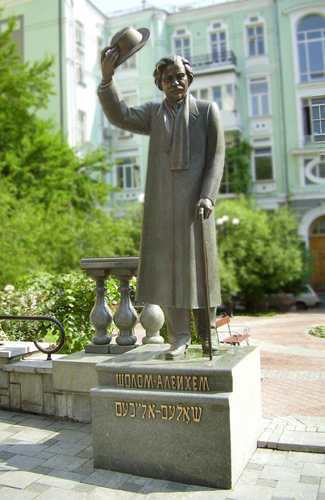
I have included a photo of the statue of Aleichem in Kiev. It is wonderfully ironic that Russia and Kiev honor him this way, considering how the tsarist regime treated Jews and that Aleichem had to hide when he lived in Kiev because he did not have a license to live there, as required of all Jews.

Unlike Twain, Aleichem was deeply religious and superstitious. For instance, his tombstone in New York City lists his death date as May 12a, 1916 because he was afraid of the number thirteen. He died too young before finishing From the Fair. The abrupt ending is unsatisfying, but well, L’Chaim to his life and all of ours.

If you were to use a pen name, what would it be?

Try To Remember

Today’s guest post comes from Beth-Ann.

September has always been my favorite month. Now I’m not so sure. Maybe I loved the ninth month because it hosted my birthday, but I think I favored it because I have always loved school.

The day after Labor Day always seemed to be New Year’s Day. A new school year was a new beginning. We didn’t do a lot of shopping when I was growing up, but I clearly remember shopping expeditions for school clothes. There were those crisp new dresses with the itchy crinolines that we begged mom to remove with her vicious seam ripper. Even more emblematic were the new school shoes-always leather and either tied or buckled because loafers were verboten until sixth grade. Of course we wore our new duds even though I grew up far south of here where it was too warm for long sleeves or corduroy.

When we got to school the magic continued. It wasn’t until after we arrived that we learned the names of our teacher and our new classmates. Hope lived eternal for “the nice teacher” and a class without mean boys. We got new books or at least new used books and got to write our names in them.
Frankly I found summer boring and was glad for September and a chance to get back to a building with spelling bees, good grades, and library books. We got our supply lists and got to go buy new notebooks, crayons, and pencil boxes.

I remember September with the sweetness of “The Fantasticks.”

My enthusiasm for the golden month with blue skies re-ignited when my son was young. I found the start of school more fun than he did, but he always liked camp more than school.

My heart no longer goes pitter pat as August ends. As much as I love the Fair, I am careful not to go on the Last Day in order to avoid seeing the end of summer and the beginning of September. Even though I have the wistful fondness for the sweet month in Jerry Orbach’s song, I know it is the dread gateway to the nasty, short gray days of a loong Minnesota winter. The cold future dulls even the blue sky and the taste of rich ripe tomatoes.

How do you remember September?

Traveling in Yungus

Today’s guest post is by Jim in Clark’s Grove.

A few years ago I was given an agricultural volunteer assignment in the Yungus region of Bolivia by a non-profit organization, ACDI/VOCA. Yungus is a region of Bolivia located in the mountains East of La Paz. I was asked to help a small export company control bean weevils that were attacking black beans which this company was introducing as a crop. Many Yungus farmers grow coca as their main crop and were interested in growing black beans.

Coca is a legal crop in Bolivia. Illegal production of cocaine from coca is discouraged. I passed through several control points where checking was done for chemicals that could be used to manufacture cocaine. Dried coca leaves, which are chewed by some Bolivians, are sold locally. Coca tea is given to people to help them with altitude sickness. I drank some coca tea and didn’t experience any change in mood that you might expect from cocaine.

My trips to visit bean fields involved traveling on very narrow mountain roads and walking up long steep trails. Part of the time we traveled in taxi cabs that went very fast on the winding roads. I was extremely frightened by the taxi rides until I got use to traveling in those cabs. On the trails I was barely able to keep up with my party and then only if they slowed down. It was my good luck to have a bright young translator and a good natured representative of the export company as my traveling companions. They maintained their good humor throughout the trip.

I visited a wide selection of the farms that were growing black beans. These farms were located near small villages that had facilities for travelers which were not always in great shape. There was usually a nice small park or town square in the middle of these villages. Citrus grew along the edges of roads and trails. The fruit on these trees was freely available to eat by all who passed by. Chicken was the main dish served locally and it was often served with quinoa soup, rice, and cooked plantains. In some places we used a translator who could speak a language used before the arrival of Europeans. Some woman wore the traditional colorful skirts seen in many pictures from this part of the world.

This trip was a great adventure. I have many fond memories associated with my visit to Bolivia. I was highly impressed by the political climate. The President of Bolivia, Evo Morales, is a former coca farmer who had been involved in political organizing in rural areas. Some people were creating a problem for Morales by demanding a change in the location of the government. During my stay a rally of more than a million people was held to provide support for Morales. The head of the export company that I was helping said that Morales was the best hope the country had for solving its many problems.

I very much enjoyed my trip to Bolivia in spite of the difficult traveling conditions.

Do you remember having a lot of difficulty on a trip that turned out well in the end?

Research Associates Wanted

Believe it or not, sometimes I spend an astonishing amount of time trying to find an appropriate topic to feature in a Trail Baboon post.

It’s not that there’s a lack of interesting topics to cover, it’s just that every idea raises questions, and those questions lead to other questions, and partial answers lead to different questions, and then there’s a funny You Tube video of a cat that barks like a dog, and somebody mentions a book that I want to find at the library, Michele Bachmann just said something remarkable, and suddenly it’s midnight. Dang.

Why do I engage in so much aimless, randomly guided research? I like to have all the information and questions answered before getting started on a post, which means I never get started on a post. And towards what purpose? It’s not like writing a blog post is about KNOWING anything. Far from it.

So instead, I offer you a question to consider. It’s something I’m wondering about but frankly, spending ten minutes looking for the answer convinced me that I would soon spend another 90 minutes at it, possibly all within the next half hour. And when it was done, I would have nothing to show for it except an even larger sleep deficit and whatever trinket I might buy on Amazon in the process.

Today is the anniversary of the attack on President William McKinley by Leon Czolgosz, an anarchist who felt he could change the government by taking out one guy. Czolgosz approached McKinley at a reception at the Temple of Music in Buffalo, NY. He held a revolver wrapped in a cloth, and shot McKinley twice as the President reached out to shake his hand. There might have been a third shot, if not for quick action by three men who were nearby. Here’s the NY Times account from September 7th, 1901.

There was an instant of almost complete silence, like the hush that follows a clap of thunder. The President stood stock still, a look of hesitancy, almost of bewilderment, on his face. Then he retreated a step while a pallor began to steal over his features. The multitude seemed only partially aware that something serious had happened.

Then came a commotion. With the leap of a tiger three men threw themselves forward as with one impulse and sprang toward the would-be assassin. Two of them were United States Secret Service men, who were on the lookout and whose duty it was to guard against just such a calamity as had here befallen the President and the Nation. The third was a bystander, a negro, who had only an instant before grasped the hand of the President. In a twinkling, the assassin was borne to the ground, his weapon was wrested from his grasp, and strong arms pinioned him down.

McKinley later died of his injuries, and Teddy Roosevelt became President.

But here’s the piece of the puzzle that interests me – the brave bystander. We hear time and again that in a moment of crisis there is confusion, silence, paralysis. It’s the rare individual who leaps into action and in the attack on Mckinley, one person did, alongside two Secret Service Agents. Until tonight, I’d never heard anything about him.

Is that our man in the center of this drawing by T. Dart Walker?

Who was he? What, if anything, was written about him? Tell me Baboons, if you can, about this quick thinking bystander.

Or, if you don’t have a day to waste on this, tell us about your most successful research project.

R.I.P. Joe Hill

It’s Labor Day Weekend. Apologies for the late post, baboons. I slept in. I was up and walking around, but my brain was not “online”.

Trail Baboon will take a brief hiatus for the holiday and return with a fresh post on Tuesday.

Here’s a song for Labor Day – the famous union activist rallying song, “Joe Hill”.
References to this tune usually mention Joan Baez, and there’s no doubt, she’s great.

But for my money, the quintessential version of Joe Hill is this one, done by the incomparable Paul Robeson.

Interesting that in this time of diminishing influence for organized labor, a new book is out about Joe Hill. William A. Adler’s biography of the Union icon has been reviewed favorably in the New York Times (pinkos!), and with cool reserve by the Wall Street Journal (fat cats!).

Invariably the headline that goes with any review is that this new book presents evidence that Hill, a labor activist executed for murdering a Utah grocer in a botched robbery, was framed.

Maybe. Maybe not. Why didn’t he use the evidence to exonerate himself? One argument is that he realized his fame as a martyr was more valuable to the union cause than his own life. Hill is said to have encouraged his executioners to “Aim” and “Fire”!

It’s hard to imagine anyone taking such a dispassionate view of a fatal choice, but if I knew that cueing the firing squad would eventually get Paul Robeson to sing an unforgettable song about me, I might understand.

Who would you choose to sing the heroic ballad about you?

Ghost Town

A few lines of ultra-light verse for the Friday before Labor Day.

The Summer’s almost over now.
The season slipped away.
That’s why I’m leaving poems
on my schedule for today.

I’m leaving after lunchtime
and I won’t be back at all.
I’ve got a meeting to attend
due east of West St. Paul.

It has to do with hamburgers
and chips and cheese and beer.
A very urgent meeting, yes.
If not, I would stay here.

It’s all about the water
in the lakes where people play.
inflatable flotillas
might be launched. It’s hard to say.

I’ll have to handle worms today
and poles and fish and dirt.
It could get very messy.
I will have to change my shirt.

My sacrifice is willing.
As to that, please have no doubt.
That is why I’m leaving early.
I’ll be working. But I’m out.

Ever cut out early on a late summer Friday?