
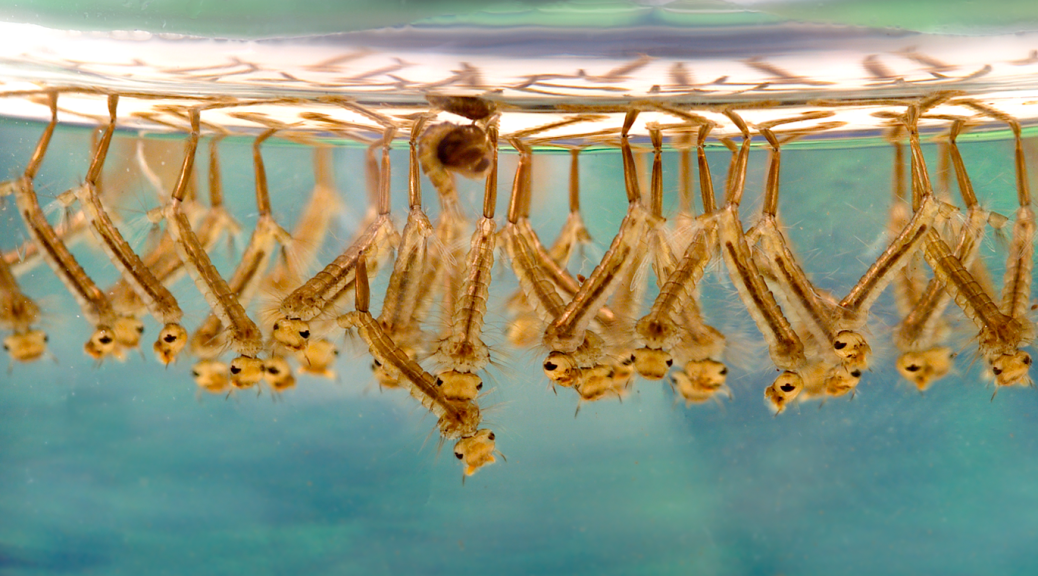
Header Image: “Culex sp larvae” by (Image: James Gathany, CDC) Licensed under CC BY 2.5 via Wikimedia Commons.
Today’s post comes from marketing maven Spin Williams, who is always in residence at The Meeting That Never Ends.
One of the top restaurant marketing trends of 2015 is locally sourced, organic foods.
If it’s local, people are fascinated. Why? Because a lot of them have no idea food can be grown nearby. That all connects to the concept of going “out” for dinner, which the baby boomers learned to think of as an exotic treat when they were growing up in the hardscrabble 1940’s and ’50’s.
“Out” was always a better place to get a meal than at boring old “in”, where mom was likely to serve up the same gray meatloaf or chicken hotdish again tonight.
“Out” might bring you an exotic choice like chicken wings, or at least the chance to have a milk shake with your meal. The chances of that went way up if dad ordered a beer.
The message to impressionable youngsters of that era – the farther “out” you went, the better the meal.
But yesterday as we were going over the latest science stories at The Meeting That Never Ends we saw this bit of research about how mosquitoes choose who they’ll bite. The clear indication is that the little pointy-nosed critters are lured by something genetic that is shared among families!
The assumption here is that it’s a fundamental element of body odor. Identical twins were found to be equally attractive to the tiny bloodsuckers of summer.
A couple of great marketing ideas quickly came out of this.
My favorite – identify particularly scrumptious bloodlines and present them as “decoy guests” for hire at high-buck summertime parties. If we know mosquitoes love those Johnsons, or just can’t get enough of the Herrera sisters, hire them to draw the swarms away from the more important invitees.
The downside?
Having to segregate the bait people from the rest, and possible lawsuits over West Nile Virus.
But then we realized something else – if we completely disregard the scientific method and turn this research on its head, it could be an early indication that the reverse is true and people also have genetic predispositions to like certain foods!
For restaurateurs, that means there is this tantalizing future scenario – when guests arrive they check in at the hostess stand and are given a quick DNA test to determine their pre-ordained dining tendencies.
That person then receives a menu tailored to their genetic food preference profile! Imagine – a restaurant that could hand you a menu where you’ll like absolutely EVERYTHING!
Would you go there?
Of course you would, as long as your family doesn’t also have an inherent fussiness over things like genetic privacy.
Our bet is that most people will be perfectly fine with it, and the establishment could also work some side agreements with marketing firms to get a secondary income on the data!
Yes, we realize that people get particularly overwrought about misuse of personal information. But for the most part, when our data is harvested we don’t even know about it, so the pain is nearly invisible.
The only obvious downside we see for consumers in this would be a tendency for restaurants with outdoor seating to put especially tasty people in a separate area, to draw away the attention of any needle-nosed intruders!
Yours in Marketing,
Spin
Do you come from an especially flavorful family?


 Trail Baboon
