
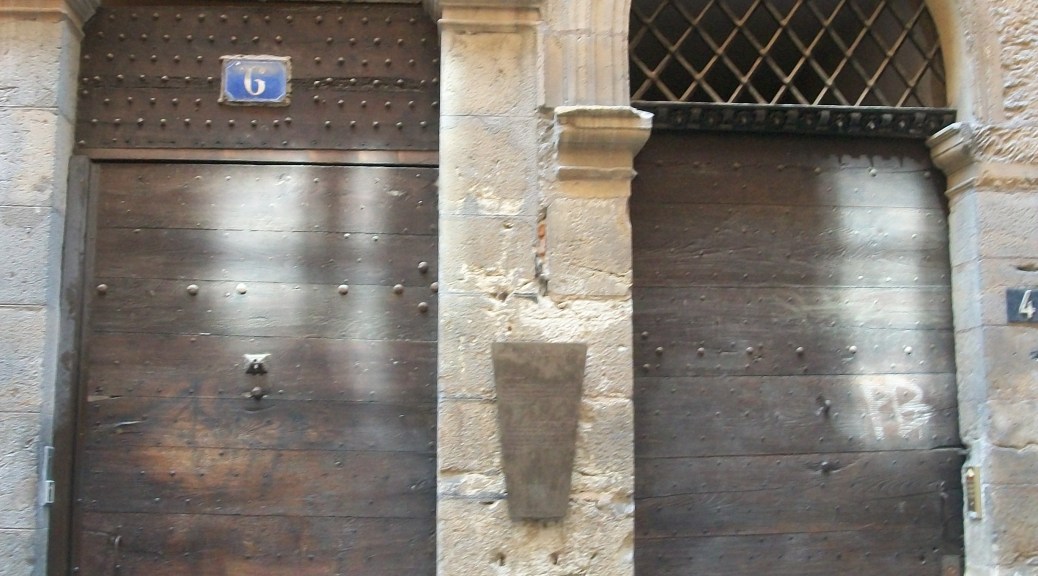
Today’s guest post comes from Barbara in Robbinsdale.
I have loved secret passageways and other hidden places since I was a very little girl. The first house I remember had a bedroom closet that my mom fixed up as a play house. I remember a hanging light bulb and unfinished attic-y floorboards covered by an old rug; I could touch the rafters of the sloping ceiling… my first hidden place. The other upstairs closet was long and narrow, and I liked how it connected to my folks’ bedroom right next door… my first secret passage.
As I grew older there were more hidden places: the house my grandpa built with its “secret staircase” to the attic, cleverly tucked into a bedroom closet; a friend’s house where the bookcase in the main room <i>was the door to the up-stairway</i>! Heaven. Closets under stairways, pull-down attic staircases, “forts” under pine trees, pedestrian tunnels under busy streets… I’ve always been drawn to these.
So imagine my delight when, on a walking tour in Lyon, France in early May, we came upon the Traboules (originally from the Latin ‘transambulare’ , meaning to cross, pass through).
In the 15th and 16th centuries during the height of Vieux (Old) Lyon’s silk trading with Italy, city planning was not at its best. Most streets ran parallel to the river, making it pretty difficult to get from one street to the next without taking a long detour. Merchants and Italian architects created, between the courtyards of the buildings, a network of passages – usually hidden by doors that were used as the outer entrance to the apartment buildings. They were then used by both the hard-working and the indolent.

Many of these passages still exist, and some of the available entrances are now marked with a plaque (as between the two doors in the photo); others look very ordinary. Often there is a set of mailboxes in the courtyard behind these doors. These were used by the French Resistance during WWII – perfect locations in which to exchange messages.
What is (or was) your favorite hiding place?
 Trail Baboon