
One of the surprises that came out of my recent trip to Fort Myers was discovering the remnants of the Koreshan Unity Settlement – a Utopian community established there in 1894 by a charismatic leader named Cyrus Teed, who believed in some fairly progressive things including the educational value of artistic expression and full equality between the sexes.
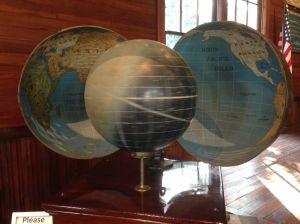
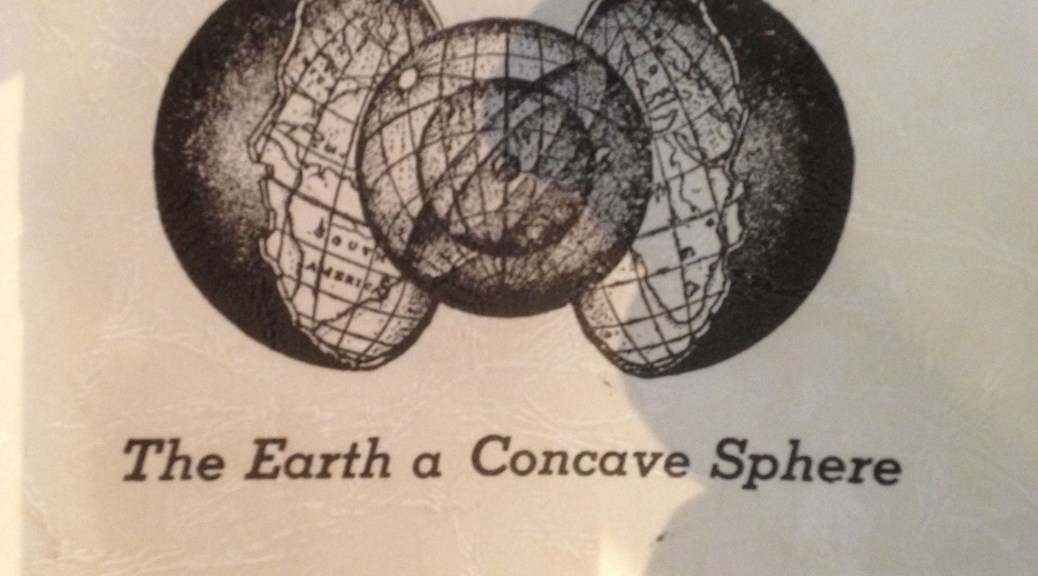
But there was at least one thing major thing he got wrong. Teed preached that the Earth was a hollow sphere, and we lived inside it. He thought the globe that we know so well was actually inverted – with the continents pasted around the underside of the curve. Looking up (or inward), you would see a revolving ball of gas that was layers thick, only allowing us to view the refracted rays of the sun, located at the center. The sun, rotating once each 24 hours, was light on one side and dark on the other – thus giving us day and night.
The land beneath our feet was also layered, but digging through it would eventually bring you to the outside of the sphere, beyond which there was … nothing.
Teed and his followers considered the commonly accepted idea of a limitless universe with humans living on the outside of the globe under a distant sun and with planets and stars all whizzing around in their own orbits as inherently chaotic and unknowable, putting God beyond the reach of human understanding. Teed said the Koreshan system “… reduces the universe to proportionate limits, and its cause within the comprehension of the human mind.”
Easily said, though it didn’t take very long for his book, The Cellular Cosmogony, to lead this particular human mind to a state of exhaustion. Still, I would love to have a t-shirt featuring their motto – “We Live Inside!” After all, it’s not that different from the philosophy of Minnesotans in January.
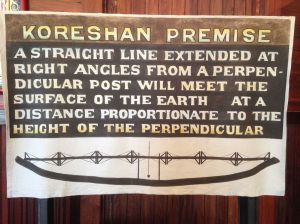
The Koreshans went to great lengths through observations and experiments and words, words, words to support their notion that the wide horizon visible off the Florida coast actually curved up with a smile, rather than down with a frown.
Cyrus Teed died in 1908 and while his utopian settlement lingered for a few decades it eventually faded away. A prime directive of complete celibacy for the most ardent followers of Koreshanity might have had something to do with that. The last Koreshans gave their vast tract of land to the State of Florida in 1961 which allowed for the establishing of a state park.
What impressed me most in this brief encounter with Cyrus Teed and his philosophy was the power a charismatic person with absolute conviction can have over others who are less certain in their beliefs; and once convinced, the amazing ability we humans have to cling to ideas that are completely and obviously wrong.
How do you know you’re right?
 Trail Baboon