Tag Archives: Music

Happy Trails

Happy Monday, Baboons!
I had a nice, artful post prepared for today, all based on the idea that a Deficit Ceiling Deal would still be nothing more than an elusive fantasy. Oh well. My loss is everyone’s gain!

Fortunately, faithful regulars are standing in the wings with prepared entries.

Today’s guest post is from Plainjane from the West Side.

I don’t know how often these two artists have appeared in the same sentence, but I find it striking that one, Bill Morrissey, who I’ve enjoyed for years, should pass at the same time as one, Amy Winehouse, who I was mostly aware of because of her notoriety. Clearly both were tremendous talents and very troubled souls. Bill’s autopsy blames a heart ailment, but it is widely known that his health was damaged through years of alcohol abuse. In Amy’s case, she struggled publicly with addiction. I think of her as the English Janis Joplin.

I’ve read the comments on Facebook about both of those deaths, and I’m truly saddened by the lack of compassion expressed by some of my younger “friends” at Amy’s passing. I’m guessing that the more compassionate remarks about Bill’s death has to do with the age of the commentators.

I’ve been pondering the connection between creative genius, talent, mental illness and addiction. We have so many examples of people with extraordinary talents that have led, by most ordinary definitions, miserable lives.

Depression seems rampant among many of the creative people I admire the most, and I’m wondering whether there’s a connection between the sensibility that allows you to immerse yourself into the pain of others and the creative urge. Although I’ve never counted, I’m guessing that there are far more love songs written about love gone wrong or betrayal than falling in love.

And unless you’re a fan of “True Romance” I’m guessing that most of us think of conflict and pain as a very real part of life and great novels.

I love happy endings, but at the ripe old age of 68, I’ve come to the conclusion that truly happy endings are uncommon. One of the most idealistic love songs that I can think of is Bill McCutcheon’s “Last First Kiss, written as an anniversary gift to his wife. It’s lovely, but you have to ask yourself if many real relationships actually fit this description:

Sunday morning, coffee’s on
The kids are gone
I’m thinking of that moment when
All you had to do was speak
My knees went weak
Yeah, I’m twenty-two years old again

You were my last first kiss
I never imagined love could be like this
You are the woman I still can’t resist
You were my last first kiss

That Friday night at your front gate
It was getting late
A long, slow walk home from the dance
You said you had a real nice time
Slipped your hand in mine
I closed my eyes and took a chance

Been to heaven
Been through hell
Since I gave you that ring
Now heaven knows
I wouldn’t change a thing

Sunday morning, coffee’s on
The kids are gone
I’m thinking what a ride it’s been
Still all you have to do is speak
My knees go weak
I’m twenty-two years old again

©2001 John McCutcheon/Appalsongs (ASCAP) & Steve Seskin/ Larga Vista Music/ Scarlet Rain Music ( ASCAP)
Swannanoa, NC July 2001

Compare that to the distance and lack of communication that mark the relationship described in this Bill Morrissey song – “Birches”.

Which seems more “real” to you? And does “reality” matter, when it comes to art?

Steerage Song

Today’s guest post is by Beth-Ann.

Early this month, Dan Chouinard and Peter Rothstein premiered a musical docu-drama (Peter’s word) telling the story of immigrants who traveled through Ellis Island. Steerage Song is a powerful homage to what is lost and gained by immigrants.
Beautiful voices sang the words from Emma Lazarus’ poem inscribed at the Statue of Liberty

“Give me your tired, your poor,
Your huddled masses yearning to breathe free,
The wretched refuse of your teeming shore.
Send these, the homeless, tempest-tost to me,
I lift my lamp beside the golden door!”

And like John McCormack in this video the talented cast sang about the Beautiful Isle of Somewhere.

I was moved by this production for many reasons, but one of the big ones is that I am from an immigrant family. All of my great grandparents, my grandmother, and my son are immigrants. They came from Ireland, Russia, Germany, Austria , and Korea to this foreign land where they learned a new language, new jobs, and how to add their potatoes, kreplach, and kimchi to the melting pot that is America.

I am also a migrant. I was born in Japan on American soil and didn’t come “home” until I was 9 months old. Since that time I have lived in Michigan, New York, North Carolina, Virginia, Maryland, Massachusetts, and Minnesota. I think this Land of 10,000 Lakes in My Isle of Somewhere.

We are all immigrants and some of us are migrants too.

What has been your family journey lit by the lamp at the golden door?

That Special Something

What is it in a great musical performance that touches our emotions?

Dunno. Something special. Costumes? Smoke bombs?

That’s the full extent of my personal scholarship on this matter, and one of the reasons I find it very difficult to write about music. Fortunately there are scientists who can’t shrug at a mystery. Some of them have taken a closer look, trying to understand what makes music expressive.

It’s an important question, especially in the age of auto-tune, when so much attention is paid to whatever Lady Gaga is wearing on the latest awards show.

I know people who cringe at the thought of scientific investigations into the fundamentals of art, worried that the process of picking apart a beautiful thing essentially kills it, and that we’ve got more than enough technology being applied to music as it is.

Maybe so, but it’s a great relief to hear, after laboratory-based manipulation of recordings, detailed surveys, exhaustive experiments and thorough brain scans, that the machines have indeed detected something significant.

It’s the human element that makes all the difference.

Variations, limitations and “imperfections” matter greatly, and a machine can’t improve the power of a skilled pianist’s performance. Some of the most interesting research is described in Pam Belluck’s article in the New York Times. The piece is lengthy but well worth the time.

The story includes some great quotes from Paul Simon about the mechanics of a song, which led me to this video made in Zimbabwe more than 20 years ago, when Simon (who will play in Minneapolis on May 2nd) performed “Diamonds On The Soles of Her Shoes” with Ladysmith Black Mambazo. There’s great spirit and choreography from the South African vocal ensemble, and watching it cleansed all that scientific thinking from my mind.

What’s the best performance you’ve seen?

Keepers of the Flame

Today is set aside to honor one of the most beleaguered sectors of our retail economy – the small independent record store. Special events are underway at nearly all the economically pummeled and most certainly doomed establishments. For years it has been an article of faith that the shop you go to when you want to physically peruse an assortment of non-mainstream recordings will soon be extinct.

So think of this as the day the Dodo Bird decided to have an open house. How will you feel about yourself the day after you find out he’s gone for good? And you didn’t even visit when you had such a nice invitation!

Having said that, I must note that there are many small shops that continue to defy these dire predictions and (knock on wood) always will. They enrich our communities and give us hope.

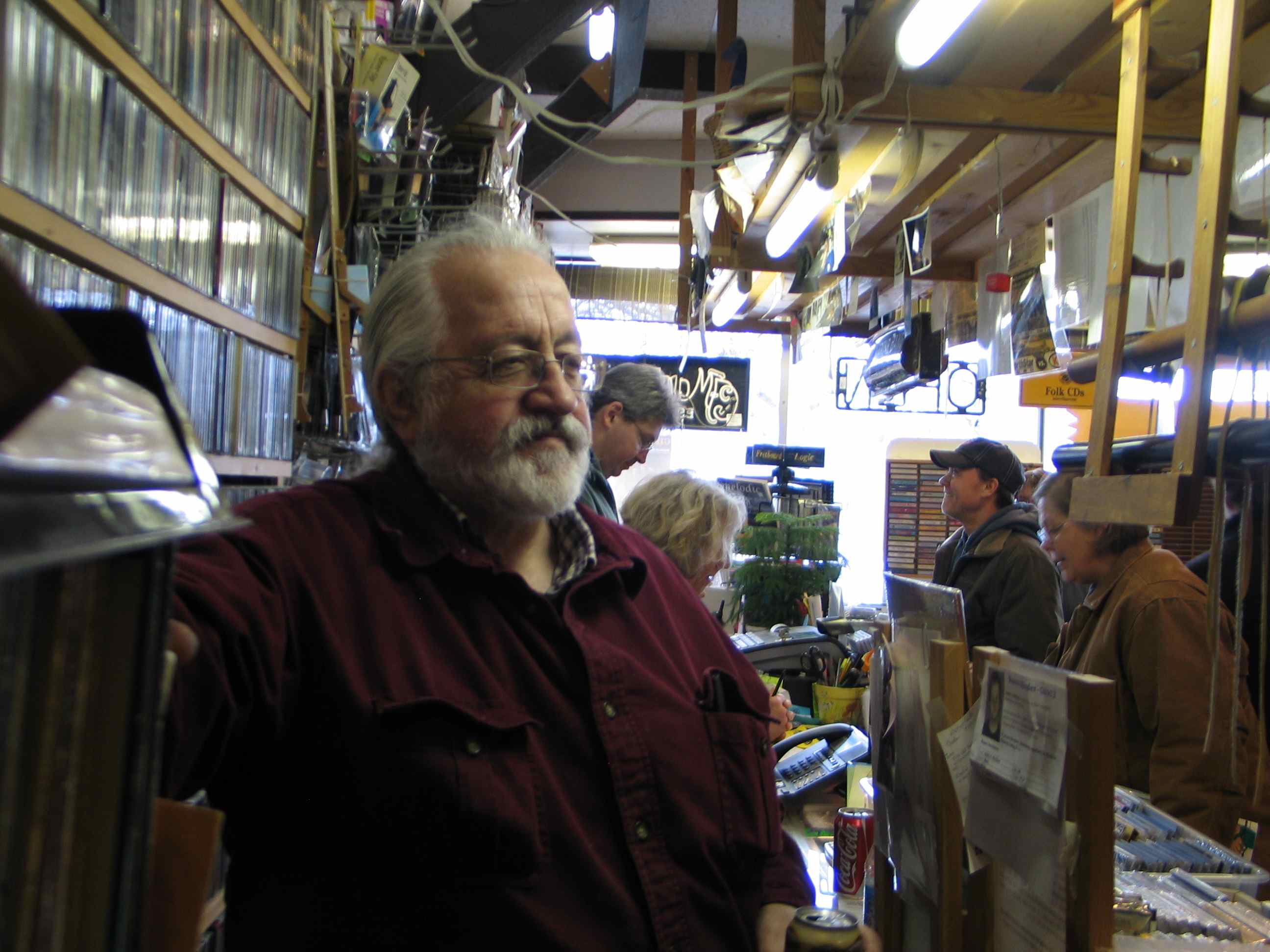
Chief among these sturdy stalwarts is the Homestead Pickin’ Parlor in Richfield, which has catered to an acoustic and roots music crowd since its founding in 1979. The shop is also an academy where some of the finest local musicians of today teach the finest local musicians of tomorrow. The Homestead, under the steady leadership of Marv and Dawn Menzel, is an invaluable resource – a place where performers and their fans find nourishment.

I talked to Marv yesterday and he confirmed that the shop is a survivor.

“There’s no question that small businesses received the brunt of the downturn in the economy. But we’re alive and well. The rent’s paid. The lights are on. And we’re open for business.”

When I pressed him on the dismal economic predictions for those who sell CD’s in a world increasingly in love with the download, Marv acknowledged that the Homestead Pickin’ Parlor is more than a record shop.

“But records are certainly a big part of what we do. Every CD that’s released by an artist, and I’m sure there are exceptions to this, but … it’s a work of art. The artist puts a lot of him or her self into that product, not only the selection of tunes but the art itself, the liner notes … it’s a package that they’re putting together with their fans in mind. And with the advent of the downloading and everything we’ve lost sight of that. Or we are abdicating our right to have such a thing. And that troubles me dearly.”

As a consequence of it’s location on Penn Avenue just south of 66th Street in Richfield, the shop suffered from years of highway construction on the Crosstown and Interstate 35W – a disruption that made it difficult even for not-too-distant customers to get to and from Homestead. Now that the work is done, Marv Menzel is optimistic.

“We’re back to having easy access … and we’re looking ahead to a brighter future.”

The Homestead Pickin’ Parlor will celebrate Record Store Day with live music and hot dogs. There will be specials. And though you can always visit them online, if you don’t find the strength to get up and walk away from that computer, you’ll cheat yourself out of a wonderful and whimsical experience.

Who knows what you might find, just thumbing through the bins?

Share a record store memory.

Sunday Extra:

When I stopped by the Homestead Pickin’ Parlor yesterday, business was brisk.
Live music and free hot dogs added to the festivities. Added advantage: It was cozy inside despite the gale force winds and barely-above-freezing outdoor temps.

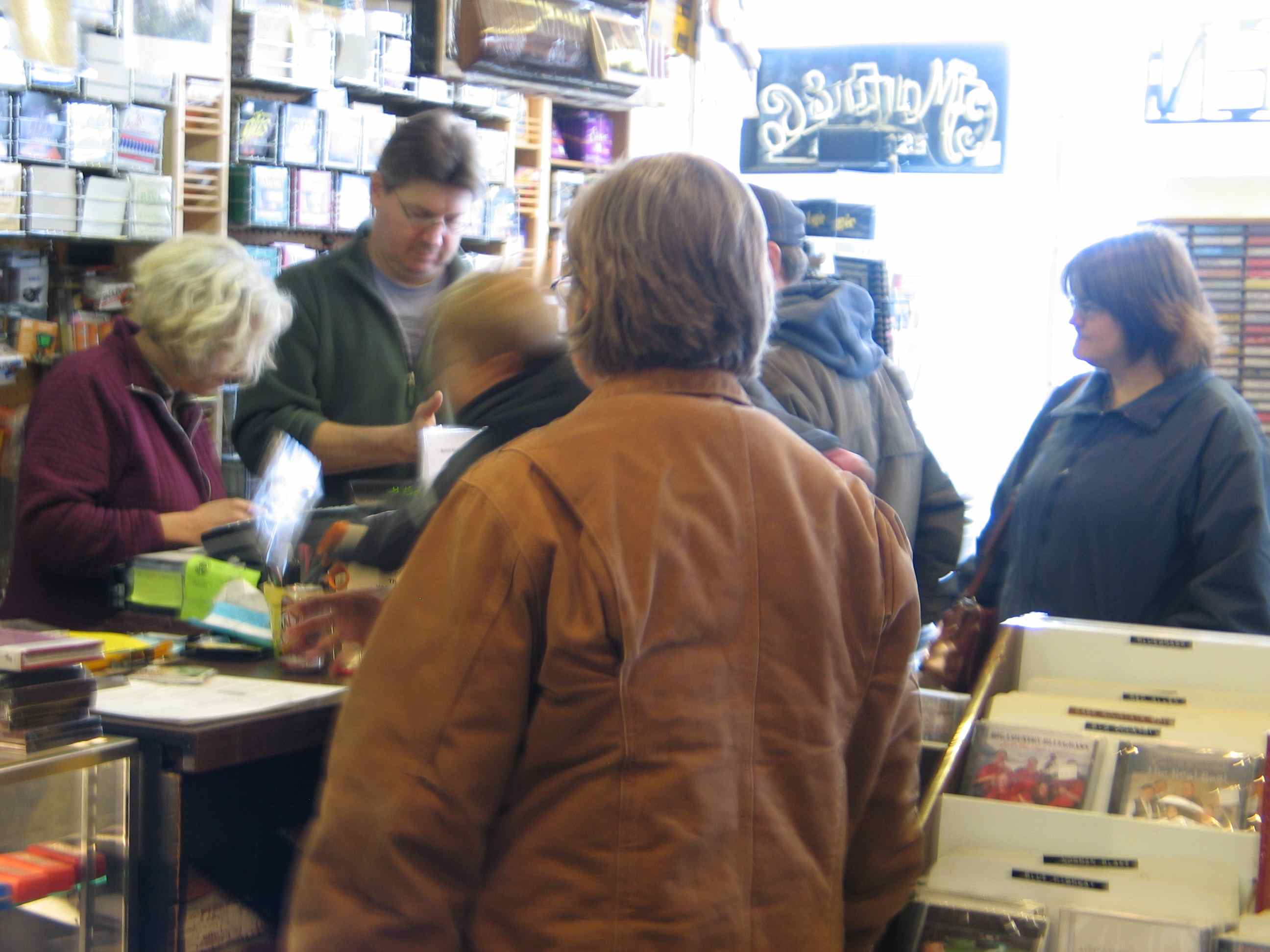
Marv admitted this was far from a normal Saturday crowd, and he appeared to enjoy the commotion. Shoppers stood elbow-to-elbow going through raggedy cardboard boxes full of CD’s and LP’s – just the way it should be.

And when I say “raggedy cardboard boxes”, I’m not kidding. At Homestead, every type of display option is on display. From the ‘nice tidy bin’ approach to the ‘box on the floor’ strategy to the ‘stack of discs in the corner’ configuration, the product is out and ready for you to discover it!

Waiting to be Adopted
Marv Menzel Behind the Counter

There’s a lot to see at the counter. A retail consultant might say there’s too much here for any one thing to make an impression, but I hope that consultant’s advice would get lost in the clutter. The cash register is more than a place to check out with your purchase – it’s a day’s worth of distraction.

All in all, it was a warm and cheerful place to be on a blustery afternoon in April. If only every day could be like Record Store Day!

Shoppers crowd the register
Service Menu Etched in Wood

Bird is the Word

It’s the season for bird songs – the kind the birdies sing for themselves and the sort of song people sing about the birds. I’m sure a few titles will occur to you after a moments’ worth of thought:

Red Red Robin, Rockin’ Robin, Skylark, Lark in the Morning, Three Little Birds, Free As a Bird, Gonna Find Me a Bluebird, Be Like The Bluebird, When Doves Cry, Dupsha Dove … you get the idea.

A loon was spotted on Lake Calhoun yesterday, according to Bob Collins and Jayne Solinger at the MPR blog News Cut.

I can’t think of many songs about loons, even though loon and Calhoun both fit so comfortably into the classic Moon / June / Croon rhyming scheme popular with songwriters of the golden age of romantic word-rich ditties. It’s no surprise that local songwriter Ann Reed took note a few years ago and gave us this, which, alas, I can only offer you here in the form of lyrics. The song is on her 2009 recording Where The Earth is Round.

Loons on Lake Calhoun
words and music: Ann Reed • © 2009 Turtlecub Publishing

I’m riding on my bike
Gliding along
The light is early morning
It’s pretty and half-awake
This city that has
The lakes as its reward

I stop all my inner debating
And waiting a minute, it hovers and fades

Ducks talking, coots check in
Chalking up routes
They’ve been on their migration
Then floating up above
The soloist does her stuff
With carbonation

It’s a melody picked out
To tell how a tickle would sound if given the room
There’s loons on Lake Calhoun

They’ve dropped in to see a show
Stopped to see grebes they know
From a long, late winter
The people lift eyes from the ground
Seeming surprised at the sound
Of grace, delivered

I never expected a miracle
Here I’ll admit: Oh, I rarely — do you?
There’s loons on Lake Calhoun

And they’ve made it from far, far away
Before takin’ it northward, but before they do
There’s loons on Lake Calhoun

I contend that any songwriter can put a classy nightingale or a colorful oriole in their lyric, but you need someone like Ann to write and sing about loons, coots and grebes.

As for other migrations, it looks like at least one Ruby Throated Hummingbird made it into Wisconsin yesterday. And was immediately stripped of its collective bargaining rights. So it goes in the northern climes this year. And still the migratory beat goes on. Lots of things are cropping up – Robins, Earthworms, Whooping Cranes, Barn Swallows, etc.

Meanwhile, in New Orleans, they face an exploding population of feral chickens. This isn’t a migration, it’s a multiplication. But it might cause some cock-a-doodle-doo intolerant people to head north.

And in Canada, it’s Canada Geese, who are not only proliferating, but are threatening (to the not-so-quiet alarm of some scolds) to become our northern neighbor’s official bird!

What have you seen or heard lately that indicates a migration is underway?

Birthday of the Blues

Today is Billie Holiday’s birthday. She started her famously untidy life in Baltimore on April 7th, 1915 as Eleanora Fagan. It didn’t last long. She died at 44.

It’s hard to imagine how anyone could begin with more obstacles to face – poverty and racism for starters with physical abuse and drug addiction down the road. With no status and no advantages she managed to create a lasting body of work and fundamentally changed the way people sing songs. Billie Holiday performed sold-out shows at Carnegie Hall and was also arrested on drug charges in a hospital bed during her final illness. Saying she had highs and lows doesn’t even begin to describe it.

What strikes me is how casually the world would have overlooked her, as countless millions born into similar circumstances have been. It is completely whimsical that we got to hear her voice at all – it could so easily have gone another way. Jazz impresario John Hammond went to a club to listen to a different singer but heard Billie Holiday instead. She caught a break and made a lasting impression, and as a result people will be listening to Billie Holiday long after the rest of us are forgotten.

Here she is with her voice weirdly out of synch to the video – so close your eyes if you have to. I’m guessing this is what the experts mean when they say she sang like a horn player, trading solos with the guys in the band.

So I guess we learn from this that talent can be found an appreciated in spite of adversity, though in the case of Billie Holiday you can’t say adversity was overcome. Her amazing emergence makes me think of a talk I heard a few weeks ago that had to do with the way diamonds are formed and brought to the surface. They are incredibly hard to find even if you know the conditions are right for diamonds to exist. There could be a diamond strike under your house, or under the parking lot across the street, but not necessarily both.

Ever stumble across an amazing, totally unexpected find?

The Voice

Today is Bobby McFerrin’s Birthday.

He’s a performer with the skill and the openness to unite all the musical genres. There doesn’t seem to be a style that’s beyond his reach. McFerrin teaches while he entertains, and he gets more involvement out of his audiences than anyone since Pete Seeger was in his prime.

I first became aware of his talent with the live recording of his solo performances in Germany. The Germans call him “Wunder Stimme”, or “Wonder Voice”. I’m still amazed to hear this one guy keeping a crowd enthralled, singing without accompaniment and using his own body for percussion. What a remarkable (and gutsy) thing to do.

It almost didn’t happen. He was a 27 year old piano player working with bands when he had his “Aha” moment.

“I was living in Salt Lake City and I was an accompanist in the dance department at the University of Utah. I was walking home during a lunch break when, all of a sudden, I knew I was a singer. I called the Hilton Hotel to ask for an audition. I sang five tunes and the guy hired me on the spot. I started working as a singer right away, at the piano bar.”

I wonder why it hit him then – walking home for lunch. Maybe hunger had something to do with it. And calling the Hilton to ask for an audition just because you had this weird idea? That’s bold. But if you’re Bobby McFerrin, it pays off.

On his 61st birthday today we’ll hear him with some other geniuses, Mark O’Connor, Yo Yo Ma and Edgar Meyer.

He had one hit, “Don’t Worry, Be Happy”. McFerrin handled that just the right way – he let it open some doors, but didn’t allow one song to define him. Instead of succumbing to the constant pressure to come up with another hit song, and another and another, he stopped performing his chart topper. He let it go off and have its own life without him.

Who else would do that?

McFerrin has established himself as a musical force that thrives in areas outside the narrow demands of popular culture. He has shown us a remarkable combination of integrity and freedom, in part made possible from the money generated by one big financial success.

You’ve just written and performed a hit song, and the money is rolling in. What do you do NEXT?

Acoustic Resurgence

I don’t really think acoustic music is about to have a resurgence in the popular culture, but it is nice to see that Bob Dylan, The Avett Brothers and Mumford & Sons will do a special “salute to acoustic music” as part of Sunday night’s Grammy broadcast.

21st century Folk Scare, anyone?

Here’s Bob using his unplugged guitar to do a familiar and uncomplicated version of one of his most resonant songs.

But why is his face so blue? Sunburn medication, perhaps? He looks like a love child of Woody Guthrie and one of the Na’vi from the film Avatar.

What does it mean to be “Tangled Up In Blue?”

Faith

Babooners are music lovers – that’s how this blog got started. But many of the artists we appreciate work out beyond the edges of the very intense spotlight that shines on the mega-stars who will get all the attention on Sunday night’s Grammy broadcast. Today’s guest blog revolves around one of those hard working musicians.
It was written by Steve Grooms

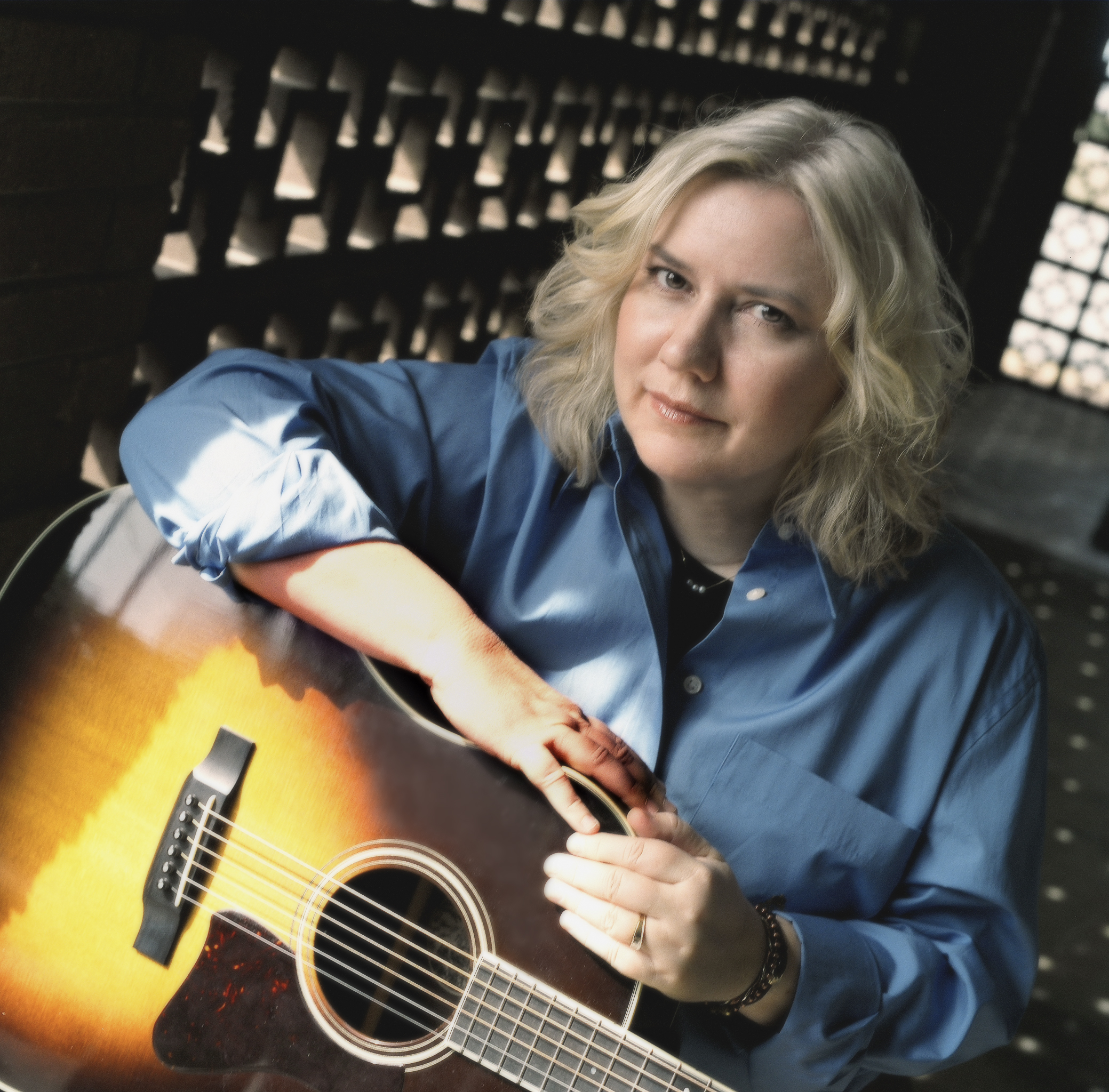
In the winter of 1995, a southern singer made a northern tour to promote her first CD, arriving in Minneapolis in the middle of a heavy snowstorm. Kate Campbell was born in New Orleans in 1961. She grew up passionately interested in civil rights and all the changes she saw going on in the South. She began writing intelligent songs, folk songs with poetic elegance. Kate called her first CD “Songs From the Levee.”

To promote her evening gig, Kate dropped in on the Morning Show, hosted then by Dale Connelly and Tom Keith. She performed three numbers and said she’d be appearing that evening in a little café that used to sit kittycorner from Odegards’ bookstore, on Grand Avenue in Saint Paul.

In spite of the cold and snow, I decided to go. When I go to the restaurant I had to feel sorry for Kate. She was an obscure singer in an obscure venue, performing in the middle of the week during a snowstorm. Her audience consisted of three guys, counting myself. At times like that I don’t think about whether an entertainer is amusing me; I always worry that they won’t have a good impression of Minnesota, and I clap with abandon to show them that Minnesotans have big hearts.

Kate, of course, was gracious. She played guitar and sang her favorite songs as enthusiastically as if this had been a White House concert. Ira, her husband, Ira stood at the back of the room with a box of CDs, enjoying the concert.

Kate Campbell

When the concert was over I clapped enthusiastically and then approached Ira to buy a CD. He showed me what looked like two different CDs but explained that they were both “Songs From the Levee.” The difference was that there were two versions of the cover art. A little confused, I asked if it mattered which one I bought.

Ira thought, then brandished a CD whose cover featured a yellow watercolor scene. “This is the original cover art,” he said, “and you might as well get it. If Kate’s first CD becomes a collector’s item some day, this one will have more value.”

I was speechless and I looked at him closely to see if he had been kidding. This man had just watched his wife spend an evening serenading three Minnesotans in puffy coats and drippy noses. If he felt humiliated, it sure didn’t show. Instead, he was talking about her first album becoming a collector’s item! I bought the CD with the original art but was too distracted by Ira’s faith in his wife to ask Kate to autograph the jewel case.

On Grand Avenue outside café the snows whirled dreamily like a snow globe. As I stepped into the night I was thinking, “Oh, lady, I hope you love him like he loves you! That man believes in you absolutely. I don’t know what kind of career you are going to have, but I would bet tonight that your marriage is going to go the distance.”

The new company created by Kate and Ira just released her eleventh CD.

Has anyone ever believed in you at a time when you weren’t sure you even believed in yourself?

Walking Music

In one of yesterday’s comments, Clyde mentioned taking a brisk morning walk in Mesa, Arizona while listening to this song by Peter Mayer.

Peter is a wonderful guy and this is a great song for many cosmic reasons. But one of the more cosmetically attractive things about it is that the music unfolds at a pace that is just right for walking. Same thing here, though a little faster, from Fats Domino.

The right music at a perfect pace can make a walk more pleasant, though caution is always advisable. There has been a recent flurry of attention devoted to the developing hazard of walking while fiddling with electronic gadgets, amplified by a viral YouTube video of a Pennsylvania woman tumbling into a shopping mall fountain because she was walking while texting. Inattention can have serious consequences, and it’s not a new problem. These NPR stories about distracted pedestrians are two years old.

Back to walking and listening to music – we’ve been doing this since the invention of the transistor radio, though at least in the pre-Sony Walkman days you didn’t have the immersive experience of headphones to seal off the outside world – just a single earplug to deliver the music. Or else you turned it up all the way and had the sound blasting out of the radio’s tinny little speaker through the tiny holes in its leatherette case.

And before that? We had to play the music back in our minds. Or, heaven forbid, sing it to ourselves! That’s the kind of strange behavior that caused our fellow pedestrians to cross to the other side of the street (after looking both ways, of course).

What’s your favorite walking music?