Tag Archives: Nature

No Planet Left Behind

Here’s a note that came in yesterday afternoon from perennial sophomore Bubby Spamden, who knows the routine and the calendar at Wendell Wilkie High School much better than the teachers and administrators.

Hi Mr. C.

I’m sitting in study hall with nothing to do after finishing the MCA tests. That’s the Minnesota Comprehensive Assessments. They’re the tests we take to find out if we’re really the miserable losers our parents say we are, and also how bad our school is failing based on the rules for the No Child Left Behind Law.

I can tell you that law is definitely not working at Wilkie ‘cause I’ve been Left Behind, Kicked To The Side, Thrown To The Wolves, Pushed To The Curb and Tossed From The Train over and over again for so many years in a row now that school visitors pretty much always mistake me for the janitor.

Seriously, I’ve got a 5 day shadow by 5th hour every day. If I gained about 200 pounds I could totally pass for Mr. Lootanen.

But I wouldn’t want to be a school janitor. Cleaning up our school is the hardest job on Earth. Teenagers are gross. Me included. I just got caught dropping a Tootsie Roll wrapper on the floor and Ms. Flipping, our study hall monitor this hour, called me out on it. Actually, her name isn’t Ms. Flipping, that’s just what we call her because of how she reacts to things. Kinda dramatic. I couldn’t even defend myself because you know how slow your mouth gets when there’s a Tootsie Roll in there. I was helpless.

So anyway, she got steamed and said I should go online and find some resources and then write an essay based on my research about what I would do to clean up the planet for Earth Day, which is this Sunday. And then, she said, I would have to prove to her on Monday that I actually did something that was on the list.

The Earth is kinda big, so now I’m thinking maybe I’d be better off pretending to be Mr. Lootanen and trying to pick up here at the school.

But then I found this article at The Huffington Post that really makes it simple. According to the writer, I can take a hike with my family, (Somebody at home IS always telling me to ‘take a hike’) pick up litter in my neighborhood with friends, (I would have to get a totally different group of friends to try this one), come up with a recycling plan for the coming year, (I thought years just automatically recycled themselves – isn’t that how people like you get to be so old?) or join a larger public clean-up (my grandfather says there’s nothing clean about the larger public – that’s why he never goes out).

I was starting to feel a little desperate. I didn’t think I’d be able to do any of these things. But then I saw this last Earth Day idea: “Even if you can’t do any of the above – make sure you take some time to think about the importance of preserving our planet.”

Ahhh! That’s more like it! My life has been all about finding the simplest answer on a long series of multiple choice tests. There’s always an easy way out of having to do something, if you show some patience and look for it.

Yes, the planet is important, and preserving it is a good idea. If there were no planet, we’d just be floating free in space with no air or bicycles or cocoanuts – three things I would not want to have to do without.

Whew! Job accomplished for another year!

Your Earth Protecting Pal,
Bubby

What are you doing for Earth Day?
Wherefore Bart Thou?

I just got another voluminous text from a friend without thumbs. I can only imagine the amount of time it takes him to write these!

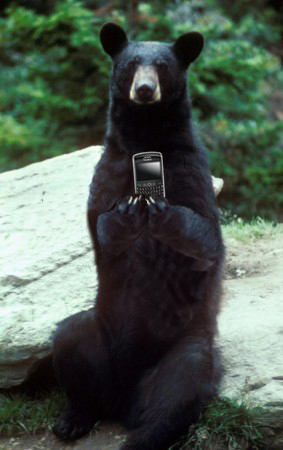
Bart - The Bear Who Found a Smart Phone

Hey there. Bart here.

My old pals at the DNR sent out this press release that kinda ticks me off – all about “nuisance” bears. If any particular kind of critter deserves the word “nuisance” in front of their name, it’s NOT the bears. I’d explain just who I’m talking about but you already know I’m right.

The DNR gives us a long list of things that people are NOT supposed to do – things that supposedly encourage “nuisance” bears. I hate lists.

* Do not leave food outdoors from barbeques and picnics, especially overnight; coolers are not bear-proof.

Why do you make more food than you can eat? And yes, we know how to open your coolers! If you ate what we eat in springtime, you’d need something cold to wash it down!

* Replace hummingbird feeders with hanging flower baskets that are also attractive to hummingbirds.

What makes you think I don’t like pretty things? Bears aren’t barbearians!

* Eliminate birdfeeders or hang them 10 feet up and 4 feet out from the nearest trees; use a rope and pulley system to refill them and clean up seeds that spill onto the ground.
Where bears are a nuisance, birdfeeders should be taken down between April 1 and Dec. 1.

This is perverse. You’re punishing birds because I’m fat.
Have you no shame?

* Pick fruit from trees as soon as it’s ripe and collect fallen fruit immediately.

Greedy! Who has time to do this?

* Limit compost piles to grass, leaves and garden clippings; adding lime can reduce smells and help decomposition

Love the lime. And add tequila for a Compost Margarita!

* Clean barbeque grills after each use, and store them in a secure shed or garage away from windows and doors.

I have never seen a human clean a barbecue grill. And believe me, I’ve spent a lot of time in the shadows, watching.

* Elevate bee hives on bear-proof platforms or erect properly designed electric fences.

You’ll get on a ladder with an active beehive? If you’re THAT daring, might as well be sure the electric fence is plugged in before you start to put it up. I’ll definitely watch!

* Do not put out feed for wildlife (e.g., corn, oats, pellets, molasses blocks).

Molasses comes in BLOCKS? WANT!

Here we go with another whole dang summer of you trying to keep me from having fun eating stuff. Just remember – I was not the one who asked you to stay out of the woods, and I definitely did not ask you to come without your food. You’re perfectly welcome to bring it here if you want.

Really.

Most of the other stuff they say about keeping your distance from me is true. I’m kind of shy and will go away if you give me the chance. But if you’re coming to visit me, be a good guest. I’d like a hostess gift, please. In fact, Hostess makes great gifts. I love Twinkies! Now they come in Chocolate Creme!

Just as I feared the last time he wrote, Bart has developed a Twinkie habit. Dang! Sometimes we have to protect our friends from the bad things they love. On the other hand, it sure is nice to see their faces light up when you deliver the contraband!

Fill in the blank – “Friends don’t let friends ________.

The Thing With Feathers

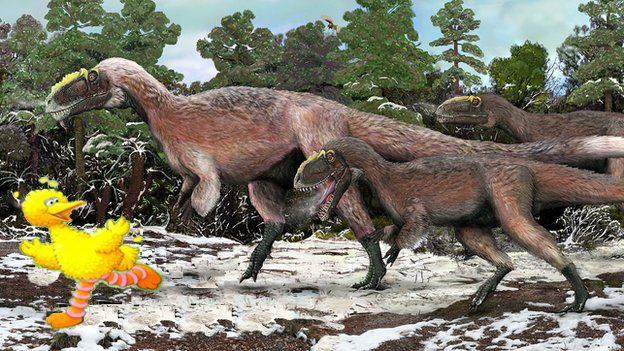
Finally, archeologists have found something in China that may soften the fierce image of the famous T. Rex. The nasty tempered terrible lizard had a fine feathered cousin.

Said to be the largest feathered creature ever to walk the Earth at 30 feet long and weighing in at a ton and a half, this critter couldn’t fly but I wouldn’t make a big deal out of that if I were you. A massive feeling of inadequacy might lead a fluffy fellow to overcompensate in the tearing-things-to-bits department.

Notice has been issued to all of history’s other so-called “big” avians – you better run!

This new discovery will surely take its place alongside Kim Jong Il’s Beanie Baby collection as a fresh emblem of the sometimes odd collision of viciousness and preciousness. Think Slobodan Milošević in Minnie Pearl’s Hat.

Yes, he was a killer, but oh so charming!

Good accessorizing can help change even the most severe negative impression, and feathers, especially the downy, baby-chick like fuzz attributed to Yutyrannus, can make a huge difference.

In fact, an account in the New York Times notes that the name of this creature is Yutyrannus huali, a melding of Latin and Mandarin which means “beautiful feathered tyrant”.

Yes, style matters, even for dictators and despots.

What do you put on when you want to win them over with your plumage?

Arctic Art

Although I work with words and audio most of the time, I have great admiration for anyone who can take a good photograph. As discriminating baboons know, there’s a lot more to it than point-and-click. And for wildlife photographer Paul Nicklen, there’s a whole lot of physical courage involved as he steps out into Arctic weather and submerges himself in frozen oceans. Nicklen has worked at the top of his craft, producing features for National Geographic. He’s going to be speaking tonight at the University of Minnesota – part of a program by the U’s Institute on the Environment.

If you can only watch the first five minutes of this TED talk, you’ll get a sense for depth of his commitment and the quality of his work. And if you make it through the first five, you’ll feel a strong urge to watch the rest – but be warned! There are penguin innards on display. Cute!

Another measure of Nicklen’s intensity – I’d call it a day and send in my photos after swimming with one Leopard Seal. He took a dive with 30! No wonder the photos are so good.

Describe the best picture you’ve ever taken.

My, What Big Eyes You Have!

The latest word from the murky depths of the ocean is that the Colossal Squid has eyeballs the size of banjos. That is a surprise.

First of all, I didn’t know there was such a thing as the Colossal Squid – I assumed “Giant” was the biggest size they came in, but no. The Giant Squid is dainty compared to the Colossal Squid, though they are both larger than the Ample Squid, the Full Figured Squid and the Voluptuous Squid.

And no other creatures on Earth have such generous amounts of eyeball acreage as these Plus Sized Squids. They live in the deepest, darkest part of the sea, so it makes sense that they’d need bigger blinkers to take in more of the sparse supply of light. But a scientist quoted by the Christian Science Monitor says these vast baby blues are unusual – there are diminishing returns once one’s headlights get larger than an orange.

Good to know the mammoth squid contingent has a rebellious nature, but where does That leave us?

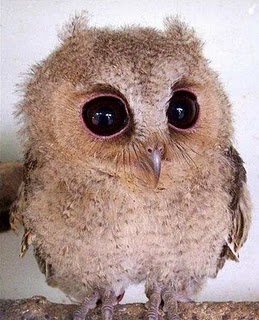
We humans have a fondness for big-eyed animals, judging from the number of watery, pleading looks you see on the faces of online kittens, owls, lemurs, tarsiers, and Marty Feldman, of course. And yet something tells me very few people are likely to be charmed by the biggest eyes on earth, those pleading peepers of the not-so-cuddly, but deserving-of-your-love denizens of the deep, the totally misunderstood Colossal Squid.

Too bad. So for St. Patrick’s Day, an eyeball salute to our friends who inhabit the darkest corners of the ocean floor.

When Squiddly eyes are smiling,
They see near a hundred yards.
And when Squiddly eyes are laughing,
‘Tis because they’ve read your cards.
And when Squiddly eyes are happy,
They are far removed from day,
And when Squiddly eyes are squinting,
Sure, ’tis ’cause they froze that way.

How have you adapted to your environment?

The Poet Sees His Shadow and is Appalled

It occurred to me that this would be a good day to look for poems about groundhogs, and thus I discovered Richard Eberhart, who was born in Austin, Minnesota in 1904.
I would like you to think I am a literate person and wise when it comes to poems, but the truth is I have read very few and know almost nothing about them. But I do like silly rhymes and absurd things.

So I was delighted to discover Eberhart, because he appears to be well regarded, yet he did not consider himself too fine an artist to write about poking a dead groundhog with a stick.

I liked the poem “The Groundhog“, especially at the beginning when the expired rodent is still fresh and Eberhart describes “the seething cauldron of his being.” But I was a little disappointed that the poem didn’t rhyme, and that he didn’t take advantage of all the comic opportunities that a dead groundhog has to offer. Intstead he turned somber and serious, bringing in Montaigne and St.Theresa. And he didn’t mention Groundhog’s Day. Not even once.

Right now, part of my day job demands that I take perfectly decent work by good journalists and twist their carefully arranged words into unrecognizable radio copy. If there is a legitimate and newsy reference to an event happening today, I insert it. This is called “aggregation.” At first I felt a little guilty about the practice, but now it has become an annoying habit. Unfortunately for Richard Eberhart, because it led me to steal his first two lines and then go off in a completely different and totally selfish direction.

In June, amid the golden fields,
I saw a groundhog lying dead.
His flanks were flat as last year’s yields.
And flattened, also, was his head.

Where once a lively creature sat,
a rotting carcass lay there, still.
In fields of wheat, he would be chaff.
In dumps at Punxsutawney, fill.

I thought, “herein a poem lies.”
The cloud of flies around him thick.
And there beneath the summer skies
I chose to poke him with a stick.

The muck and ooze that issued forth
did bubble, boil, and downward run.
The cloud of flies flew to the north
and angrily blocked out the sun.

A shadow dropped across the scene
And cast a silent, solemn pall.
The groundhog’s flanks were turning green
but this he noticed not at all.

“I’ll write a poem about death,”
I told myself, “that will not rhyme.”
“I’ll mention Rome and Greece and hair
and love and bones and sap and time.”

And somewhere in there with a wink
I’ll note the angles and obliques
of sunlight and the rodent’s stink
and winter lasting six more weeks.

Though that means nothing to our pet
who, all collapsed and in decay
is flat as any thing can get
and doesn’t think of Groundhog’s Day.

Clearly this silly rhyme is far from the sort of poem that Eberhart would actually write, and does nothing to honor him or his intent. It is, in fact, a travesty. Yet I couldn’t resist, and have no regrets.

Under what circumstances do you feel compelled, against your better judgment, to get your two cents in?

Ask Dr. Babooner

Dear Dr. Babooner,

I’m not a mean person, and I love animals. I really do. The thing that got to me about our little dog Rockne is that he was, well, obnoxious. His original name was Mr. Fluffs but we re-named him after we realized he was going to be a loud, persistent, yappy pest. Calling him “Rockne” was part of our private joke. We live on a banana plantation in southern Florida and he absolutely loved the fruit. So whenever one of us went into the yard the other invariably said “Go out there and skin one for the yipper.”

I guess you had to be there.

Anyway, Rockne’s vocalizing would come in waves. Sometimes he’d be quiet for almost a day, and then the following week he’d go at it non-stop. What really grated on my nerves was when he would go off while we were in the car. Something about the enclosed space magnified his yip, yip, yip, yip, yip, and it didn’t help that he simply couldn’t abide the site of a jogger. Something in his worldview totally rejected the concept of a human being in a designer sweatsuit, running.

And we saw lots of them. Weird, I know. You’d think people wouldn’t have to lift a finger, much less a foot, to break a sweat in south Florida. But run they did, and Rockne let ’em have it every time we spied someone chugging down the road. The sound inside the car was excruciating. Finally one day I stopped to let the jogger go by before opening the door and telling Rockne to get out and chase her. It was a foolish, spiteful move. I figured he would run for a short distance, wear himself out, think better of his compulsion, and that would be the end of that. No more barking at people along the road. I was counting on the day’s high heat and humidity to drive home the point.

I’ll never forget it – just before he sprang out of the car, Rockne gave me a long, last look. There was something potent in it. Not reproachful, just … accepting and maybe a little judgmental. But it was profound. And then he was gone.

He skittered off after the jogger just as fast as his little legs would carry him, but before he got close enough to catch her he quite suddenly veered into the underbrush and disappeared into what I then realized was The Everglades.

I was kind of heartbroken. I mean, on a certain level I was happy to be rid of him, but on the other hand I realized he probably couldn’t survive out there. I mean, the Everglades has bobcats! Not to mention crocodiles AND alligators! My wife was deeply ticked off – this was six months ago and she still won’t speak to me. And now today I see THIS!

Apparently Burmese Pythons are killing just about everything in the Everglades. My only hope is that Rockne managed, through some unexpected combination of wisdom, yappy persistence and canine guile, to convince the pythons that they were brethren, and rather than lunch he became King of the Released Pet Nation.

Otherwise, I’m feeling really, really guilty right now. But should I?

Sincerely,
Remorseful About The Fate I’ll Never Know

I told R.A.T.F.I.N.K. he should absolutely feel remorse. Putting any creature out of the car within shouting distance of the Everglades ought to be a crime, but especially a tempting morsel like Mr. Fluffs (or Rockne, if you must). But I would not comfort myself with the thought that your dog somehow became King of the Pythons. That would not be a good development for you. Just in case, you should stay far, far away from the swamp.

But that’s just one opinion. What do YOU think, Dr. Babooner?

Old Brains

I’ve been reading far too much about old brains lately.

In fact, my mind has to put up a shield of self-ignorance, essentially denying that it is also a brain, before it can help me learn anything about them. Reading that it takes billions of interconnected neurons to process the words that tell me it takes billions of interconnected neurons to process the words is the kind of bio-informational feedback loop that causes wisps of smoke to come out my ears.

It feels like some things are not worth knowing.

But the latest news about old brains sends exactly the opposite message – that we should exercise our brains to keep them fit. And while we’re at it, we should exercise everything else, too.

My one-stop-shopping site for OBI (Old Brain Information) is the New York Times, where they are clearly trying to corner the market for elder ecephalifans. The paper isn’t called “The Gray Lady” for nothing, and if you want to know what’s happening among the folds of gray under the waves of gray, they’ve got it.

It turns out there’s a new study that shows some beneficial effects of exercise for people with a heightened risk of developing Alzheimer’s.

Education was also found to be a long-term brain benefit. A different study found that education is associated with a longer life and decreased risk of dementia. “The effects of education are dramatic and long term,” said one doctor quoted in the story.

Here’s an excerpt that confirms everything you already thought about brain health, although if you’re over 50, putting it together in a string of words this smooth would have taken you a lot longer than you imagine.

Many researchers believe that human intelligence or brainpower consists of dozens of assorted cognitive skills, which they commonly divide into two categories. One bunch falls under the heading “fluid intelligence,” the abilities that produce solutions not based on experience, like pattern recognition, working memory and abstract thinking, the kind of intelligence tested on I.Q. examinations. These abilities tend to peak in one’s 20s.

“Crystallized intelligence,” by contrast, generally refers to skills that are acquired through experience and education, like verbal ability, inductive reasoning and judgment. While fluid intelligence is often considered largely a product of genetics, crystallized intelligence is much more dependent on a bouquet of influences, including personality, motivation, opportunity and culture.

Yes, that’s what I’ve got. “Crystallized Intelligence.” It sounds so sparkly!
And hard, prickly and brittle.

But I have no trouble believing that education keeps your brain alive. In a world so full of things we don’t already know, the only question is – what to study? That’s the economics question and again, the Times comes to the rescue with a blog about what the top 1% of earners majored in.

It turns out the largest percentage of 1%’ers studied “Health and Medical Preparatory Programs.” No surprise there. In second place, Economics. Even an economist could have predicted that one. Third place goes to Biochemical Sciences. A bit of a surprise! But fourth place is the shocker – Zoology. Zoology? My understanding is that Zoologists study animals in their natural environments and also in captivity. Animal behavior is a special fascination, and zoologists work in university settings, research institutions and zoos.

I’m guessing the Zoologists who are making the huge bucks took their knowledge of animal behavior out of academe to some more lucrative arena, like Wall Street. After all, what better place to apply all those hard-learned lessons about the law of the jungle?

What have you done for your brain today?

R.I.P. Cheetah

And so we discover the mixed blessing of being a well-known movie chimpanzee.

Chimp fame hinges on your ability to interact with the humans. No starring roles for you, Cheetah. You are always there for comic relief. Never will you get cast in parts with depth or substance. Delivering a performance that is a masterpiece of subtlety is impossible – your talent will forever be wasted on an audience of morons who all think they’re smarter than you. Your fans. Though to them, you look like every other chimp in the world, or as one commentator said yesterday, ” … like George Burns.”

Here’s the ultimate indignity, Movie Chimp – when you die, some people will question whether it was really you. Even Kim Jong Il was immediately accepted as a legitimate inductee into the legions of the dead without having to show his papers, and he was a lot more guarded and mysterious than Tarzan’s best buddy. What a comedown for Cheetah – to go from being the world’s most famous primate to being called an impostor. You, the one true holder of Hollywood’s poop flinging thrown. I know what you’re thinking, Movie Chimp. “This is fame? I was there on the screen, larger than life. How can you suggest I am not me?” You SAW me!

Ah, we looked at you, Cheetah, but did not see. To us, you were just another pretty, hairy face.

I’m calling here and now for an end to any investigations into the late chimp’s identity. So what if the “Cheetah” who died yesterday was, in fact, some other chimp? Is there any satisfaction in that knowledge? I say “no”, because if yesterday’s obituary was for a Tarzan sidekick-pretender, that means the “real” Cheetah in all likelihood died years ago unnoticed and unlamented. Feel better? Me neither.

So farewell, Cheetah, or someone very much like you. We loved that smile!

Aside from our simian friend, name your favorite movie animal.

The Oldest Chickadee on Earth

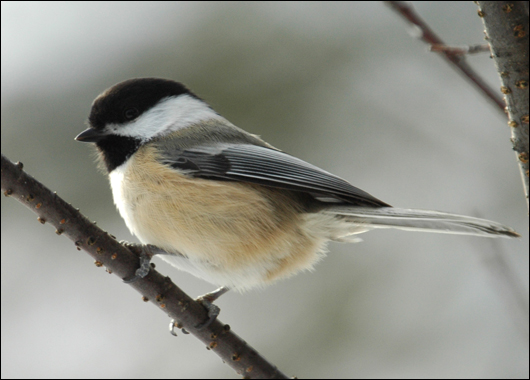
I had the pleasure of talking with ornithologist Michael North on KFAI the other day. He bands birds in Cass County in Northern Minnesota, and on December 9th he captured a black-capped chickadee he has seen before – nine years ago to be exact. The first time he saw it, Michael determined the bird’s age to be about two years, based on the shape of the tail feathers. He says after a year in the world, the tail feathers of a chickadee go from sharp-edged to rounded. I think life does that to all of us.

Not THE bird, but one very much like it.

It is unusual for a chickadee to live so long, and Michael North determined that this particular bird was the oldest chickadee on record at 11 years, 6 months. You can hear our interview here, along with a song made up just for the occasion by the stellar and chickadee-friendly artist Claudia Schmidt.

We don’t often think of a chickadee’s small life as having an arc, but imagine what that bird has been through, somehow surviving through all the hazards of life in Northern Minnesota for well over a decade. Not to mention making it through 11 winters without a snowmobile suit or alcohol to assist. We don’t know how much longer this bird will survive, but at the moment it is the Oldest Living Chickadee on Earth. That is quite an achievement. I can only guess what trials have been met and what calamities have been surmounted. I suppose there was a hungry cat somewhere along the way, and a sharp-eyed hawk. But so far, none of the normal things that can do in a chickadee have done a thing to this one.

What might be in the autobiography of the Oldest Chickadee on Earth?