Tag Archives: Nature

Whitey

Today’s guest post comes from Beth-Ann.

There is an albino squirrel in my neighborhood. My inner geneticist sent me to check him out to confirm his pink eyes and complete lack of pigment.

Most white squirrels are not albino. They have a pigment defect known as leucism. They cannot produce melanin, but because they do produce other pigments their eyes are colored and not pink.
Albino squirrels are rare not only because of the unusual nature of their mutations but because their associated vision problems and poor balance interfere with the needed squirrel life-tasks.

I am not the only one fascinated by albinism. In many traditional societies people with albinism were thought to be prophets and seers; while other societies isolated those without pigment because they were so different. Melville’s Moby Dick was inspired by a real albino whale.
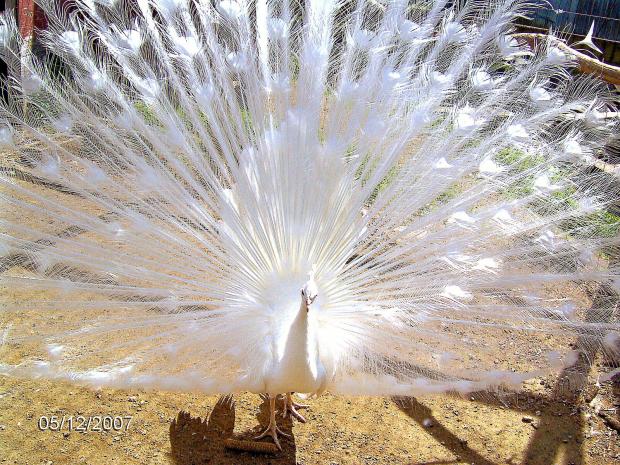
I am equally fascinated by organisms of unusual colors.

I love talking to the sheep farmers at the State Fair about black sheep. Traditionally black sheep were shunned because their wool had little commercial value since it couldn’t be dyed. Now crafters actively seek naturally colored wool. Did you know that white sheep have pink tongues and black sheep have bluish black tongues?

Every year I journey to the Farmers’ Market to buy blue potatoes, purple and yellow carrots, and golden beets. I once made a salad with 5 colors of peppers and 4 colors of potato. I am glad that the seed catalogues arrive at my townhouse annually even though I have never had a garden. I peruse them in search of more unusual vegetables for my imaginary garden.

Whitey and I want to know, “How important is color in your life?”
Big Yellow Taxi

Today is Joni Mitchell’s birthday. Born Roberta Joan Anderson in 1943, she’s 68.

Joni Mitchell is the influential creator of a collection of songs that stand apart from the standard music industry categories. “Both Sides Now” and “Woodstock” are touchstones for a generation, but this one is my favorite because it is a good tune that still matters.

“Big Yellow Taxi” will last a long time – as long as its predictions continue to come true. Valuable bits and pieces of our world are being lost while we argue about who deserves to have the most money. Meanwhile, Switzerland has a Tree Museum. And sadly, it will always be true that “you don’t know what you got ’til it’s gone.”

One account says Mitchell wrote this song on a trip to Hawaii, discouraged to look out her hotel window on to a huge parking lot. Of course, without parking lots, how could airports operate? And without airports, how could Canadians get to Hawaii?

What’s the most disheartening parking lot you’ve seen?
And the most cheerful?

Baboons in the News

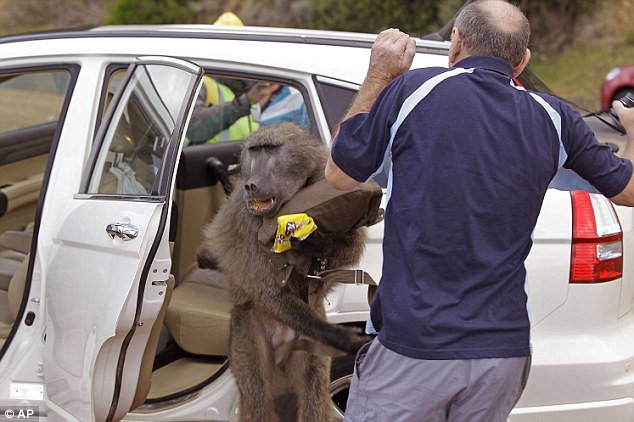
This story from South Africa was just so charming, I couldn’t resist. A baboon breaks into the car of a guy whose job it is to follow around the baboons to make sure they don’t mess with people and break into their cars.

I, too, have been this effective in some of the jobs I’ve held.

The Daily Mail’s story says the baboon monitor is “flinching out of the way” of the thief, although the caption could just have easily said “The baboon, tired of being watched, decked the nosy monitor with a brisk right hook as he made off with the prize.”

We know that the baboon took the man’s bag out of the back seat and made off with it. We have no clue what was in the bag, but obviously it was something irresistible. Only Blevins knows. Or is this Rhonda? Or some other member of baboon society we have not yet met? Clearly, there is an untold tale here. Perhaps through bits and pieces of imagined detail drawn from our vast reserves of baboon knowledge, we can divine the true story.

Tell it.

Go Big Or Go Home

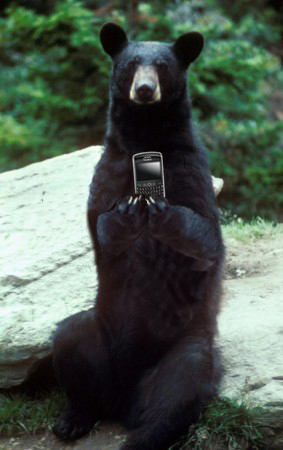
An elaborate text came in from the North Woods. Here’s an approximate translation from the original Ursus Textish.

Bart - The Bear Who Found a Cell Phone

Hey, Bart here.

I’ve been hearing that people are doing a victory dance over some guy shooting a great big bear not far from the Twin Cities. There’s lots of “gollees” and “gawrshes” about the bear’s height and weight – almost 650 pounds and taller than 7 feet.

True. Fella was unusually big. But he wasn’t a freak, he was a forecast.

We bears have been watching you, and can see that we’ve fallen behind in a some pretty important contests. All the wild animals have. Yup. You’re winning the temperature contest and calling the shots in the air quality contest (though we just won a small victory). And you’ve been getting bigger physically while we’ve stayed kinda the same.

All that stuff you’ve been saying about how “massive” and “enormous” and “gargantuan” this poor dead bear is – well I’ve got uncomfortable news.

We bears have been saying the same thing about you for years – ever since we woods-dwellers noticed that you two-legged comfort-junkies were having trouble squeezing through the doors of your Winnebagos. It was in the mid-90’s when word got out that an average human wouldn’t fit in a normal sized tent anymore. Talk about making a bear’s job easier! You being bigger meant it was easier to spot you from far away, simpler to hear you coming through the underbrush, and a lot less taxing to chase you down. And surprisingly, the more you ate, the more food you left scattered in your wake.

Here’s a joke we bears tell each other:
Question: How do you find a hunter when he’s downwind?
Answer: Follow the Doritos!

But then it hit us – with an average male bear weighing in at 250 pounds and an average American male human at 190 pounds, it wouldn’t be long before we’d have to run from YOU! Especially if we stumbled across you when you were feeling obsessive about your cubs! (I hear there’s a bunch of Cubs in Chicago who will never grow up!)

Anyway, let this be a notice to you. Black bears are on the move, size-wise. With our habitat shrinking and yours getting bigger, we realize that someday we’re going to stand toe-to-toe. When that day comes, you’d better hope we’re not standing ON your toes, because our only chance for survival is to get bigger, hairier, smellier, and nastier. If humans are gonna respect something, first they gotta learn to fear it.

Moose are disappearing and the bears are bulking up to get ready for a confrontation around our homes and yours. Come December, we’re going to skip the hibernating and launch our own series of protests – Occupy Tool Shed, Occupy Bird Feeder, Occupy Camp Ground, Occupy That Paranoid Place Inside Your Head That Never Ever Sleeps.

There’s a bear in the woods. And he’s HUGE!

Your pal,
Bart

I thanked Bart for giving me a good chill in the lead-up to Halloween. But I don’t think we’re really headed for a showdown with the bears, do you?

A Rake’s Progress

I have just started the annual ritual of collecting all the fallen leaves in my yard. Soon they will be carted off by a giant, smoke belching truck to a compost pile somewhere in the wilds of Ramsey County, where the leaves will be allowed to rot, much in the same way they are already decomposing on what we may laughingly call my ‘lawn’.

In an age when jobs of all kinds are routinely discarded, re-assigned or left undone, I’m not sure why I still have this task. Can’t it be outsourced or digitized? Isn’t there a highly educated person in Bangalore who can collect my leaves twice as fast as I can by using an app of some kind? Why do the only jobs that remain seem utterly meaningless?

Still, I rake.

It’s not like I’m actually clearing the yard, I’m just putting the leaves on notice that someone is watching and a token effort will be made. I don’t pretend to have enough energy or interest to get every last square centimeter of leafage into the barrel, unlike my neighbor down the street who has apparently gone over his lawn with a vacuum and a pressure washer. It’s that clean. I suppose the fall chores are, for some, a welcome chance to be busy.

Rakewell Prepares to Groom The Lawn

For the rest of us, it feels like a made-up activity – something invented by the devil to see if we can be persuaded to fall into obsession, destroying ourselves in the process.

Hogarth has already documented this too-familiar sequence in “A Rake’s Progress”, whereby a young dandy named Tom Rakewell inherits his miserly father’s fortune and takes only 8 short steps to wind up in a madhouse called Bedlam – all the result of poor choice-making.

Defeated and Insane, As Usual

In Stravinsky’s operatic version of the same story, the moral is “The devil finds work for idle hands.” So it goes for the man too enthralled with the idea of a pristine yard to see how this compulsion destroys his soul. The story always ends in a topsy-turvy bedlam of leaves.

Staying focused only on the jobs that are truly important is a daunting challenge and a test of character.

How do you decide if something is truly worth doing?

Punctuated Equilibrium or Stephen Jay Gould #2

Today’s guest post is from Clyde.

I used to work for a superintendent whom everyone called “Ballpark” because he could not get out a sentence without a sports metaphor. He had a half-dozen uses for the term “ballpark.”

Similarly because of my constant use of science metaphors and science parallels to what we were reading, my students used to wonder if I was an English teacher or a science teacher. At this stage in my life two of my favorite science metaphors, which I had to carefully explain in class, are very useful descriptive terms.

The first is ENTROPY, which is a concept from Newton’s second law of thermodynamics. I bet all baboons know the concept. In pure science, it is much more complicated than as used in my metaphor or common usage. Entropy is the tendency for systems to proceed to disorder, chaos, or randomness. Complex structures will eventually break down to their constituent parts (such as my body). It was an effective way for students to understand “Lord of the Flies.”

Old age is certainly a battle against entropy. A friend of ours says that when she is a senile wreck in a nursing home that she wants someone to tie her knees together every morning before she is put in a wheelchair and rolled out into the common area. A pastor we know has been dealing with a mother and daughter who were both in long-term care, the mother for old age and dementia and the daughter for a degenerative disorder. When the daughter died, every few minutes the mother would find out her daughter had died and grieve freshly all over again, including several times at the funeral.

The other metaphor, PUNCTUATED EQUILIBRIUM, is from S. J. Gould. For a long time the unassailable rule of geology and evolution was that all change occurs at a constant and slow rate. Various scientists in different fields fought this rule for much of the last century and finally won. For instance a region of eastern Washington called the Scablands is now believed to have been created in a few days, not millennia, as if Lake Erie has suddenly decided to empty over Ohio in a three days. A similar but less dramatic event occurred along the Minnesota River valley.

Biological and geological change are now believed to have had long periods of stasis or very slow change and briefer periods of intense change. Of course, “briefer period” can also mean thousands of years or more as opposed to millions of years or more. Gould and a couple of other people developed the term “punctuated equilibrium” to describe this concept, which seems to me more widely applicable. (In its root meaning, “punctuate” means break in or interrupt, as in “puncture.”)

For instance, geo-politcal/social/economic/technological equilibrium was “punctuated” in so many astounding ways in the 1990’s it should have been overwhelming, but we all just kept motoring along. Humans are so very adaptive. I wonder if the punctuation will ever cease.

How much are entropy and punctuated equilibrium metaphors for your life and times?

A Lilipadlian Life, or Stephen Jay Gould #1

Today’s guest post is from Clyde.

At 6 a.m. I rode the Sakatah Trail to a bridge across a narrowing in Eagle Lake, a fun place to watch wildlife, such as beaver, egrets, herons, swans, eagles. This morning below the bridge was a swarm of a few hundred 3-6 inch catfish, most about 5 inches. They were feeding on water bugs, or perhaps their larva on the surface of the shallow water in a circle about 8 feet across.

After a bit I saw a pattern to their movements. Four to six catfish would make a group and swim abreast across the area of feeding. At the edge of the circle they would disband and swim back into the circle, soon joining another band. In the 20 minutes I watched I guess about 150 such groups formed, swam, and then disbanded at the edge. The few three-inch fish were never part of a group.

The question, of course, is, in the language of the evolutionists, what advantage is there to such behavior? The answer is obvious; improved feeding. A group can sweep up the larva and/or bugs more efficiently. When the larva/bugs try to swim out of their way, the ones at the edge catch them. I wonder two things: 1) is there more advantage to being in the middle or at the ends? 2) are some fish dominant, as in wolf packs, and always get the more advantageous position?

Can you tell I read a lot about nature and evolution. I believe Stephen Jay Gould is one of the great essayists, a match for Montaigne, Addison, Steele, Pepys, Emerson and the like. Thoreau I would still place above all of them. Perhaps it seems odd that as a former pastor I read about evolution. But I see no conflict; I believe reading about nature and evolution has a strong worshipful aspect. I admire the mind of the creator, in the design of both species and processes/systems. I have on occasion quoted Gould from the pulpit, but not his evolutionary thinking as such. Gould’s nature essays covered vast ground, including one of the finest and also one the stupidest essays ever on baseball. I did have one church member who knew who he was, and we enjoyed our inside joke.

The fish behavior I observed raises one of the most difficult questions for evolution, one that still perplexed Darwin at his death: how do cooperative behaviors develop? Survival of the fittest is a fully competitive model in which each individual is trying to protect its DNA and pass it on at the expense of other species and individuals.

How in a very competitive world do cooperative and even community behaviors develop? In some non-human species community roles have developed, such as foster parenting. How does one explain the vast community/cooperative behaviors of humans in evolutionary terms? A theory of an altruistic gene has developed to explain such behavior, which really only raises deeper questions. One man believes he has identified a gene for religion, thereby disproving the existence of God, which again only goes deeper because, of course, God could have made that gene.

It is a fascinating and complex issue. I do recognize both competitive and cooperative behaviors in myself and think to some extent they are instinctual. I have a visceral competitive response every now and then, damn it. I also think that in general men are more competitive and women more cooperative, but that may be learned in socialization. Lots can be said, but:

Where do you fall on the competition/cooperative continuum? Where would you like to fall?

Charges Dropped Against Charging Bear

The unfortunate encounter between two Yellowstone National Park hikers who “did everything right” and a grizzly bear who was just “protecting her cubs” ended in the death of one of the hikers. That’s sad. But the Park Service is probably right in its decision to not destroy the bear in question, since its behavior marks the attack as defensive.

Officials called it a ‘one in three million’ occurrence. Literally. It turns out that 3.6 million people visit Yellowstone each year, so let’s hope this is the only one. The Christian Science Monitor pointed out that bear population numbers and the number of park visitors are both on the upswing. Unexpected meetings are bound to increase. Two people were killed by bears near Yellowstone last year.

How can we adapt to defuse these dangerous situations?

The married couple spotted the bear and her cubs and retreated. They turned their backs on the animals and continued down the path the way they had come. When they checked to see the bears reaction, she was already charging them.

Clearly the hikers’ actions in this case were not enough to get the bear to see that they intended no threat. What part of “backing down the trail” don’t you understand? All of it, I suppose. Wild grizzlies just aren’t attuned to the signals we send. I think I would have done exactly the same thing as these two hikers did, probably with the same results.

The man who was killed told his wife to run when the bear charged them, but park rangers say it was her decision to play dead that probably saved her life. The bear attacked the man first, inflicted the fatal wounds, then turned its attention to the woman, picking her up by her backpack before dropping her and leaving.

She must have done a convincing job, though I can only imagine being crazy with fear in that situation. How does a person stay still and limp while being picked up by a grizzly? But with a bear that’s able to run 35 miles per hour, this may be the only reasonable reaction to a defensive attack.

And yet playing dead is not a natural behavior for humans, nor is it something we teach in our schools. Too bad. There’s another important skill that has been sacrificed to our obsession with reading and math.

Still, as Tim Pawlenty would tell us, if you can find it on Google then the government doesn’t need to do it. And wouldn’t you know – there is a small but earnest “how to play dead” industry online.

The best advice I’ve seen so far has to do with breathing – you should do it, but not too much. Also:

* When people die, they do not always have tongue sticking out one corner of their mouth. Try to avoid it.

* Do not smile, even if the people around you are laughing and saying stupid things.

Yes, smiling is a dead giveaway for any ‘playing dead’ player. We all know the dead have nothing to grin about, and do not generally ‘get’ punch lines, even obvious ones.

Perhaps we will, through brutal experience, develop this survival strategy until we are on par with the wily possum. But how many millions of years will it take before evolution gives us a grizzly who will charge you, pick you up and drop you, then tell a good one-liner, just to make sure?


Do you know a joke that’s guaranteed to get a laugh?

In Dublin’s Fair City

… Where girls are so pretty,
I first set my eyes on sweet Molly Malone!

So goes a famous old Irish song, done here on You Tube by The Dubliners.

I thought of this song when I read yesterday that the spread of Zebra Mussels across Lake Minnetonka appears to be steady and unstoppable. Infestation is probably inevitable, though there have been efforts to slow the advance of this invasive species by encouraging boat owners to drain, clean and dry their boats before moving from affected waters to clean ones.

Ah, well.

At least when Minnetonka’s docks and shores are completely encrusted with sharp shells, we can sing to our new overlords about their relentless advance.

I love to go boating,
A-drifting and floating,
On summertime days in the suburbs out west.
The lakes get quite rowdy.
They’re frothy and crowdy.
With Zebra Striped Mussels, Alive, Alive-O!

Alive, Alive-O! Alive, Alive-O!
They’ve got Zebra Striped Mussels, Alive, Alive-O!

On Lake Minnetonka,
They drop so much stray junk ya
can’t even see water beneath the debris.
The piles are fantastic
They’re discarded plastic
And Zebra Striped Mussels, Alive, Alive-O!

Alive, alive-O! Alive, Alive-O!
They’ve got Zebra Striped Mussels, Alive, Alive-O!

So thanks to the sportsmen,
The starboard-and-portsmen,
Who go lake-to-lake with their vessels un-drained.
They’re spreading and trading,
Wholesale propagating
Those Zebra Striped Mussels, Alive, Alive-O!

Alive, alive-O! Alive, Alive-O!
They’ve got Zebra Striped Mussels, Alive, Alive-O!

Do you pick up hitchhikers?

A Splash of Color

While riding my bike yesterday morning on the way to retrieve a car that has been in storage all winter, I was stopped short by a splash of color on a corner lot.

A friendly fellow named Pete was out tending his tulips. He told me in lightly accented English that he was from the Netherlands, and that gardening is something he does as a gift to share with the community, including lucky passers-by like me.

He was examining the beds. Some late-blooming tulips were mixed in with a few of the earlies, which is not a fatal flaw, but it means with a little bit of shuffling bulbs around, things could work better next year. Pete likes everything to be timed properly, just like the producer of a fireworks show wants to create amazing crescendos.

Also, once the petals fall, it’s tough to remember exactly which color is planted where, so it’s smart to take notes and make adjustments.

He showed me his map of the layout. I admire anyone who is a careful planner.

I felt lucky to have the chance to stop for a look at Pete’s garden – now that I’ve got the car back I’m much less likely to happen down a random street. In this case, a random street with an appropriate name – NE Summer St.

The calendar says we’re deep into Spring. Where have you seen the proof?