And so we discover the mixed blessing of being a well-known movie chimpanzee.
Chimp fame hinges on your ability to interact with the humans. No starring roles for you, Cheetah. You are always there for comic relief. Never will you get cast in parts with depth or substance. Delivering a performance that is a masterpiece of subtlety is impossible – your talent will forever be wasted on an audience of morons who all think they’re smarter than you. Your fans. Though to them, you look like every other chimp in the world, or as one commentator said yesterday, ” … like George Burns.”
Here’s the ultimate indignity, Movie Chimp – when you die, some people will question whether it was really you. Even Kim Jong Il was immediately accepted as a legitimate inductee into the legions of the dead without having to show his papers, and he was a lot more guarded and mysterious than Tarzan’s best buddy. What a comedown for Cheetah – to go from being the world’s most famous primate to being called an impostor. You, the one true holder of Hollywood’s poop flinging thrown. I know what you’re thinking, Movie Chimp. “This is fame? I was there on the screen, larger than life. How can you suggest I am not me?” You SAW me!
Ah, we looked at you, Cheetah, but did not see. To us, you were just another pretty, hairy face.
I’m calling here and now for an end to any investigations into the late chimp’s identity. So what if the “Cheetah” who died yesterday was, in fact, some other chimp? Is there any satisfaction in that knowledge? I say “no”, because if yesterday’s obituary was for a Tarzan sidekick-pretender, that means the “real” Cheetah in all likelihood died years ago unnoticed and unlamented. Feel better? Me neither.
So farewell, Cheetah, or someone very much like you. We loved that smile!
Aside from our simian friend, name your favorite movie animal.
I had a cup of coffee this afternoon with a friend of mine – a very nice man who just got back from Los Angeles and a visit with Jayne Meadows. He knows a lot of grateful, gracious, formerly famous people who are invariably thrilled to have someone a) remember them, b) pay attention and c) ask questions.
Why yes, I’d be delighted to tell you more about me. Pull up a chair.
Later today I’ll head down to St. Olaf with another good friend to talk to some of the students who work at the campus station, KSTO, about creating radio. Another walk around the block for a couple of old dogs. I’m looking forward to it, though I’m not sure my style of radio has much appeal to the online generation. So much of everything (music, humor, companionship) is available through the Internet, it’s hard to talk about a sound-only medium without seeming, well, quaint. In fact, our little presentation and Q & A will be streamed live on video here.
Go figure.
I plan to encourage the group to make full use of the possibilities of the medium by embracing its limitations. Take the absence of a visual as a challenge to activate the imaginations of listeners. How? I can only go over some of the things that worked for me, but who cares about that? The next generation will have to take a fresh approach if radio is to survive this latest assassination attempt by a brassier, flashier, but inferior technology.
Jayne Meadows was a star but not a legend. More “B” list than “A”. What does that mean? She once won the Susan B. Anthony Award for portraying women in positive roles. You can’t get to be a big star doing principled stuff like that. But it does leave you with a set of memories you can always enjoy talking about.
A local college invites you to be a visiting expert.
Yesterday’s multi-dimensional discussion of Viewmaster reels reminded me that my late brother had an urge for collecting some unusual things. For some reason, he was compelled to accumulate recordings of Prokofiev’s “Peter and the Wolf” with celebrity narrators. At the time of his death, he had obtained about a dozen different copies. I know he had versions that featured Peter Ustinov, David Bowie, Jonathan Winters, and in parody form, Weird Al Yankovic.
He also collected stereo cameras.
This is the sort of device that was used to take the Viewmaster photos. Two lenses, set about eye-width apart, would record separate, oh-so-slightly different images. On a Viewmaster reel, these images would be placed opposite each other on the wheel to feed each eyeball the necessary part of the scene. We didn’t have the raw materials to make Viewmaster reels, so my brother used a handheld viewer that could only display one 3-D image at a time.
A couple of his cameras are Realists. I love the sound of that – it makes it seem like the machines have a philosophy. Rather than click, the shutter heaves a deep sigh.
We had great ambitions of building a huge stereo photography library – something to prove to future generations that we, too, had depth as well as color. A friend even picked up a perfect little portable stereo slide filing cabinet at a garage sale – complete with some other family’s memories of Colorado, New Orleans, Michigan and Northern Minnesota. We meant to fill up the drawers with our own adventures. Alas, time won that race. But the cameras remain, accumulating a thick layer of dust.
I could show you exactly how thick the dust is, if you would just peer into this viewfinder …
“A penny saved is a penny earned” is a frequent litany in the kitchen.
Which would perhaps irritate the three children, except the mother also says it every time she adds another penny to the broken teapot sitting high in a glass-fronted cabinet.
If it is a war-time lead penny, still in common circulation at the time, she says, “A lead penny is still a penny earned.”
The collection of pennies is closely watched until they have 105 of them. The expenditure of that $1.05 is carefully planned by the children, a project they complete in collaboration.
One hundred and five pennies buys three sets of View Master reels. A set can be one, two, or three reels, but a pack of three is preferred. They can be purchased at either drug store or the dime store, which is never called by its real name, The Ben Franklin.
As the pennies mount, which takes a few weeks, they study their options. None has any interest in the cartoons or the other things so obviously aimed at children. They only want historic sites, geographic wonders, or world or national travel sites. When tourism becomes an “industry” in northern Minnesota, reels for Duluth and the North Shore start to appear in the selections, which confuses them. How can the Aerial Lift Bridge or Split Rock Lighthouse, which are so familiar and near, rank with the Eiffel Tower?
Over the years they collect and regularly view London, Paris, Rome, New York City, San Francisco, the Rhine, Yellowstone, The Grand Canyon, the buildings and monuments of Washington D.C., Carlsbad Caverns, Mammoth Cave, Niagara Falls, Dawson City, Plymouth, Mt. Vernon, the time of the mastadons, the Everglades, Angel Falls, the Field Museum, the Louvre, and on and on until they become living-room-braided-rug-world-travelers.
The excitement of planning the next purchase is as great, or maybe greater, than viewing the reels themselves.
The appeal is not only in the magic of the stereoptic effect, but also in how the small black viewer pressed to your eyes shuts out the here-and-now and takes you away for as long as your index finger holds out pulling down the lever to spin the reel.
A penny saved is a travel adventure earned.
If you had a magic View Master, what seven pictures from anytime and place would it show?
In my childhood the few farmers of southern Lake County shared equipment and work. Many of those farmers were characters worthy of being remembered. Two of them were Nordic Bachelor Farmers.
The Swede
Ole, his real name, I promise, lived in the valley below us up a side road of a side road of a side road in a small house. I always wanted to get into that house, to see if it was as neat and precise as were his barn and garages and to see if it had any frills. I never made it in.
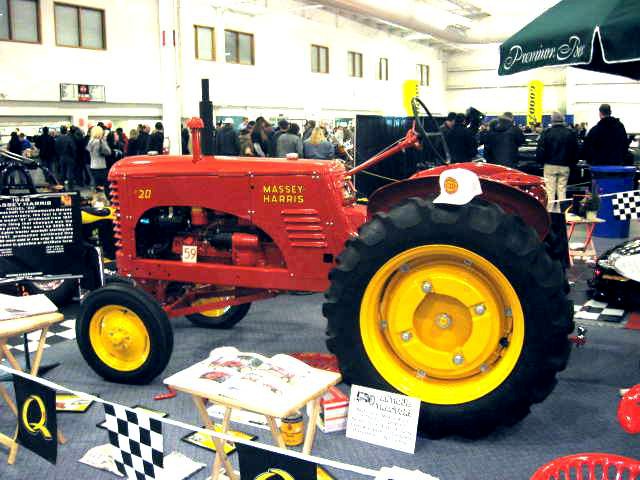
1948 Massey-Harris
In our early years on our perch above the valley, before the trees got too tall, we could just see his farm. It was three miles away, but by road it was seven miles. Ole owned a threshing machine. We would trade work or oats for him to come to our farm with “the separator,” as we always called it. Ole would putt-putt along at a much slower speed than necessary in his 1940’s era red and yellow Massey-Harris tractor towing the machine to and from our farm. Ole never rushed anything. Never. Ole never got excited. Never. Ole would talk . . . but . . . seldom . . . softly . . . with lots of . . . pauses.
He was slight of frame with massive hands at the end of long dangling arms. He always wore a cap, except when he came awkwardly into our house to eat. I waited for that moment when he stood at the door wiping his feet, cap in hand, calling my mother “Missus.” Powdermilk Biscuits would not have cured his shyness, nor given color to his pale skin, which somehow never tanned or burned, nor given thrust to his receding chin.
It was his head I waited to see. He had classic male-patterned baldness, and, here is what I awaited, five large bumps on his head. I do not know why he had them. They seemed benign, and he lived into his late 70’s. But what child could not be enthralled by those bumps!
The Norwegian
Noble—yes, that was his name—was my father’s best friend. And as opposite of my father in temperament as a man could be. He had been a Lake Superior fisherman until the coming of the lamphrey. He switched to farming, with which he needed much help from my father. I liked his name, and he did have a serene Nordic unpolished nobility. But I liked his brother’s name better, Sextus, which always made me giggle. Noble was short, stout of frame, and walked with small slow careful steps. He always bent his upper body forward and furrowed his brow as if deeply worried, which he was not.
Oh, how many stories there are about his kind, gentle, and implacable nature. For instance he once brought back 50 wild yearling steers off the Montana Range, and trustingly left a gate open, letting them escape. We got back 49, one of which died.
One was found as far away as Beaver Bay.
One day when he was about 50 years old sitting drinking coffee at our house, calling my mother “missus,” he casually mentioned that he had married the week before. My parents snorted coffee. It was a women we knew—brusque, demanding, fast-moving, and intolerant of incompetence. It proved to be a lasting, loving, and happy match.
After I moved back to Two Harbors, I often saw Noble. Once I mentioned to him that my backyard had a large pile of firewood which was too punky to burn in our fireplace. He agreed with my suggestion that it would burn in the large barrel stove in his garage, fashioned for him by my father.
Fordson Model F
One Saturday he showed up with a hay wagon pulled by his 1930’s era Fordson tractor, famous for its durability and utter lack of power. Noble had three tractors, one a powerful International Harvester, but he loved to use that old putt-putt Fordson. As he backed it down into the low spot in my yard where the wood was piled, I told him that I did not think it had the power to pull out the load. He thought a moment and said, “Yup, yup, probably not,” and started to load wood. Halfway through the job we went in for coffee. He took off his hat, wiped his feet carefully, and charmed my wife, calling her “Missus.”
As you can guess, the Fordson would not pull out the load. He did not get mad; he just laughed and said, “Yup, yup, you were sure right about that.” He drove the 11 miles home and 11 miles back the next day with the IH, which pulled it out easily.
That was, sad to say, my last meaningful contact with that exemplary man. But I picture him every time I hear the term “Norwegian Bachelor Farmer.”
I will come clean – I like accordion music. I am even, sort of, a groupie. For a handful of seasons, my best friend and I have bought orchestra tickets for a few concerts. An integral part of the evening out is the accordion player in the skyway by Orchestra Hall. He’s always there, upturned hat on top of his case, slightly unkempt hair wrestled back into a ponytail, a smile lighting up his face. Once I happened to find him across from the Ordway on an opera night – walked through Rice Park, out of my way, just so I could put a little cash in his hat (Accordion Groupie behavior, I realized).
The first time I heard the accordion guy, it was a lovely surprise to hear a bit of a musical prelude on the way in to the hall from the parking ramp. Fairly quickly it became part of the evening’s routine to ensure my friend and I had a few singles ready for the accordion player. When one of us is without singles, we divvy up what we have so that we can each put something in the hat. He plays everything from French café music to opera to folk tunes. I have threatened to waltz my pal across the skyway; I have danced a bit on my own. My mother upped the ante one evening when she and I went to the orchestra and she admitted, while I was digging for ones, to singing along with the accordion guy when she was out with friends. (“He was playing ‘Nidälven’, I had to sing along…” Can’t fault her logic, really.)
The skyway accordion guy is as much a part of the concert experience as seeing the orchestra itself – he is a standard character in my Orchestra Night script, and I cannot imagine a concert without him (though once he was only there after the show…he confessed, somewhat sheepishly, that he had been on a date). He is one of a cast of thousands in my daily world; more than a mere walk on role, and still less than a supporting character. There have been others like him – characters in my world that I do not know, or know well, but who enrich the tapestry of my days: Taylor the Worm Man who rode the #3 bus with his plastic bucket, fishing gear and philosophies, departing with a nod and a reminder of his memorable name; the woman who came into the restaurant where I worked one summer who always wore a big pin with a picture of Barbara Streisand, ordered food that had never been on the menu, and refused to be served by the waitress with the white streak in her hair; the older fellow who I often see out for an afternoon walk when I drive home from work, always chewing on an unlit, but well used, pipe. Without this changing cast of background characters, life would have less texture, less color, less life. And no accordion accompaniment.
Who are the walk-on and supporting characters in your world?
Welcome to a place where pine cones are medicine, a stick can be a baby bottle, a lily-of-the-valley is a fairy lamp with lots of little tiny lights.
I get to see my 8-year-old neighbor Lola each week for a couple of hours. She always has an idea for what we should do, and although we’ve done a couple of artsy projects (yes, she’s made a placemat from old greeting cards), the most fun has been pretend. And the best place for pretend seems to be out of doors.
I had almost forgotten about pretend. I did plenty of it both as a child, and when my child was young in the 80s. But that was long ago, so clearly I was a bit rusty. I found it’s a bit like riding a bike – you never really forget how. One person says something like “This stone can be the fairies’ doorstep”, and suddenly you find yourself saying “I know some seashells that can be more steps – I’ll go get them!”
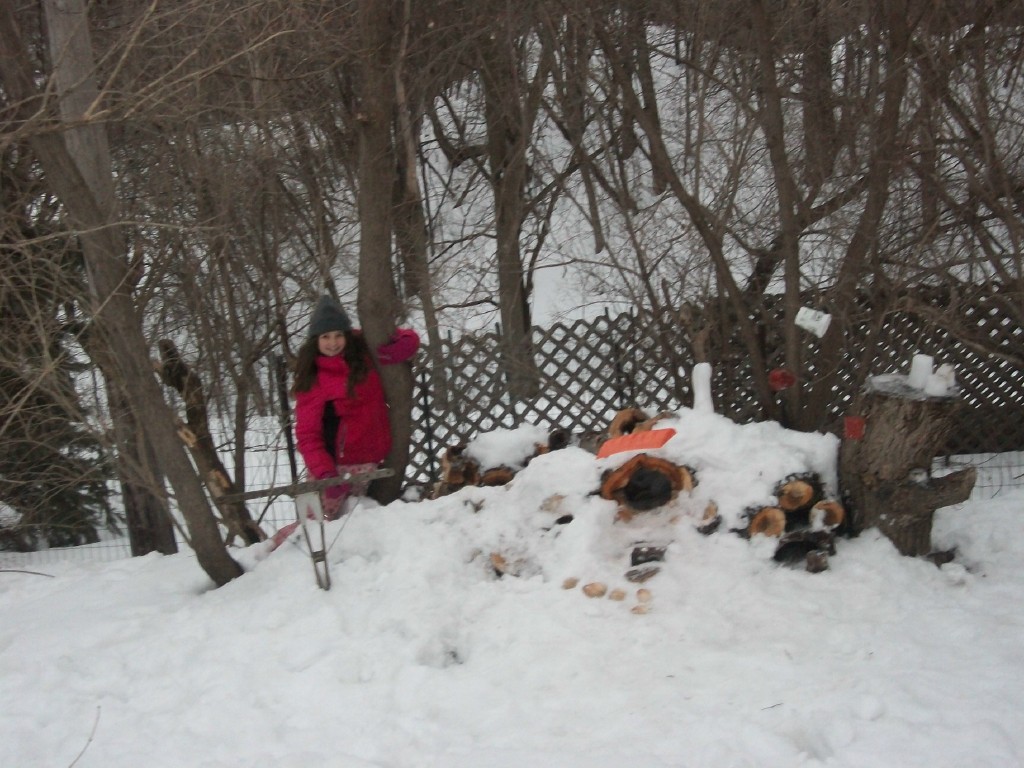
When one of those last snowstorms surprised us, Lola and I converted the woodpile-snowdrift into a Fairytown, where the overturned shells became stepping stones, and later (not overturned) for fairy dishes. A hollow log was a safe haven for squirrels and chipmunks and other critters. Once it got warmer, Husband helped us build a Fairy House from some scrap wood pieces and an old squirrel feeder.
Our favorite game to date has been Ambulance. Lola created a doll hospital in a pine tree’s low branches, with hammock style beds she fashioned from tablecloths. She had brought three dolls with her that day, and the wheel barrow was enlisted as The Ambulance.
With the use of both my cordless and cell phones, I was able to call Lola the Ambulance Driver and tell her what street to zip over to (streets were named by what they were near: Garden Lane, Brick Lane, Shovel Lane…). She whisked an injured baby to The Hospital, where there were five available rooms named by the type of injury they housed: Broken Left Leg, Broken Right Leg, Broken Left Arm, Broken Right Arm, and Anything Else!
There was even a waiting room for me, the anxious mother – the garden bench out front over by Brick Lane. All babies/toddlers were successfully treated and given pinecone medicines, and returned by the Ambulance to their homes.
Do you have anyone in your current life with whom you can pretend?
If not, try it here: What would be the prominent features of your imaginary town?
Today is Dave Garroway‘s birthday, in the year 1913. He was a TV star back when people dressed up to be on TV. But he was a radio man too, and for a time in the ’50’s he was everywhere. His conversational style of hosting was a departure for the more formal, announcer-y approach, and his work as the original host of the Today show helped bring some intimacy to the new, blurry, black-and-white frontier.
How’s this for a good morning greeting in November of 1957.
“And how are you about the world today? Let’s see what kind of shape it’s in; there is a glimmer of hope.”
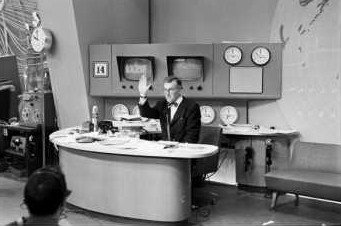
And you have to love a guy who established as his trademark, in Eisenhower’s America, at the height of the Red Scare, a simple one-word sign off, accompanied by a raised hand with the palm forward – “Peace.”
Signing off with "Peace".
Though Garroway seemed so easygoing and cheerful on the air, he struggled off-camera, and depression eventually took its grim toll. He ended his own life with a shotgun. He was 69.
There were a lot of things wrong with the ’50’s and ’60’s. I wouldn’t want to go back there to watch good people endure semi-official racism and a host of corrosive things we just “didn’t talk about”, like mental illness. But I do like the thought of TV shows where the ladies wear diamonds, the gentlemen have bow ties, and there’s room for chalkboards and chimpanzees.
Here’s Garroway’s appearance as a surprise guest on a popular show – basically 20 questions, but televised.
I know the real estate market is in miserable shape, but some deals are irresistible.
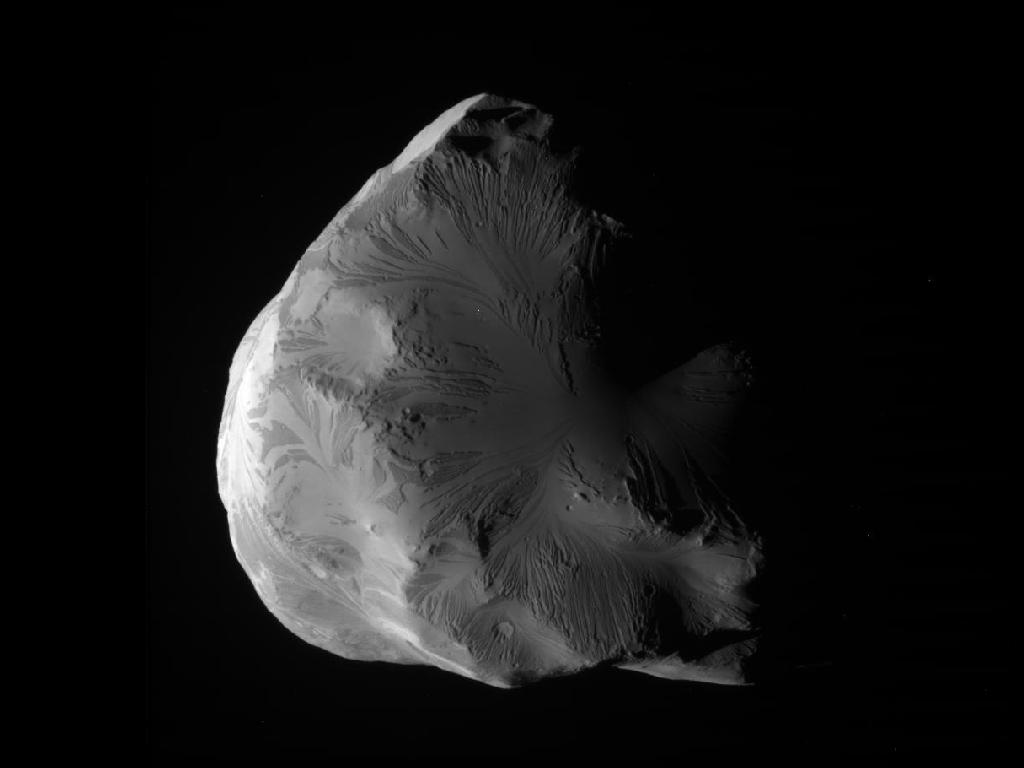
Wouldn’t you like to own this fabulously ornate and undeveloped chunk of terra incognita? The property itself has the same luxurious texture as the lumpy pillows that engulfed you when, as a five year old, you sat down on Aunt Helene’s mammoth brocade sofa, and almost disappeared.
This wonderful bargain is, in fact, NAMED Helene. How unique!
Don’t let the fact that Helene is a rather remote property prevent you from taking advantage of this once-in-a-lifetime opportunity. Moons of Saturn are numerous, it’s true. But they are not for everyone. Helene is frightfully cold and traditionalists shopping in the moon market sometimes disparage Helene for her clack of classic roundness. But this is a satellite with an unforgettable shape – clearly distinct from any run-of-the-mill sky disc. No one looking at a line up of charming orbiters would mistake Helene for a common moon!
And Helene is much more than a chiseled work of art – she occupies one of only five exclusive Lagrange points which can guarantee consistently excellent and unchanging views of both her sister moon Dione and the planet Saturn!
Yes, it is a rare individual who could afford to even attempt to buy a moon of Saturn. But times (for some) are so flush, the embarrassing build-up of money almost requires that a grand gesture be made in the form of just this kind of extravagant purchase – the kind that no one else would ever attempt!
C’mon, doesn’t it remind you of a heavy, musty smelling pillow from that favorite couch? What did you call it back then, when you were just a child? Rosebud?!
What useless thing do you own just for the sake of owning it?
Today is the anniversary of the debut of “The Ed Sullivan Show” on CBS TV, June 20, 1948. At the beginning, it was called “Talk of the Town”, though it wasn’t long before people began to refer to it by the name of it’s not-very-telegenic host, a mumbling newspaper man who appeared awkward on camera. Critics savaged him, but viewers liked Ed just fine. He may have been the first “reality” TV star.
The thing I liked about Ed’s show was its variety. He had acrobats and actors, dancers and directors, opera stars and puppets and rock bands too. There were lots of songs from Broadway. Rogers and Hammerstein were on the very first show!
But the act I’ll always remember is the plate spinner. Watching this guy do his thing is how I learned I could never be an anarchist. I get far too tense thinking about the possibility that the fragile world will come crashing down into a state of total ruin. Watching this act was almost unbearable for me as a 13 year old who liked things to be nice and orderly.
You may have to sit through an ad to see it, but that’s shew biz!
It occurs to me now that Ed Sullivan’s plate spinner was a preview of our multi-tasking modern workplace. Nobody is responsible for only one thing these days. Back in 1969, we thought he was insane, but Erich Brenn could be any school teacher or office manager in 2011.
What was your favorite act on the Ed Sullivan Show?





 Trail Baboon