Tag Archives: Outer Space

A Trip To Glenelg

The directors of the Curiosity mission on Mars are planning a road trip for the rover. Just like so many of us do in late August, NASA will pack the family in the car and go sightseeing. Even though we just got done spending what felt like YEARS in space, we have to look at something new? Can’t we just stay in one place?

Image credit: NASA/JPL-Caltech/Univ. of Arizona

Apparently not. In this case the new attraction is named Glenelg, which has some interest for the scientists because three different kinds of terrain intersect there. I don’t know the textbook terminology for it, but basically there’s some stuff that looks like it could be bedrock, some other crater marked stuff that might be quite old, and lots more of the stuff that Curiosity landed on.

Glenelg is a palindrome, and the planners named it thus because Curiosity will visit the spot twice. Once on the way to the base of Mt. Sharp, and once on the way back.

This is how engineers amuse themselves.

Following the travels of Curiosity will be fun if you are the sort of person who happens to find driving very slowly and looking at rocks delightful. Teenage joyriders may lack the patience for this particular trip, but we have the mission planners to thank for giving us a nice variety of rocks to enjoy. Rocks, boulders, outcroppings, chunks, lumps. Mars Rover watchers will see plenty of terrain and will learn many new words to describe dusty red nuggets over the next weeks, months and years.

Here’s what I’m waiting to find out – when Curiosity starts claw at the ground with its shovel, will we say it is digging holes in the Mars?

If a similar rover from another civilization was sent to Earth on a quest to explore some scenic spot where multiple kinds of terrain intersect, I’m certain its mission planners would land it at the Lengby Rest Area in Polk County, Minnesota.

The Red Triangle Inside A Circle Marks Our Landing Spot
There’s Landing Space Between These Metallic Outcroppings!

There are lots of good reasons for curious aliens to do this.  For one, there’s a flat parking area, so their rover can be lowered onto an even surface. It would be a particular challenge for the engineers to pick a location that’s empty – my recommendation is to go for one of the first spots you come to – far away from the trash cans, the commode, and vending. But those exciting features could be part of a future road trip for the Earth Rover, once it has found its bearings and established a link with the home planet.

Those New Chryslers Just Get Uglier and Uglier

And there’s summer tourism, of course. People up from the Cities would take  pictures of the extraterrestrial machine as it takes pictures of them. Actual aliens would be off-putting and we’d ignore them as long as they ignored us, though we’d talk behind their backs and make all sorts of unflattering assumptions about them. But if they sent their machines, well, that kind of space traveler is a little more approachable. I’ve been to the Minneapolis Auto Show. If it has four wheels, it will draw a crowd.

But the best reason is that Minnesota is home to four different biomes and all four of them come together within a few miles of that potty break paradise between Erskine and McIntosh. There’s Coniferous Forest to the Northeast, Tall Grass Aspen Parkland to the Northwest, Prairie Grassland to the West and South, and Deciduous Forest to the South and East. What a treat for an automated rover sent from a place like Tatooine, which we all know is a desert planet in a binary star system. Those parched taxpayers would want to get their money’s worth, and the Lengby Rest Area would deliver. All this different terrain to look at!

The only problem – the Lengby Rest Area is situated in the median, so the machine will have to cross Highway 2 to get to the good stuff. But that’s just another kind of scientific discovery – do Minnesota drivers brake for exploratory robots? Sometimes you have to go there to find out.

Where’s your favorite road trip rest stop?

Headline Writers Blast NASA

by Bud Buck

Newspaper headline writers across America, but particularly on the densely populated East Coast, have accused NASA of “trying to ruin us,” with the awkward timing of the latest Mars mission.

“For me, this is an above-the-fold feature from hell,” said Tim Lanyard, chief headline writer for the Baltimore Defunct Doorstep Times. “First thing Monday morning it has to be the top story. Everybody is going to be talking about this event that isn’t going to happen until 1:30 am Eastern Time.”

Lanyard was referring to NASA’s plan to land Curiosity, a car-sized automated rover, on the surface of the planet Mars. The attempted landing is the most complicated and risky extra-planetary mission ever attempted, and the space agency has spent weeks trying to manage expectations while simultaneously building anticipation about the mission.

“They’ve been promoting it like an action movie,” complained Tiffany Charmes, Viral Video Reviewer at the Hartford Au Courant. “Just look at this video,” she said.

http://youtu.be/kyACKOj1o40

“The production values, the dramatic music, the lighting – Whether the thing lands successfully or blows up, people are bound to be entertained,” Charmes whined. “It increases the pressure for us to cover it.”

But accurate coverage of this story is nearly impossible for old-school newspapers, given NASA’s timelines.

“There’s no way we can get anything about Curiosity’s successful landing or horrendous crash into the earliest morning edition. By 1:30 am, we have to have the dang paper printed and headed for the trucks,” said Jonah Perry, V.P. for S.T.P. (Stop The Presses) at the Boston Ink Stained Wretch. Right now, the headline I’m going with is ‘Mars Thing Happens!’ The sub-head is ‘Check Our Website’. It’s killing me to do that, but I’m nearly dead from a bunch of other bad habits anyway.”

Headline writers also ripped NASA for scheduling the showy maneuver so close to the mid-point of the 2012 Olympic Games.

“With a successful mission, the urge to go with something like ‘NASA Sticks Landing’ is going to be irresistible,” said Alice Strug, Manager of Originality at the Charlotte Breakfast-Placemat. “It will make our heads explode to avoid it, but we’ll have to. Conversely, she said, a botched landing will beg for some kind of auto-crash parallel. ‘NASA Car Hits Planet’ is a headline I’d both love and hate to run.”

All of this hand wringing is further evidence that printing current events on dead trees has become awkward and almost unmanageable in today’s constant news cycle. Of course, by the time you read this, up-to-the-minute and accurate accounts of what actually happened will be available online, which some readers will say makes this whole discussion pointless.

Maybe so, but my deadline was last night and I had to having something turned in. I’m not a morning person, so deal with it.

This is Bud Buck, reporting!

Bud Buck is a journalist of questionable merit. It is quite possible he has invented most, or all of his sources and quotes – something not unheard of in today’s (or yesterday’s) news environment. His work on Trail Baboon is featured as a favor to an old friend, and as a direct result of editorial laziness.

You know what really happened. Write your own Curiosity landing headline.

Globular Clusters

I was delighted to find this treasure in my mailbox yesterday – a photo of a clump of stars about 20 thousand light years from our solar system.

Image credit: ESA/NASA

The Hubble Space Telescope is responsible for capturing the image of these very old stars known under the title “Messier 107“. They’ve been blazing away in the night (and daytime) sky for billions of years.

Messier 107 is a globular cluster – a defining name given to about 150 collections of stars located around the Milky Way.

Globular Clusters would also be an excellent name for a breakfast cereal.
All that’s missing is the technology to make crunchy bits that glow with an intense light when milk is added. Dark chocolate milk of course – to keep the deep space feel of things.

How hard would that be?

I know cereals don’t have jingles anymore, but this one should! Although you’ll have to make up your own tune.

Globular Clusters can’t be beat.
You can eat ’em with sugar, with fruit, with meat.
They’ll twinkle and sparkle and rock your bowl
‘Cause each box comes with a free black hole.

Globular Clusters every day!
They’re bright as stars in the Milky Way.
They’re packed with energy, there’s no doubt.
And time itself cannot snuff them out!

Globular Clusters – count them all.
There’s great big taste in each blazing ball
A fusion of flavor in every one!
Your breakfast will shine like the morning sun.

Globular Clusters!

What’s your favorite breakfast cereal?

Sea of Tranquility (World)

Today is the anniversary of the first landing by humans on the Moon. It happened in 1969 when the Lunar module from Apollo 11 touched down in the Sea of Tranquility. Not an actual sea, of course, but a darker area on the moon’s dry surface that was thought to be a sea by early observers.

Photo by NASA/GSFC/Arizona State University

Not long ago, NASA’s Lunar Range Observer took a photo of the area from 30 miles up. The bright spot to the left is the Apollo 11 site. For the people who already believe humans actually travelled to the moon, this is proof positive that a landing occurred. For all the moon hoax conspiracy theorists, flat-earthers and space travel deniers, it is just another bad Photoshop job.

But take a good look at the site. NASA says the area in the photo is about four tenths of a mile across from side to side and from top to bottom.

It just so happens Disneyland Park in Anaheim, California is about four tenths of a mile across from The Many Adventures of Winnie the Pooh on the west to the outer edge of Autopia on the East,
and also from Mickey’s House on the North to the main gate on the South.

Coincidence? I think not. If the current push towards the private exploration of space continues and ultimately includes space tourism as a main revenue source, the Apollo 11 landing site at the Sea of Tranquility (World) will become a significant historic and recreational destination.

Photo by NASA/GSFC/Arizona State University/Google Maps

People will flock there with their families, though they’re bound to complain about that insipid music that accompanies the ride on It’s A Small Step After All.

Invent an attraction to go in (or near) Sea of Tranquility (World).

Wayfaring Stranger

I felt silly last week while going through a mild panic about hail hitting my new car. There was no actual damage, and in the larger scheme of things, what’s the difference?  I’m planning to keep the car for at least ten years and suck all the value out of it anyway. When it comes time to sell, there will be many more concerns than a few little dimples on the hood.  And really, aren’t there much better things to be alarmed about?  Just about then, I ran across a NASA Press Release with this title:

Giant Black Hole Kicked Out of Home Galaxy

WASHINGTON — Astronomers have found strong evidence that a massive black hole is being ejected from its host galaxy at a speed of several million miles per hour. New observations from NASA’s Chandra X-ray Observatory suggest that the black hole collided and merged with another black hole and received a powerful recoil kick from gravitational wave radiation.

“It’s hard to believe that a supermassive black hole weighing millions of times the mass of the sun could be moved at all, let alone kicked out of a galaxy at enormous speed,” said Francesca Civano of the Harvard-Smithsonian Center for Astrophysics (CfA), who led the new study. “But these new data support the idea that gravitational waves — ripples in the fabric of space first predicted by Albert Einstein but never detected directly — can exert an extremely powerful force.”

The press release goes on to say that while this is probably a rare occurrence … “it nevertheless could mean that there are many giant black holes roaming undetected out in the vast spaces between galaxies.”  And because they have consumed all the gasses surrounding them, “… these black holes would be invisible to us.”

Thank you NASA!  This is exactly the sort of thing I was hoping for – a new reason to worry about armageddon arriving in a way I have not yet imagined.  Black holes absorb everything in their vicinity – even light doesn’t escape.   I had become relaxed about the ever-present potential for the sudden, random strike of a massive, undetected asteroid, exploding like a thousand nuclear bombs over my back yard.  The odds haven’t changed on that one, but now that I’ve had a few years to factor it into my nightmares, I’m accustomed to that particular level of dread.

I’m Not From Around Here

A black hole wandering into our galaxy would crush my car and me and all my stuff into something smaller than a hailstone, so let’s get our priorities straight!   This exciting new bit of dark information opens up a higher level of paranoia because it combines an existing, somewhat abstract fear of outer space with an old horror film classic – the mad, wandering loner.

The notion that there are orphaned Black Holes roaming the cosmic countryside with nothing to lose means I can marry my trepidation about galactic surprises to my conviction that all strangers are potentially insane and probably homicidal.

It’s not so farfetched. If you had just been ejected by gravitational slingshot from the center of your home galaxy, wouldn’t you nurse a grudge against pretty much everything, but especially against tiny planets where some clueless people place too much importance on a flawless paint job?

Tell us about a surprising encounter with a stranger. 

Impending Merger

Possibly the most intriguing bit of news I’ve heard in the past few weeks is the new level of certainty reached by scientists that our Milky Way Galaxy and the Andromeda Galaxy will merge in about 4 billion years.

There had been some doubt. Sky watchers have noticed the movements and have wondered if the two galaxies might be drawn together by their gravity – this at a time when the universe itself is expanding faster and faster, leaving even more emptiness between the objects. But these two galaxies are close enough that the expansion will not draw them apart.

Galaxies, as big as they are, have their own destiny and ours apparently is to join with Andromeda.

We’re talking about billions of stars, some (maybe all) dragging a retinue of planets, asteroids, comets and debris, coming together in one grand conglomeration. And yet none of the stars will hit each other! This was said with certainty in one article I read – yet how can they know?

And if the merger of two galaxies is anything like the acquisition/merger of two corporations here on Earth, there are bound to be casualties. Several hundred duplicate retail outlets and half the staff of the PR department, for example.

Two things drove the magnitude of this event home for me –

One is a video simulation of the galaxies as they are expected to interact – an initial co-mingling 4 billion years from now with momentum that carries them apart again, and a final, second alignment 2 billion years later. Looks like fun if you’re not in the middle of it!

The other is a simulation of the night sky as seen from Earth with Andromeda approaching – about 3.75 billion years from now. Imagine if you went outside and saw this.

Beautiful, romantic, and a bit like looking down the train tracks at the onrushing southbound commuter as your wheels spin in the mud. Gulp.

Who knows if we, as humans, will still be around to witness the merger? Probably not. But I did see a cockroach the other day and I tried to tell him (her?) to keep an eye on the sky for big changes. I got the usual disappearing act for an answer.

In such an unpredictable world, I’m amazed whenever we KNOW something is going to happen for certain and for sure. Galaxies will collide. Neither Congress nor the Koch brothers will be able to stall it or stop it or spin it.

As in corporate mergers, making everyone feel comfortable with joining the new entity will be a challenge. Maybe a clever name and some good signage will help.

What should we call the new galaxy?

Pinhole Camera Pt. 2

I was looking forward to seeing last night’s partial eclipse of the sun, but lacking a welder’s mask I knew it would be melted eyeball time if I actually tried to watch. So when the day started with rain, and continued with rain, I was only mildly disappointed that clouds would hide our solar peek-a-boo.

But when the skies cleared in the late afternoon, I knew I had to find a west-facing wall with a nearby tree and a clear view of the horizon so I could see if the tree-leaves-as-pinhole-camera phenomenon worked.

Luckily, Columbia Heights High School had all the required components.

And there you see all the little curvy sun-cresecents, just as Aristotle predicted. Impressive! What better place to have a scientific principle demonstrated than the wall of the local high school.

And there happened to be a guy there with a welder’s mask, so I got a direct look too!

When have you been astonished to discover what you were told is true?

Lunar Madness

Here we are, gathered on this bleak Monday, a band of hardy stragglers huddled together in a sheltered corner of the internet. We are the last survivors of Earth’s weekend “Supermoon” encounter.

Saturday evening’s 14% larger-than-normal full moon came as a boon to photographers, lunatics and doomsayers. The full moon has always had some baggage and is regularly blamed for episodes of weird human behavior. The moon’s elliptical orbit brought it to its closest Earth approach at the same time fullness arrived, causing worldwide consternation even though nothing was out of the ordinary.

© Copyright Adrian S. Pye

But theater people already know what great dramatic effects can be wrought with timing and careful manipulation of the lights. And how little those effects will mean if you perform them while the curtain is drawn, as it was here in the Twin Cities on Saturday night.

Still, we live in a particular place and at a specific time when things that are bigger and brighter than normal are revered. We like the concept of “super-ness”, whether it’s applied to football games or french fries. Even a small fragment of extra power is alluring, and some wondered if a close-approach moon might trigger a rash of earthquakes and tsunamis. It didn’t, but it did shake loose an avalanche of online articles about the “Supermoon”, and how there was really nothing to fear.

In the end, paying closer attention to what goes on in the night sky can’t be bad, and I know some learning happened. For example, until I encountered and made myself pay attention to the “Supermoon”, I was unsure if the word “elliptical” had two or three “L’s”. Now I know!

Here’s a nice educational flyer from space.com with more handy information.

Learn what makes a big full moon a true 'supermoon' in this SPACE.com infographic.
Source SPACE.com: All about our solar system, outer space and exploration

All Supermoon needs now is a song.
Here’s one idea, to the familiar tune of “Moon River”.

Moon … Super! Wider than a mile.
Calamity’s your style … they say.
You seem bigger, you quake trigger.
The closer you look the more we pull away.

Space drifter, raising up our tides
Upsetting our insides, don’t scoff!
Our planet is nearing it’s end! It’s chaos you portend.
You’re a lousy friend, Moon – Super! Back off!

Are you unsettled when someone stands too close?

Space Mine Balladeer

I was intrigued by the story this week that some above-average billionaires are proposing to explore space for a way to accumulate even more wealth through the burgeoning not-yet-an-industry of Space Mining. The idea is to find precious metal rich asteroids, and to plunder them with robots.

These machines will then somehow deliver the spoils to Earth where already fat portfolios will swell with an infusion of Space Cash. I suppose that’s the sort of thing you dream of when you’ve already got more money than a person can comprehend – more mind-blowing wealth. But what a sad business plan – to do all this with unfeeling robots cheats the rest of us out of all the melodramatic Space Mining Songs that would be written if humans actually left the planet to do this work.

Of course we’d have to change some of the standard references.
Here’s a Merle Travis original:

And here’s a group called Ryan’s Fancy doing their version that appears to include only Merle’s chorus. But I love it that they’re performing on what looks to be the ruins of a gantry after an especially tumultuous launch from the spaceport.

One could, if one were so inclined, imagine how this classic might be adapted by the poor unfortunates who would rush to find a living by collecting silver in space.

Come all you young fellows so young and so fine
And seek not your fortune way up in the mine
Every mineral is precious and pure – unalloyed.
But it’s hell to dig deep into an asteroid.

It’s dark and it’s cold and it’s desolate too.
Where the gravity’s weak and the comforts are few.
Where the metals are rare and the air is refined.
It’s stark and its grungy way up in the mine

They will tell you at launch that you’re gonna be rich
In a spacesuit there’s no way to scratch at that itch
It’ll claw at your heart, it’ll tickle your mind.
But there’s no satisfaction way up in the mine.

It’s dark and it’s cold and it’s desolate too.
Where the gravity’s weak and the comforts are few.
Where the metals are rare and the air is refined.
It’s stark and its grungy way up in the mine

You’ll feel weightless and nauseous and all kinds of sad.
And you’ll think of your family left back on the pad.
When you total it up and they give you your leave
You will barely earn back what they charged you to breathe.

It’s dark and it’s cold and it’s desolate too.
Where the gravity’s weak and the comforts are few.
Where the metals are rare and the air is refined.
It’s stark and its grungy way up in the mine

What was the least rewarding job you ever did?

Here Come the Groceries

Ooops. My apologies for the late post, Baboons. It was ready to go but I forgot to push the right buttons – perhaps the whole process should be automated.

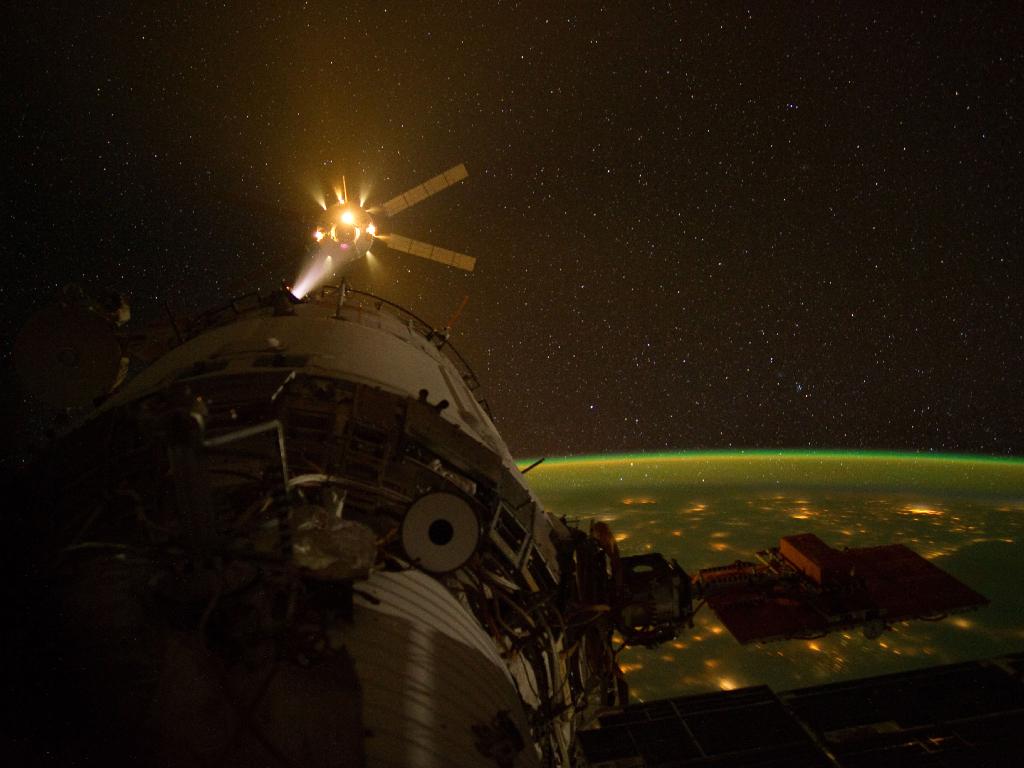
It feels like some of the impossible stuff we used to enjoy in movies is, in part, coming true. I’m sure I’ve already seen this image of a pilotless cargo pod docking with the space station in one of the Star Wars movies.

But this really happened last week – 7 tons of supplies just showing up, all bright and futuristic-like in something called an Automated Transfer Vehicle, or ATV-3. Welcome, mechanical stranger. Meet R2D2 and C3PO. They say the space station crew stayed up late to watch this operation unfold, and who wouldn’t? The beauty of space plus the sophistication of the technology plus the colorful lights and gas jets plus the tension of wondering if it will really work plus we get to have a new flavor of space food sticks on board FINALLY because I’m getting tired of Banana Nut!

And here’s a surprise – the cargo pod is disposable. According to the Christian Science Monitor report, the Space Stationites are supposed to fill it up with garbage and then release it to burn up completely in the atmosphere on an uncontrolled re-entry. It’s history’s most expensive Hefty bag, and not all that different from what my dad liked to do in his burning barrel out in the side yard. Bring out your junk! Anything that leaves here in a wisp of smoke is forgotten. Isn’t that how we got into this climate change mess?

They say the space program is a preview of coming attractions here on Earth.

Would you trust a drone to deliver groceries to your door?