Tag Archives: Outer Space

A Little Place in the Country

The question of whether there is another planet in the Universe that can support life has always struck me as the kind of question we ask for sport because it really has an easy answer – Yes! I say that with confidence, as long as you don’t need any absolute proof.

Consider the universe. It’s pretty big and there’s lots of stuff spread around it in multitudinous combinations. So I expect that there are trillions of planets that can support life, billions that can support human life, millions that can support a human life comfortably, thousands that can support a human life as timid and finicky as my own, and at least a half dozen that already have a nice retirement bungalow set up for me and the Mrs. alongside a beautiful sea made of some fun-to-behold liquid that I can definitely watch but not go jet skiing on.

I’m sure they’re out there. I just can’t name any for you.

And now along comes the ESO (European Southern Observatory) to declare that I’m right! There is another potential home for you in the stars. Billions of them, in fact, and relatively close, too! Figure out how to get there and you can start moving your stuff, as long as you don’t mind living right next door to a Red Dwarf. And of course I don’t. I’ve thought for a long time that accepting diversity and practicing non-discrimination is a question of practical justice and also the basis of an excellent long-term survival strategy. So I’d live happily next to a cool Red Dwarf, especially if my current neighbor, (The Sun), is a hothead planning to expand and incinerate the neighborhood (as everyone says) in a few billion years.

If the ESO scientists are right, those holding upside-down mortgages will not find relief anytime soon and we’ll never have another real estate bubble on Earth. The market just got flooded. Terrain is cheap. The good news? Terrain is cheap. All you need is transport. Oh, and air.

What are your requirements for a new planet?

Odd Couple

It’s like one of those rumors you heard in high school. Jupiter really likes Venus. I mean really, really likes her. See how he does everything he can to get closer?

Jupiter - blotchy lovestruck loser

For, like, the whole past week he’s just been hanging around. If you catch a glimpse of her, look nearby. There he is, looming! Weird. Do you think she likes him? If there are two planets that are NOT going to get together, it’s them.

She’s so small and hot, and he’s huge! They say he’s incredibly gaseous. And people who watch him closely say he’s so moon eyed around her. Or maybe those are actual moons. Hard to tell.

Venus - electrified hotness

Stranger things have happened. Venus and Jupiter will appear to get quite close today, but really, there’s absolutely no chance they’ll ever actually be an item. Two reasons:

1) If you grew up with the same straight-line map of the solar system I saw, you know that Venus is off to the right, between us and the gigantic flaming sun. And Jupiter is far left – out past the asteroid belt and halfway to Uranus. They’re simply too far apart. We shouldn’t even be able to see them in the same piece of sky. Don’t these planets know their left from their right? Didn’t they learn the chart?

2) In Mythology, Jupiter and Venus are a father/daughter pair. Ugh. I know those Gods and Goddesses were a little indiscriminate, but come on. There’s a whole universe out there. Pick somebody more appropriate!

Tell us about the Oddest Couple you know.

Our Tremulous Moon

Here’s some evidence that things are not so sedate on the surface of our moon.
Photos from the latest gizmo to get a close look at our natural satellite reveal signs of geologic activity sometime within the last 50 million years. In other words, just yesterday. This and yesterday’s Super Tuesday results pretty much put a fork in former Speaker Gingrich’s chances to be our next President. Who wants to spend precious tax dollars building and traveling to Moon Base Newt when all the fun of leaping around in low-G could be ruined by a rolling Moonquake? Next thing you know we’ll discover the destructive tracks of an airless tornado. All the disadvantages of Earth and still nothing green? No thanks, Newt.

Photo from ASU/SI/NASA

But whether or not we ever go there to use it as a leaping off place, the moon will remain a beguiling bauble in our night sky – a maker of songs and silent witness to a trillion wishes. Who knew, during those times when we stood shivering in the moonlight, the moon itself might have been shaking too? Seismic activity is more charming at a safe distance. Now that we know it happens, perhaps exceptionally patient lovers will be able to see the lunar surface tremble.

Blue Moon, you saw me standing alone.
Without a dream in my heart.
Without a love of my own.

Blue Moon, how did you sense what I ache for?
A love I silently spake for.
Is that what you had a quake for?

And then suddenly there appeared above me
a crash of rocks and dust – a lunar din
I heard somebody whisper ‘Can you love me?”
and when I looked the moon had cracked a grin.

Blue Moon, now I’m no longer alone
without a dream in my heart
without a love of my own.

And it so COULD be our way station to Mars! Why, just tonight, in the eastern sky, the Blue Moon will be quite close to the mysterious Red Planet. Almost exactly the distance from one side to the other of your clenched fist when held at arms length.
Why couldn’t we just step across?

Sky Map from NASA

What to you like to look at in the night sky?

String of Lights

I would be a terrible astronaut and a complete waste of oxygen on the International Space Station because I’d always be looking out the window at things like this, courtesy of NASA.

The Eastern Seaboard at Night.

NASA says: Boston is just out of frame at right. Long Island and the New York City area are visible in the lower right quadrant. Philadelphia and Pittsburgh are near the center. Parts of two Russian vehicles parked at the orbital outpost are seen in left foreground.

Just imagine all the stuff going on down there. And think about what it takes to keep all those lights on. In case you’re still questioning what’s what, here’s another view:

A couple of things come to mind.

I can see where Philadelphia is near the center along the corridor of light that stretches from sparkling New York City down to the glimmer that is Washington D.C., but Pittsburgh is on the western side of Pennsylvania. So if Pittsburgh is the somewhat dimmer blob just above the center point of the photo, those farther flung smudges are probably Erie, Toronto, Columbus, Cleveland, and maybe even Detroit.

Here’s the other thing – the sure knowledge that two Russian space vehicles were over the Eastern Seaboard at Night would had had us all hiding in the fallout shelter 50 years ago. Today we look at those Russian orbiters and think how cool they seem in the lovely blue light. Back then, of course, the light would have been bright red, and Kruschev would have been gleefully pounding his shoe on the table.

Now, it’s merely a captivating vista.

Where is the window that you could gaze through for hours?

From a Distance

You generated an impressive conversation on Friday, Babooners. Based on your response to the question-of-the-day, I conclude that this is a group that draws inspiration from the idea of being able to launch and head a government agency. If there was any doubt, that confirms it. The place is full of liberals!

And there’s nothing wrong with that! But it’s good to know who you’re dealing with.

Government agencies do tend to create their own atmosphere and climate – they are not known for being responsive to outside conditions. The market-based model some would impose on government is much more inclined to follow the latest trend and capitalize on the current fashion. If photo views on flickr are any guide, the National Aeronautics and Space Administration should immediately re-write its mission and change its name to OPEPA – the Off Planet Earth Photography Agency. If NASA were a movie studio, the moguls running it would most certainly do this – give the people what they want until they lose interest. Right now, the people seem to want distant pictures of our beautiful planet.

Since posting it last week, NASA’s latest photo montage of Earth as seen from a distance has been viewed 3.2 million times. And that’s just for side A, featuring North and Central America. Side B, showing Africa, the Sinai Peninsula and India was posted yesterday. The photos are highly detailed, and were taken by a satellite orbiting much closer to the surface than these photos suggest. Click on one and with patience, you’ll have an opportunity to look at a highly detailed image. It is, frankly, amazing.

The Suomi NPP satellite had to make six passes at a height of 512 miles to get enough information to stitch together an image that looks like it’s orbiting at a distance of almost 8,000 miles. This sophisticated gizmo was launched at the end of October, and already it is delivering startling photos. Take a look.

Sometimes, perspective makes all the difference.

What does it take to see something clearly?

A Space Weather Sunnet

Aside from an unfortunate scarcity of a few minor items like jobs, money, and political civility, we enjoy a great abundance of just about everything else.

Just think of all the things that surround us in much larger numbers than we could ever need –

Celebrities
Colleges
Supermarkets
Automakers
Medical Syndromes
Goldilocks Planets
Electronic Devices
Sports Stadiums
Coffee Shops
Things to Worry About

And on the “worries” front, there’s a fresh new ulcer maker in the news today – an unsettling universal calamity, so to speak – Bad Space Weather.

Haven’t checked the Space Weather today? You thought the cold and icy slush close to ground was enough to temper your enthusiasm? There’s more! This morning we’ll experience the effects of a massive solar storm with a tsunami wave of charged solar particles washing over the Earth at around 8 am central time, all the result of a Coronal Mass Ejection that happened on Sunday. Whats in a Coronal Mass Ejection? All sorts of bad, radioactive stuff that will amp up the northern lights but won’t get down to our level, thanks to our planet’s natural defenses.

Which doesn’t mean we can’t go into a tizzy over it, especially since we’re in a lull between incessant coverage of Republican primaries. But in spite of the occasional alarms that go out, Space Weather just doesn’t seem as immediate as stuff that’s closer to the skin. If only the great poets would romanticize it, perhaps Space Weather would seem more real.

With sincere apologies to Shakespeare, and anyone who loves him:

Shall I compare thee to a solar flare?
Thou art more lovely and less violent
Solar winds may tilt Earth’s elastic air,
Gaudy northern lights, while bright, are silent:
Sometime too hot the eye of heaven shines,
And often is his gold complexion blotched;
And whilst he rises and too soon declines,
He cannot ever be directly watched.
But thy eternal visage may be seen
With all thy bling and fancy articles
By naked eyes alone, without sunscreen
or visors to deflect charged particles.
Looks that thrill direct or in reflections
Outshining Coronal Mass Ejections

Does it make sense to worry about the sun?

More Junk From Overhead

We now know that Russia’s Phobos-Grunt Moon-of-Mars expedition will come crashing back to Earth sometime soon – probably next week.

The spacecraft looks like an elaborate wine-cork removal system I once had. “Corkscrew” was too simple a name for it, and it worked about as well as Phobos-Grunt.

While the mission had been to learn more about the Martian Moon Phobos, instead we will find out about more about how big, heavy, out-of-control things re-enter our atmosphere, explode, melt, and plummet. There might even be some advances in debris field plotting, based on the exact location of the uncontrolled landing of 20 to 30 pieces of the spacecraft.

No doubt Bathtub Safety Officer Rafferty would tell us to take cover for the next fortnight, sitting under the stairs beneath a pile of old mattresses until he sounds the all clear. But where’s the fun in that? If a speeding, molten-hot Russian space chunk scores a direct hit on your house, there’s probably no safe spot anywhere inside, unless you have built a reinforced bunker in the basement.

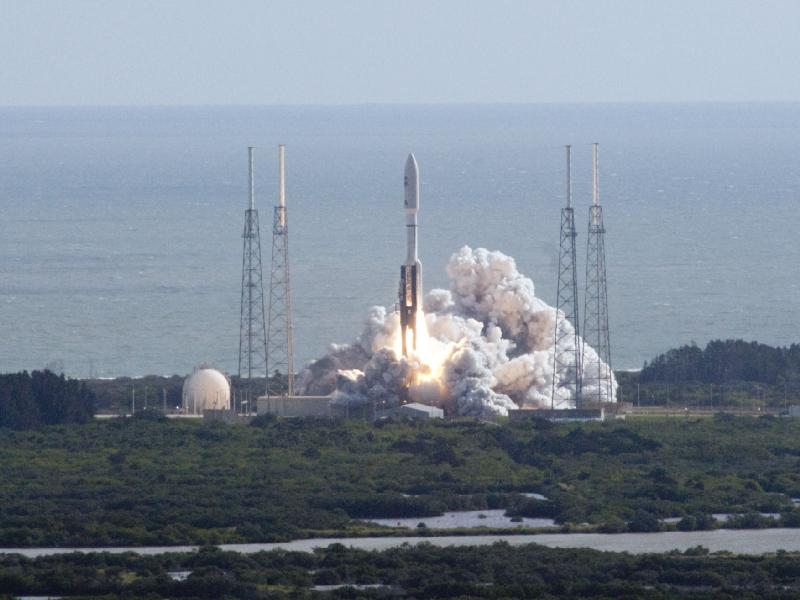
And maybe that bunker is not such a bad idea. The new age of private space exploration means more launches are in our future – possibly MANY more. How many will be poorly planned and ill-advised? If this is the dawn of a new Age of Exploration and the rockets are modern schooners setting out for distant, uncharted continents, then we are the creatures who live at the bottom of the sea – filtering through the stuff that settles and watching for shipwrecks that happen over our heads.

I have often wondered what such denizens of the deep thought of the sudden, catastrophic arrival of the Titanic. Weird, I know. But really – it would come as a bit of a surprise, don’t you think?

And some day in the far, far distant future, when the explosion of our own sun becomes a real threat and we have identified other Earths in “Goldilocks” zones near distant stars, you can bet the well-to-do of our planet will plan their exodus in vessels loaded with their accumulated riches. Why? Because people will always try to take it with them.

Naturally, some of these panicked expeditions will founder.

The good part – Priceless booty rains down all around us.
The bad part – A lot of it is on fire.

Still, it’s always lovely to gaze at the stars.

We blast off for a new planet in ten minutes. What’s in your suitcase?

Miracle on a Ball of Ice

There is a standard type of story often seen in movies where a character is set up as a sure failure – the kind of engaging but doomed loser who faces insurmountable odds and will, under normal circumstances, succumb to a much stronger opponent.

And yet … for reasons that are inexplicable, our hero emerges victorious in spite of it all. We love these tales of amazing, unlikely underdogs.

Add to that list the tale of Comet Lovejoy, a recent discovery by an amateur astronomer in Australia – Terry Lovejoy. Already we are ahead of the game – our sky spotter has a perfectly charming and appropriately seasonal name. My guess is that a comet named after amateur astronomer Neil Grudge-Spite would not get the same kind of global press.

Lovejoy detected the comet in late November – early enough for scientists to train several space based detectors on the object, to track its certain demise as to streaks towards the sun. Here’s one description of the expected chain of events as posted on a Navy website dedicated to Sungrazing Comets just days after news of Lovejoy’s solar approach was announced:

“Welcome to the beginning of the end of Comet Lovejoy’s billions of years long journey through space. In less than 10 hours time, the comet will graze some 120,000km above the solar surface, through the several million degree solar corona, and — in my opinion — completely evaporate. We have here an exceptionally rare opportunity to observe the complete vaporization of a relatively large comet, and we have approximately 18 instruments on five different satellites that are trying to do just that. “

Here’s the amazing part – the comet skitters around the sun … and EMERGES! The comet watchers are dumbfounded. You can see video of the approach and escape here:

And here is the same skeptical Navy observer quoted earlier, delightedly eating crow:

“I don’t know where to begin. I simply don’t know. What an extraordinary 24hrs! I suppose the first thing to say is this: I was wrong. Wrong, wrong, wrong. And I have never been so happy to be wrong! For the past two weeks I have been saying that Comet Lovejoy would not survive perihelion in “any appreciable form”. When I said this, I envisioned that we would see some very diffuse component maybe last a few hours after perhelion, but not much else. I was spectacularly incorrect!
Last night, between 7pm and 8pm (ET), the SDO team blogged and tweeted live the passage of the comet through SDO’s extreme ultraviolet AIA camera. Not long after the first images were made available came the announcement that the comet was seen plunging into the solar atmosphere. I expected this, but was nonetheless delighted. What I did not expect was that a short time later it was seen to re-emerge!
Somehow it survived being immersed in the several million-degree solar corona for almost an hour …”

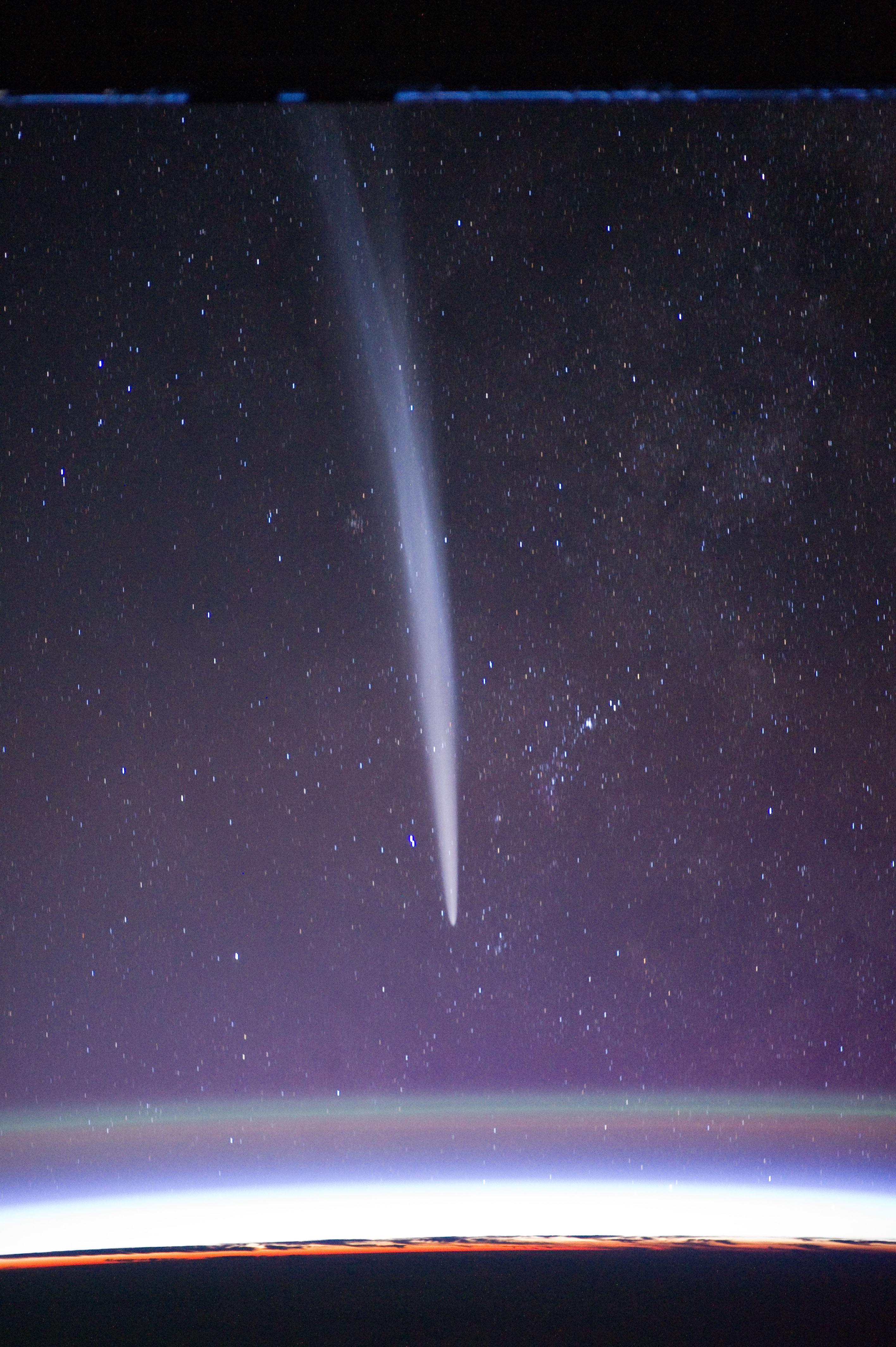
Lovejoy, our hero! And here’s the victory parade – a shot of the comet’s tail taken from the International Space Station by Commander Dan Burbank, who called it “… probably the most amazing thing I’ve seen in space ….” The glowing green tail of the comet Lovejoy, emerging just ahead of the sun from behind the Earth’s horizon.

Who’s your favorite underdog?

The Great Oxidation

Having spent the weekend discussing places we’ve lived, let’s turn our attention now to places we may live some day in the distant future. Or, dear baboons, places where other restless creatures already live. Places they may be longing to leave.

Which brings us to Kepler 22b, the most recently discovered “Goldilocks” planet – a place orbiting a different star where the temperature is ‘not too cold’ and ‘not too hot’. Initial observations indicate conditions could be favorable for human-like life.
That is, if the planet has a surface.

Dang! When it comes to the nuts and bolts of existence, there’s always that complicated bit about needing a surface to sit on. Not to mention some of the other necessary valuables, like having to have water to drink, food to eat and air to breathe. Air is especially important.

In writing about the notion of a “Goldilocks” planet, Dennis Overbye of the NY Times identifies an event that had to happen before life as we know it on Earth could get its start – The Great Oxidation.

“The seeds for animal life were sown sometime in the dim past when some bacterium learned to use sunlight to split water molecules and produce oxygen and sugar — photosynthesis, in short. The results began to kick in 2.4 billion years ago when the amount of oxygen in the atmosphere began to rise dramatically.

The Great Oxidation Event, as it is called in geology, “was clearly the biggest event in the history of the biosphere,” said Dr. Ward from Washington. It culminated in what is known as the Cambrian explosion, about 550 million years ago, when multicellular creatures, that is to say, animals, appeared in sudden splendiferous profusion in the fossil record. We were off to the Darwinian races. Whatever happened to cause this flowering of species helped elevate Earth someplace special, say the Rare Earthers. Paleontologists argue about whether it could have been a spell of bad climate known as Snowball Earth, the breakup of a previous supercontinent, or something else.

Eventually though, Earth’s luck will run out. As the Sun ages it will get brighter, astronomers say, increasing the weathering and washing away of carbon dioxide. At the same time, as the interior of the Earth cools, volcanic activity will gradually subside, cutting off the replenishing of the greenhouse gas.

A billion years from now, Dr. Brownlee said, there will not be enough carbon dioxide left to support photosynthesis, that is to say, the oxygen we breathe.

And so much for us.

“Even Earth, wonderful and special as it is, will only have animal life for one billion years,” Dr. Brownlee said.”

Which all seems rather wonderful and dismal at the same time. Clearly the clock is running and as many science fiction writers have already suggested, it is high time we start looking for another place to be before Earth becomes uninhabitable. Is Kepler 22b it? And in this time of ritual celebration, why is it that the major religions have traditional festivals that inspire and create a sense of wonder, while science offers us nothing except another episode of “MythBusters“?

Perhaps scientists should develop something celebretory that can spark the imagination of the unfaithful.

What would be one of the features of a festival built around “The Great Oxidation Event”? “Oxi-Claus?”

Are We There Yet?

This is the very best part of any road trip. You’re just getting started, everybody is fresh and looking forward to adventure. We’re going to Mars Beach! We’re flying AND taking the car! How cool is that?

Anything is possible, and at the start it’s easy to imagine that fun will be had by all. What could go wrong? When we get there we’ll dig around in the sand and play in the water! And if that gets monotonous, we can drive around and look at things, like outcroppings of rock and crater walls.

OK, some of this is guess work, but that’s part of the fun of going – the spirit of discovery!

After an exciting count-down to the moment when we pull (loudly) out of the driveway, things start to get a little monotonous. The ten little experiments in the back seat start to feel cramped and restless.

It’s going to take HOW long? And what do you mean we don’t really know for sure that there’s water there right now? What fun is a beach where there USED to be water? And I know, you told me it’s a special place that’s colored red, but then why isn’t it hot there?

This is a family trip where we’d better find a way to enjoy the journey, because we’re not going to Disneyland. We’re not even going to Knott’s Berry Farm. It sounds like we’re going to stop in the desert and turn over some rocks, hoping something crawls out from underneath to bite us.

Yipee.

Describe a favorite car trip, or one that you’d like to have.