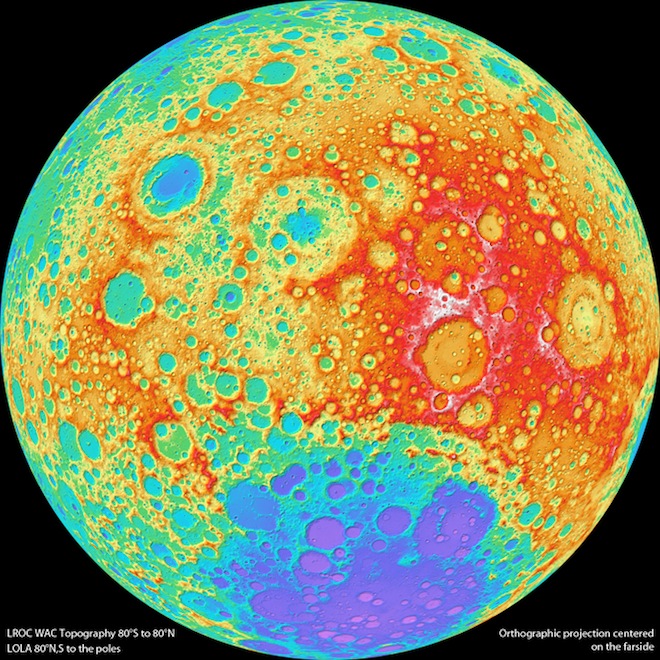
The moon has finally been given its closest close-up ever – a technicolor shot that shows all its ridges, pockmarks and wrinkles in startling detail.
The magazine Wired says the map was created with a camera that you could hold in the palm of your hand. If your hand was orbiting the moon (along with the rest of you) by going round and round over the poles. Probably not worth the trouble, since being thrust into such an inhospitable situation would make the size of the camera in your hand the least amazing detail of your airless, murderously cold, suddenly off-planet world.
The different colors are an alarming feature of this shot. They depict elevation with the white sections being highest. Altitude then descends through the red, orange, green and blue areas, all the way down to the lowest of the lowlands – shown in violet. I don’t mind it that the moon has different elevations, but to see it looking like a hippie’s tie dyed bandana is unsettling.
Standard moonly gray goes well with all the settings on Earth and with each outfit in every wardrobe. That’s why our “traditional” moon is welcome everywhere as a nightlight or a backdrop. The gaudy moon we see in these new photos clashes horribly with … everything. You have to wonder if we would feel differently about our moon if it really had this electric beach-ball look.
And that complexion – Oh My! It seems as though Mr. Moon has not been spared a single cosmetic trauma. It makes me happy to have an atmosphere!
Would you sit for a close-up portrait, knowing it would show every flaw?
Here’s a freshly written note from perennial sophomore Bubby Spamden, a lad still looking for his future.
Hey Mr. C.,
In Ms. Axiom’s science class yesterday we had this great discussion about a new idea from some astronomers at Princeton and Harvard who want to find out if there are other civilizations out there in the universe. They’re going to use telescopes to look for light from alien cities! Is that cool or what?
I used to think that my ideal job as an adult would be “Planet Finder”, but now that so many distant planets have already been found, I’m thinking “Alien City Spotter” would be an even better job for me. It’s still in my chosen field, which we took a test to figure out. My results said I would “thrive in any line of work that involved Looking Into the Sky and Wondering About Things.”
When we were talking about it in Ms. A’s class I said I wanted to be the first human to find an alien city because I’d get to name it after myself! “Bubbopolis” is what I’m thinking, because it’s so much fun to say. There’s enough of a beat there that people would probably write songs about it and then there’d be a huge push to build a spacecraft to go visit Bubbopolis as soon as possible. Maybe when we got there, the Bubbopipolitans would like my name so much they’d actually change over whatever they were calling the place to the much cooler name I gave them – which would mean instant immortality on two different planets for me! That pretty much lines up with my life’s goals!
But then people started to chip away at my great idea. Nathan Nathanson pointed out that the article said these scientists were only going to look for alien cities in our own solar system, where we’re pretty much 100% sure there are no other advanced life forms or civilizations anyway, and that to look farther than that we’ll have to build super telescopes that haven’t even been invented yet! So what, Nathan? You think you’re so smart just because you read all the way to the end? I’m against getting all the information on things because it leaves no room for your imagination!
And then that fun-killing egghead Samantha Quilts stood up and said that what would probably happen if we found an alien city with its lights on at night is very different from what I imagined. Rather than build a rocket to go there, we’d all probably get so scared we’d go into a worldwide panic about turning OUR lights off at night so the Bubbopolis creatures wouldn’t be able to see US.
She’s probably right.
But even then I could have a good career as a Nighttime Glow Warden.
I’m already pretty harsh with my parents when it comes to leaving lights on at night – they’re the worst! One time I came home from this football game at about 10:30 and all the lights were on in the living room and the TV was blaring away, but they had gone to bed! That’s crazy. What were they thinking? I gave them a good talking to the next morning, which felt really great, and they didn’t seem to mind it either.
By the way, “Scolding People” came in second on the list of job areas that I’d be good at.
Your pal,
Bubby
I congratulated Bubby on this small step forward in his continuing project of figuring out what his someday job could be, though it made me wonder if he’s looking a little too far into the future. Still, with our carbon production running well ahead of predictions, browbeating people for leaving the lights on at night could turn into a growing career field.
As we prepare for the annual Trick-or-Treat kidstorm in our neighborhood (more than 500 tiny treats handed out at our door last year), I’m reminded of the blessing of infinite variety in our candy universe. We have hard, crunchy candies and soft chewy ones. Dark chocolate and milk chocolate for the older kids and fun, fruity chews for the tykes. Some candies are solid throughout. Others have gooey and even liquid interiors, which can strike some people as creepy and even dangerous.
And so it goes for asteroids, apparently.
There are millions of them in the asteroid belt, and they come in all shapes and sizes. Last year the European Space Agency accomplished a close-by flight on one such object, named Lutetia. Something about Lutetia is not quite right – she’s a lot denser than she appears (also true for some people – yours truly included). In the case of Lutetia, the theory making the rounds right now is that there’s molten metal in the center, which would be something new for asteroids and could suggest that Lutetia was on the way to becoming a full-fledged planet before succumbing to a case of arrested development.
It might also explain where magnetic meteorites come from.
Lutetia is odd shaped and nugget-like. It actually reminds me of a couple of things – one is a piece of the bag candy “Pop Rocks”, which fizzed in your mouth. Remember those? There was a pervasive bit of urban lore claiming kids who swallowed the candy or mixed it with a carbonated drink would suffer some kind of gastro-intestinal explosion – a thought that was just threatening enough to make Pop Rocks irresistible.
And of course as we’ve already discussed, Lutetia’s weird shape is reminiscent of a well-known image by Edvard Munch, now made even more alarming by the thought that there’s hot liquid metal sloshing around inside. How appropriate for Halloween. Don’t bite down too hard, unless you want to SCREAM!
The winners of the Nobel Prize in Physics are three American scientists who asked some important questions and wound up getting answers they didn’t expect.
Hubble's snapshot of the backyard, courtesy of NASA
As a result they gave us this confounding image of a universe that is expanding rapidly, with stars and galaxies rushing away from the center at ever-increasing speeds.
How’s that?
For folks (like me) who write news stories and summaries, Nobel week is a challenge and an education. In trying to explain how a prize was won, we’re called on to distill and decipher other people’s complicated multi-million-dollar research. Do you really think I can, with little knowledge or understanding of the field, step in and do a better job explaining a major technical principle in fewer words than the scientist who has spent his or her life struggling with the same information?
Some topics don’t like to be compressed.
But try I must. So why not take it all the way down to the minimum? Here’s a challenge – boil the expanding universe down to three lines, with five syllables in the first line, seven syllables in the second, and five in the third.
Go.
Galaxies racing
faster away from center
Mama will be pissed.
Dark Energy is
The unseen motivator
Behind the madness
The whole universe
Receding away from you
It’s not personal
The spaces between
the words in this haiku are
bigger. What’s up, huh?
Leave your own haiku, or just explain how the universe will end.
Washington based apologists for a well-known group of galactic killers have managed to get the charges dropped in a case that might be the greatest unsolved massacre in history. Involved are two high-profile families of troublemakers, both of them familiar to anyone who loves popular entertainment.
The facts:
The Culprit
65 million years ago, an enormous explosion wiped out everybody in the famously lizard-like Dinosauria family. These were nasty characters whose offenses against plants, animals and each other, but especially against scientists, have been well documented in prehistoric-themed movies, with particular honors going to Jurassic Park.
For the past few years it has been suspected that this explosion and the ensuing global calamity was the work of one or more members of the Baptistina family, a rogue cluster of asteroids once described “aimless chunks of useless metal” known for their propensity to fall violently on unsuspecting planets and their moons.
According to the oft-repeated story, friction, infighting and outright collisions within the Baptistina family led to a violent split, sending certain members of the tightly knit clan into a headlong exile outside the comfortable orbit that had marked their brutal existence for so many years.
One of the renegade Baptistinas is said to have flown so far off course in its blind rage that it crashed into the only home the Dinosaurias had ever known, causing a huge dust cloud that fouled the atmosphere and choked off sunlight for eons, and leading to the death of every Dinosauria in the place, which was a lot.
But now the asteroid-loving excuse-makers at NASA say the Baptistina break-up happened 80 million years ago, too late to allow for one 6 to 9 mile wide disgruntled ex-Baptistina to go on a Dinosauria killing rampage as soon as 65 million years ago.
“The demise of the dinosaurs remains in the cold case files,” said Lindley Johnson, program executive for the Near Earth Object (NEO) Observation Program at NASA Headquarters in Washington. “The original calculations with visible light estimated the size and reflectivity of the Baptistina family members, leading to estimates of their age, but we now know those estimates were off.”
I have no idea what Lindley Johnson is talking about, but I think at least one of the Baptistinas had the means (they’re huge and suicidal) and the motive (dinosaurs are incredibly ugly). But did they have the time? As for sequencing, I think it’s easy to under-guess how far an annoyed asteroid can go in 15 billion years.
But apparently no one is going to prosecute any Baptistinas from here on out.
“We are working on creating an asteroid family tree of sorts,” said Joseph Masiero, the lead author of the study. “We are starting to refine our picture of how the asteroids in the main belt smashed together and mixed up.”
Yes, asteroids getting smashed together is definitely the problem. All sorts of reckless things begin to sound like a good idea when you are an asteroid who has had one too many bumps. Don’t close the book on this, NASA! They’re hiding something!
The most annoying miscarriage of justice you can recall?
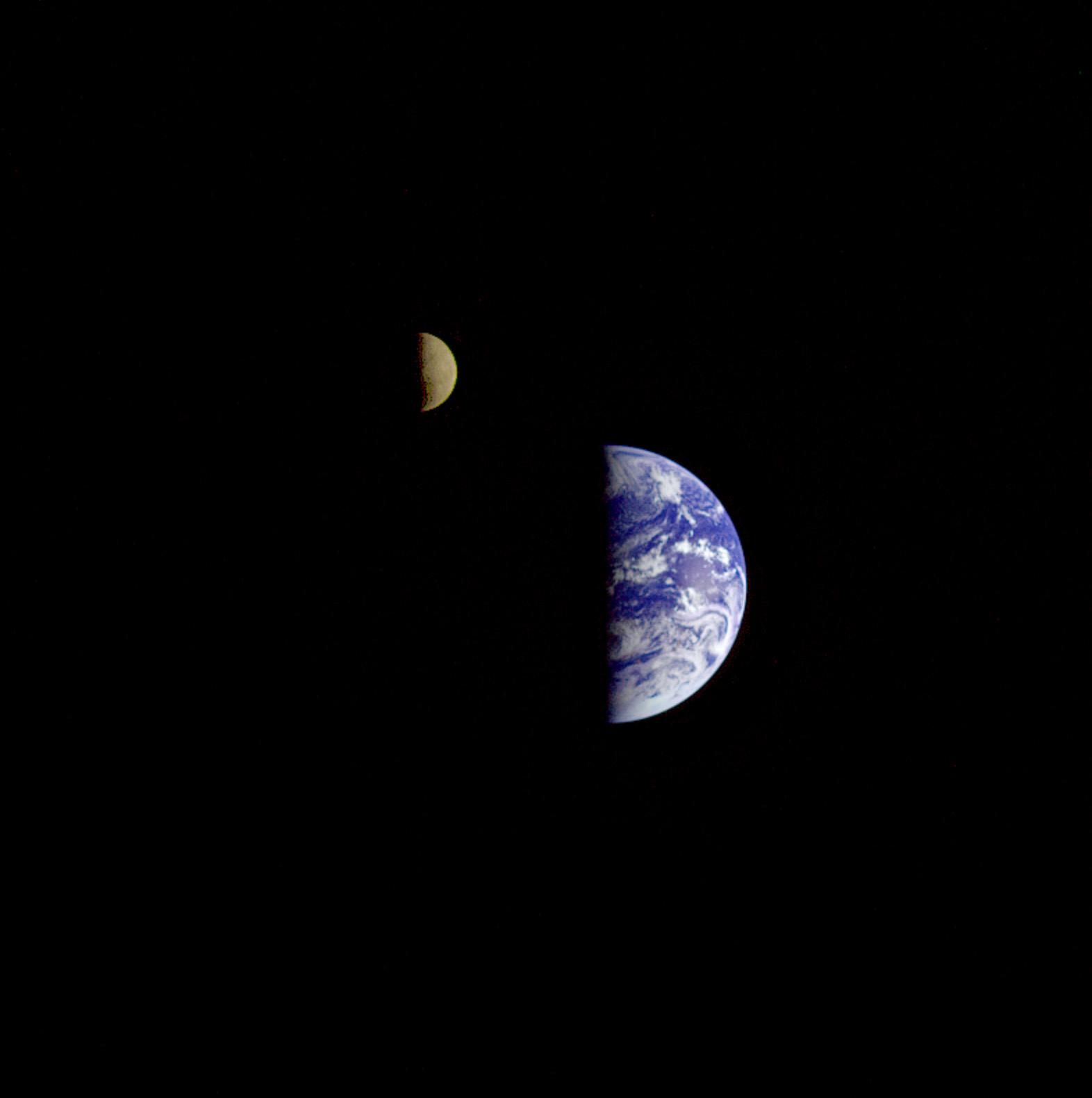
Yesterday was the anniversary of the taking of this photo, snapped from the Voyager spacecraft in 1977. It shows Earth and its moon – the first photograph ever taken with both in the same frame.
Imagine, these two celestial bodies, linked forever in a gravitational embrace, but never photographed side-by-side.
That is, unless you count that time they went clowning around in the photo booth at Dayton’s Arcade in downtown Minneapolis.
It was a spur-of-the-moment thing. They’d been orbiting Block “E” for much of the day, feeling tired and a little goofy, when some people came out of the booth laughing. Earth happened to have a couple of quarters in her pocket, and she thought, ‘why not’?
There’s something about that photo booth environment that makes the pictures taken there more memorable than most of those high-buck, carefully posed portraits.
Maybe it’s the built-in incentive to mug for the camera. After all, you gave up your pocket change for this and the shutter is going to click whether you’re ready or not, so you might as well do something to make it look like you’re having fun!
The Voyager photo cost more – lots more. Bazillions. And it is an amazing, historic image. But there is an icy distance to it that simply couldn’t exist in the close confines of the photo booth. If it’s a buddy picture you want, something full of warmth and fun, the photo booth is where you want to be.
Describe a favorite photo of you with a friend or a relative – where was it taken and how did it come about?
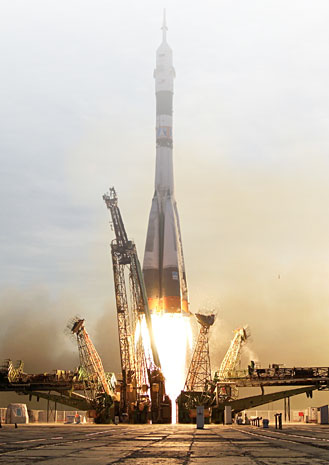
The Russians launched an unmanned rocket loaded with several tons of supplies bound for the International Space Station earlier this week and while it got off to a good start, the delivery faltered and the mission fell back to Earth.
News reports explain that this event is cause for serious concern now that Russian boosters are the only reliable method we have for getting to the space station. The shutting down of the U.S. Space Shuttle program means the next American in space will have to get there atop a rocket similar to the one that just had an unplanned landing in Siberia. No doubt NASA’s decision makers are looking at this very closely. But before we point fingers, let’s remember that our own space program has suffered several genuine disasters that involved tragic losses, and yet we sent good people back up in what was basically the same equipment.
This recent Russian space failure resulted in no loss of life, so far as we know. But there were several intriguing line near the end of the article which forces me to hedge …
The rocket and Progress ship crashed in the dense Siberian forest. The Russian Ministry of Emergency Situations said rocket debris landed in three separate areas of the Altai region in southern Siberia, which borders Mongolia.
The regional governor, Yuri Antaradonov, said the police had cautioned people to stay clear of the wreckage, as it could be contaminated with toxic fuel. His only concern, he said, was that some people may have been camped in the forest at the time of the crash because “it is the season of collecting pine nuts” in that part of Siberia.
Forget the East Coast surprise Earthquake and the looming menace of Hurricane Irene. What if you were out in the beautifully dense Siberian forest collecting pine nuts when you noticed your reindeer was gazing up at a rapidly growing, rumbling speck in the August sky?
Does this mean pine nuts are going to be even MORE expensive?
What is the most surprising thing you’ve seen overhead?
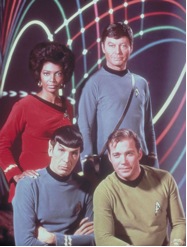
I absolutely adore Science Fiction shows – always have. Since the original “Star Trek” series was televised when I was in grade school right up to current edgy shows like “Fringe” that are being aired now. Along the way I’ve enjoyed all Star Trek series and movies, Babylon 5, Dr. Who, Hitchhiker’s Guide to the Galaxy, Stargate series, Quantum Leap, Battlestar Galactica (the recent one – not the cheesy old one with Lorne Greene) and others.
The best way to explain my love of science fiction is the feeling of exhilaration I experience when well-done science fiction explores the range of possibilities available in our wide universe – the dreams of what could be. Time travel, parallel universes, technology advances, spiritual and physical evolution. I am fascinated and uplifted by the innovative genius of the writers and how they use beloved and familiar characters to flesh out the questions, curiosity, dark urges and brilliance that always bubbles beneath in our collective consciousness.
I’m guessing that doctoral theses have been written about the triumvirate of archetypal characters that embody Kirk, Bones and Spock. Personally, I’ve never fully understood or felt the need to pick apart and analyze art or literature to mine the metaphors and deeper meanings that may be there – fascinating and rich they may be. I prefer the simple-minded pleasure of watching my favorite characters that seem like old friends, wrestle with the challenges of the future and unheard of scenarios … yet they resonate with the same challenges you and I face on a daily basis in one form or another.
And the gadgets! I remember pretending an old metal Sucrets box was a communicator, trying to emulate Capt. Kirk’s ultra-smooth move of taking his out of back pocket and flipping it open. Now I try to do that with my cell phone. Not as easy as it looks. But the idea of transporters, tricorders, warp speed, translators, bloodless surgery, healing instruments, the TARDIS, parallel dimensions, etc., really gets my blood jumping. The moments I experience the hold-your-breath, expansive, spellbinding trance of great storytelling that transport me to a different level of thinking, a blinding new perspective or breathless possibilities that never occurred to me before. And yet – there’s an underlying familiarity of how it relates to present day problems, shows us our vulnerabilities and celebrates the glories of human existence in a way most other genres cannot.
Granted there are occasions of heavy-handed morality, clunky storylines, weak acting and – God forbid – cheesy special effects; but they all add to the charm of the genre, and are forgiven in a generally good quality Science Fiction show. It’s also a fact that some current technologies were based on science fiction gadgets. Even the making of science fiction shows and movies contributed to great advances in movie special effects that we now take for granted.
What gadget, technology or personal power from Science Fiction would you most like to see, do or have in your life?
We are blessed with a world full of interesting places to go, but lately I’ve been eyeing the sky because there is something terribly frightening and totally irresistible about the notion of space travel. Scoffers say that like South Dakota, outer space is impossibly empty and it has no taxes. Two great qualities! And space is a lot closer than Sioux Falls – only 62 miles away!
Atlantis Launch 2009, photo from nasaimages.org
Unfortunately, now that the Space Shuttle program’s orbiters are being dressed for museum duty, there is no American-made vehicle that’s suitable for off-planet expeditions. This is a problem if, like me, you prefer a domestic model for all your extraterrestrial trips. Call me fussy – I just don’t care for the fit and finish of those Soyuz capsules. True, I’ve never been in one, but I’ve never been in an Apollo capsule either and yet I have taken thousands of imaginary NASA voyages. Soyuz? Zero. Besides, I’ve made some assumptions about the places where Russian craftsmanship and too much vodka might intersect – probably in the construction of the airtight bulkhead and where the electrical systems meet explosive gasses. Unfair, I know, but on such small prejudices is brand loyalty built.
Still, I am forced to accept the reality of the situation – I am a baby boomer and my pioneer time has expired. My government is not going to send me into space unless it’s with a limited air supply as part of a larger plan to reduce the cost of Medicare. Meanwhile, our decision makers have been flip-flopping on the goal of the next mission. Is it the Moon? Is it Mars? Or should we compromise and aim for an empty spot halfway between the two? It would be hard to get excited about reaching an empty, airless state of suspension with no gravity to pull you in any direction. Job seekers know you can achieve that kind of limbo today, without leaving home.
But there’s good news too! There is new energy behind the commercial space industry, and there are fabulously wealthy wanna-be astronauts who are looking for ways to have a unique experience. These Moon-eyed potential customers will lead us into the next era of space travel! They’ve already accomplished a great deal on planet Earth, and in the process have accumulated sufficient resources to pack a 10-story tall rocket booster full of $1,000 bills. Now it’s a simple matter of lighting a small fire to generate the needed lift. And several private companies are racing to strike that match.
The firm Space Adventures has already sent 7 well financed people on journeys to the International Space Station at a price of 20 to 35 million a head. Sensing a limit to the appeal of near-Earth travel, the company is also selling trips around the moon and back inside a three-seat capsule. It’s basically the same route taken by Apollo 13, but without the unplanned explosions and near-death experience. The ticket cost? 150 million. One spot has already been taken and one seat is needed for a pilot to fly the thing (go figure). That still leaves one space open for travel into open space. Late seat assignment note: you might not get the window.
For potential cosmic voyagers with a thinner wallet, Space Adventures offers some bargain astronaut/cosmonaut-like experiences, including solely terrestrial trips to watch a launch in central Asia. The real attraction here is an opportunity to pay almost $16 thousand dollars to spend a few hours in a Soyuz flight simulator, which according to the Space Adventures website, “has been in use since the 1960’s.” Enticing! And if that price is too steep, I can arrange a domestic excursion where, for half that amount you’ll get to spend the whole day sitting in a Chevy Corvair which has also been in use since the 1960’s. Extra bonus – when the session is done you can take it home!
Elon Musk’s commercial venture, SpaceX, isn’t flying passenger missions right now, but the company is trumpeting last Spring’s receipt of a contract from NASA to figure out a quick way to get the 7 passengers in its Dragon capsule safely back to the ground in the event of a sudden launch emergency. That’s an exciting scenario, but only if you have the pleasure of watching other people deal with it!
And then there’s Richard Branson’s Virgin Galactic. The company is already building a spaceport (Spaceport America!) in New Mexico, and claims to have a list of at least 400 people who have signed up to take a sub orbital flight in a vehicle called SpaceShipTwo (you know a vehicle is tight inside when there’s no room for spaces in its name). The plan is for the craft to be released at 50 thousand feet from a large, two-fuselage carrier plane called Virgin MotherShip Eve. A rocket then propels the 8 passenger SpaceShipTwo high enough to see inky galactic black above and a thin line of Earthy blue below, with five minutes of recreational weightless time before you have to strap in for your glide back to the ground. In this sense, Virgin Galactic is expanding on the proven success of the Disney World scenario – high entry price/long wait/short ride. Sorry for the delay – there will be no flights until at least 2013. But a 20 thousand dollar down payment is due immediately against your final cost of 200 thousand. It does guarantee you a spot in our airtight teacup, though. So go have a hot dog and watch the fireworks – a Cast Member will call you when it’s time to strap in.
Realistically, these space travel options could only appeal to adventurous people who combine extravagant wealth with exceedingly deep reserves of patience and a suppressed fear of death. It would also help to have a good imagination. How many people do you know who combine all these qualities? If anyone comes to mind, salute them with a glass of Tang and a package of space food sticks, because they represent the next frontier in human flight!
Thanks to the Sherrilee, Renee, and Beth-Ann, the guest bloggers who kept the conversation rolling while I was enjoying a long weekend in northern Minnesota.
It was a wonderful time to be away – even the mostly rainy day was delightful. And I learned about perspective! There is a proper way to record the events when you are catching impossibly tiny fish.
Pose like this ... ... not like this!
Summer, 2011 is turning out to be wonderfully green and lush. If you were lucky enough to not flattened by a tornado in North Minneapolis or submerged by a river in Minot, the weather has probably been pretty fair for you. Still, it is an upper Midwesterner’s obligation to complain bitterly about whatever prominent feature the climate is projecting. In this case, it’s the outrageous amount of rain and the far-too-cool temperatures, though the truth is that we are blessed to have enough moisture and something less than blistering heat.
For those who would like to experience a truly harsh environment, I suggest you book your passage as soon as it becomes possible to visit an asteroid.
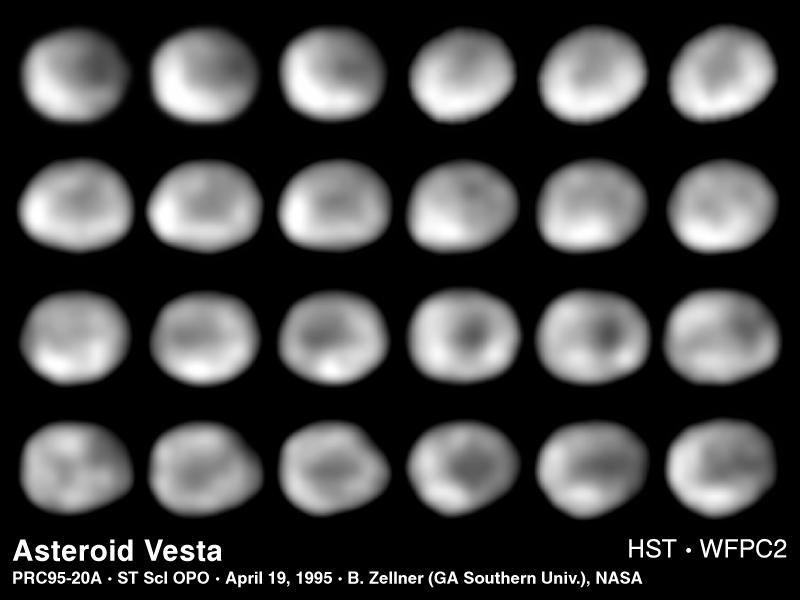
This would be the vacation of a lifetime, if by vacation you mean a bleak and frightening experience that feels endless. NASA has sent a probe named Dawn to spend a year with Vesta, an asteroid that orbits our sun. Like some of those exotic vacation resorts you’ve chosen and then regretted, we don’t know very much about Vesta. Even the brochure is puzzling – this line-up of all the best known features makes Vesta’s amenities look like an assortment of blurry potatoes.
But they have sun there (or we wouldn’t be able to see it), so let’s go! I think I can see a pool in the third image from the top left, and is that the golf course in the fourth picture from the right, bottom row? I think it is, and it looks like there are no trees to get in the way of all the perfect, lo-gravity shots I plan to hit.
Fun!
Describe a vacation destination that was much different than you imagined.







 Trail Baboon