Tag Archives: Travel

Span Fan

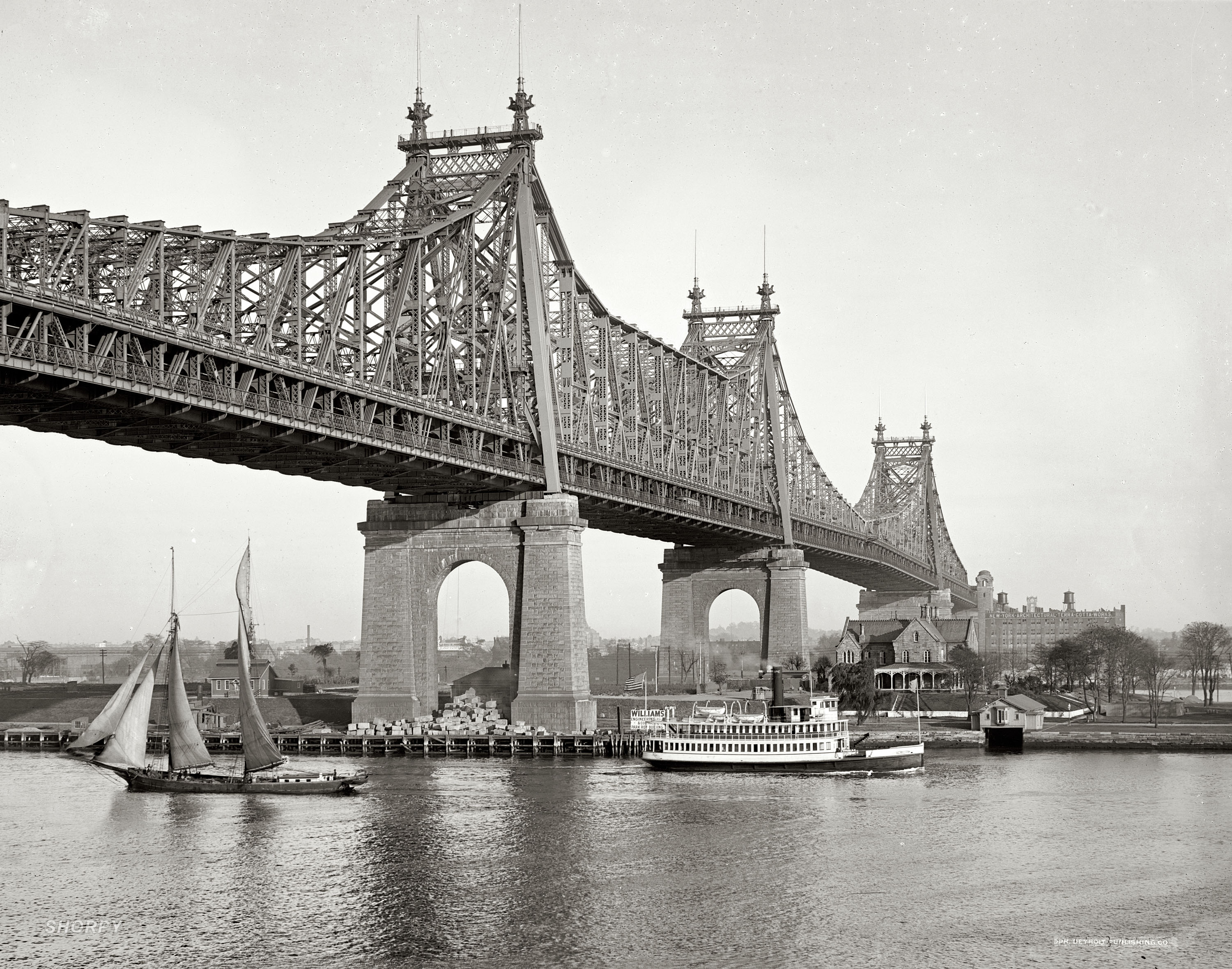
Today is the anniversary in 1909 of the opening of New York’s Queensboro Bridge connecting Manhattan with Queens across the East River.

Though it’s not quite as famous as it’s sister to the south linking Manhattan and Brooklyn, the structure has a distinct profile, a colorful history, and a place in The Great Gatsby, Charlotte’s Web, The Simpsons and its very own Simon and Garfunkel tune – the 59th Street Bridge Song (Feelin’ Groovy). Didn’t know this was about the Queensboro Bridge? Except for the title, the song doesn’t mention a bridge at all.

The Queensboro Bridge cost 20 million dollars and 50 lives back in 1909. The structure is really two cantilever bridges, each with a foot on Roosevelt Island. It has a busy, baroque look with ornamental flourishes that today’s lawmakers would never approve.

Taking a look at this structure’s history, it’s a wonder anything ever got built, then or now. There were strikes and delays. Somebody placed dynamite on the bridge in a union dispute. United Pennsylvania Steel was accused of using too much of their product in the construction as a convenient and secret way to drive up the cost.
Infrastructure is expensive and the bills keep coming. New York has spent a half billion dollars fixing up the Queensboro Bridge over the past quarter century, and yet people still paint it with graffiti and drop trash out their windows as they drive across it. Go figure!

But I do admire big, grand construction projects, and bridges can play a romantic role in people’s lives that mere roads can’t match. When I was a kid I got a thrill out of any trip that required a major crossing. The favorite bridges of my youth – The Bear Mountain Bridge and the Tappan Zee Bridge.

What was so special about them? They were big and scary, that’s what! And when we crossed them, it was an event. Suddenly, there we were on the other side of the river. Who knows if we’ll ever be able to get back?

What’s your favorite bridge?

A Little Place in the Country

The question of whether there is another planet in the Universe that can support life has always struck me as the kind of question we ask for sport because it really has an easy answer – Yes! I say that with confidence, as long as you don’t need any absolute proof.

Consider the universe. It’s pretty big and there’s lots of stuff spread around it in multitudinous combinations. So I expect that there are trillions of planets that can support life, billions that can support human life, millions that can support a human life comfortably, thousands that can support a human life as timid and finicky as my own, and at least a half dozen that already have a nice retirement bungalow set up for me and the Mrs. alongside a beautiful sea made of some fun-to-behold liquid that I can definitely watch but not go jet skiing on.

I’m sure they’re out there. I just can’t name any for you.

And now along comes the ESO (European Southern Observatory) to declare that I’m right! There is another potential home for you in the stars. Billions of them, in fact, and relatively close, too! Figure out how to get there and you can start moving your stuff, as long as you don’t mind living right next door to a Red Dwarf. And of course I don’t. I’ve thought for a long time that accepting diversity and practicing non-discrimination is a question of practical justice and also the basis of an excellent long-term survival strategy. So I’d live happily next to a cool Red Dwarf, especially if my current neighbor, (The Sun), is a hothead planning to expand and incinerate the neighborhood (as everyone says) in a few billion years.

If the ESO scientists are right, those holding upside-down mortgages will not find relief anytime soon and we’ll never have another real estate bubble on Earth. The market just got flooded. Terrain is cheap. The good news? Terrain is cheap. All you need is transport. Oh, and air.

What are your requirements for a new planet?

Meet The Jetskis

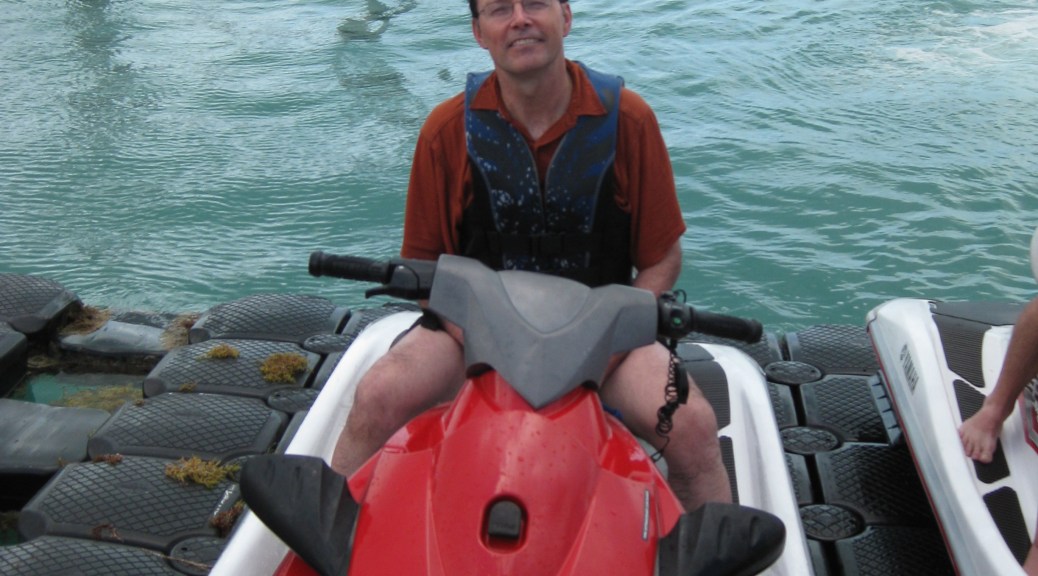
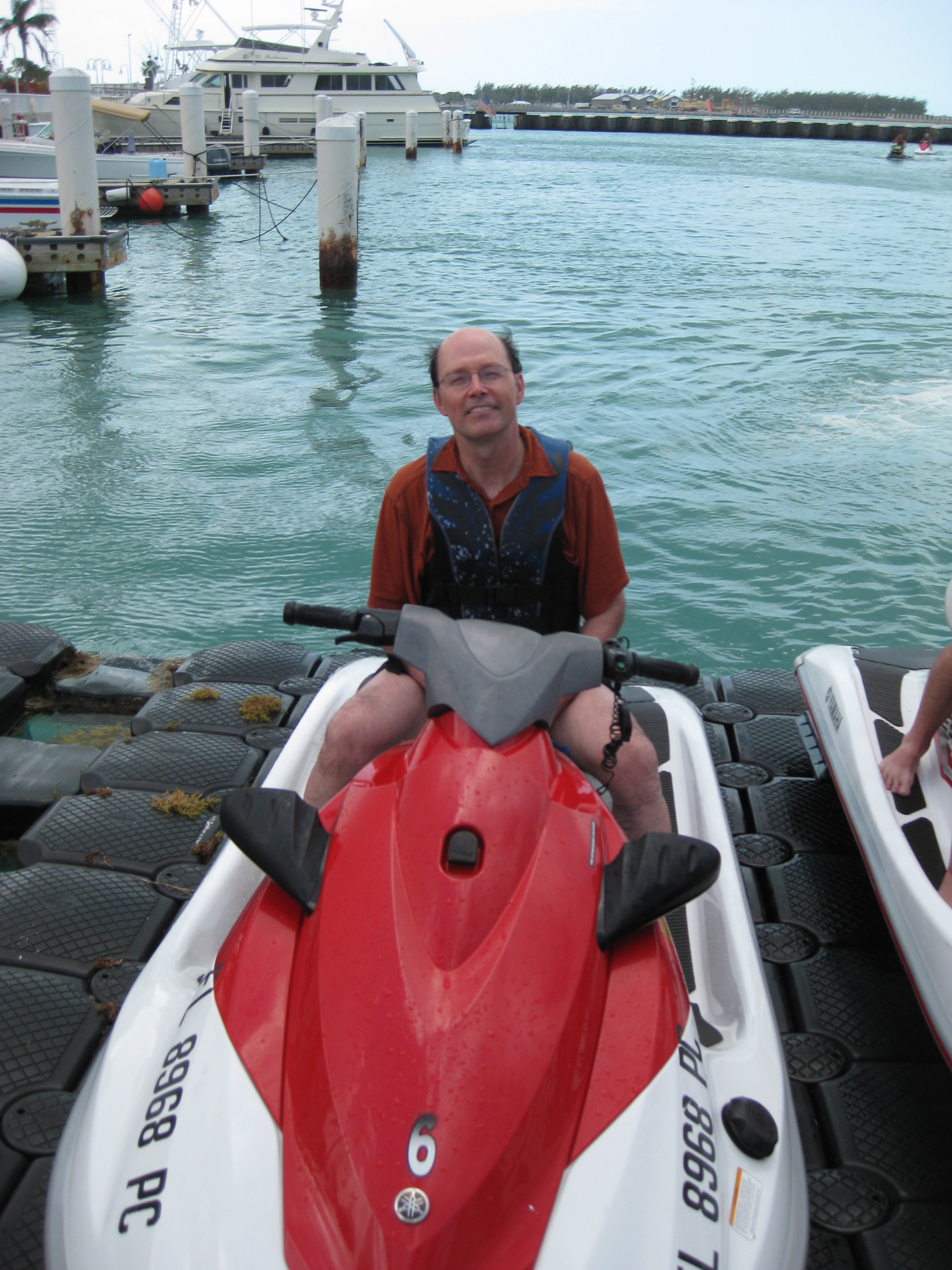
No, it’s not the title of a futuristic cartoon series set in Poland. I’m talking about a highlight of my family vacation last week in Key West – a rash bid by a group of novices to quickly circumnavigate the island on rented personal watercraft.

Yes, I was surprised to see myself attempting this on such a powerful machine. I’m slow at virtually every activity I attempt and I’m much more of a canoe traveler, speed-and-noise-wise. Even when I’m driving the car, there’s a lot of coasting and enjoying the scenery. But Key West is all about loud, raucous, obnoxious fun. So when Gus (age 22) gravitated towards the jet ski tour, I decided to go along and give it a try.

This, despite the fact that playing in the ocean is always risky. I think James Cameron had a better idea of what he was getting into, and was probably safer in the process of doing it.

We signed up for the first group of the morning, leaving the dock at 9:30 for a 90-minute spin. You can rent individual machines or pair up and ride double with no increase in price. In the best father-son tradition we opted for solo water rockets, which turned out to be a wise choice. Four others who approached this as a couples event endured emotional trauma at the launch point, with one reluctant young woman storming away from her boyfriend with these parting words – “I HATE You!” The ever- helpful tour guide said “You’re better off going without her, dude. She wouldn’t have enjoyed it.”

No kidding.

Another couple had the opposite problem – once they were informed that the trip would not be taken at a leisurely pace (It’s a big island, dude), she seemed plenty willing to let him go it alone.

Him: “If you don’t want to come along, I’m OK with skipping it.”
Her: “No, it’s fine. You go and I’ll wait here.”
Him: “We can do something else instead.”
Her: “No, I’m perfectly happy to stay behind. You go.”
Him: “I don’t want to go if you’re not going.”

Both wanted to back out without ruining it for the other, so they rode together. Miserably.

No, those aren't my feet.

My victory? Aside from not dying? I didn’t fall off, hit a dock, a rock, or get run over. Which is remarkable when you consider I was deafened by the engine and blinded by the spray for most of the journey. Keeping up with the guide was a white-knuckle experience, and I couldn’t slow down because I knew there was a single file-line of rookie pilots right behind me, all of them as oblivious to their surroundings as I was, or else fully engaged in arguing with their partner about whether or not they should even be there.

The only part that was more terrifying was the moment when the guide went back to retrieve one member of a two person sled who had tumbled into the water, telling we three individual survivors that we should “just mess around in this area here”, meaning we were supposed to zig-zag around a bit, keeping a sharp eye out for boats, obstacles and each other. Sitting still in the rolling waves presented a strong risk of capsizing, but “messing around” meant we could wind up colliding at high speed. Hmmm. Which would be better?

We chose random skittering about and got so turned around we mistakenly took up with another tour group as they cut across our playground. Oops. My excuse? When you’ve got a snoot full of briny foam and are feeling desperate to be back on land, every passing water jockey looks like Our Dear Leader.

And yes, in spite of it all, the jet ski experience was a definite highlight of the trip. But the next day (and even today) every muscle felt the strain of hanging on for dear life.
I’m glad I did it, and I’m glad it’s done.

When have you been exhilarated AND terrified?

Trip to Azerbaijan

Today’s guest post comes from Jim in Clark’s Grove

Azerbaijan

I had the good luck to be selected three times to serve as an agricultural volunteer by ACDI/VOCA, a nonprofit organization. In an earlier guest blog I wrote about the volunteer work I did in Bolivia. I also worked in Bulgaria and Azerbaijan. On all of these assignments I had the opportunity learn about parts of the world that are very different from the United States. Of the three countries visited, I think that Azerbaijan differed the most from the USA. When you hear someone saying that a place is different they are usually mean it is a place they don’t like. Personally I enjoy exploring places that are different and found many things that I liked in Azerbaijan.

Hydar Aliev

Azerbaijan was formerly part of the Soviet Union and is now an independent country which had as its President a former high member of the ruling party of the Soviet Union, Hydar Aliyev. Hydar’s son is now the President of the country. Azerbaijan is set up as a Democracy. In fact, Hydar and his son have ruled Azerbaijan more or less as dictators because they rigged their elections. I was told by an Azeri, as a joke, that Hydar had visited President Bush and had told him how to rig his reelection. I was also told that Bush would be visiting Hydar because there is a lot of oil in Azerbaijan.

I was asked to help with issues related to vegetable seed production. A stop was made at a tomato processing plant where they were saving the seeds extracted when doing the processing and giving them back to the farmers for planting. I found that this procedure worked well. While at the tomato plant I heard another humorous comment about an American. A man who ran a fish processing company told us that he had been visited by an American who asked him about plant inspection procedures. The American told him how it was done in the USA and the Azeri man said it is the same with us. It isn’t the same because you need to bribe inspectors in Azerbaijan. After that we had a joke about how things are done in Azerbaijan that included the phrase, “same with us”.

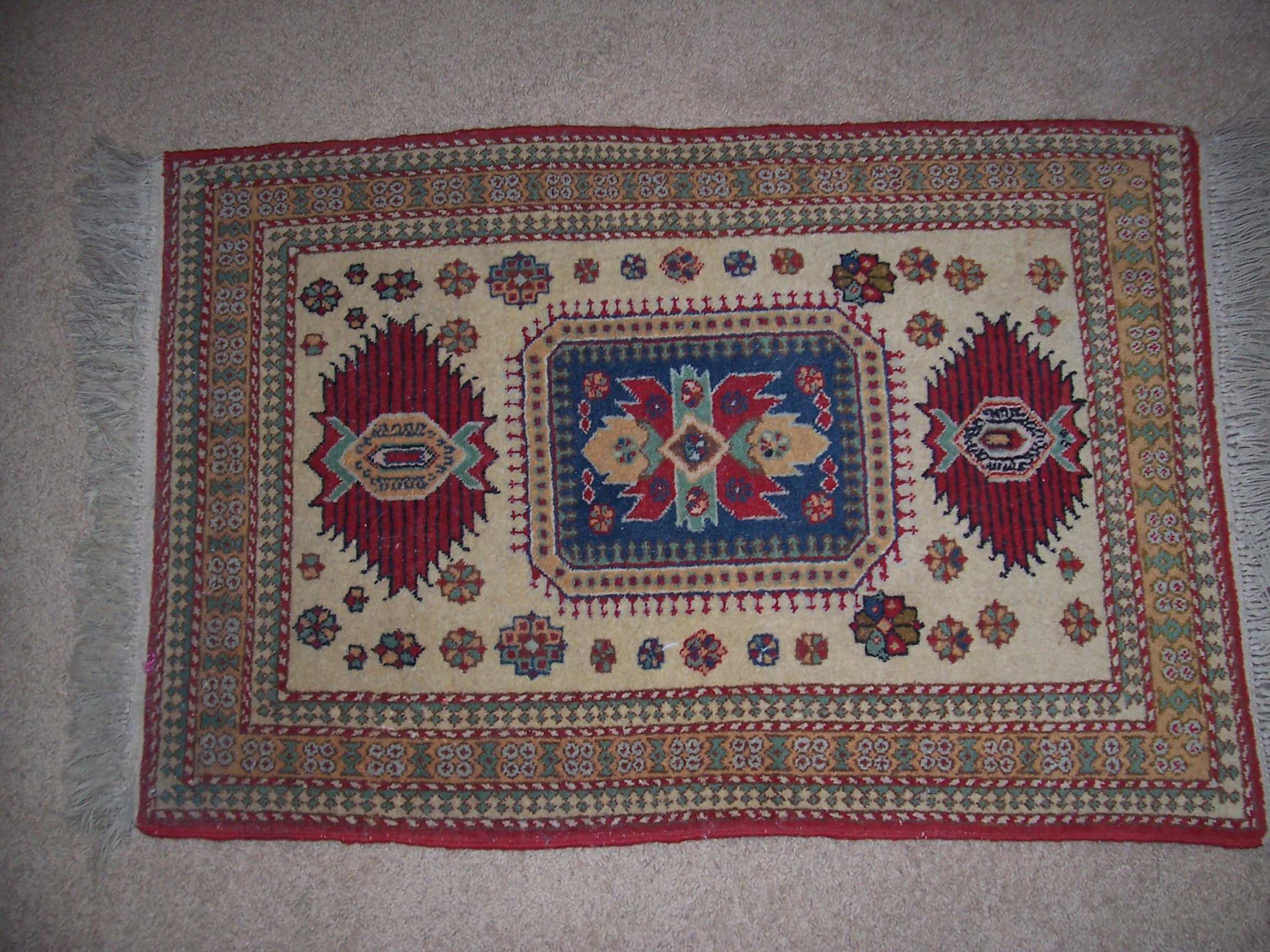
A Rug I Bought in Azerbaijan

I was treated very well by everyone. One man told me that the Azeri people were extremely shocked and very sad about the events of 9/11. The food was very good, included delicious grilled sturgeon with pomegranate sauce. I visited an impressive very old walled section of Baku, the capital city, and strolled through an attractive city park at the edge of the Caspian Sea. There are some very poor people in the country, but there doesn’t seem to be much street crime. I felt safe at night walking alone in the central part of the capital. It is one of the most liberal Muslim countries with laws protecting the rights of women.

What is the most different and interesting place you’ve visited?

Happy Landings

Today is the anniversary of Amelia Earhart’s 1935 flight from Honolulu to San Francisco.

She’s not famous for this one, though it was a long solo ordeal that could have ended badly. Earhart is best known for the trip from which she didn’t return, inaccurately memorialized in my favorite song about a real event – Amelia Earhart’s Last Flight.

That last flight, still a mystery, is exceptionally song worthy. It’s hard to imagine a better chorus than this:

There’s a beautiful, beautiful field,
far away in a land that is fair.
Happy landings to you, Amelia Earhart.
Farewell, first lady of the air.

I thought it would be fun to listen to the song on this, the anniversary of a flight where she actually DID have a happy, though tired, landing. The Aberdeen, South Dakota American-News published this as part of its account:

“I had a lot of sandwiches with me but I didn’t eat any of them. I did eat a hard-boiled egg, which was quite a luxury, and drank some tomato juice. I feel just filthy and I want a bath.”
Miss Earhart said commercial flights between the islands and California were “entirely feasible.”
“They are inevitable,” she said, “and we’ll be flying everywhere in a short time.”

She was right, of course.

Describe your most arduous airplane journey.

Sunday in Savannah

Today’s guest post comes from Clyde.

Every New Years Day, which it is when I am writing this, I remember our first trip to Savannah.

A school district southwest of Savannah hired me to come do a workshop from 8 a.m. to 1 p.m. with the faculty of an elementary school on the Friday after News Years Day. Now think about that. A Friday morning after New Year’s Day. I was suspicious, but the principal, a charming woman with one of those endearing Georgia accents told me it would be fine. (Does any state have a wider range of accents than Georgia?)
If I flew to Atlanta and came back on Monday, it was cheaper for two tickets than one alone coming back Saturday. The district agreed to pay the two tickets and two nights stay.

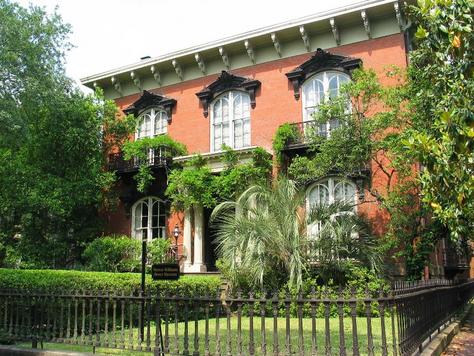
Savannah Home

My wife and I flew down on New Year’s Day, which wasn’t as hectic as I expected. It was a pleasant drive down from Atlanta. The next morning, I went looking for the school. It was difficult to find in those pre-Google days, when GPS was in its undependable infancy. I always allowed myself ample driving time on mornings like these, fortunately. I drove west on a state highway through Fort Stewart, which I had not noticed on the map. When I got to where, by the map, I planned to turn south, I was not allowed to do so because it would take me through military gates. It took awhile to find how to get around the fort proper. Then I asked for directions; no one could help me because no one who worked in gas stations or who came in as customers had lived there very long.

Now I was really suspicious. Why was a faculty coming in on this odd Friday where so many people lived temporarily? By stories told to me by former students, I expected most of the faculty were Army wives, who had been home for the holidays and now had to come back for this Friday instead of coming back on Sunday. I stumbled upon the school.

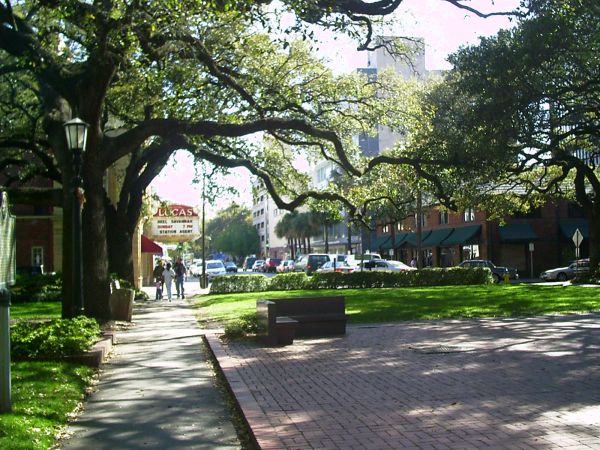
Downtown Savannah

The principal told me, yes, most of her faculty were Army wives. She also told me that the school board had been angry with the faculty when they wrote the calendar the previous spring, which is how this day came to be. All three elementary school faculties would be in the group. The secondary teachers had their own workshop. Wow! Was I going to have a fun morning or what! If I were in the faculty, I would be angry and not a willing participant.

The workshop was very participant-active; about 65% of the time they would work on tasks instead of listening to me, which would make the day terrible if they did not comply. I began with some fun loosing-up activities, to which they fortunately responded. At coffee break they told me their grievances, but that they had decided not to hold it against me.

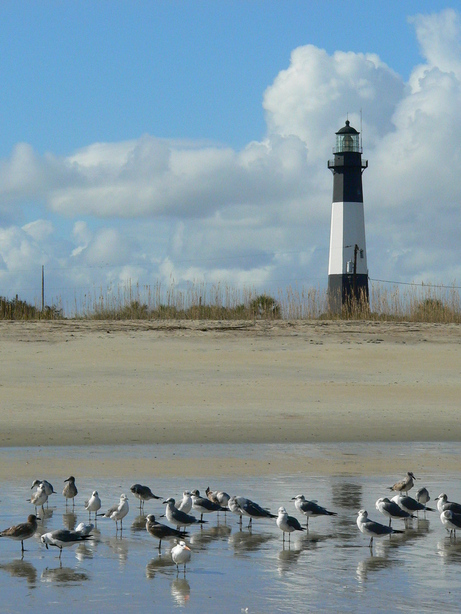
Tybee Island

The five hours flew by. They laughed, did the work, posted their work on the walls, and gave me high reviews for the day, among the highest I ever received. Afterward the principal and teacher leaders took me out to lunch. The principal, with a bit less of that charming accent, told me she had lied on the phone, that she expected open rebellion. As one of the teacher leaders said “I guess we just turned the other cheek.”

That afternoon and for two days, my wife and I discovered Savannah. We walked the squares, rode the buses, toured old homes, strolled Tybee Island beaches, ate wonderful meals. We were blessed with two other trips to Savannah when the Savannah Schools hired me after hearing about that first day.
Ah, Savannah!

When have you seen someone turn the other cheek gracefully?

Are We There Yet?

This is the very best part of any road trip. You’re just getting started, everybody is fresh and looking forward to adventure. We’re going to Mars Beach! We’re flying AND taking the car! How cool is that?

Anything is possible, and at the start it’s easy to imagine that fun will be had by all. What could go wrong? When we get there we’ll dig around in the sand and play in the water! And if that gets monotonous, we can drive around and look at things, like outcroppings of rock and crater walls.

OK, some of this is guess work, but that’s part of the fun of going – the spirit of discovery!

After an exciting count-down to the moment when we pull (loudly) out of the driveway, things start to get a little monotonous. The ten little experiments in the back seat start to feel cramped and restless.

It’s going to take HOW long? And what do you mean we don’t really know for sure that there’s water there right now? What fun is a beach where there USED to be water? And I know, you told me it’s a special place that’s colored red, but then why isn’t it hot there?

This is a family trip where we’d better find a way to enjoy the journey, because we’re not going to Disneyland. We’re not even going to Knott’s Berry Farm. It sounds like we’re going to stop in the desert and turn over some rocks, hoping something crawls out from underneath to bite us.

Yipee.

Describe a favorite car trip, or one that you’d like to have.

Over the River

Today’s guest post is by Clyde.

When we were raising our children, we lived in Two Harbors and my parents lived above the east end of Duluth, only about two miles from Hawk Ridge. Among the four ways we could drive to their house, our favorite was to take the Seven Bridges Road.

Here is YouTube of a song about the Seven Bridges Road:

In winter the Seven Bridges Road was plowed only part way up the hill. Thus for our traditional Thanksgiving Day drive to my parents house we would always take the Seven Bridges Road, assuming that it would ere long be closed. And a family tradition was born to sing as we passed over each of the seven bridges “Over the river and through the woods to Grandmother’s house we go.” As our children matured, one would always ask, “What’s another popular Thanksgiving song?” A question which still lacks an answer.

Why is that? Why are there not many popular songs for this second most American of holidays? Everything seems right for songs: the season, the purpose, the mood, the many items associated with the day. But no songs have arisen.

Also, serious writers of serious music, i.e. classical, often embody popular songs, i.e. un-serious songs, in their serious music. Have I missed it, or has no one used Lydia Maria Child’s “Over the River and through the Woods” in this way?

Another mystery: Her poem which provides the words to the song was called “A Boy’s Thanksgiving Day.” Why is her poem of her childhood memories called “A Boy’s Thanksgiving Day”?

Here are her words:

Over the river, and through the wood,
To Grandfather’s house we go;
The horse knows the way to carry the sleigh
through the white and drifted snow.

Over the river, and through the wood—
Oh, how the wind does blow!
It stings the toes and bites the nose
As over the ground we go.

Over the river, and through the wood,
To have a first-rate play.
Hear the bells ring, “Ting-a-ling-ding”,
Hurrah for Thanksgiving Day!

Over the river, and through the wood
Trot fast, my dapple-gray!
Spring over the ground like a hunting-hound,
For this is Thanksgiving Day.

Over the river, and through the wood—
And straight through the barnyard gate,
We seem to go extremely slow,
It is so hard to wait!

Over the river, and through the wood—
Now Grandmother’s cap I spy!
Hurrah for the fun! Is the pudding done?
Hurrah for the pumpkin pie!

Why the dearth of Thanksgiving songs?
Go ahead. Write one.

Circular Tourism

Today’s guest post is by Clyde.

“A penny saved is a penny earned” is a frequent litany in the kitchen.

Which would perhaps irritate the three children, except the mother also says it every time she adds another penny to the broken teapot sitting high in a glass-fronted cabinet.
If it is a war-time lead penny, still in common circulation at the time, she says, “A lead penny is still a penny earned.”

The collection of pennies is closely watched until they have 105 of them. The expenditure of that $1.05 is carefully planned by the children, a project they complete in collaboration.

One hundred and five pennies buys three sets of View Master reels. A set can be one, two, or three reels, but a pack of three is preferred. They can be purchased at either drug store or the dime store, which is never called by its real name, The Ben Franklin.

As the pennies mount, which takes a few weeks, they study their options. None has any interest in the cartoons or the other things so obviously aimed at children. They only want historic sites, geographic wonders, or world or national travel sites. When tourism becomes an “industry” in northern Minnesota, reels for Duluth and the North Shore start to appear in the selections, which confuses them. How can the Aerial Lift Bridge or Split Rock Lighthouse, which are so familiar and near, rank with the Eiffel Tower?

Over the years they collect and regularly view London, Paris, Rome, New York City, San Francisco, the Rhine, Yellowstone, The Grand Canyon, the buildings and monuments of Washington D.C., Carlsbad Caverns, Mammoth Cave, Niagara Falls, Dawson City, Plymouth, Mt. Vernon, the time of the mastadons, the Everglades, Angel Falls, the Field Museum, the Louvre, and on and on until they become living-room-braided-rug-world-travelers.
The excitement of planning the next purchase is as great, or maybe greater, than viewing the reels themselves.

The appeal is not only in the magic of the stereoptic effect, but also in how the small black viewer pressed to your eyes shuts out the here-and-now and takes you away for as long as your index finger holds out pulling down the lever to spin the reel.
A penny saved is a travel adventure earned.

If you had a magic View Master, what seven pictures from anytime and place would it show?

Traveling in Yungus

Today’s guest post is by Jim in Clark’s Grove.

A few years ago I was given an agricultural volunteer assignment in the Yungus region of Bolivia by a non-profit organization, ACDI/VOCA. Yungus is a region of Bolivia located in the mountains East of La Paz. I was asked to help a small export company control bean weevils that were attacking black beans which this company was introducing as a crop. Many Yungus farmers grow coca as their main crop and were interested in growing black beans.

Coca is a legal crop in Bolivia. Illegal production of cocaine from coca is discouraged. I passed through several control points where checking was done for chemicals that could be used to manufacture cocaine. Dried coca leaves, which are chewed by some Bolivians, are sold locally. Coca tea is given to people to help them with altitude sickness. I drank some coca tea and didn’t experience any change in mood that you might expect from cocaine.

My trips to visit bean fields involved traveling on very narrow mountain roads and walking up long steep trails. Part of the time we traveled in taxi cabs that went very fast on the winding roads. I was extremely frightened by the taxi rides until I got use to traveling in those cabs. On the trails I was barely able to keep up with my party and then only if they slowed down. It was my good luck to have a bright young translator and a good natured representative of the export company as my traveling companions. They maintained their good humor throughout the trip.

I visited a wide selection of the farms that were growing black beans. These farms were located near small villages that had facilities for travelers which were not always in great shape. There was usually a nice small park or town square in the middle of these villages. Citrus grew along the edges of roads and trails. The fruit on these trees was freely available to eat by all who passed by. Chicken was the main dish served locally and it was often served with quinoa soup, rice, and cooked plantains. In some places we used a translator who could speak a language used before the arrival of Europeans. Some woman wore the traditional colorful skirts seen in many pictures from this part of the world.

This trip was a great adventure. I have many fond memories associated with my visit to Bolivia. I was highly impressed by the political climate. The President of Bolivia, Evo Morales, is a former coca farmer who had been involved in political organizing in rural areas. Some people were creating a problem for Morales by demanding a change in the location of the government. During my stay a rally of more than a million people was held to provide support for Morales. The head of the export company that I was helping said that Morales was the best hope the country had for solving its many problems.

I very much enjoyed my trip to Bolivia in spite of the difficult traveling conditions.

Do you remember having a lot of difficulty on a trip that turned out well in the end?