
Advertising represents a bid by well-financed entities to capture our attention and direct or change our behavior. Yet the baboons on our trail sound like they are exceptionally committed to avoiding this influence. From Verily Sherrilee’s use of the mute button to Ben’s channel changing, to That Guy In The Hat’s aggressive and possibly un-American refusal to own a TV, one could almost say living a low-ad lifestyle is a point of pride.
Spend your billions, Captains of Industry. We are unswayed!
What’s more, we are oblivious to your desires!
A research and consulting organization called YouGov looked at advertising avoidance, particularly as it applies to political ads. But they also looked at how assiduously their sample viewers skipped around other kinds of advertisements too.
The chart they published could have been drawn by Clyde, who appears to be having a personal feud with the Geico gecko.
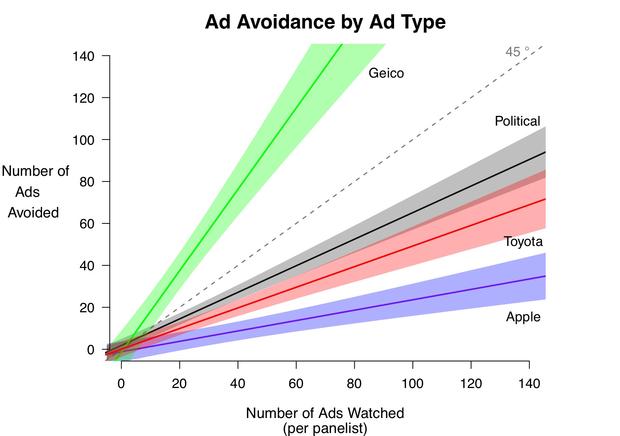
One can see that the insurance reptile’s ads were ignored with a level of enthusiasm that must make people in the gecko animation industry think perhaps it is time to go about polishing up the resume.
Human attention is a prized commodity in our digitally interconnected world, and each person has a finite amount of it to trade on the open market. Right now, other people (producers, talk show hosts, movie stars, disc jockeys, bloggers) get paid to do or say things we will read, watch or listen to so intently that we might accidentally stick around for the things some lizard (pitchman or politician) has to say. What a disappointment to learn how expert we have become at ignoring the message.
Will it ever come to a point where large companies simply pay us directly to consume their ads? Would you give the Geico gecko your eyes, ears and brain for thirty seconds if he gave you a quarter to do it?
Fifty cents if you could pass a multiple choice test about it?
A dollar if you could force a friend (probably not for long) to watch it?
New models will be developed. How much is your attention worth?
 Trail Baboon
Good morning. I think there probably would be a way to set up a system on computers where you could click on an icon and get paid for watching an ad by having some money put into an account electronically when you finished watching the ad. You would need to have a computer that can watch you so that they know you were looking at the ad. Maybe I should sell this idea to some ad company.
So how much should I get for each ad I watch? If they are 30 seconds long and the pay is 50 cents, I would be able to make $60 an hour if I watched 120 ads per hour. I probably couldn’t stand to do that. However, I could earn a little extra cash very once in a while by watching 20 or 30 commercial. That might be okay.
LikeLike
Sorry I won’t be able to attend to this until later.
LikeLike
Uh, what was the question again? (Sorry, I was multi-tasking.)
Chris in Owatonna
LikeLike
🙂
LikeLike
Paying consumers to watch ads would be a wonderful development. Right now I have to pay good money to avoid advertising by streaming shows via Netflix. With this new plan, presumably I could opt to not watch ads for free!
LikeLike
I like your thinking, bill.
LikeLike
I think the phenomenon of ads when you google a topic that make you watch them for 5,4,3,2,1 seconds before hitting the skip ad button speak to the point of the day. Podcasts are such an interesting way of presenting stuff I care about I find Lynne Rosetta caspers ads for parmigianno, prosciutto and the 5,Italian products just fine. Maybe ads that support things that you love instead of the tv crap of the moment with an ad thrown in. I watch a lot of tv land which is flashbacks to the past therefore conducive to catheters and mobile carts and diabetics meds. I laugh at the mainline to the foogies they have discovered . Ads are great. If you don’t like it shut off the tv shut off the radio skip the trip to the store where billboard and ads on bus stop seats and the sides of buildings call out. If its bear count to ten before the grafitti artist shows up. We call out for distraction. We are so easily distracted that it’s a contest and a race to grab the piece of the pie from the poor unsuspecting schmuck who is going through life with his hands in his pockets and his visa card open to use that the dollar suckers are out there. The power of suggestion is huge. Whatever you do don’t think of blue.
LikeLike
What did you say?
LikeLike
It would have to be a lot more than fifty cents for me. I don’t want commercials to get in the way of my reading. I’m desperately trying to finish both my book club books this week and have taken to reading them during commercials at night; if I turn off the tv and just read, then pretty soon I’m asleep! Been a hectic week.
LikeLike
I read a cyberpunkish story once–think it might have been by Timmi DuChamp–in which there were holographic advertisements all over the city, and you couldn’t look at them for more than a couple of seconds before you would be charged for the product or service they were promoting. Just paying attention to the ads was legal consent, tantamount to a contractural agreement. Most people were deeply in debt and were in a sort of indentured condition to pay that debt off. I found advertisements annoying before reading that story, but it, along with nonfiction like “Affluenza,” made me think more in depth about the advertising industry and how and why it manipulates us.
LikeLike
Do you recommend “Affluenza,” CG?
LikeLike
It’s been a while since I last read it, but I think it’s worthwhile. All the stats are dated, of course, and the authors speak in hopeful tones about the powerful new “voluntary simplicity” movement…which has since allowed itself to be co-oped out of relevance. However, the principles are sound, and it’s a quick, fun read on what could be, in the wrong hands, quite a dismal subject. IIRC, I saw a copy of the book at Boneshaker last time I was there, and the two programs the book was based on are still available, too. While on the subject, “The Story of Stuff” was another good book on overconsumption that I read a bit more recently from the library.
LikeLike
This reminds me of a story I saw many years ago that I’ve never seen since. In the future, a doctor is called to check on a man who is being locked up in a psychiatric hospital because he has turned off his wrist phone and his briefcase fax, etc. This future world looks way too much like today, where everyone was connected 24/7 and communication was practially the holy grail. After talking to the psychiatric patient, the doctor begins to turn off his own communications devices one by one. Everyone who knows him becomes hysterical and, you know where this is going, the doctor eventually ends up in the psychiatric hospital as well.
LikeLike
VS, that sounds like an Outer Limits episode! While we’re recommending SF stories, I’m going to put in a pitch for E. M. Forester’s “The Machine Stops,” which is available online. It’s so relevant to our technology-bound society, it’s rather shocking to learn that it was originally published in 1909.
LikeLike
I didn’t go this year, but on several occasions I have paid to see the British Advertising Awards at the Walker. They can be pretty entertaining and cheaper than flying to London to watch the telly.
LikeLike
I haven’t been to the Brits, but they are one of the biggest money makers for the Walker. I think there are 50 or 60 showings during the holiday season every year. The numerous showings of the Brits are not much fun for a certain person I know who works at the Walker taking care of tickets and managing other aspects of getting people in and out of all those showings of the Brits during holiday season.
LikeLike
Dorothy Sayers’ novel “Murder Must Advertise” gives an entertaining glimpse of a 1930’s ad agency. Sayers actually worked as an advertising copy writer and coined the phrase “It pays to advertise”. I highly recommend the book. My attention is worth quite a lot, and i don’t think advertisers could afford it. Anyway, the money would be wasted, as I don’t shop that much. I am such a disappointment as a consumer.
LikeLike
While lurking yesterday the old, old ad phrase for a pain reliever kept entering my head–“Please mother, I can do it myself!” Corny, corny, corny. I wonder if that was Sayer’s ad.
LikeLike
“Hey! Let’s get Mikey!” “Aw, he won’t eat it; he hates everything” “HE LIKES IT! HEY MIKEY!”
LikeLike
The actual line delivered in this commercial was, “Give it to Mikey – he’ll eat anything”
LikeLike
Rattle rattle thunder clatter boom boom boom
LikeLike
From what Bill said yesterday regarding how ad agencies work, it seems the TV show, Madmen, is pretty close to the real thing.
LikeLike
The real thing is stupider and not as glamorous.
LikeLike
That ABD was me.
LikeLike
I don’t know how the word gets out about our bird feeders, but somehow the ads are working well in the Redpoll community-good eats at Renee’s this morning!
LikeLike
Word of mouth, I suppose. 🙂
LikeLike
On the fly
LikeLike
In the air
LikeLike
On the wing
LikeLike
My attention is obviously not worth a whole lot, at least not to an advertiser; not that that’s news to me or anyone who knows me. While I was working in Minneapolis I participated a number of times, for pay, in marketing research focus groups despite the fact that my purchasing habits were far from ordinary. Some of those focus groups had to do with naming things; Health Partners was the result of one of those efforts. Eventually it became obvious to those marketing researchers that I wasn’t representative of the average consumer, so eventually the invitations to participate stopped.
The notion of watching ads for pay is intriguing, if puzzling; why would you want to do that, pay someone to watch your ads? If your ads are good enough, people will pay to see them, as evidenced by the annual showing of the best of British Adverts at the Walker Art Center. But, I think tim’s point is well taken, advertisement bombards us everywhere. How much of the space in the magazines you subscribe to is paid advertising? I suppose the coupons in the Sunday newspapers provide a reasonably good measure of how many people pay attention to them, but personally, I’d be content if I never saw another billboard.
LikeLike
the true question is can you come up with enough interesting stuff to support all the ads they stick in there and how much they charge is based on how many interested people turn the pages to get by the ads.
LikeLike
For me the answer so far has been, not usually. I have cancelled any number of subscriptions because ads were taken over and I felt as if I were paying too much for the actual content of the magazine. Some ads are actually informative, but the wast majority are just promoting stuff I can live quite happily without, and I certainly do not want to be paying to see them.
LikeLike
Aggressive? I thought it was just plain apathy…
Attention certainly carries a value or worth. Not sure what mine is worth. But I would suggest that such value could also be tied into how well-connected one is socially. Social ~media~ would be easier to measure but I could see businesses trying to quantify not only other types of social settings/relationships they could take advantage of but also how much your friends/family respect you, take your advice, or pay attention to what you say, do, or think (bang for the buck!). YouTube is a perfect example. At a certain level of views, you are offered advertising dollars in exchange for allowing them to put a commercial before you’re able to watch the video. I envision a time when the favored child of the family is eating dinner and says, “Wow, Mom! This ham is ~really~ good! I’m so glad it was brought to us by Hormel. Who still makes their ham the way they did back then…etc, etc, etc.” We’ll all have chips in our heads to keep track of the sales pitches we give and receive.
LikeLike
Rise and Shine Baboons!
I spent a long time this morning trying to decide how much my attention is worth to an advertiser, and I could not come up with anything. Then it hit me–I want my professional rate!!!!
LikeLike
Ooh, yes!
LikeLike
I thought you might like that.
LikeLike
Although now that I think of it, I don’t get my professional rate for my work-the State of ND does. I am a salaried employee. Pooh!
LikeLike
I want your professional rate, too.
LikeLike
I don’t mind any commercial the first time or two I see it, even that commercial for mesothelioma legal service that promises me to get even if I have died from it. My problem is with commercials I see too often, which is basically ALL commercials. My plan would be to set up a sliding scale. I would watch any commercial for free, but one time only. After that, each successive time I am subjected to that commercial I would charge a little more. The first 12 repetitions would be a bargain, relatively, but my price would keep going up and at a increasingly steep rate. By the time they have showed me the same ad two dozen times, I would be able to live comfortably on my new income.
LikeLike
I actually enjoy watching most ads one to three times, despite what it sounded like yesterday. I do like analyzing them as sociological specimens. I enjoy looking at the high production values of the very polished ones. I have gone back now to not watching much TV so I will be in the dark from now on. My wife just is not ready to switch to Netflix for her shows. But I may win yet. We need to decide about moving in the next two weeks. Probably will not, but that could affect our TV watching.
As for being paid, the U forced me into a study group on the MMPI, for which I was not paid, but they could not have paid me enough. Watching ads for pay would be worse, I think.
LikeLike
Morning-
Like Jim said, there would have to be a way to make sure I stayed to watch the commercial.
When I stream things on Hulu, if I have the option to watch all the commericals at once I choose that. They start, I get up and leave; go get something to drink. potty break, read a magazine, glance back at the computer to see where it’s at, get another drink, read another section of the paper — Oh, it’s on? OK, back to the computer.
That same logic applies to training videos at work. So I’ve heard. Not that I’m advocating doing that… no, of course not. Wink wink, nudge nudge.
I think advertising really is simply about name recognition. Get the name out there enough that people know it– the trick is not to overwhelm them and annoy them with the name. (The Burger King scary King and some old Subway ads drove me crazy) Who was the insurance company that had crazy examples (See, don’t know the name off hand but I might recognize it if I saw it) and I liked how they sang / hummed the theme music at the ends. “Bum badum bum bum bum bum”? How many times have I taken a survey either online or on the phone where the person is asking about some product and they ask you to name examples. I give them two and they list another 6. Ever heard of X, Y or Z? Nope…
So then we bring this back to a local level. We’re trying to advertise a community theater or college production. What should we pay for; newpaper, radio or TV? I don’t see ads in the paper unless I’m looking for it. I don’t listen to commercial radio and switch channels on TV. It really is word of mouth and social media that gets my attention. If my friends are taking about some show on FB then I’m going to be more interested.
And look at how FB and Twitter have taken over news already. How many stories has NewsCut had this week about the power of social media?
I told a local dance group they needed a fiberglass dancer bolted to the hood of their car to get peoples attention. THEN put signs on the sides for the show and dates. And talk it up on FB. That’s how you get some peoples attention anyway. If they use social media…
LikeLike
I used to spend hours writing brochures to advertise our products to educators. We did 147 brochures in my time there. It was work by committee as Bill talked about yesterday. Exhausting. Everyone was convinced I did not know crap about it, which I fully believed by the 25th or so but I kept being part of the design process, trying to keep my mouth shut and mostly succeeding. By the 26th or so I was convinced we were all idiots. The other three in the process were all convinced they were geniuses. My then partner was convinced that he was the measure of all mankind and all must be what would catch his eye and make him want it. The graphic designer was convinced it was a work of visual art. The tech guy was convinced it had to fit into the tech specs of the design and printing process and that he was the greatest writer since Hemingway. Yet somehow through all of that we kept selling products until the market itself vastly changed with the coming of NCLB.
My wife does promotion for a big church bazaar here in Mankato. It brings in $15-20,000 dollars. I told here that the only thing bringing people was word of mouth. One year I helped at a booth near the front door. I asked at least 250 people why the came, how they knew about. The answer was all word of mouth in one form or another. Not a person had read an ad or heard one on the radio.
LikeLike
hmmm, maybe if the companies involved paid people to watch their ads, more people would be able to afford to BUY what they are flogging.
I’m still trying to work out how it is that “business” figures they can grow their customer base while simultaneously and as a group shrinking their workforce.
LikeLike
If you can figure out the answer to this, you can write a book and then put ads all over so people buy it!
LikeLike
we will talk about my new project in a month when its launched. this is a key point for my focus. its kindsa fun
LikeLike
I don’t think my attention is worth much. I’ve been working hard at (trying to) train my thought patterns to consciously buy less, get rid of excess, and not buy things other than the necessities of life without thinking carefully about it (the hardest thing to do this with is book buying. and chocolate.)
However, if the 8 colleges youngest daughter has applied to would pay me to look at their websites and the mail they send…I would definitely do that. For hours. Oh wait, I already do that…without pay. In fact, starting next fall I will probably have to pay one of them a lot of money.
LikeLike
Please excuse my ignorance.
A question regarding paying colleges: since I only have the one child in college and no other college experience, is tuition always due early January for 2nd semester? Or does that vary by school?
We pay 1st half in August, and second in January. Is that typical?
And in a related comment, I think a larger percentage of tuition payments should be tax deductible. For all four years! (or 6 or 8).
Thank you.
LikeLike
Are you getting the American Opportunity Credit? That’s good for four years, and is more generous than the tuition & fees deduction, since it’s a credit rather than a deduction.
LikeLike
I’m not familiar with that. Nor has my accountant mentioned that. I’ll be checking it out! Thanks–
LikeLike
Ben, all I know is that the tuition is due when the particular college says it is. However, I believe most of them are more than willing to work out a payment plan with you.
LikeLike
Oops, the ABD strikes again. That is me.
LikeLike
You can change colors and shapes instantly. Wow. No wonder you can walk out of escape-proof prisons.
LikeLike
Who says I escaped? Dale said I’m still incarcerated.
LikeLike
coild a college student declare himself a corporation and then deduct his studies as a business expense? its an investment in his future income shoud be ble to deduct it after he makes it. after he graduates meanwhile he is borrowing form you and you shold be able to prededuct it.
LikeLike
Using social media for advertising strikes me as somewhat insidious. If you pick up a newspaper and it has an ad that is made to look like a news story, they at least put a disclaimer on it in small print that this is paid advertising. In the online world, it’s difficult to know where the line is. For one thing, most people using social media will sell there endorsement cheap. There are a lot of online contests that don’t have you fill out an entry blank anymore – they just say “To enter, just Like us on Facebook!” Just a chance at winning something is enough for most people. I am rather choosy about using the Like on Facebook – generally I think for-profit companies should pay me cash if they want me to promote their product.
My niece received a big box of Clairol products after she wrote a blog piece about a Clairol shampoo that she liked. She wrote the piece before she knew she was going to get the product, so there was no quid pro quo. Still, going forward, if she writes something about a product, she’ll have to examine her motives – is she mentioning it because it’s such a good product, or because there’s a chance she could score some freebies?
I can honestly say I have never received ANYTHING for the review I wrote on these pages for my Robostir. Nothing has come my way from Apple or Starbuck’s for my endorsements either.
LikeLike
you could tell them its read by as many people as visit some countries over the course in a year. i think you ought to get a free coffee or set of batteries for the robostir. apple they should just give you a new laptop every two years for saying good stuff the problem is they have enough appleheads talking nice about them for free. i think you should all stop
LikeLike
I make many decisions on products to buy based on reviews I read in the customer review section of Amazon.com’s pages. But it has often occurred to me that many of those reviews must be bogus. Don’t you wonder how many of the laudatory reviews are written by company employees? I’ll bet Amazon.com will tell me that they can smell a fraud; I’ll bet I don’t believe them.
LikeLike
And maybe some of the bad reviews are written by employees of a competing company?
I take reviews with a grain of salt – for example, the ones that give 5 stars because they just opened the box and it looks good and it arrived promptly. Um…don’t you want to see if the thing works? or lasts longer than a week? or, if it’s a book, see if you like it? Or some reviewers will give one star because they accidentally ordered the wrong item. Whose fault is that?
LikeLike
I used to write good reviews for friends in various ways whether I knew the thing I was reviewing or not. They asked me to do it. My daughter makes a point of writing reviews for places, restaurants for places that have been good, which is probably what we all should do. My son has a friend who is hired to write positive reviews of books and music, He is good at it and makes a point to preview the materials so he can write a concrete review. But positive.
LikeLike
A writer friend once put me under intense pressure to write a positive review of her latest book. I did it, feeling compromised, because I like her. But the review wasn’t as good as I can do.
LikeLike
When I’ve had such requests, I have the requester write exactly what he/she would like me to say, then tweak it enough to not lose all integrity. This applies to references for jobs, etc. It’s also a lazy way of helping someone out.
LikeLike
people ask me to write reviews and then when i do they read it and tell me never mind
LikeLike
As both a writer and reader of recommendations submitted by job applicants, I have learned to distinguish between what a recommendation is saying and not saying. It’s often very obvious that the writer of a recommendation has serious reservations about the candidate. For liability reasons many previous employers are not willing to actually state any concern about an individual’s performance, but if you read between the lines it’s not difficult to pick up issues that they may have had.
LikeLike
Yes, Steve, there are ways to filter for employees writing reviews and sniffing out bogus reviews as well. It’s not 100% perfect, but there are ways to do it with text filtering and other technologies (as well as plain old human eyes on the reviews looking for certain patterns).
LikeLike
But there are people like my son’s friend who know what the filters look for and how to dodge them. Who is one step ahead of whom?
LikeLike
My nut-job niece-in-law, Ms Hypochondriac, is having a thrill. She is riding by ambulance to the hospital, facebooking the whole way. Will we get updates from the OR?
LikeLike
All her friends are telling her what she did wrong to get kidney stones. Her mother told her to wash her hands.
LikeLike
LikeLike
Aka “Blow up your TV”.
LikeLike
Nice.
I’m watching my TV
And a man comes on and tells me
How white my shirts could be
But he can’t be a man ’cause he doesn’t smoke
The same cigarette as me
Rather than posting a link I will let you sing it. You all know it. All together now.
LikeLike
LikeLike
Speaking of word of mouth…I thought of this yesterday, but didn’t get around to researching it. Does anybody else remember the National Discount Brokers Duck Quack phenomenon? Here is a description I found online about it:
Nearly half a million people a day called National Discount Brokers’ voice mail just to hear the sound of a duck quacking.
Callers dialed into the toll-free number and heard an automated reception that began with typical corporate prompts such as: “To request a new account kit, press two.” But the seventh option piqued the interest of people around the world. “If you would like to hear a duck quack, press seven,” the automated attendant said.
At its peak, nearly 500,000 people called the line to hear the sound of the duck, tying up the company’s phone system in the process.
NDB has used a mallard as its mascot for more than 60 years, but it never thought option seven would garner so much attention.
Word spread quickly, passed along by the more than 270,000 customers who regularly called the company’s toll-free line, reaching across North America through e-mail. According to NDB, “We didn’t do anything – we just left it on our voice mail. The Internet took care of the rest.”
The number of calls to the 800 number cost the company about $8,000 a day, but the money was well spent. “The exposure is the equivalent of 100 television commercials,” NDB said. “And that would cost us millions.” NDB saw a 75% increase in new customers during the duck quack’s heyday and the feedback has been almost entirely positive.
“We’ve got e-mails from all over,” said NDB, adding that the number works in North America only. “People just love it. We’re supposed to be a stiff, Wall Street company, but we’ve gotten calls telling us that every company should have an option seven.”
This all happened about fifteen years ago. I tried calling the number to see if you can still hear the duck. The number connects to TD Ameritrade now, so I suppose NDB got swallowed up in merger mania. Nothing of much interest on the voicemail menu.
LikeLike
funny
LikeLike
I think I remember this. Didn’t know the company, but I’m pretty sure I called. Yep; sounds like a duck. Course I have my own ducks now. Hmmmmm…. if I recorded them…. and put it on a 900 #…. Hmmmmmm….
LikeLike
i dont think pornograhic ducks would be a hit ben. keep thinking though.
LikeLike
Well, Mr. Tuxedo finished The Hobbit tonight and is planning to quiz me seriously about why Tolkien let three of the dwarfs die in the battle. Otherwise he is sad is done and is going to start LOTR tomorrow.
LikeLike
tell him to start making notes on how he will lay out the storylines in a couple of years when he begins writing his own stuff. might as well start drawing up the first series of books before you begin formal school
LikeLike
Three Rings for the Elven-kings under the sky,
Seven for the Dwarf-lords in their halls of stone,
Nine for Mortal Men doomed to die,
One for the Dark Lord on his dark throne
In the Land of Mordor where the Shadows lie.
One Ring to rule them all, One Ring to find them,
One Ring to bring them all and in the darkness bind them
In the Land of Mordor where the Shadows lie.
JRR T.
(It’s really fun to know this one by heart – you’d be surprised how often I recite this in the presence of others.)
LikeLike
Braggard.
LikeLike
I have never quite memorized it. I will now do so for the sake of my future conversations with Mr. Tuxedo. He is still upset Biblbo did not kill the dragon and wants to know why Biblo betrayed the dwarfs. I am writing a 1000 word essay for him to read (kidding). This will be a long long conversation.
LikeLike
what was the dudley moore move where he had to tell the truth. volvo’s boxy but good.
jaguar for guys who like to impress women they dont know
LikeLike
dudley played an advertising exec in the movie
LikeLike
Crazy People.
LikeLike
Thanks
LikeLike
I confess to liking the Allstate “mayhem” commercials. I love them.
LikeLike