
Today’s guest post comes from Clyde.
I love serendipitous juxtapositions. Last month a book and a picture careened into my life at the same moment.

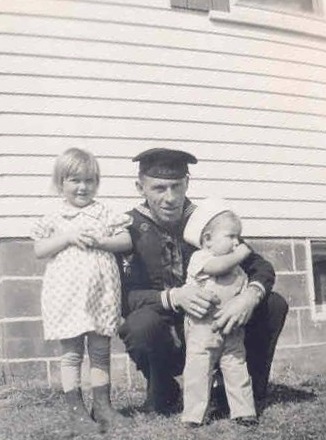
This is the picture. I’m with my father and my sister, and he is just home from the war.
The book is Hamlin Garland’s memoir Son of the Middle Border. Today an unknown author, Garland was one of the writers who inspired my interest in literature and writing. His rather stolid and overly political fiction reflects the life of my mother’s ancestors and her own life. Because my mother’s family history is set in northwest Iowa, his writing would also touch the history of a few other Babooners.
Another way to describe Garland’s early fiction is as the tale of the hard life that Laura Ingalls Wilder wanted to tell, except her daughter urged her to make them children’s stories (who could argue with that decision). Garland’s childhood oddly parallels Wilder’s. He was born in West Salem WI, which is near LaCrosse. His father then moved them to Hester, Iowa, for a brief period and another brief period in Burr Oak, Iowa, where the Wilder family also lived briefly. The Garland’s moved on to a homestead north of Osage, Iowa, or to say, southeast of Albert Lea. From there the Garlands moved to Ordway, SD, long since gone, near Aberdeen.
When Garland’s first book Main Traveled Roads was published in Boston in 1891, it released a storm of criticism because people believed that the life of the Western farmer was full of joy and reward and not dirt, hard work, and deprivation. Garland was an outspoken activist traveling through the country, urging land and economic reform. His early fiction is driven by a point of view called “naturalism,” which portrays humans as caught under the control of powerful impersonal forces, such as weather, plagues, economics, genetics, politics, and random chance. Stephen Crane of Red Badge of Courage, whom Garland encouraged and supported, wrote to a similar point of view with better narrative skill.
I had my mother read Main Traveled Roads when she was about 60. She understood it fully on instinct. She told me of how the details of early Iowa farm life were the details her father told her about his childhood, which were not unlike her own childhood. People sometimes think my childhood was hard, but I do not think so, nor does my sister. We know how hard it once was.
Garland’s memoir begins with his first meeting with his father. Garland was almost four years old when his father came home from the Civil War. It was their first meeting. As I read that opening chapter, I paused to reflect as I often have, that the two great untold stories of America are the lives of the women while the men were off to war and the adjustment men had to make coming home. William Wyler’s The Best Years of Our Lives tells that story very well. Almost every man in the cast and crew was a war veteran, including Harold Russell, who lost both hands in the war. He won the Best Supporting Actor Oscar.

Just as I was contemplating all this, my sister sent me that photo of the two of us with my father. But there are a couple of things you don’t know yet about that image. One is that it is my first meeting with my father. I was born while he was away at war. And the second is that the version you’ve seen has been adjusted. The original photograph was shot at a distinct angle.
My mother took the picture. She took two others that day with my siblings, one of which is as tilted as this. I have a thousand pictures taken by my mother. Only these are off-kilter. I always assume we are seeing her own emotions in that angle. Obviously, With photoshopping it is possible to straighten that picture. How prosaic it is without the tilt.
What do you view from a unique perspective?
 Trail Baboon
Good morning. I am a big fan of authors who wrote about the hard times in this country from the first half of the 1900s and from the 1800s. I know I have read something by Hamlin Garland that I very much liked, but I can’t remember much about it. I especially like the authors that wrote about hard times because many of them are somewhat political or overly political, as you say Clyde. I’m thinking of authors like Sinclair Lewis, Upton Sinclair, and Willa Cather.
I have worked at a wide range of jobs which probably gives me a somewhat unique perspective. I’ve had many kinds of employment from meat packer to agricultural consultant. I got my ability to do a wide range of work from my Dad. Although almost all of his career was spent in the electrical power industry, he knew that industry from a wider perspective than most. He started out working on maintenance in a very small power plant and then worked his way up to being the top engineer for the design of very large power plants. I didn’t manage to work my way into any top position. However, I didn’t mind doing all kinds of work and my Dad never made any negative comments about the odd assortment of jobs that I held.
LikeLike
I am going to have to chew on this question a bit.
For now, I want to add to the list of authors Glenway Wescott who wrote The Grandmothers. I enjoyed it on many levels, but was more than a little disgruntled at his perspective on the European immigrants (my people). Reading Laura Ingalls Wilder revealed the same attitude (imagine my surprise).
The tilt of the photograph as originally taken has some of the same effect on me as a similar angle Orson Welles used in Citizen Kane. Makes me want to hang on to my chair so I don’t slide off and imparts a subconscious feeling of insecurity.
LikeLike
I read Garland years ago, but forgot or perhaps never realized he grew up in NW Iowa. I think Fred Manfred was also considered a naturalist author, and was born in Doone, IA, right there in the NW part of the state.
I have a unique perspective on video/computer games and school sponsored athletics, both of which I believe should be curtailed if not eliminated, but that is a losing battle, I know.
LikeLike
I will return later with an OT post, but first I want to reply to Clyde’s thoughtful question. I have been a writer, photographer and editor. That alters how I respond to written or visual communications. I hesitate to call my perspective “unique,” but I view written communications and images with the eye of someone who has created them. To create something is to make a great many decisions (present or past tense? perspective? etc). Each decision you make to do a thing one way means you have decided against doing it in all of the other ways that might have served that purpose. The simplest example I can give is how you start any written communication. What event comes first in a novel? Through whose eyes do we see the action? What is the attitude of that person toward what is happening? How complex or simple is the language?
Reading or viewing things as a person who has created similar things means that I am aware of all the decisions made. So when I encounter some kind of communication, I automatically reflect on other ways the thing could have been made. Clyde’s photo, for example, is a bit cattywampus, plus only two of the three figures are relating to the photographer. Why? Does that tell us anything about the moment being caught in the photo? Perhaps another photographer would have insisted on all three subjects looking at the camera with big smiles. Would that photo have been as interesting? My book about my parents begins with a silly photo in which I have just stuck my foot in my first birthday cake. The first words of the text establish that my parents are the true subject of the book, not the plump kid with frosting in his toes. The intent, at least, was to show the reader/viewer something whimsical but more complicated than it at first seems.
LikeLike
I agree, Steve, that the type of work you have done will give you a somewhat unique perspective. I worked for a couple of years as a roofer and now I tend to pick on errors in the way roofs have been laid out.
LikeLike
Not disagreeing with your point of view, except one statement is confusing or in error. The picture was take by my mother on the day my father came home from the war. The girl is my sister. The boy is me. So all three are related to the photographer.
LikeLike
I think Steve is referring to the fact that you, Clyde, in the photo, are not looking at the camera.
LikeLike
i think he was noticing that you were looking away form the camara
LikeLike
You look,Clyde, like a typical toddler who isn’t too sure about the adult behind him and who would much rather be doing something else.
LikeLike
In fact, you looked stressed.
LikeLike
I thought he was just more interested in something else going on – watching the dog or some other animal, perhaps.
LikeLike
Manfred is a favorite of mine. I’m sure you know that Manfred was of Frisian heritage, Renee. As some of you might remember, from past comments on this blog, Renee and I are both at least partly Frisian. Don’t mess with us!
LikeLike
Manfred’s Frisian community never really knew what to think about him. His books shocked them, but they were proud of him despite themselves. He was a fixture in my home town, the object of admiration, gossip, and outrage. He was really tall, well over 6’5”.
LikeLike
What is the general consensus about the book Wisconsin Death Trip? I read it years ago, and then later heard lots of criticism about it. Westcott and Garland are mentioned frequently in the book.
LikeLike
I have that book and have had it open many times for visual research, but have never read it.
LikeLike
My recollection of that book is that there were some really weird and disturbing things coalescing around Black River Falls in (I think) the late nineteenth century. I used to have the book and may have it still, but I haven’t seen it lately.
LikeLike
I own a copy unless one of my many house cleaning helpers took it. I think I still have it.
LikeLike
I got the book this summer based on recommendations here. (Thanks MIG).
What was most striking to me was how hard life was back then. The early deaths, the fires, how many people were admitted to the ‘Insane asylum’. The number of times ‘bums’, when refused food, poisoned the cattle and burned down the barns. It was both depressing and made me glad I wasn’t facing those problems.
Renee, I certainly would not have remembered the surnames mentioned in the book.
LikeLike
It made an impression on me. I think I read it when i was in high school.
LikeLike
I read it a couple of years ago.. pretty sure I got the recommendation here. I agree with Ben about how hard everyday life was. Currently reading a book that almost glorifies “the old way of life” – it’s bugging the heck out of me!
LikeLike
I remember the names because they were authors whose books I had no access to when I read Wisconsin Death Trip..
LikeLike
I still have my copy. It’s been close to 40 years since I read it, and only remember bits and pieces. The photographs really stay with you, though.
LikeLike
Apologies for being off the trail so much lately. I have been reading as much as I can, but time for comments winds up at a premium. Sigh. But to the question at hand…I’m not sure exactly what I view from a unique perspective. My co-workers tell me I have a weird ability to visualize how data moves from one system to the next, tracking on when it is transformed slightly and how it gets used – but that just makes me a data nerd, I think. And it doesn’t seem so special an ability, just something I get curious about, so I follow the data river upstream until I find the source – like hiking in a forest of 1s and 0s.
Hmm. Maybe that is my unique perspective: having been a liberal arts major who had to do a lot of writing and a technical writer for a few years after that means that I have also built up an ability to translate between the technical and non-technical, between developers and coders and the “business” side of a conversation. I get teased some at work for my sometimes oddball metaphors for how a system or function works, but I also have heard more than a few folks say that my analogies and metaphors have helped them understand something better.
Btw – the book mentioned sounds like fodder for BBC. Do we have a next book or a meeting date? I missed that info somehow…
LikeLike
Jacque and Lou have graciously offered to host the next meeting at their Eden Prairie abode on February 9th. The main selection is Broken For You, a novel by Stephanie Kallos. The book jacket blurb compares her writing to that of John Irving and Anne Tyler. The secondary non-fiction offering is Nick Hornby’s More Baths, Less Talking, a collection of writings about books and the readers who love them. (The book’s title is explained in the third-to-last piece.) In the meantime, please avoid frostbite and enjoy your holidays. from the bbc liner notes posted by linda after the tiny december get together .
it is nice to have a brain like yours act as laison. the coders are a special bunch. to be able ot discuss their stuff on their behalf is worth its weight in gold
LikeLike
Unique is not a word I would choose. Depending on how you parse it, we are either all unique in our perspectives or none of us are. I will freely acknowledge that my perspectives tend to be especially idiosyncratic. Nevertheless, I am comfortable with them, have arrived at them thoughtfully and deliberately and I am unlikely to change them.
As I interjected late the other night on the Trail, Hamlin Garland is a person of special interest to me and I have an assortment of his books in various early editions in my library. As Clyde has already mentioned, Garland was one of a group of realist authors that emerged in the late nineteenth century. Others of the group included, besides Sinclair Lewis, Frank Norris and Henry Blake Fuller. He is often accused of being too political in his work, especially some of his earlier novels and certainly his writing is informed by a strong sense of indignation at the injustices he saw, but I suspect that some of the outcry against his work was simply that he was telling the truth in places where the public had come to expect fantasy.
Garland was varied and prolific. In addition to his story collections, “Main Travelled Roads” and “Other Main Travelled Roads”, and his novelized memoirs, “Son of the Middle Border”, “Daughter of the Middle Border”, “Back Trailers of the Middle Border”, plus a couple more Middle Border titles, he published books of poetry and essays. Later, he turned to writing western-themed romances, in the nineteenth century sense of the word “romance”. He involved himself in the plight of Native Americans about the time that Edward Curtis was building his photographic portfolio and Helen Hunt Jackson was writing “Ramona”.
Garland was also fascinated by psychic phenomena and was himself the first president of the American Psychical Society. Several of his novels are built around supernatural themes.
Parallel to Garland’s novelizations, he also produced a series of literary reminiscences, the first of which is “Roadside Meetings”, in which he recounts his experiences, the people he met along the way, and his personal observations during his long career as a writer.
As someone who reads a lot of nineteenth century material and who is always seeking, in that material, to establish connections between people and places and events, Hamlin Garland is an interesting and valuable resource.
LikeLike
Thanks for the essay, Clyde, the photo, the food for thought, and the intro to another author I was not aware of. Will have to read something…
I sometimes see possibilities that others don’t. I remember hashing over some problem at a Wedge Co-op coordinators meeting (1980, where 22 coordinators were still trying to make managerial decisions by consensus). It was obvious to all that something or other wouldn’t work; I was the only one who pointed out that we didn’t KNOW that till we tried it. Wish I could remember what it was. (As it turned out, we did try it, but it didn’t work. 😐 )
I can often see visual solutions to space difficulties in rooms, which is how I came to being called “Space Wizard” when I had my organizing business. I have since realized that a LOT of people are as good as, or better than, I when it comes to organizing, but I can still claim some skill with the spacial aspect.
LikeLike
I did not ask the question. Dale changed it, a decision with which I agreed and I agree. So maybe I will answer it later myself.
I have a ________________ [I wish I had a word for this; not “hang-up,” not “fetish,” “issue” is too bland] with the word “unique.” “Unique” means singular, only, one of a kind, as the “uni” at the beginning says. So, in the pure sense of the word something cannot be more or less unique, but the word today as used as synonym for “unusual.” So it is picky to be bothered by something being said to be more unique. It does make sense to say it but my ear hears it as wrong.
LikeLike
In Minnesota I guess you’d say “different.” 🙂
LikeLike
I have the same aversion to careless use of the word unique. Qualified, it means nothing.
LikeLike
ok so you two wordies … do you share my pet peeve for an historical event. i researched and found out the basis for the misuse of the an in this instance but i still *cringe*…..
LikeLike
Don’t know who you are referring to a “two wordies,” but yes, an historical event raises my eyebrows every time I see it. Not exactly a “cringe,” but I react to it with puzzlement.
LikeLike
It wasn’t until PJ’s response that I was clear on what you were asking. I guess that indicates that use of ” an” before words beginning with “h” isn’t cringeworthy for me. It’s merely an artifact of British pronunciation, where the “h” would have been silent. I actually enjoy artifacts like that in the language.
LikeLike
its meant to be used when the h is silent.as in salad herbs or honor where the use on an a would sound weird. a honor or put a herb in the soup would be obviously screwy but i dont get the fact that an historic moment doesnt sound as out of place to the educated ear. would you like an hamburger? never comes up
LikeLike
i dont know what i had going on pj but yesterday while i was not being allowed to post on word press, i was also not seeing your response. i posted the same message to clyde on the fact that steve was referring to clydes looking away in the picture and the two wordies was because i saw no response from you until later in the day when i was at a different location.
LikeLike
I used to teach students that life gives us “perceptual filters,” a term a college psychology professor used. So when you read literature you are perceiving the world through that person’s filter, which helps us understand and hopefully expand upon our filters. A history teacher friend taught me the line “history is the story of famous dead white men,” which later became commonly used. You can say what I read as literature in high school and college was written by famous dead white men. Expanding reading to include other points of view is vital, IF you accept my point that reading is about understanding perceptual filters, yours and others. It so happens that Garland wrote much about the plight of the women on the frontier, which is good, but it is still written by a man. I wrote two extended graduate papers on the women in Garland’s fiction.
One of my larger perceptual filters, like most of us, comes from how I was raised, which was very unusual in my generation and very common in generations before mine.
LikeLike
Speaking of perceptual filters and then I am going to go clean house, Jamie Ford recently had his book “The Hotel at the Corner of Bitter and Happiness” rejected as a movie because people would not want to see a movie about two Asian kids. My daughter and family recently saw the Disney movie Frozen and appreciated it as a movie and for the fact that it intentionally portrayed the main female character as independent and able to solve her problems without the help of a man.
LikeLike
I think “Hotel” would be a great movie… a way to increase people’s awareness of how the Japanese invasion of Hawaii dismantled and often destroyed the lives of so many Japanese-Americans here on the mainland. And I agree with the “Frozen” assessment as well…. in fact, I’ll rank it right up with “Mulan” and “Brave” as my favorite Disney movies!
LikeLike
As a cultural anthropology student, one of the things that was discussed in most every class was what my professors called “cultural goggles” or “cultural glasses” – you can’t really ever fully understand another culture or sub-culture, or fully experience it because you’re own culture will always color your perceptions. If you recognize that, then you have a greater ability to step away from your culture and can better appreciate how your culture shapes your reality.
LikeLike
Rise and Shine Baboons!
Clyde I have to come back later to post more, but I LOVE your pictures, and the crooked ones I like the most.
LikeLike
OT: Dale told me he is going to be gone the week after next. I sent him another guest blog for that week, but I bet he would like more.
LikeLike
I also emailed a story to Dale for the first time, but I’m guessing that it’s too racy to be published here 🙂
LikeLike
why dont you tell it now and beat him to the edit
LikeLike
There’s an idea.
LikeLike
Hmmmmmm……………..
LikeLike
So was my perceptual filter impacted by the fact that from the age of birth to five and half I had my thumb in my mouth? Maybe that’s why I have trouble seeing the thing right in front of me.
LikeLike
OT: I want to thank the cheerful crew that helped clean my home yesterday. Bill, Robin, Linda and Barbara made for a fun and industrious group. The generosity of Baboons is nothing short of amazing! And there was a wonderful surprise toward the end of the day . . . something lost was found!
LikeLike
…in the attic!
LikeLike
You are teasing us!
LikeLike
I thought it was Professor Plum in the Conservatory. It was the attic?…
LikeLike
With the lead pipe.
LikeLike
Clyde and I have something in common: we both were toddlers before we met our fathers as they were away in WWII. I’ve
been told the story that when my dad first walked in, he tossed his army hat into the corner. I promptly scooped it up, marched over to this stranger and said, “Go home, man!” It wasn’t a particularly good start for our relationship.
LikeLike
let him know you were looking after the homefront just like him
LikeLike
My unique (or otherwise more apt wording of the question since we are all by definition, unique) perspective is that of a Libertarian viewing our country’s political theater from the “outside” as all third parties are necessarily relegated by our society’s tacit acceptance of the two party system.
From this lone perspective (for example, I was one of 17 voters in Steele County who voted for the Libertarian candidate for president in 2008), I see politics as tragicomic theater in that politicians will do almost anything short of murder to win elected office, promise to make life perfect for everyone, then immediately ignore trying to help anyone achieve anything except for those who have enough money to give to the pols to help them win re-election. It is one of the great examples of Shakespeare’s quote,paraphrased: “… full of sound and fury and signifying nothing.”
If politics didn’t hurt so many people in such significant ways, it would be comic farce on the level of the Marx Brothers and Peter Sellers.
Chris in Owatonna
LikeLike
I dearly hope that ranked choice voting will take root and spread to national elections. If the local elections process is successful in working the bugs out, the two major parties will have some serious competition, and the real winners will be the voters.
LikeLike
Ranked choice voting certainly deserves a try, Linda. It couldn’t make elections any worse than they are.
Chris
LikeLike
i had a hell of a time today, i was out in my warehouse and i kept getting kicked off. i didnt have anything particularly profound to say but i never do. i am accustomed to typing at will all the nothing particularly profund stuff i have to say. to
retell the story that was nothing profound for the third or fourth time is difficult. the unique view i have is pretty bobvious to me. i have a family friends and others i share the planet with and it seems to me that the conclusions to are never the same as the others i share the journey with, the combination of the input processing the conclusions reached the actions taken and the response to the reactions are all mine and not yours or anyone elses. great story clyde. i love the photo and the angle of it is very cool. im guessing your mo was a little taken with he moment she was witnessing huh?
LikeLike
I love it when something is bobvious to me.
LikeLike
Nothing’s ever very bobvious to me – I’m benvious.
LikeLike
benvious: wishing you had the idyllic country life of our own gentleman farmer and technical director, xdfben. 😉
LikeLike
Wonderful, Renee (and Linda).
LikeLike
And I’m just boblivious!
LikeLike
Bamazing!
LikeLike
Bsnort.
LikeLike
mig not remee on the benvious comment before renee came back with bamazing
LikeLike
Huh? Now I’m completely bonfused!
LikeLike
I have Fuch’s dystrophy, a vision problem that causes halos to appear around lights. It’s hardly unique – it runs in families. My mother had it, and my sister has it, too.
One one hand, the halos can be lovely. One sees the world in starry-Van-Gogh-night splendor. Christmas lights are especially enchanting. It can also be frustrating, though. City planners put streetlights directly bove street signs to illuminate them, but for me it makes them almost impossible to read, because the halo surrounding the light washes out the print on the sign.
I especially loathe those bright white halogen headlights on cars. The halos are huge, and the lights are so bright they are painful. When I’m driving and a vehicle with those lights approaches from the opposite direction, I slow way down. If there was something right in the path of my car, I’m not sure I would see it.
LikeLike
I am highly sensitive to light, too. Part of my FM.
LikeLike
would shades help with the polarized lens help? . also do the halos extend to peoples auras also . i have heard there is a condition that allows some to see that stuff.
LikeLike
I don’t think I am very good at aura perception. I’m not sure exactly what an aura should look like, though. So how would I know?
I’m not sure shades would be helpful. Maybe the kind that baseball players wear, the ones you can flip down for a momentary glare and flip up when it’s dark again.
LikeLike
Lately, I’ve been having near-double vision. Seeing two of everything is disconcerting, so tomorrow I have a six-hour test scheduled. I’ve also had some short term memory problems for a couple of months, mostly forgetting what day it is. When it’s Sunday, I think it’s Monday. This has stumbled me up with appointments with clients. My greatest fear is early onset dementia, but the doc thinks this is due to my left temporal lobe agitation since this is the part of the brain which controls short term memory. More later.
LikeLike
I just sent a guest blog to Dale, too.
LikeLike
lets see if ha pays attention to the guest blogs on the correct days of the week the teams are supposed to be plugged according to my new years resoloution for others. mine was correct clydes was not.
LikeLike
looking forward to it renee
LikeLike
OT – I’m so excited! I’ve just received a 14 page “essay” written by my paternal grandmother about her life. As you may recall, my dad was given up for adoption just a few days after his birth. This “essay” was written by his birthmother, in response to a series of questions submitted to her by her granddaughter (my cousin, Lise, who lives in Dearborn, MI). Cecile was born in 1894 and passed away in 1992. Although she neglects to mention anything about dad (you wonder what else was left out), it is still a fascinating and detailed account of the family I never knew. Still trying to absorb it all.
LikeLike
What a wonderful find!
LikeLike
cool,enjoy
LikeLike
Guest blog?
LikeLike
Human beings.
LikeLike
That is the everyday challenge for all of us. 🙂
LikeLike
hang in there
human beings are the worst beings on the planet except for all the others
I love mankind … it’s people I can’t stand!!”
― Charles M. Schulz
LikeLike