The Parade

Today’s post comes from Verily Sherrilee


I love parades; I always have. I love the floats, I love the military guys with all their flags, I love the Corn Queen’s Court waving from the backs of convertibles. Growing up in St. Louis, we went to see the Shriners’ parade every year; the flowers, the clowns, the bands – I adored it all. I even love the parade every afternoon at the State Fair.

So it was fortuitous that twenty-five years ago, I bought a house in Tangletown. This is the one neighborhood in Minneapolis that defies the grid layout that the rest of the city enjoys.  And it is also one of the neighborhoods that has an annual Fourth of July parade.

We gather at Washburn High School – everybody in their red, white and blue attire. Kids decorate their bikes, trikes, scooters and wagons for the parade. Dogs wear their best festive bandanas and there are always balloons galore. The fire engine arrives and the fire fighters pose for photos with the excited kids. Then the engine starts up, someone usually has John Souza on a boom box and we head out, weaving our way through the streets of Tangletown.  Neighbors who aren’t parading sit on their porches or front steps and wave as we go by.  After 6-8 blocks, we end up at Fuller Park where we have a fabulous party. Games and prizes for the kids, a band, kegs of root beer, hot dogs. Everybody brings their blankets and picnic lunches.

It’s a wonderful way to begin celebrating the Fourth – laidback and fun. And close to home!

How would you design your parade float?

We’re Number 6!

Today’s guest post is by Steve Grooms

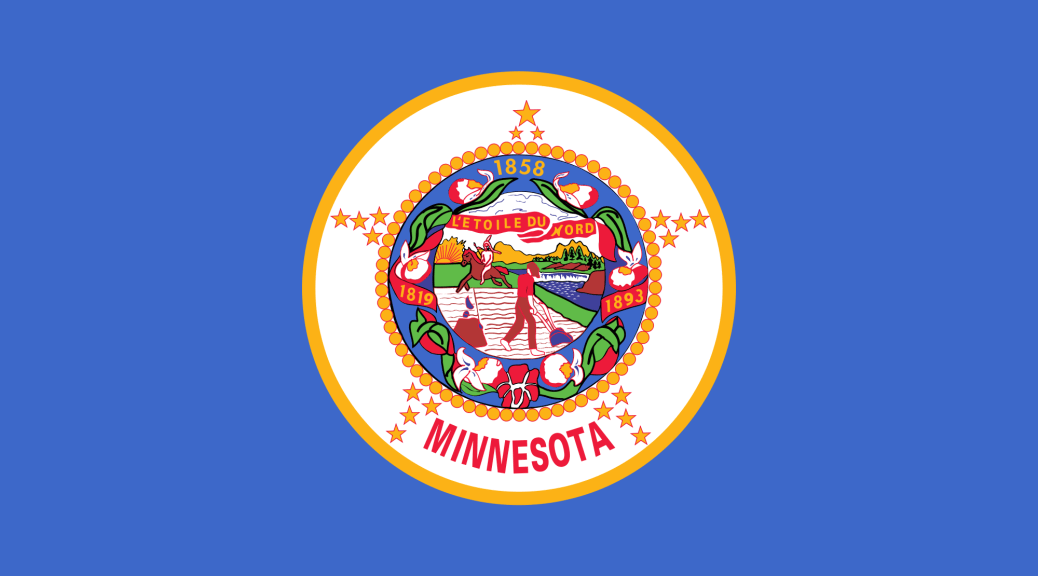
It seems some southerners just can’t let go of the Stars and Bars, the Confederate battle flag. They consider it a symbol of a romantic past. Historians tell us it is a romantic past that never existed, but romantics do not let facts get in the way of convictions. And yet, who are we to feel smug about anyone else’s flag? The Minnesota flag is hardly an example of beauty and positive values. There is actually a scholarly group that studies flags and critiques their design. The American Vexillological Association rates the Minnesota flag as sixth in the country—and that is sixth from the bottom not the top!

When it comes to rankings, Minnesota almost always ranks best or close to best. But it is an official and undeniable truth: our flag sucks. Our flag ranks somewhere like political ethics in New Jersey, environmental protection in Louisiana, or public schools in West Virginia.

Ouch!

More to the point, our flag is highly offensive to Minnesotans whose ancestors were here before Europeans arrived to “discover” the Mississippi River (right where it had always been), chop down the white pines and extirpate such critters as elk, wolves and buffalo.

The flag depicts a European settler tilling his field. His holds a plow, although his rifle is nearby. He looks over his shoulder at a near-naked Indian on horseback who carries a spear. This odd scene is Minnesota? Well, it was when the flag was adopted in 1893, just 21 years after the tragic conflict between the Dakota and the state’s pioneer settlers.

According to a historian quoted in a recent Star Tribune story:

“The image of the pioneer, a peaceful man who has laid down his gun and is plowing his field, is juxtaposed with the image of the Indian, who may still want to fight (his spear is at the ready) but who seems to be riding away.

“The pioneer/farmer is using a plow, a symbol of civilization. The white man is depicted as a ‘doer’ who is entitled to the land, trees and water, empowered by the concept of Manifest Destiny. The Indian is the vacating tenant. A peaceful transition is suggested, but this ignores the tense and problematic history of conflict between European settlers and Indians, such as the complicated history of treaties and the Dakota War of 1862.”

I have other quibbles with the flag:

The logo declares, “L’ Etoile du Nord.” French, of course, is the native language of Minnesota.

The Indian is seen as riding south (which we know because of the position of the setting sun). And yet we know that Sioux survivors of the Dakota conflict were forcibly relocated to a bleak bit of land in central South Dakota. They didn’t ride there but were shipped out on boats like prisoners of war.

The river shown in the flag is widely presumed to be the Mississippi. Oddly, it runs west to east.

The pioneer is shown pushing his plow by hand. We could ask our farmer friend, Ben, how well that would work. I believe we are meant to be inspired by the stump in the field because it represents something like civilization. I am more inclined to see a stump as a symbol of the pioneers’ heedless abuse of nature.

The seal celebrates the beauty of Minnesota’s mountains. Somehow, like the little town of Lake Wobegon, the famous Minnesota Mountain Range fails to appear on modern maps.

The flag celebrates farming and logging, the most important industries of 1893. But gee, there are so many important businesses now that the flag fails to recognize. Shouldn’t the state flag have a Cheerio on it to acknowledge our food companies? Why is there no pacemaker on the flag? No Post-it Notes? No brewery? Shouldn’t our flag include the logo of Minnesota Vikings, or at least the Twins?

How about those flowers circling the plowing scene? They do nothing for the overall design, which is as cluttered as a teenager’s bedroom. Flags should look good from a distance, even when flapping in a wind. Our flag looks like something designed by a committee, a committee of folks who flunked the only art class they ever took.

What we have is a flag that is politically offensive and factually goofy. I could live with that if it were pretty. But, alas, our state’s flag is vexillogically challenged. What we somehow inherited is a flag that flag experts consider “a really, really, really crappy design.”

If it were yours to design, what would Minnesota’s flag look like?

The Minnesota 10

Today’s guest post comes from tim

35 years ago a guitar teacher told me we only get 10 perfect per year in minnesota and they are all in april and may before it gets hot and buggy.

i observed that he was correct and have been keeping track ever since. 10 is about right with the exception of a summer 3 years or so ago when we had 100 perfect days. no rain so no bugs or humidity made for the nicest summer ever but the drought was another issue.

i have discovered along the way that when you are thinking about the really hot or the really cold days here in our weather driven world that there are a max of 10 hot days and 10 cold days per year too.

it helps put it all in perspective

what do you hate? tolerate? and appreciate?

The Oracle on Has Left the Building

Today’s guest post comes from Clyde.

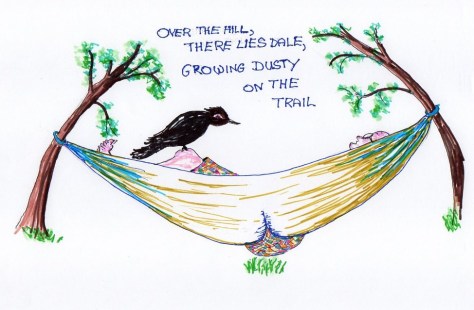
So Dale is on sabbatical, bless him.

Sabbatical is an Old Testament word and concept. In Leviticus God orders that every seventh year the land is to be given a solemn rest. I doubt that happened very often. Giving up a year of food does not seem possible. In Deuteronomy God says every sabbatical year, seventh year, you are to forgive all debts and make special efforts help the poor. I doubt that happened. So, you see, a sabbatical is supposed to last a year, but, please, no one tell Dale.

Dale in Hammock

The day of rest, the Sabbath, is based on the same word. A couple guest blogs back I mentioned Minnesota’s attempt to pass blue laws, which perhaps would have made Sunday more of a day of rest. I hate it as a law, but I appreciate the concept of Sunday as a sabbatical.

When a pastor takes a sabbatical, she/he is sent off with a blessing ceremony. Our lead pastor is on a three-month sabbatical. During his ceremony his stole (the long cloth that drapes around the neck and down the front) was hung over the pulpit, which seems vaguely funereal, or as if the stole is pointing a finger at him saying “get right back here and do sermons for us to ignore.”

Sabbatical seems a wise concept, for both the land and the people. It implies a rebirth, new growth, re-creation. Our modern use of the word recreation is such a small application of the word. Recreation is important, of course, but is is far from re-creation.

The concept exists in many cultures, such as the Aborigines’ walk-about, which, too, is a small word for a large concept. The Navajos and other American Native peoples have ceremonies designed to re-create a person.

Often I have tried to re-create myself and failed. I always end up the same person I disliked before, which is home turf for us Lutherans.

I am a little afraid of a re-created Dale. What will the nicest guy we know become?

How would you re-create yourself?

Those Wascally Wabbits

Today’s guest post comes from Jacque.

As I child I loved the Beatrix Potter book Peter Rabbit. I loved the story; I loved Mama Rabbit’s warning to stay away from Farmer MacGregor’s garden; I loved adventurous, naughty Peter with his snow white tail; I loved the drawings; I loved sitting on Dad’s lap listening to his low voice recite the book one more time.

Farmer MacGregor, the anti-hero wearing overalls and carrying the fearsome pitchfork, was the recipient of all my fear and scorn.

He was mean.

He was Peter’s enemy.

He did not understand Peter at all.

Soon thereafter, Bunny Rabbit on Captain Kangaroo appeared, tormenting Mr. Moose with his rainstorm of ping pong balls. I thought that was so funny. Bunny Rabbit was my secret friend. Mr. Moose was a perfect foil who just never caught on to Bunny’s smart tricks.

Later in childhood Bugs Bunny arrived, carrot in hand, ready to torment Elmer Fudd. “What’s Up, Doc?”   Elmer Fudd was just such a Fuddy-Duddy, never smart enough to out smart Bugs. I loved Bugs.

As a child I was on the side of the Rabbit, wherever the rabbit appeared.

Well, not anymore. I am now Mr. Moose, Farmer MacGregor, and Elmer Fudd all in one.

My vegetable/flower garden in fenced in, the flowers in the flower garden carefully protected, all to prevent rabbit carnage. Despite all this the rabbits chewed away a coneflower this spring. They almost destroyed a yellow button flower that came over the prairies on the covered wagons with my ancestors, as well as a coral bells. These are all hardy perennial plants which are nearly impossible to destroy, and these wascally wabbits nearly got them all.

Last year we witnessed a genius baby rabbit who learned how to traverse the rabbit fence around the vegetable garden. Lou and I stood there watching as the baby bunny scaled the rabbit fence straight up to a hole large enough to allow him/her through, then slithered into the garden. We then knew exactly who devoured the seedling radishes, beets, carrots, and kohrabi. After opening the gate, I charged into the garden, startling the bunny who then left the enclosure the same way he or she entered.

A tiny 5 pound critter reduced me to rage and blind frustration. My perspective shifted and the souls of Mr. Moose, Farmer MacGregor, and Elmer Fudd entered my being. I yelled “What’s Up Bunny?” at the departing tail.

What has caused you to experience a shift in your perspective on an issue?

Strawberries!

Today’s guest post comes from Sherrilee

I’m not sure why I first started picking strawberries every year; now it’s a tradition that I don’t want to do without.  The strawberry picking window is pretty small – usually a couple of weeks in mid-June.  This year the weather has been perfect and berries are right on schedule.

Strawb3

Strawberry picking day starts out early; we always try to get to the fields by 6:30 a.m.  Once the sun comes up, pickers descend on the fields… sometimes the fields can be picked out by 10 a.m.  And the early morning is cooler for picking.  Young Adult and I pick in rows next to each other – she is not a dedicated picker, but understands the concept of “as soon as the boxes are full we go home”.  Of course, an integral part of strawberry picking is strawberry tasting.  The berries were sweet and juicy this year.

Strawb5

Once home it’s time to process all the berries.  This year we did 14 jars of freezer jam and froze about 16 pounds of smoothies over the winter.  And it was a strawberry orgy for three days straight: strawberry cake, strawberry peach pie and lots of bowls of fresh berries with whipped cream.   My mother was not a canner; I am entirely self-taught and I really enjoy it.  So when I found this poem by Joyce Sutphen, it didn’t remind me of my mother, but maybe someday it will remind the Young Adult of me.

Canning

It’s what she does and what her mother did.

It’s what I’d do if I were anything

like her mother’s mother – or if the times

demanded that I work in my garden,

planting rows of beans and carrots, weeding

the pickles and potatoes, picking worms

off the cabbages.

Today she’s canning

tomatoes, which means there are baskets

of red Jubilees waiting on the porch

and she’s been in the cellar looking for jars…

There’s a box of lids and a heal of golf

rings on the counter.  She gets the spices

out; she revs the engine of the old stove.

Now I declare her Master of Preserves!

I say that if there were degrees in canning

she would be summa cum laude—God knows

she’s spent as many hours at the sink peeling

the skins off hot tomatoes as I have

bent over a difficult text.  I see

her at the window, filling up the jar,

packing a glass suitcase for the winter.

Joyce Sutphen

(from First Words: Poems, by Joyce Sutphen, Red Dragonfly Press, 2010)

Do you have a seasonal tradition?