
This weeks Farming Update from Ben
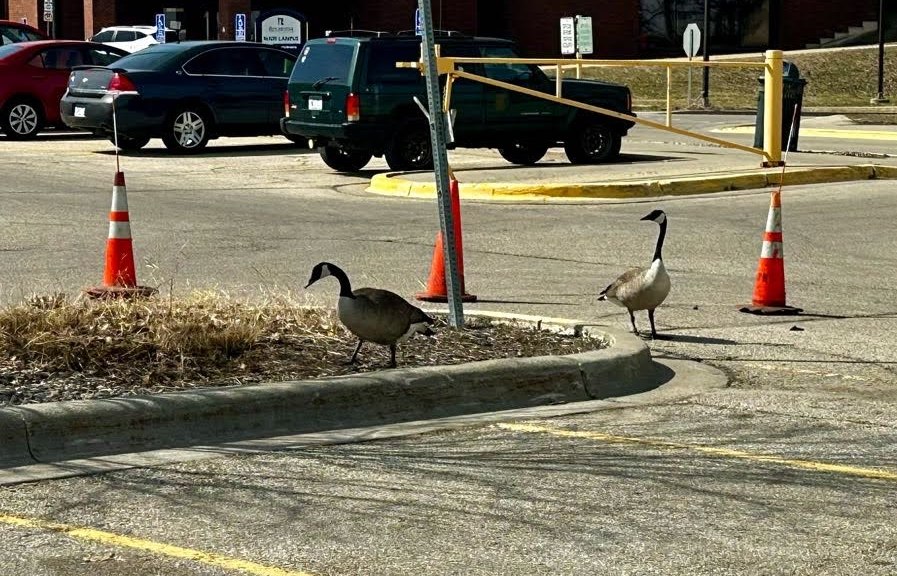
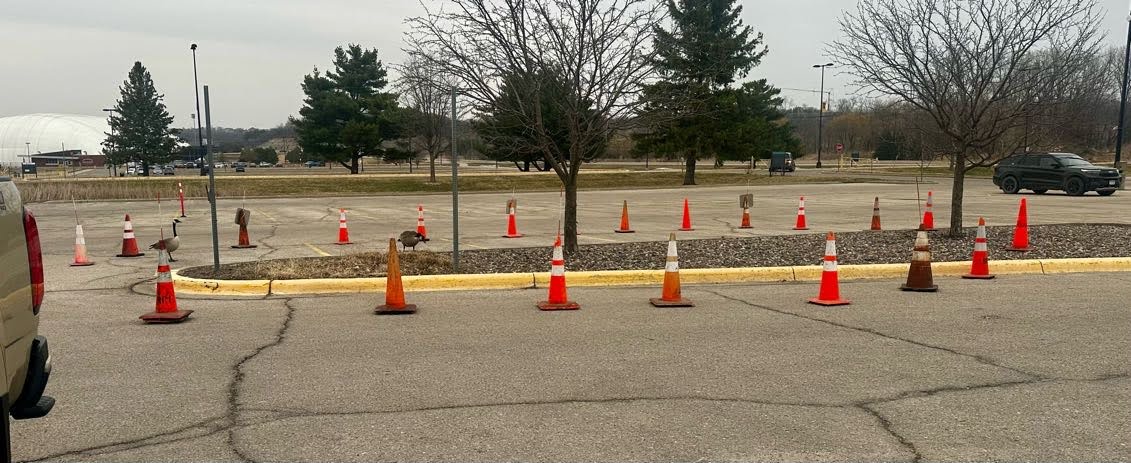
It’s angry goose season at the College again. Caution tape and cones have been put up and emails have been sent out warning us of the danger. The first day as I passed the pair in the parking lot, the male goose just opened his mouth at me. Didn’t even hiss, but he was warning me off in no uncertain terms.
Last Friday Kelly and daughter and I drove to Alexandria. I went to pick up the Track Wacker for use this spring. We took Highway 14, stopped in Mankato for a bathroom break and filled the truck with diesel fuel. $132 later we headed for New Ulm where we stopped to see Hermann the German. I’m pretty sure I was there with my parents when I was a kid. Really didn’t remember anything about it, and on Friday it was 30° and windy and we didn’t linger very long. He’s closed for renovation anyway.

Two lane roads the rest of the way to Alexandria and a very nice drive. We got adjoining rooms at the hotel so daughter could have one room and Kelly and I could have the other. It was a pretty slick way to do it, and I would sure try it again in the future.
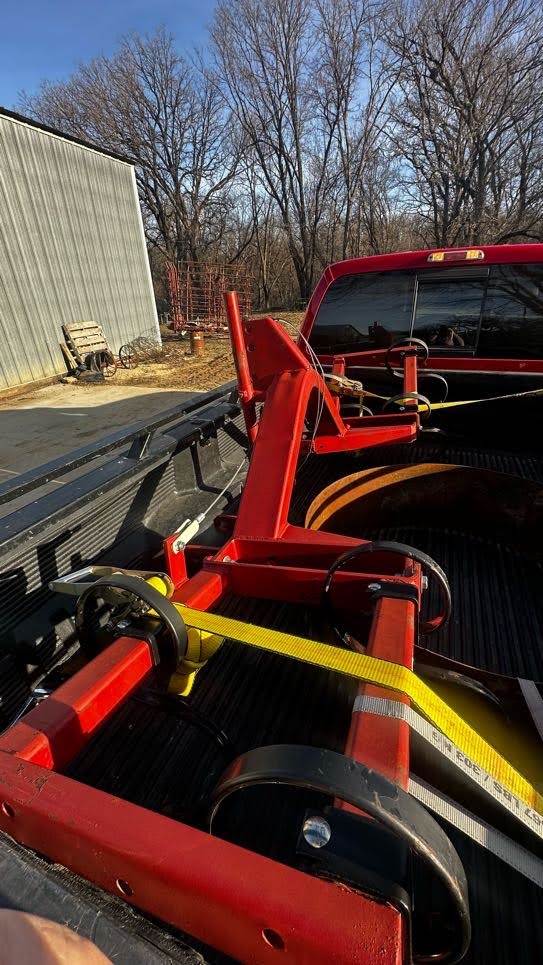
I got up early the next morning, had a mediocre breakfast at the hotel with French toast sticks so tough I couldn’t chew through the crust on the bottom, but the sausage patties were good and I headed half an hour northwest to Millerville to pick up the Track Wacker. I knew it would fit in the back of the pickup. Then for good measure, I bought a fire ring as well.
I got back to the hotel just as the other two finished breakfast and we packed up and were back on the road. Drove to see Theater L’Homme Dieu where I spent a few days with a show back in 2010. Again, quiet two lane roads home, probably didn’t have any traffic for 20 or 30 miles. Saw some really long trains. I couldn’t get over how long some of them were.
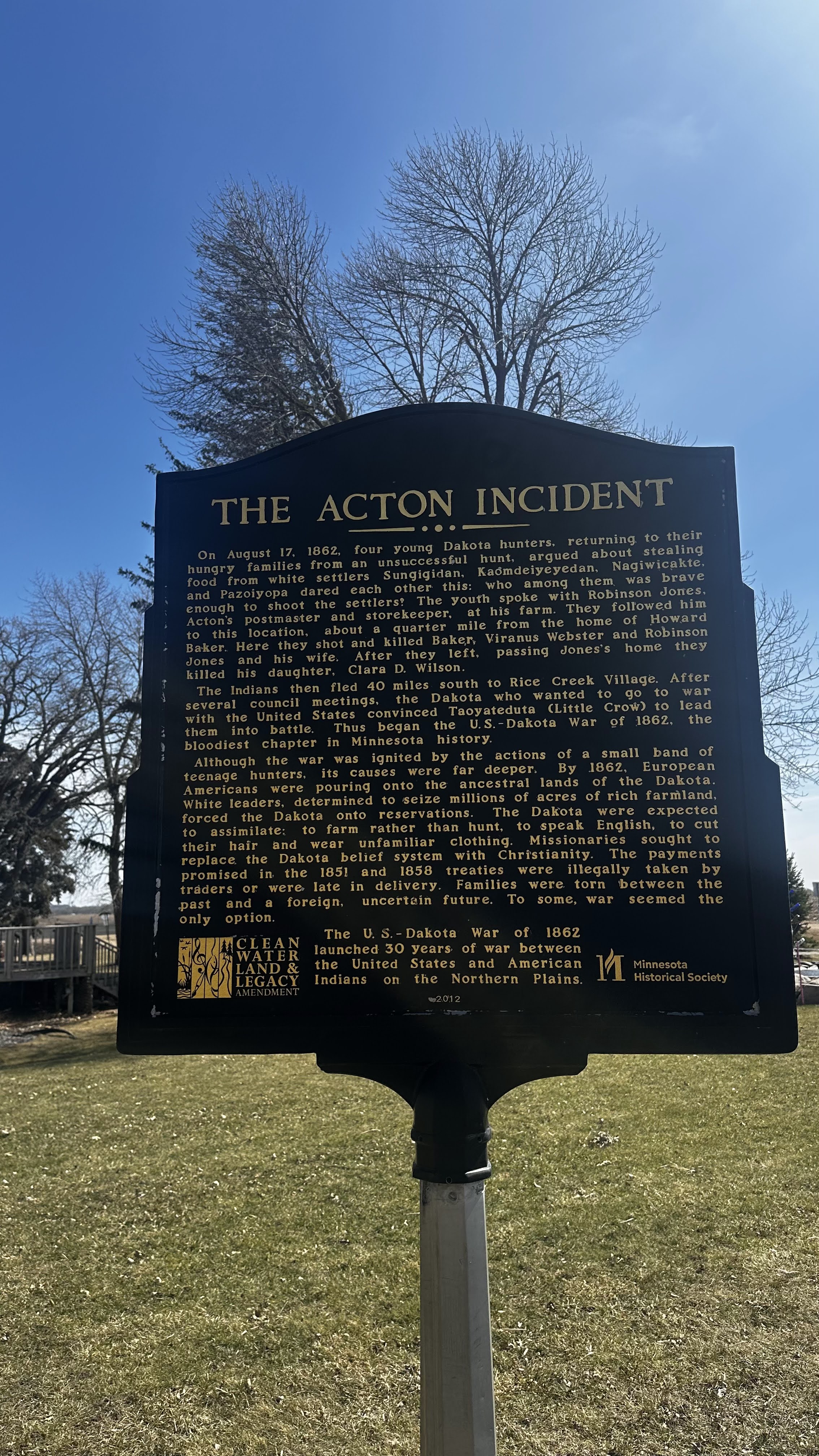
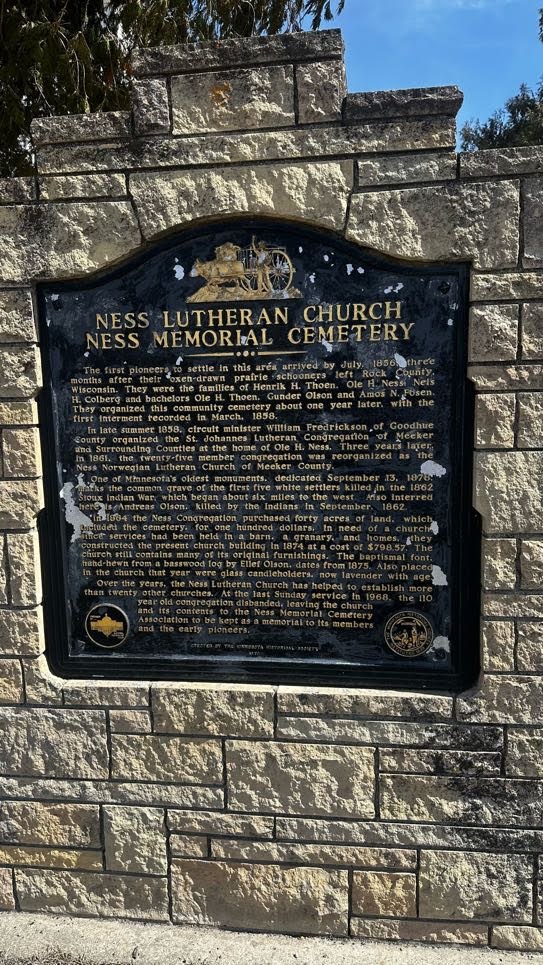
Being a sucker for a historic roadside marker I had looked up a few before leaving. A few miles outside of Grove City we stopped at the Acton State Monument. The battle of Acton, the Acton incident, and the Ness Cemetery. They mark the beginning of the U.S. – Dakota War of 1862. You know, it’s one thing to read about it in the books, it’s another to stand there and realize it happen RIGHT HERE.
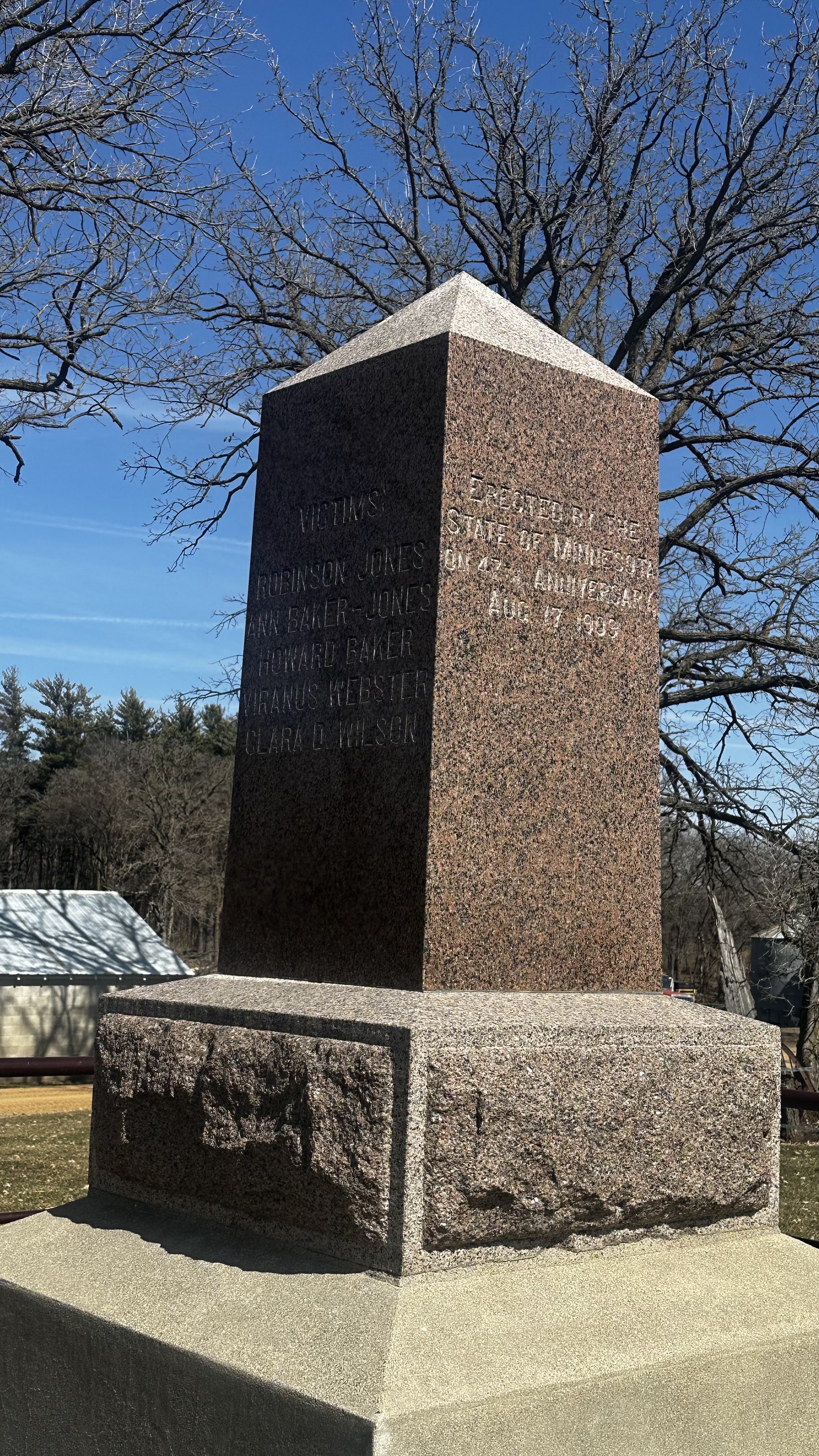
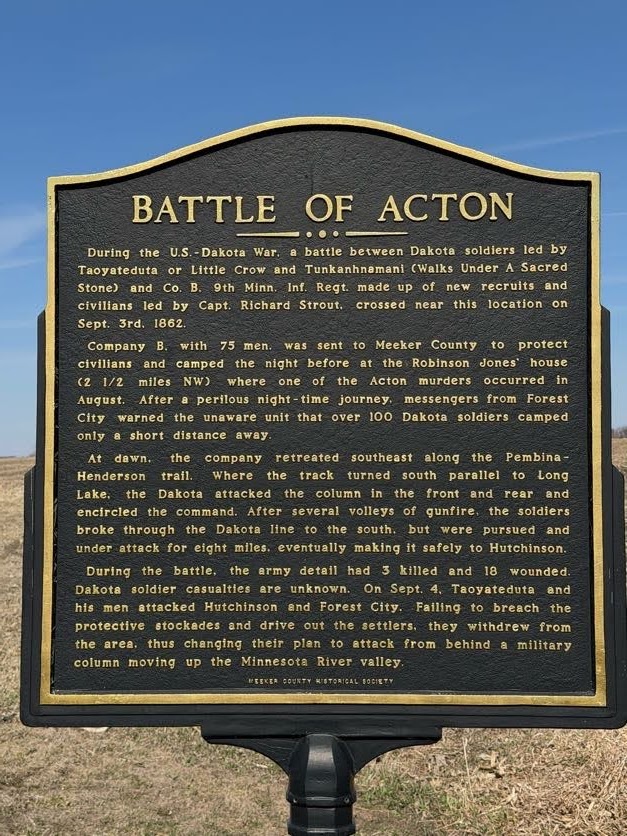
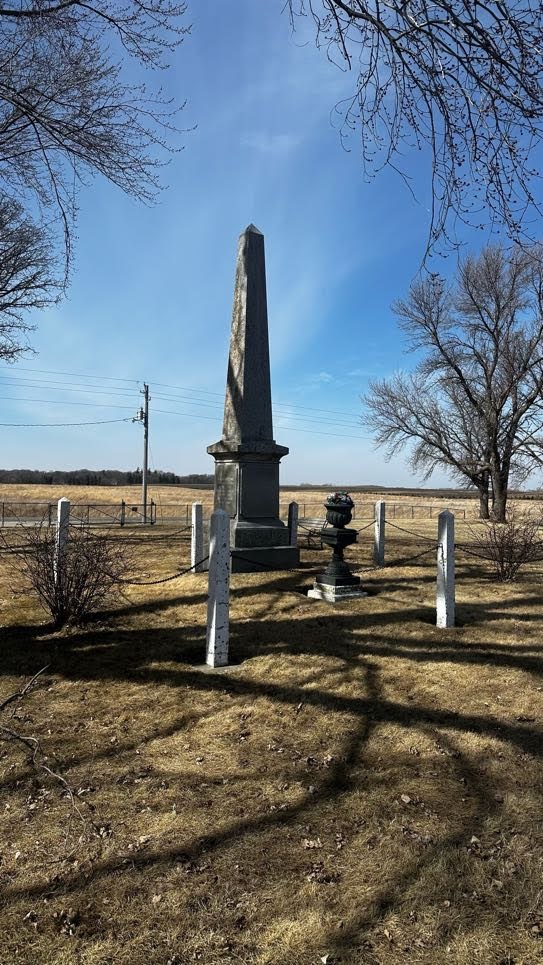
And then to the Ness Cemetery and see the monument: one of Minnesota’s oldest monuments (Dedicated September 13, 1878) marking the burial of those first victims. It was a very deeply moving experience for us.
Twelve hours of driving and about 600 miles. We got home about six in the evening. A couple neighbors had come over to feed the dogs and collect eggs. They call the dogs their “dog grandchildren” and gave Bailey extra food “because we love her“. Sure is nice to have neighbors like that.
Sunday I unloaded the truck, took the rear blade off the tractor, hauled the snowblower out, I even got the lawnmower out and mowed down some grass and weeds before I put the snowblower in its summer parking spot. Daughter and I picked up driveway markers, (but I haven’t taken the snow fence down yet, I don’t wanna jump the gun too fast), and I got the four wheeler running and drove that around a while. Drove down in the pasture to check things out after winter.
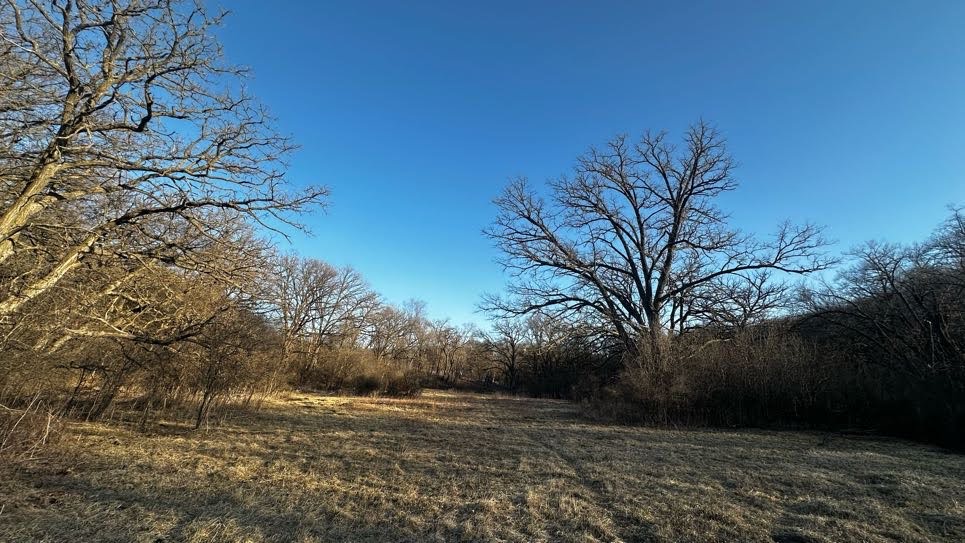
I also picked up branches along the road and Kelly picked up branches in the yard. I think the spring mud is pretty much done. The fields are really drying out, or at least they were before it rained all day Thursday. It could be an early spring here doing fieldwork. If I was a little more prepared I might’ve been able to get out and do a little fieldwork in March. I remember one year doing some on March 31. That doesn’t happen very often.
I spent a few hours in the Shop one night putting a couple new LED lights on the back of the 8200 tractor. Took me an hour to do the first one and five minutes to do the second. Standing on a work platform and reaching over the outside dual tire was another instant of wishing I was 6 inches taller or my arms were 6 inches longer. But I managed. The 6410 tractor that I use for the majority of the work, I’ve replaced a bunch of lights with LED and I have four more to replace and two more to add on the back. It only has two rear work lights at the moment and really could use two additional. It was on my to-do list but apparently will be a summertime project.
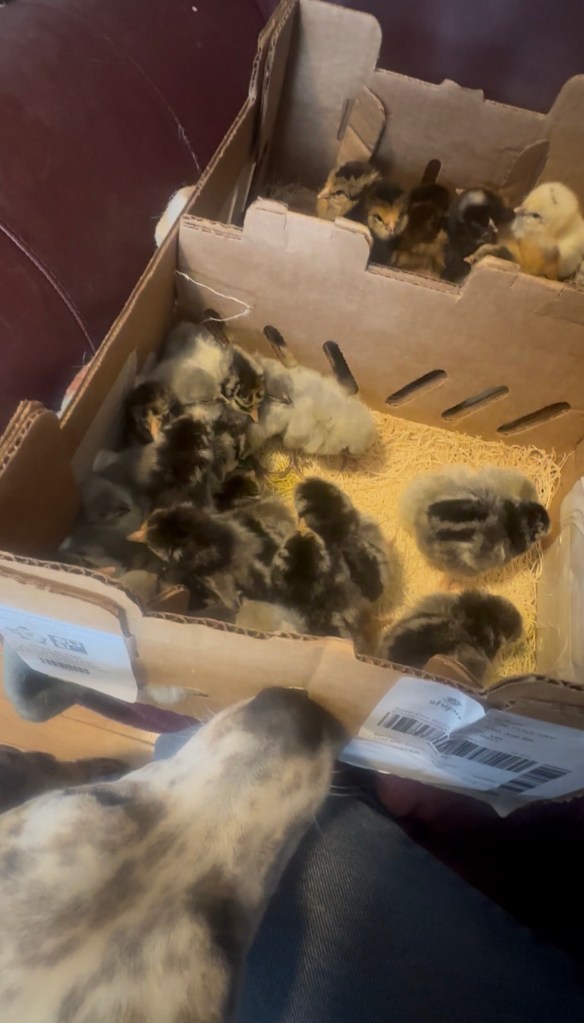
Baby chicks arrived on Wednesday morning. I had gotten their pen ready so once they were delivered and we did the usual pictures and videos of them in the box, I could take them right down and dip their beaks in the water and get them all settled in. I ordered 50 this year for $260. Last year I ordered 40 and it was $170. Twenty of the Easter egg blue and green layers, 10 of the Silver Laced Wyandotte,, 10 Lavender Orpington, those gray ones like Mabel from a few weeks ago, and 10 of Hatchery choice. Could be anything.
So far so good on them.
My summer Padawan came to the college a couple of days and helped me paint the set. He tries to educate me on what’s hip these days. When I took him back home he showed me all the different kinds of cologne he has and told me in the winter you wear something warm and spicy and for example he wouldn’t wear this certain cologne at this time of year. I stared at him quizzically. Why not? And he stared back at me. Like, because everybody knows that. Well, you have to learn that somewhere I said. I mean did he read that in GQ magazine? (He doesn’t read magazines.) Well, just everybody knows that he said. I laughed. Well, I don’t.
HAVE YOU EVER ATTACKED A GOOSE?
WHAT IS THE PROPER NUMBER OF CONES TO PLACE AROUND SOME GEESE?
 Trail Baboon
We had a pug when I was a teenager who bravely chased a whole flock of geese into a pond when we were visiting my aunt and uncle in Fergus Falls. The pug appeared to feel pretty proud of herself.
LikeLiked by 6 people
Awww… the chicks! And I love that photo of the pasture after winter.
No direct contact with a single goose here… There are a lot of geese around Lake Winona – has created some controversy about how to handle it. I don’t remember the latest decision, will see if I can find out – but goose poop is an issue on the walking/biking paths.
LikeLiked by 5 people
For years, Rochester boasted about the 30,000 – 40,000 Canada geese around here. I remember the city buying a “Big Green Poop Machine” to clean off the sidewalks. It made the news. And then immediately disappeared from the news. I asked the papers “answer man” about it. The city bought it in May of 1999 and evidently it didn’t work very well. They traded it off on something else just a few years ago.
And now the goose population is down to just a few hundred and the geese are discouraged from mingling.
I do buy a product called ‘Flight Control’ that I use at the Rep Theater downtown. I spray it on the grass; it looks sort of milky colored, but evidently looks red to the geese and they don’t hang around there meaning they don’t poop on the sidewalks. I learned about it from the college grounds crew. Can you imagine playing football on a field covered with geese? Yuck.
LikeLiked by 3 people
What is a cone to a goose?
I’m more interested in your comment about being a sucker for roadside monuments. I, too have been known to go out of my way to visit certain monuments and sites as well as significant cemeteries. Some of them are not out of my way, like the sign calling out the bow and arrow delineated on the distant hillside near Red Wing. I’ve passed that so often there’s no need to stop and read it.
I once diverted to Neshonoc Cemetery near West Salem, Wisconsin to visit the graves of Hamlin Garland and his family. Once, when Robin and I were visiting friends in eastern New York, we spent a day driving across Massachusetts solely to visit Mount Auburn Cemetery, where many notable literary figures, like Longfellow and Oliver Wendell Holmes and theatrical luminaries like Edwin Booth and Charlotte Cushman are buried. There is also a cenotaph dedicated to Margaret Fuller and a monument to Robert Gould Shaw. On the way back we diverted once again to Harvard, New York, where Bronson Alcott and family attempted their utopian experiment at Fruitlands.
While giant Germans and giant Nutcrackers and so forth seem consciously touristy and don’t interest me much, I am drawn to the idiosyncratic sites, many of which, as it happens, are in Wisconsin, like the Dickeyville grotto and Fred Smith’s cement park in Phillips.
LikeLiked by 4 people
Correction: Harvard, Massachusetts, not New York.
LikeLike
Bronson Alcott is quite the personality, isn’t he?
I really enjoyed Mark Twain’s home in Haaahhtfod, Connecticut. Harriet Beecher Stowe’s cottage is near by, as well.
LikeLiked by 2 people
Even at this remote perspective, Bronson Alcott is infuriating or absurd or pathetic or all three.
LikeLiked by 2 people
The Transcendental Gang talked a lot but Bronson Alcott put it into action and proved how idiotic it was in practice. Been to many of those gravesites, including Garland. Did a major graduate paper on him.
I have trouble thinking of Herman as a tourist attraction, for one thing he is way off the beaten path. The monument was serious to the Germans who built it, which proves something about my fellow Deutchmen.
I have made a point of looking up the many memorials for the Lakotah uprising. There are many, some tucked away in little nooks. One has finally been done at the site of the hanging a dozen years ago or more, a stylized bison. Next to the site. The real site is now a library.
Clyde
LikeLiked by 6 people
Rise and Shine, Baboons,
I am sure the Canada Geese of Rochester view those cones as pure entertainment. Pooping everywhere is their vocation. My understanding is that in Rochester they are quite the management problem. I have never attacked a goose, nor have they attacked me because my dogs run them off. However, I view the wild turkeys as a real threat. Those birds are aggressive!
Meanwhile, I love to stop at off-the-trail visitor sites. We stopped to view Herman the German several times. Husband’s cousin used to live in New Ulm and we would visit her. Herman is frequently being repaired, I think. In New Ulm there is also an interesting Brewery, August Schell, that gives interesting tours, as well as local history.
Ben, in the summer I visit Lake Okoboji, Iowa, another site that was part of the Dakota wars. There is a small cabin there, the Gardener Cabin, that was attacked by a small band of native men. It is now a low-key visitor site that we visited. My friend bought the book narrating the journey of the hostage they took from the cabin, Abbie Gardener, at age 13 or 14. They marched her all over Northern Iowa and Southern Minnesota until they traded her. I read her book last year. She came to hate her captors. That conflict is memorialized all over Southern MN and Northern Iowa. I think it capsulizes how insufficient public policy impacted the Native tribes and the settlers, creating devastating conflicts. An Iowa journalist named MacKinlay Kantor wrote a history of it called “Spirit Lake.” For some reason when I was 13 – 14 years old I got interested in this and read it. (It was one of the books the librarian complained that I should not be reading).
LikeLiked by 6 people
Not about Geese (which a duck-hunter friend said are fair game to shoot during season). This is about monuments of “Dakota Wars”. I just read “Touches the Sky” by James Calvin Schaap, a writer out of Dordt University in Sioux Center, IA. It is set in and around 1890 and about the slaughter of Ghost Dancers at Wounded Knee. I recommend it. Though it moves slowly at first, it is worth the deep dive, and is not overly long.
LikeLiked by 7 people
Sioux Center is about 40 mi south of Renee’s home and 19 miles north of where I grew up. Doordt is a deeply conservative small college of the Dutch Reformed church. How did you come upon this?
LikeLiked by 5 people
I’m an ordained minister in the “other” Reformed Church, the one associated with the Hudson Valley in NY.
The story in the book, “Touches the Sky” is set in the area “around” Platte, SD, on both sides of the Missouri. If you read it, you’ll find familiar geography.
LikeLiked by 5 people
See my response below re: James Schaap.
LikeLike
We have Lenten devotions written by James Schaap.
LikeLike
Has Doordt gone mainstream? ELCA would have been heretic to the Dutch Reformed!
LikeLiked by 2 people
This was in a book edited by Eastern Orthodox adherents.
LikeLike
Kathleen Norris is also a contributor.
LikeLike
Schaap is an example of what Dordt can be on its left fringe.. excellent.
LikeLiked by 2 people
He is a good theologian and writer.
LikeLike
I have never done battle with a goose, I wouldn’t dare. In fall of 2024, we had a folk of turkeys that were often my companions for my walks, none this year. I will always wonder if the coyotes or ICE made themdecide to relocate. Heard the coyotes in the middle of the night once in early winter, but not since.
I too love the roadside historical markers. It’s been interesting to see them evolve over time in “my” area.
I live in Bdote, which is where the Mississippi band Minnesota meet. There has been new signage at the point where the main turn-off for Crosby Farm is that has info about what was there before Europeans came. If you’re up for a hike, you can find the sign for Pig’s Eye’ssettlement.
They’ve also done a lot by Mankato. It fascinated me how little I knew about that area when I was growing up, even though we drove 169 regularly to visit grandparents. It wasn’t until I was a parent that I realized that while my family was in Minnesota when Laura Ingalls Wilder’s was, we were far more like the “outlandish” Norwegian immigrants than like the Ingalls family I was led to identify with.
LikeLiked by 6 people
That Nellie Olson was a real Norwegian pill, wasn’t she?
I realized while visiting Savannah, GA and while trying to understand the deep South attitude towards slavery, that in the Midwest we are similarly obtuse about Native Americans. They are quite “invisible” to us, by necessity, I think.
LikeLiked by 5 people
It never occurred to me that Nellie Olson would be Norwegian, but of course she could have been.
I was thinking of the Norwegians who called the cow, Reset, for Reet ‘o’ Roses. My dad’s family are from Belle Plains and I’ve been told by several people that the accent there was so thick as to be difficult to understand.
I grew up hearing what my mom called “schmutzy Deutsch” so I thought that was just how grandparents talked (my mom’s mother grew up speaking German, so no better on that side, and my mom’s German was better than my dad’s). Funny what you grow up thinking is “regular”.
LikeLiked by 5 people
My maternal grandmother spoke high German. My maternal grandfather’s family spoke plattedeutsch. My father ‘s family spoke Ostfriesian.
LikeLiked by 2 people
I don’t know about “schmutzy”, but “schmutzig” means dirty in German. So, “dirty German”?
LikeLiked by 2 people
Yes, my mother was saying “dirty” German, as opposed to “hoch Deutsch”, high or “proper” German.
The great aunts I knew best were my maternal grandmother ‘s sisters and they spoke in a way that I encountered when I listed the Amanas as a young adult, German and English all mashed together (but different than in Carver County, MN.)
When I took German in college, the first 2 years were pretty easy, because the word order and some grammar were just the way they talked, so I never really learned grammar, I just did it by ear. Then suddenly, it got hard.
The s&h went to Spanish Immersion school and took it in high school, but then picked up French in junior high and a bit of German at the U. I mostly just smile and nod these days.
LikeLiked by 2 people
I have the cone around geese number written down somewhere.
LikeLiked by 3 people
Ha! Perfect. Let us know the proper ratio…
LikeLike
I found it in my pillow but the geese will kill me if I reveal it. Sorry.
LikeLiked by 4 people
goose down pillow?
LikeLiked by 5 people
Good one.
LikeLiked by 3 people
I’ve been hissed at by a goose with its neck all stretched out, but not actually attacked. I was attacked by a wild turkey once. I was driving a Honda Civic into a long driveway and the turkey ran alongside the car, trying to hit the windows with its wings. I couldn’t get out of the car because that turkey was so aggressive. I finally got out and ran for the house with the turkey trying hard to hit me with its wings. I think they have some sharp spurs or something in the wings.
I’m slowly reading “Daybreak Woman,” by Jane Lamm Carroll. The writer chose a Euro-Dakota woman as a subject. She was curious about what life was like for a typical woman in those days. In the late eighteenth and early nineteenth centuries, it was common for the fur traders to marry Dakota women. This practice benefitted both the Dakota families and the fur traders. It was an important part of the early culture of the midwest.
Daybreak Woman’s mother was Dakota and her father was a French fur trader. She was born at Prairie du Chien. She spoke Dakota, French, and English. She was educated and had spent time in a mission school at Lake Huron. She married a Scottish fur trader and moved back to Prairie du Chien, then to Bdote, then west to the areas on the Minnesota River near Redwood Falls, including what was established as the Upper and Lower Sioux Agencies.
Treaty after treaty was broken during the mid-1800s. The Dakota people were promised land, but settlers flooded in and settled on it anyway. Wild game became scarce due to all of the hunting and trapping. Dakota people weren’t historically farmers. They were hunter-gatherers, and needed large areas of land for subsistence. They were also accustomed to moving seasonally. The Indian agencies wanted them to settle in one place and become farmers. Many Dakota people tried this and were successful. Other Dakota people were offended by it, and wanted to defend their traditional lifestyles.
The traders began insisting that the Dakota people had “debts” to pay and took most of the annuity funds as payment for these debts. Since many of the Dakota couldn’t read, they didn’t know what these debts were. All they knew was that they were starving, they hadn’t been paid their annuities, they could no longer hunt or trap game, and they’d been forced from their traditional lands and lifestyle. I find it hard to blame them for their anger.
The area of land described in this book is enormous. It was before many of the territories were actually states. It extended from the east side of Lake Huron in the east to southern South Dakota in the west. Most of central and southern Minnesota was part of this area, and was seen as the center of Dakota life. They believed they came from Bdote. We truly walk on native land.
LikeLiked by 6 people
The geese favorite car is the Honk-da.
LikeLiked by 5 people
This book sounds fascinating, Krista – thanks.
LikeLiked by 1 person
I need to get that book!
LikeLiked by 1 person
I guess I don’t understand the cones. Do they actually keep the geese in one place?
LikeLiked by 2 people
🥰What a flocking question, you silly goose! Geese remain in formation!
LikeLiked by 2 people
I guess the cones are really to keep the students and staff away from the geese. And I know people are obtuse with their heads down in their phones and all… maybe that’s why it takes that many cones?
LikeLiked by 1 person
I didn’t see how it could effectively corral the geese!
LikeLiked by 3 people
Tangentially, I have heard several large flocks of swans passing over in the last week. Tundra swans, I presume. They have all been heading northwest.
LikeLiked by 1 person
It’s possible that what I presumed were swans were snow geese. They fly much too high to identify by sight.
LikeLiked by 1 person
We saw a formation of tundra swans when we were out on the Wagon Bridge for Full Moon this week – we had a seasoned birder with us, so that’s probably right… At any rate, it was beautiful to watch.
LikeLiked by 1 person
Snow geese
LikeLiked by 1 person
Oops! That was supposed to be a query. I forgot I was on the trail…
LikeLiked by 1 person
i have duked it out with geese when i was a kid hunting the sloughs of dakota. you shoot one and only get the wing and then its considered humane to catch up to it and finish the kill. they are understandably very defensive as the great white hunter approaches. i quit hunting at 15. i couldnt stomach it.
my great grandfather was the child of a trader and a lakota woman. anashanabee to be precise. the father wanted th mom to leave the rez and move to town either him. she wouldnt go but she got talked into letting her son be relocated to minneapolis where he could have a better chance than in the schools they sent indian kids to. he drank the koolaid and was a very successful lawyer, athelete and the athletic director at st thomas before settling in walker on leach lake as the depression set in. he became the county attourney and tried to help the native community. born in 1870s died in 1970s. he served as pop warners assistant at carlaisle indian school and discovered mentored and named jim thorpe.
i tend to consider the indian perspective in these types of monuments and tales from our past. prior to white men the indians had figured out their way of living in respectful ways with the earth. that didnt play well come the new normal on the rez with no food, money or hope for the future. my great grandfather commented in his notes that he knew he had to do better than a non indian would be expected to do and with the knowledge that if he screwed up there would be no slack cut to an indian. golf and cribbage were his passtimes. he married a polish immigrant and had 3 kids. my grandmother was 1/4 indian, never identified as an indian and i feel it was a shame we missed out on in depth appreciation of his stories and memories. i was 18 when he died
LikeLiked by 7 people
tim
LikeLiked by 1 person
Wow, that’s quite a history, tim!
LikeLiked by 2 people
I haven’t been allowed to “like” anything today, but I do like your comments.
LikeLiked by 2 people
No geese incidents. But when I was in college, I did get charged by a swan up at Telemark Lodge. I’m not sure why I wasn’t more frightened because I didn’t run. But the swan stopped about 3 feet short of me and then turned around and left me alone. No cones around the swans!
LikeLiked by 4 people
VS, Are you back home now? Sisters still intact?
LikeLiked by 3 people
We got back Friday night. No sisters were harmed in the cleaning of Nonny’s condo.
LikeLiked by 4 people
On birds.
The Big Bear Valley California eaglets have hatched.
LikeLiked by 4 people
i like that part of california
LikeLike
I have never tangled with a live goose, but I was chased once by a white pelican in the zoo in Nykøbing when I was eight. I was terrified when it attempted to grab hold of the skirt of my pink, flowery dress with it’s huge beak. Dad thought it was the funniest thing he had ever seen and laughed loudly while I ran screaming away from the bird.
I was also dive bombed once by a blue jay who had a nest close to our back door in Carbondale. It attacked when I accidentally got too close to the nest that I had not previously been aware of, its feet actually making contact with my scalp. That bird was fierce.
LikeLiked by 2 people
LikeLike