Often when I am alone and my mind is free to wander, I am drawn to make connections between things I observe and things I know. Historical things. Cultural things. Sometimes something I see or hear will trigger a question of etymology. I see a word or name in a new light and wonder, what’s the association there? Why are cantaloupes named for the call of the wolf? What does porcelain have to do with pigs? How does lactation fit into galactic? (It all goes back to the Milky Way) Is there any link between taxicabs and taxidermy? (There isn’t. Different root.)
I was out walking and happened to see an advertisement that used the word POSH. A widely held and completely unsubstantiated explanation of its etymology is that it originated with British sea voyage to India and that the most desirable staterooms were, on a round trip, “Port Out, Starboard Home”, and that this acronym was stamped on tickets of passage in purple ink. The problem is that, though many souvenir tickets still exist in scrapbooks and museums, not a single one is so stamped, not in purple or otherwise. And who would such a stamp inform? The passenger would know what they had reserved. The crew would surely know the stateroom’s orientation by its number.
Like many etymological theories, the real origins of posh are speculative but a late nineteenth century dictionary of Romany (gypsy) terms lists “pash” as describing a dandy. By the early twentieth century, P. G. Wodehouse used it in its currently understood sense in a story, suggesting that by then it had entered into common parlance.
So, that’s a glimpse at what goes on inside my head when I am by myself.
What goes on in your head? Any favorite etymology?
Reverend Van Slyke believed the Garden of Eden was in Trempealeau, Wisconsin. Arthur Conan Doyle and Henry Thoreau believed in fairies. A family in Winona, Minnesota believed their dead daughter was a vampire.
Most of us believe things unsupported by evidence. Me, I believe I’ll have a cup of tea.
In the most significant and, needless to say, dramatic manifestation since Lourdes, the Blessed Virgin Mary appeared this week in a Minneapolis neighborhood, her first stop on a nationwide tour.
“This really blows,” she announced with palpable agitation. “I hoped we were making progress, but now it’s getting ugly again.”
In the early 1970s, Robin and I and our friend Steve Carley drove to Calgary, Alberta for the Calgary Stampede. In truth, I was only vaguely interested in the rodeo. As it turned out, the rodeo wasn’t especially exciting; the problem was that the competitors were all excessively competent—every participant performed perfectly and the difference between them amounted to seconds or fractions of seconds.
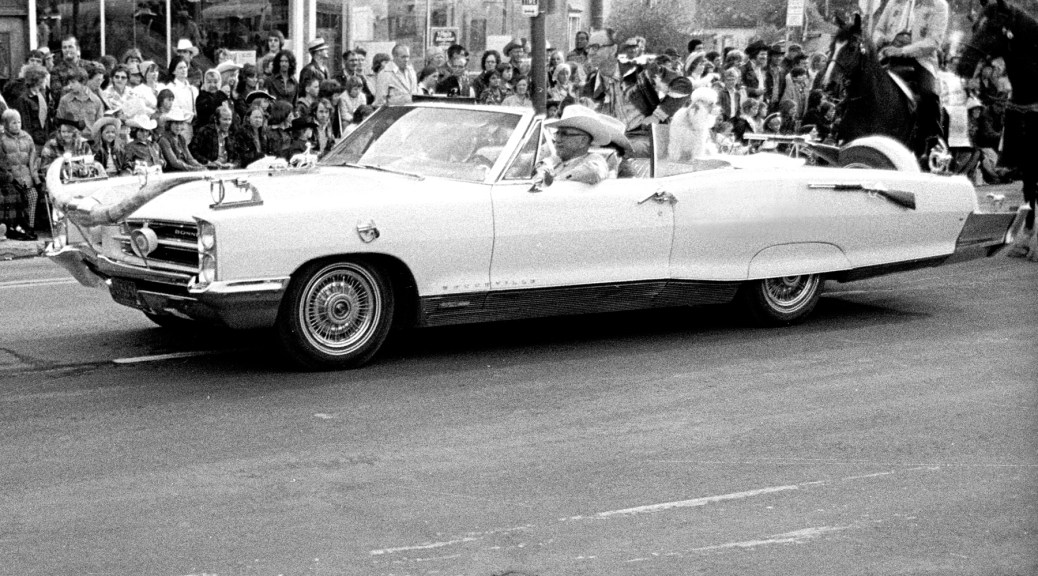
The real reason I was in Calgary was because Wilf Carter was going to be in the pre-stampede parade. Wilf Carter, also known as Montana Slim, was one of the original singing cowboys. Carter was the first Canadian country music star. An unbelievable yodeler, Carter belonged to the ilk of Hank Snow, Jimmie Rodgers, and Gene Autry. Here’s a sample:
The Stampede was my chance to see him in person. He rode in the parade, in a convertible designed, I think, by the legendary Nudie Cohn. The header photo shows that car.
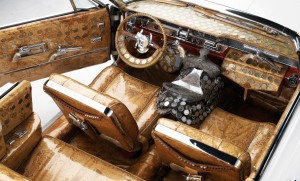
Nudie was a Ukrainian-born tailor who established himself making sequin-bedecked outfits for the likes of Elvis and Roy Rogers and later branched out to designing boots and even cars. Here’s what the interior of the car looked like:
I was going through my cowboy phase then. I was collecting and listening to a lot of early cowboy/country music. You couldn’t get a shirt in those days in the style of the classic movie cowboys, so I was making my own cowboy shirts, with fancy piped yokes and cuffs, curved slash pockets with arrowheads on the corners and pearl snaps. Sometimes the fabric was atypical— hawaiian prints, for instance.
I was never really interested in the actual business of ranching or horses.. What attracted me was the lore and milieu of the singing cowboys. The imagery of the likes of Tom Mix, Ken Maynard and William S. Hart. At the time I was working on a series of drawings I called my Patsy Montana drawings. They had nothing to do with the real Patsy Montana or her songs. She was my muse and the drawings were more along the line of “Even Cowgirls get the Blues”.
In downtown Minneapolis in the 70s and early 80s, on First Avenue, just north of Hennepin, on the second floor, there was a record shop called Pyramid Records. It was a big open space with waist-high benches around the perimeter, on top of which were boxes of records, many of them cutouts, all inexpensive, and chiefly old country recordings and vintage jazz. The proprietor sat in an overstuffed armchair in the center. He seldom made eye contact and never conversation. When you had made your selection, he would reluctantly accept your money. I’ve heard that he just disappeared one night, leaving his entire record stock behind. But he had some incredible, obscure records on offer, if you were in that market. There was a label out of West Germany, CMH, that had reissued classic early country music, including Wilf Carter, Hank Snow, the Carter Family and Goebel Reeves.
I bought them all.
Eventually I moved on from my cowboy phase, though I’ve never lost my interest in either the music or the imagery. I’ve overlaid them with newer fascinations but not many carry the pervasive richness that that long-ago cowboy fixation carried for me.
I can’t judge the extent to which I am deaf to the popular culture and the extent to which I am willfully contrarian. Some of both no doubt. But those are traits I also savor in others. What interests me, what I look for, are the obsessions people nurture that aren’t delivered to them as a readily consumable commodity— obsessions that call for research, diligence, craft and expertise. It could be an art, in the broadest sense, or it could be a collection. It scarcely matters how arcane, how peculiar the obsession might be. After all, the more elusive the interest, the more dedication it requires. And the more dedication it requires, the more it can be uniquely yours.
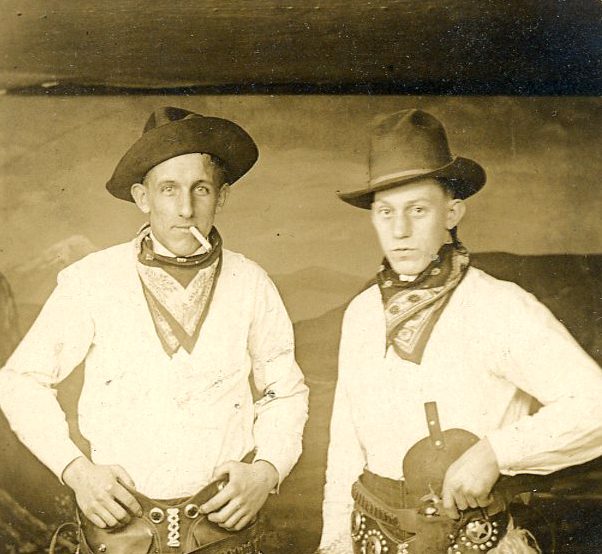
Here are pictures of my father’s father in one of his first performances as an American. He’s the one on the right. He was newly arrived from Sweden, having sailed in July, 1916 on a Norwegian-American ship, embarking from Kristiania, Norway. He was 20 years old and emigrated alone.
I say this was a performance because I see in these pictures an expression and reenactment of the mythology of America that new arrivals so frequently bring with them. My grandfather landed at Ellis Island and made his way westward from there. In America, Rickard Nilsson became Richard Nelson. I believe he had acquaintances or distant relatives in Grygla, Minnesota in the far northwest corner of the state. Sometime in the first year or so of his arrival, he traveled further west to Everett, Washington. There, or along the way to there, with a friend, he had these photos made. They were printed on postcard stock. Perhaps he sent one home to Sweden.
Almost everything I know, or think I know about this grandfather comes from physical artifacts or from peripheral research and speculation. He died when I was four years old. My father didn’t talk about him and I didn’t ask. To know him at all, I have to unpack the clues.
Even allowing for the invincibility of youth, it must have been frightening traveling across the Atlantic in 1916. German U-boat activity was heavy and being on a neutral country’s vessel was small reassurance. Over the course of the war, Germany sunk over 1300 Norwegian ships. That suggests that, despite the peril, my grandfather had strong motivations for leaving. My uncle once intimated that my grandfather had emigrated to avoid conscription into the Swedish army. Since Sweden was also neutral at that time (though it was being pressured by Germany for support), understanding the sense, if any, to that claim will require more study.
Grandfather stayed and worked for a time in Everett. I have an envelope dated December 1918 addressed to him in Everett and a business card from Everett Transfer and Feed Yard, where I assume he found work. A letter he wrote at that time (in Swedish) to the Swedish American newspaper seeks other Swedes with whom he might meet and socialize. Everett must not have been a Scandinavian hotbed. He sounds lonely and isolated.
At some point, Richard Nelson left Everett, Washington and returned to Minnesota. It was there, in Barrett, Minnesota that he met my grandmother. Like many parts of Minnesota, Barrett was heavily Scandinavian. My grandmother’s father was also a Swedish immigrant and her mother the child of Norwegians. It’s reasonable to conjecture that my grandfather was drawn to the area by the familiar, comfortable culture, the opportunity to use his native language, a chance to be his authentic self. That’s something all transplants crave.
When my grandparents married, it was in Minneapolis. My grandfather built a house for the family in Robbinsdale. He found work as a painter and in various kinds of maintenance. Most of his friends had Scandinavian last names. He had two sons, both of whom served in WWII. He finally became a naturalized citizen in 1943.
I think of him and of all my immigrant ancestors when the immigration talk gets ugly. We are all related to immigrants, some more immediately than others. At least one of us (I’m looking at you, P.J.) is an actual immigrant. We owe everything to those brave or desperate souls who picked up their lives and families and transplanted them here. We can honor them by regarding new arrivals, ones with unfamiliar customs and language and costume as kindred to our ancestors and cutting them some slack.
America at its best, at its most vital and dynamic, is always in the process of becoming something different.
What do you know about your immigrant predecessors? Any good stories?
It’s not what you think. I don’t know what you’re thinking, but it’s not that.
When I was in high school, 15 or 16 years old and living in the suburbs, I would sometimes get on the city bus and go downtown by myself. Once there, I would visit art galleries. There was a gallery on Hennepin, up a narrow staircase to the second floor, called the Bottega Gallery. It was run by a guy named Tom Sewell and it had a reputation as avant-garde. In fact, when Marcel Duchamp was in town for his show at the Walker, curator Martin Friedman brought Duchamp to the Bottega Gallery. I didn’t know anything about the avant-garde or about abstract art of any kind, but I was drawn to the Bottega Gallery and returned whenever I came downtown. At that time, Hennepin Avenue was pretty scruffy. To my suburban sensibilities it had a tang of dangerous bohemianism and adventure.
After visiting the Bottega Gallery, I would walk down to the Walker Art Center to look around. This was the old Walker, with a grand staircase leading up to an open gallery looking out on a center atrium. It was the only Walker I’ve ever really loved. After the Walker, I would make a stop at the Kilbride-Bradley Gallery. As I recall it, K-B Gallery was part gallery, part art supply store. Bob Kilbride published a newsletter/“zine” called The Potboiler, which was always entertaining and free for the taking..
When I say I didn’t know anything about abstract art, I mean I had no basis for knowing anything. Art appreciation and art history were not taught in my high school. Art was not part of my home life. I doubt that either of my parents ever visited a gallery or art museum in their lifetimes. That wasn’t in their world. My impulse to seek out art galleries feels a little like a rogue mutation of the family genetics. Nothing foreshadowed it, but there it was.
Looking down from the altitude of more than half a decade, I have enough distance to see my teen-aged self dispassionately and wonder where the motivation for those ventures came from. It certainly wasn’t peer pressure– none of my friends or schoolmates knew about my excursions. I never talked about it. I always went alone.
My secret life was innocent enough, but private. It makes me wonder how unusual that is. Did everyone have a secret life like mine? Did anyone?

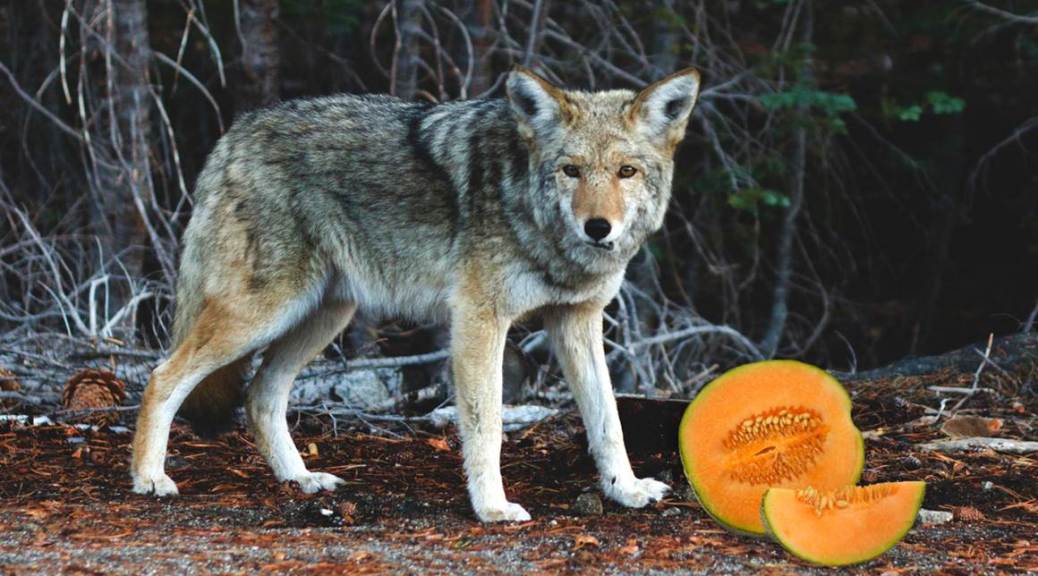
 torical things. Cultural things. Sometimes something I see or hear will trigger a question of etymology. I see a word or name in a new light and wonder, what’s the association there? Why are cantaloupes named for the call of the wolf? What does porcelain have to do with pigs? How does lactation fit into galactic? (It all goes back to the Milky Way) Is there any link between taxicabs and taxidermy? (There isn’t. Different root.)
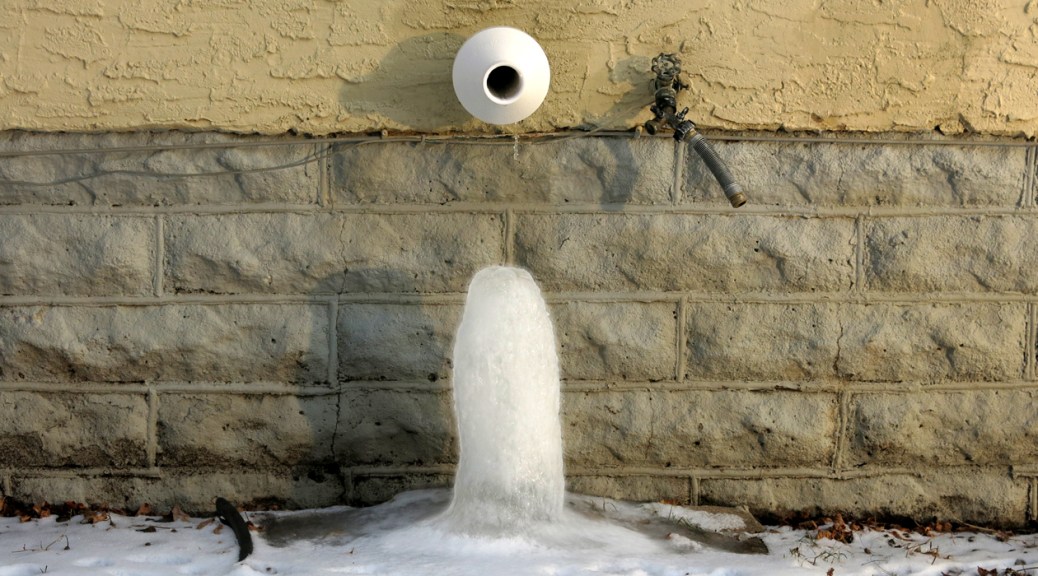
 t, though many souvenir tickets still exist in scrapbooks and museums, not a single one is so stamped, not in purple or otherwise. And who would such a stamp inform? The passenger would know what they had reserved. The crew would surely know the stateroom’s orientation by its number.
 Trail Baboon