All posts by cbirkholz

Dreaming in Small Dimension

Today’s post comes from Clyde of Mankato.

I was born too late. Just too late. Too late for the “Tiny House” craze. It all starts with my childhood and ends with my daughter.

My childhood had two tiny houses in it, more like cabins, but they could have been homes. Even then I dreamed that one day I would live in a small one-room house. I did not think that I would meet a wonderful big city girl who had no such dream.

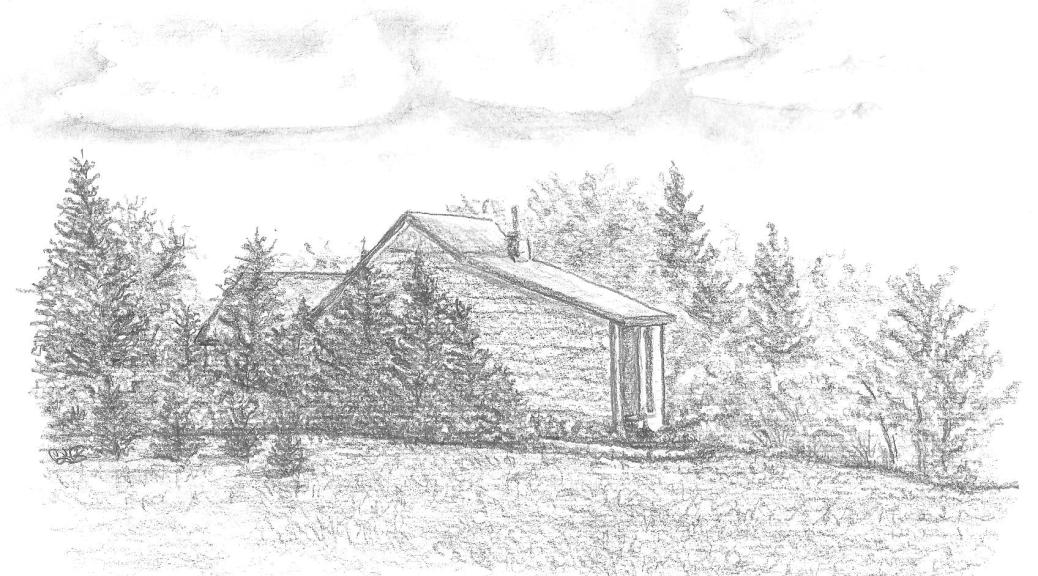
The first of the cabins in my childhood was along the otherwise uninhabited road to our farm. It belonged to an old man who lived in town. His outhouse did not bother me; our house, at that time, had only an outhouse. What happened to it, you ask? His grandson tore it down and built a large 1970’s era split-level house. I cannot blame him. It has a view of Lake Superior from its higher floors. (The header drawing is of that cabin.)

The second of the cabins had only one twelve-by-fifteen room. “The Shack” we called it, built by my brother and a friend on the edge of our fields 600 yards from our house. My brother and his friend went off to the Navy, thus ceding use of the cabin to me and my best friend, the younger brother of the man who helped my brother build The Shack. Dennis and I often slept there, after peddling into town to buy a load of sugar for our night’s pleasure. It had no outhouse, simply lots of nearby brush. What happened to it, you ask? In reality nothing, by which I mean it has melted itself into the ground. In my imagination it is the primary setting of my second novel. However, for the demands of the fiction, I tore it down and replaced it with a modern small home, but not a tiny house.

Our house on the North Shore was small, barely 1400 square feet. We did not find it lacking, in part because of our view over Lake Superior. Today we live in an apartment of 650 square feet, which we find cozy and perfect. When Sandy and I watch the TV shows on tiny houses, she always exclaims how small they are and how she could not live in one. I always dream the tiny house is mine. My daughter and her husband have plans to build a tiny house as their only home when they retire.

The tiny house fad, it seems to me, says something about our culture. We rush to the extremes: 4000 square feet or 400 square feet. Why not something of 900 to 1200 square feet, for example?

Could you live in a tiny house, say 400-500 square feet?

The Architectural Blues

Today’s post comes from Clyde of Mankato

I was driving down the street the other day, minding my own business entirely, innocent of marring the world with anything but my car exhaust fumes, when I looked up and saw two men putting a new sign on a building.

Birkholz Building

Back when I was the manager of a small company, I almost rented half of this building. The Birkholz this is now named for, if I correctly assume who it is, is no relative. (Well, I know he/she isn’t because I have no relatives named Birkholz, except my son and my ex-brother.) The probable building owner’s wife is my eye doctor. If it is he, the building will soon start tilting radically to the right.

I bemoan that my name is on such a squat dumpy pasty-white building. However, Mankato has has a spate of new construction in the last few years, which makes the Birkholz Building look blandly attractive. Let me take you on a short tongue-in-cheek tour. Along the way, I am sure many if not all of you will disagree with my assessments. My architectural taste has long been held up to ridicule.

US Banbk

I think all will agree about this new atrocity. But I give credit to a bank for giving the world a bold middle finger architectural salute, as they so often do financially.

College

This was completed five years ago at a local Lutheran college. This building is most certainly awkward. It makes me want to turn Catholic. It was Mankato’s first major step into what I call “sore thumb architecture.” We now have literally hundreds of sore thumbs sticking skyward around town, the finest exemplar of which is this thing near Minnesota State.

Sore Thumb

The next three buildings are all just being completed.


These three buildings are all on the same block, turning their backs to each other, as they should. One looks like a crossword puzzle, one looks like a Legos construction, one looks like a glass outhouse. Diagonally across an intersection from the glass outhouse is this building, which, if you took off that golfer’s cap and replaced it with a cross, would look as if they worship money.

MinnStar

Then there is the church we attend. Notice I do not indicate any sense of involvement.

Bethlehem

This building used to look like a bottling plant, beer bottling no doubt. Two years ago they spent over $2,000,000, much of went to redo the front, adding the freight loading dock to the left of our view, the rusting crosses, the sore thumb to our right (had to be one of those), and the new windows and columns. This improved, they say, the narthex inside. I guess, but, my, oh, my, how sound does bounce off all that brick and glass. I think I better be quiet now.

How are you doing with post-modernism?

I Don’t Snow About That

Today’s post comes from Clyde of Mankato

The photo shows my sister Cleo at age 13 and and me at age 10.

Standard clothing and standard work for farm children in the mid 1950’s. I cannot imagine my ten-year-old and thirteen-year-old Minnesota grandchildren working like this, nor do I want to. But I do not regret this labor in my childhood. My father did not assign us this task lightly. He no doubt was off doing even harder work at the same time. My sister, I suspect, came out of her own free will to help me. We were close that way. My sister was not afraid of exercise. She became a physical education teacher. The work she and I did mattered; it contributed to the welfare of the family.

However, one of my many back issues is a disorder in my upper back which is associated with doing heavy lifting at a young age. Perhaps it is related; perhaps it is not. I promise that was heavy snow, having been pushed there by the county plow. We lived at the end of a road.

I am a bit confused about the issue of children working. I did not make my children do much work, but none of the supposed effects of not requiring children to work is evident in my mid-forties offspring. Quite the opposite in fact.

What’s your history and attitude on child labor?

Summer 2015 in Brackets

Williams 14


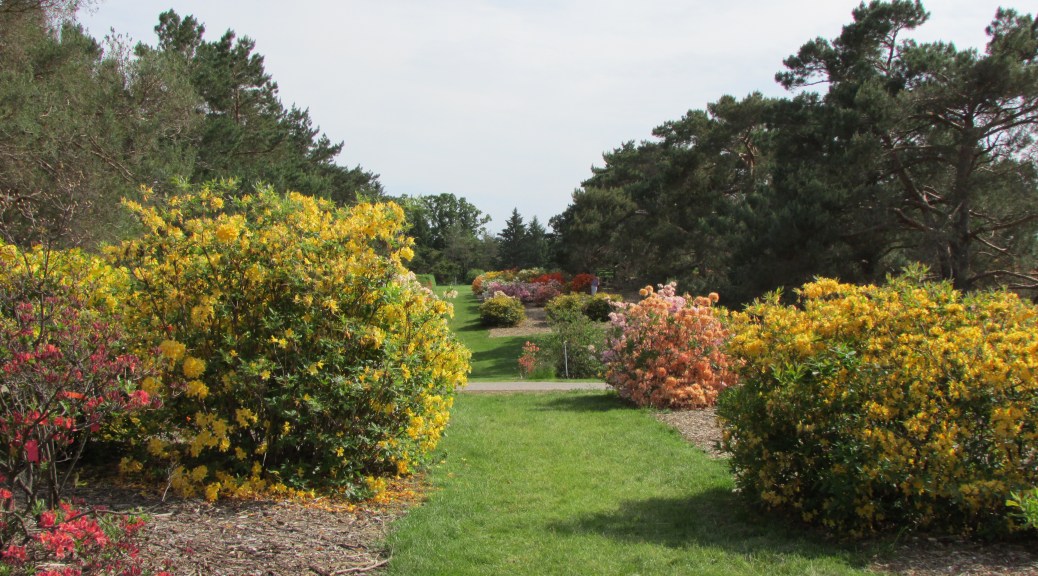
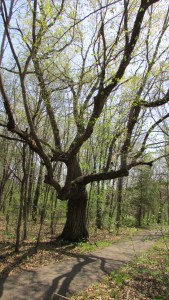
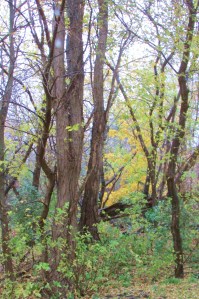
This spring, just as the trees were budding, later than normal, Sandy and I walked the Williams Nature Trail near Minneopa State Park. It has a paved path that allows her to use her walker.

In the middle of the summer we hit the MinnesotaLandscape 2015-06-01 22.21.03Arboretum at the peak of color.

Now, in this quick autumn season, out the window above my computer I  see the last bright colors hanging on.SEat

My grandson, Mr. Tuxedo was here Saturday and wished he had brought a book to read sitting out in the ravine beyond that tree.

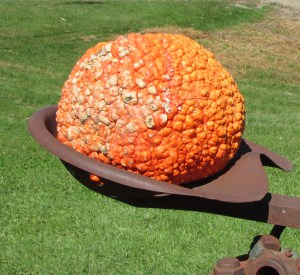
WindowThen we went out to buy him and his sister their pumpkins to carve this week. Halloween, it seems to me, is the exclamation point to summer.

Are you a pumpkin carver?

Baboon Redux – Farmers and Their Tractors

Today’s post by Clyde was first published in 2011.

In my childhood the few farmers of southern Lake County shared equipment and work. Many of those farmers were characters worthy of being remembered. Two of them were Nordic Bachelor Farmers.

The Swede

Ole, his real name, I promise, lived in the valley below us up a side road of a side road of a side road in a small house. I always wanted to get into that house, to see if it was as neat and precise as were his barn and garages and to see if it had any frills. I never made it in.

1948 Massey-Harris

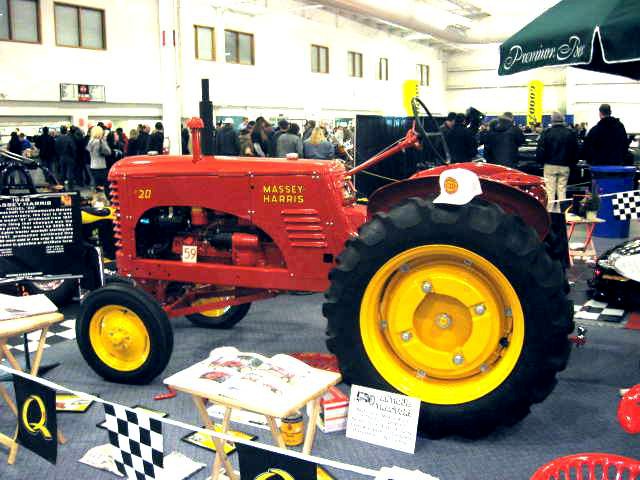
In our early years on our perch above the valley, before the trees got too tall, we could just see his farm. It was three miles away, but by road it was seven miles. Ole owned a threshing machine. We would trade work or oats for him to come to our farm with “the separator,” as we always called it. Ole would putt-putt along at a much slower speed than necessary in his 1940’s era red and yellow Massey-Harris tractor towing the machine to and from our farm. Ole never rushed anything. Never. Ole never got excited. Never. Ole would talk . . . but . . . seldom . . . softly . . . with lots of . . . pauses.

He was slight of frame with massive hands at the end of long dangling arms. He always wore a cap, except when he came awkwardly into our house to eat. I waited for that moment when he stood at the door wiping his feet, cap in hand, calling my mother “Missus.” Powdermilk Biscuits would not have cured his shyness, nor given color to his pale skin, which somehow never tanned or burned, nor given thrust to his receding chin.

It was his head I waited to see. He had classic male-patterned baldness, and, here is what I awaited, five large bumps on his head. I do not know why he had them. They seemed benign, and he lived into his late 70’s. But what child could not be enthralled by those bumps!

The Norwegian

Noble—yes, that was his name—was my father’s best friend. And as opposite of my father in temperament as a man could be. He had been a Lake Superior fisherman until the coming of the lamphrey. He switched to farming, with which he needed much help from my father. I liked his name, and he did have a serene Nordic unpolished nobility. But I liked his brother’s name better, Sextus, which always made me giggle. Noble was short, stout of frame, and walked with small slow careful steps. He always bent his upper body forward and furrowed his brow as if deeply worried, which he was not.

Oh, how many stories there are about his kind, gentle, and implacable nature. For instance he once brought back 50 wild yearling steers off the Montana Range, and trustingly left a gate open, letting them escape. We got back 49, one of which died.
One was found as far away as Beaver Bay.

One day when he was about 50 years old sitting drinking coffee at our house, calling my mother “missus,” he casually mentioned that he had married the week before. My parents snorted coffee. It was a woman we knew—brusque, demanding, fast-moving, and intolerant of incompetence. It proved to be a lasting, loving, and happy match.

After I moved back to Two Harbors, I often saw Noble. Once I mentioned to him that my backyard had a large pile of firewood which was too punky to burn in our fireplace. He agreed with my suggestion that it would burn in the large barrel stove in his garage, fashioned for him by my father.

Fordson Model F

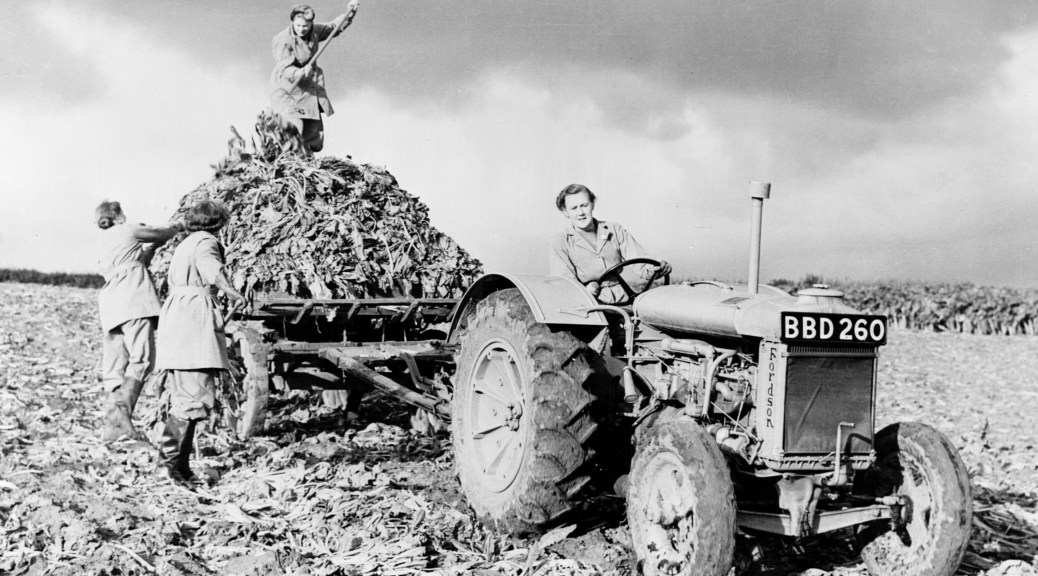
One Saturday he showed up with a hay wagon pulled by his 1930’s era Fordson tractor, famous for its durability and utter lack of power. Noble had three tractors, one a powerful International Harvester, but he loved to use that old putt-putt Fordson. As he backed it down into the low spot in my yard where the wood was piled, I told him that I did not think it had the power to pull out the load. He thought a moment and said, “Yup, yup, probably not,” and started to load wood. Halfway through the job we went in for coffee. He took off his hat, wiped his feet carefully, and charmed my wife, calling her “Missus.”

As you can guess, the Fordson would not pull out the load. He did not get mad; he just laughed and said, “Yup, yup, you were sure right about that.” He drove the 11 miles home and 11 miles back the next day with the IH, which pulled it out easily.

That was, sad to say, my last meaningful contact with that exemplary man. But I picture him every time I hear the term “Norwegian Bachelor Farmer.”

What are the tools of your trade?

The Fishy Branch of the Family Tree

Header photo by Andreas Trepte,www.photo-natur.de.

Today’s post comes from Clyde in Mankato

Well my stars and garters! Why I never!

I gave it no credence when I first read it. I would not spread such an unfounded rumor, except the more I think about it . . .

I stumbled upon the rumor in my recent trip to Greece. While high in the Taygetus Mountains in the Mani I first heard the tale, but many a lie and many an eerie story have arisen in the remote regions of the land of Homer, where poetic licenses were first issued.

Excuse me, that isn’t quite true. It is only that Patrick Leigh Fermor is such an excellent travel essayist that his book Mani: Travels in the Southern Peloponnesse made me think I was there. Why would Fermor repeat an unfounded and libelous tale from Ireland in remote Greece? Does he sense the strong similarities between the two nations that many Irish believe?


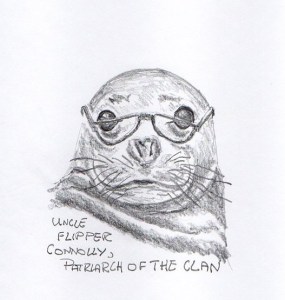
But my arduous research reveals this entry in Wikipedia quoting from Irish Names and Surnames (Woulfe, 1923): “Many traditions, connecting these harmless animals with the marvellous, are related along our western shores. Among these there is one of a curious nature, viz., that at some distant period of time, several of the Clan Coneelys (Mac Conghaile), an old family of lar-Connaught, were, by ” Art magick,” metamorphosed into seals! In some places the story has its believers, who would no more kill a seal, or eat of a slaughtered one, than they would have a human Coneely. It is related as a fact, that this ridiculous story has caused several of the clan to change their name to Conolly.”

Seal

There it is, you see, the possibility that Dale Connelly has seals as relatives. But it carries an aura of bona fides when I think about Dale: the ability to keep many balls in the air at once, his eagerness to clap his hands in applause, his sleek manner of passing through the world with barely a ripple, his migration from dry cultured Illinois to watery backwoods Minnesota, the innate ability to entertain the crowd, the gleam in the eye and the bark in the voice, the faint odor of fish.

Well, not that last one. I have never actually met Dale, you see.

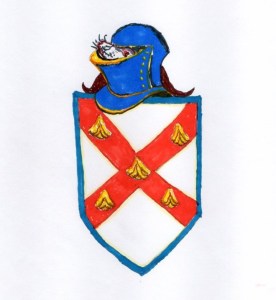
CrestThe Queen of England has a royal seal. Why can’t Dale have one?

Maybe Dale should do a double billing with Sparky at Como Zoo. Oops. Sparky is a sea Lion, not a seal. So maybe the rumor is false and I should not repeat it, Dale being more of a lion than a seal.

Would you do a DNA test? What do you think might be found grafted onto your family tree?

Timber! To an Era

Today’s post comes from Clyde of Mankato

My last guest blog asked you to look closely at grass. This time I want you to examine two slides taken by my mother in 1954. They capture an end of one era in the forest and the beginning of another.

First I apologize that the horse’s head is at the semi-exposed end of the roll. Adeline and I long bemoaned that bad luck. We both recognize the photograph has family and larger significance. Today the ratty right end strikes me as appealingly quaint.

End of one era: the horse for one, which you probably realize. In 1955 it was rare to see horses used for logging, but more than my father were still using them. However, the images also show the tail-end of old growth trees in northeastern Minnesota. Look at the size of the those birch logs! How long had they lived? You perhaps think they were sawed into birch lumber. In 1954 it simply was not done. Birch was then a difficult wood to manage as lumber. Today those logs would be worth as fortune.

I feel an affinity for those logs. First because they are birch wood, as am I, being a German birchwood. Secondly because I spent the next eight years using pieces of the logs as chopping blocks, before which I spent many an hour swinging an axe. I was well acquainted with that birch tree before it was felled. Its grandeur appealed to me. For my father it was a massive temptation to cut down. Because of the girth of the stump, he did not attack it, not having a proper two-man whip saw to do the task. Then along came that yellow chunk of steel in the other image.

Logging 1

Beginning of another era: our nearest neighbor Floyd (man on your left) was a full-time time lumberjack (cutter of trees for lumber) and gyppo (cutter of trees for pulp wood). He was a famously surely tough old bastard, older than he looks in this photo. A couple years later while cutting pulp by himself in the Superior National Forest, he broke his back when a widow-maker fell on him. He had to crawl out to a road to get help, which took two days and nights. Three months later he was back in the woods alone. His personality made working solo a necessity. Being a bachelor, Floyd could not have made a widow.

A few days before these pictures were taken, he stopped at our house to show us his new prized possession, the chain saw. They had been around, but now they were mass-produced at a level that made them affordable for professional cutters. Also, they were dependable. They were still very heavy, nothing like today’s light-weight wonders. Yet even at that weight, a new era swept the woods, for one thing allowing old birds like Floyd to earn real money cutting alone.

The moment my father saw the chain saw before him, he pictured that birch tree. And down it came, my mother coming along, after the fell deed, it seems, to photograph the results.

What you see are only the two bottom lengths of the trunk, minus the two butt pieces on which I am standing, which became the chopping blocks. It took several loads to bring up all of that tree. My father knew how to coax every piece of firewood out of large trees. How long it must have cooked our meals and heated our house! You may wonder by what means the logs made their way onto the sled. My father and I did it alone. How that is done, I will leave a mystery.

If you had those birch logs today and could pay the cost, what use would you make of them?

A Roll in the Hay

Today’s post comes from Clyde in Mankato.

I know, I was an English teacher and all that, but I am really far more visually oriented than word-oriented. I opened at random a book called The Prairie World by David F. Costello. I read this description, and until I came to the key words, which I have left blank below, I had no idea what plant he was describing:

If you examine a stem closely, you will see that the leaves alternate in opposite directions from the stem, and only one leaf grows from the node. The leaf itself consists of two parts: the sheath which forms tube around the stem, and is split its full length; and the blade, which is wide and often flat but nearly always elongated. The portion of the leaf at the junction of the blade and sheath is called the collar. The mebranous or hairy structures where the base of the blade touches the stem is called the ligule. This structure, which varies greatly among different _____s, is useful in their identification. It keeps water from flowing inside the sheath where fungi might grow. Some _____s have appendages, one on either side of the base of the blade, known as auricles . . . As the ______ continues its seasonal growth it produces new stems from buds that develop from old stem bases near the surface of the ground . . .”

Do you recognize that plant? We all know it well. But we seldom look at it at such close range. I had a colleague who taught biology who tried to get students to notice, to look, to see at both the close range and the larger picture; to see patterns, to see differences and similarities and to relish the wonder of nature. I tired to teach essentially the same thing about reading and literature.

Costello is describing grass. Just grass, grown taller than we let it grow in our cultured yards. The technical jargon does not help, it never does, except to the those in the inner circle of the world circumscribed by the given jargon.  But since every June of my childhood was driven by a high concern for grass, or hay as farmers call it in full form, I should recognize it by any description. I used to lie in it, just to relax in the sun, to rest with my dog by my side, to look up at the clouds drifting across the sky on their way to Lake Superior.

Somehow I did not Mowingroll over and look carefully at the intricacy of a single plant of grass. In the larger picture, driven by the daily details, a biology teacher and an English teacher are teaching many of the same skills.
Praises be for the small and simple yet wonder-filled things which sustain us heart, body, and soul.

Are you a good looker?

Imaginary Swamp Tryst

Today’s post comes from Clyde in Mankato

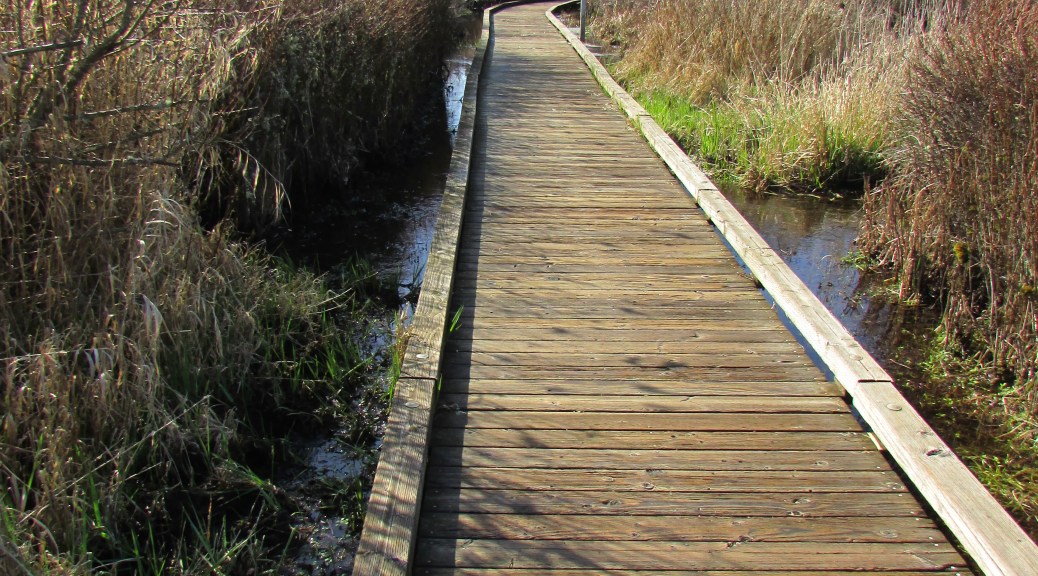
It’s a new-fangled sort of park which sits upon an ancient piece of ground. North Creek Park in Bothel Washington has a boardwalk raised over the swamp. You are there to see a biome closer, perhaps, to The Creation—however you envision that Creation—than the higher ground around the swamp, land which is now the field for suburban one-upsmanship of house, job, child, and toy.

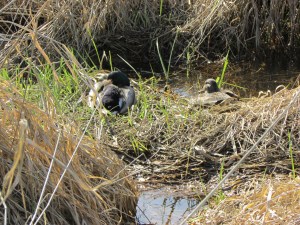
The swamp too is also a competitive field, such as among the ducks into whose spring boudoirs you almost step. Their one-upsmanship is for territory, nesting material, food, and social superiority.

Pix 1

If you are alone when you meet someone who is also alone on the narrow plastic wood pathway, you must make a decision. You can keep silence by pretending to be rapt in the reeds around you and the murky water seeping slowly north under your feet. Or you can talk to the person who passes you by. This stranger and you will intrude in each other’s space for several more seconds than when two strangers pass on the street. Here you walk slowly. You do not come here to be in a hurry. Those in a hurry have other places they must be, which is not to say that those who frequent the swamp are not driven here by a need as well.

Pix 2

I can imagine two people who have met in this way several times until they now expect the other to be on the walkway. Perhaps he is old, wearing bib overalls and heavy shoes, pushing his walker, stopping frequently to sit on the seat of his walker, either from weariness or for new appreciation of a swamp, swamps having been classified for most of his life as wasted ground to be converted to solid land, to serve as yet another field of human one-upsmanship.

Perhaps she is young, stopping often to rid herself of the burdensome effects of her early morning shift at a lunch counter, where she wheedles small tips from people tired from a night shift or still not awake in preparation for a stint of money-earning. After her walk through the swamp she will head to UW-Bothel, where the one-upsmanship of the classroom will prepare her for an adult life of one-upsmanship.

The first time they pass, they ignore each other, or rather she ignores him. The second time she nods at him sitting on his walker. The third time he reads her waitress name tag aloud. “Tish,” he says, “sounds like air coming from an inner tube.” The fourth time he greets her with the sound of air escaping between his tongue and upper teeth. When he does it the fifth time, she realizes it is a tease. Wondering where he gets overalls that round in the middle and short in th legs, she decides to call him Bibs, which tickles his fancy, as does spending even a few seconds with an attractive young woman sixty years his junior.

At the sixth meeting he is sitting on his walker by the one bench along the walkway. She takes the hint for a minute or two. They discuss the nature around them. At the seventh meeting she brings a thermos of coffee for them to share. They discuss where his life has been and where hers is going.

By the twentieth meeting they have explained to each other why they meet, their need for human contact unmotivated by any purpose other than what neither would call love, but which is love indeed.

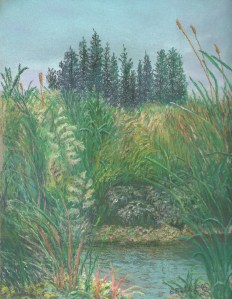
Sometimes they hold hands lightly, unself-consciously while they talk. Sometimes they say few words. Sometimes one or the other does not appear for their tryst. Neither would ask why. They would now have trust. Their favorite topic would be the nature which has drawn them, not the life that has driven them here. Neither would acknowledge passersby, such as the gimpy old white-bearded man taking pictures which he would perhaps use to paint pastels.

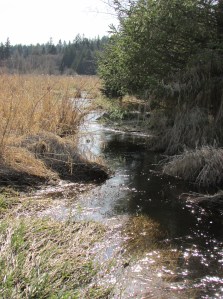
Pix 3

One day it would end. She would graduate and move for a job or for a young man whom she also loves. He might one day not appear; she would not know he had died. Since she knows him only as Bibs, she would not recognize his obituary.

But the swamp would not noticed their comings and goings. The swamp would endure—if human one-upsmanship over Creation can resist the urge to fill it in.

Do you talk to strangers?

Free-Range Kaleidoscope

Today’s post comes from Clyde.

ThomasMy last guest blog was rather drab, don’t you think? Those photos of foggy Lake Superior were nearly monochromatic.
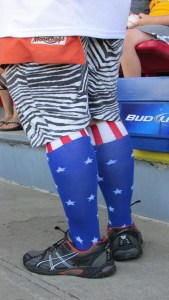
Beer Guy

However, we did have our moments of color tucked in here and there in our ten days of family celebration and travel. Sometimes, delightfully, in unexpected places.  For instance there was Thomas, when we did not even know he was in town.  And our local ballpark beer guy, who leads the crowd in his own cheer. Yes, the ball park is so small that it has only one beer guy.


And many more.

What is your color palette?