All posts by cynthiainmahtowa

Whose Barn Was This?

Today’s post comes from Cynthia in Mahtowa

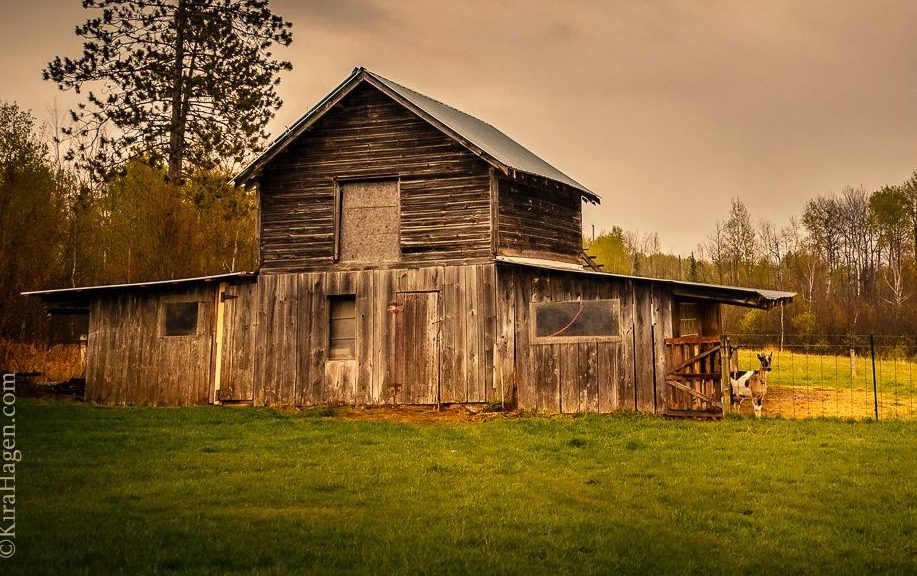
The Carlton County Historical Society in Cloquet recently embarked on a project to photograph all the old barns in the county before they are gone. A good number of them have been kept up or restored, but more have not.

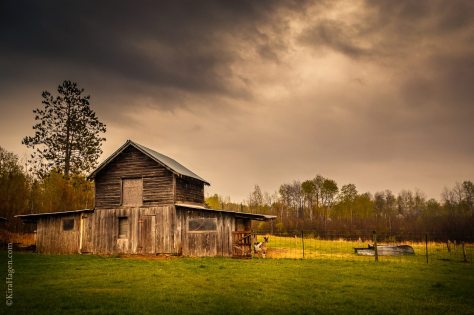
When the project was brought to my attention, I asked if they would like to include my little barn, thinking it might not be worthy as it is very small and hardly a barn at all though that’s what I use it for. The volunteer who came to check it out loved it then took photos from several angles plus measurements (14x14x14).

Then I learned that they also wanted to know when the land was homesteaded, when the barn was built, what the barn was used for…and so began another research project — in addition to my previous project: “Why Blackhoof?”.
goat-barn-clouds


I retrieved the abstract from my safety deposit box and sorted through the many entries and pages of the land changing hands often, early on for logging purposes, a railroad easement, mineral rights. Then a man named August Wilson bought it in 1915 and likely he and/or his son built the barn. August’s son Herbert and his family owned it until 1948. (The original house is long gone, I live in one built by a widow, her neighbors and relatives in the late 1960s. )

In addition to the abstract I found a neighbor who has lived in Mahtowa most of his 80+ years who was happy to share what he knew and remembered. His Swedish immigrant father told him the Mahtowa area (my land is a mile north of Mahtowa as the crow flies) was once a magnificent, prime White Pine forest. So prime that logging companies fought over and for the right to harvest the trees here…then clear-cutting and leaving huge stumps. My land doubtless was included in the greatly logged so the trees now are relatively young with only a few White Pines here and there.

There still are connections to the Wilson family in the area, so I get a smattering of stories (though so far no one knows when the barn was built). One more connection links me to the history of my land: the eldest Wilson daughter — the Mahtowa postmistress for 48 years — was sister-in-law to a cousin of the woman at MPR who hired me in 1991.

The volunteer committee continues to locate, contact owners and get written permission to photograph and document whatever history they can about the barns. And now I have joined the committee to help continue photographing and collecting histories on other barns in and around Mahtowa and the nearby townships.

What do you know about the history of the land or house you have owned and/or lived in?


Why Blackhoof?

Today’s post comes from Cynthia in Mahtowa

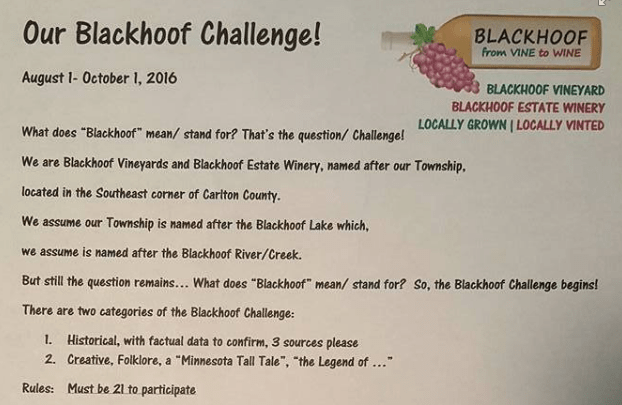
In August I decided to respond to a challenge put out by the Blackhoof Estate Winery in Barnum. (Yes, it’s true, there is a winery in Carlton County at latitude 46.5030° N and barely gardening zone 4. They plan to fill 6,000 bottles of wine this winter. Amazing harvest…but I digress.) They invited people to find the origin of the name Blackhoof which is the name of a river, lake, valley and township just east of my farm.

Researching anything is my favorite indoor sport. MPR finally made use, encouraged and developed my skills for their benefit. But now I am retired, I have to find and/or invent ways to indulge in it.

And so I began.

Warren Upham’s Minnesota Geographic Names: Their Origin and Historic Significance, Volume 17, published by the Minnesota Historical Society in 1920, states that “Black hoof” is the English translation of an Ojibwe word.” Since it doesn’t mention what the Ojibwe word is…I googled and found  in an Ojibwa-English dictionary that Makadewaa is “black” and Ninzid (an) is “foot or feet.” Then perhaps Makadenasid might be “black hoof.”

But it doesn’t answer the question “Why” Blackhoof. I traveled to Cloquet to the Carlton County Historical Society for their files on the township and found these:

  • Named after a settler of that name (but who was that settler?)
  • Named for the abundance of black deer that once ranged the area (I could find no species of “black deer” native to North America though woodland caribou, moose and elk — not any deer– were abundant in the area before the settlers arrived.)

I continued googling…and found “Catahecassa (Black Hoof, possibly from ma‛ka-täwikashä), a principal chief of the Shawnee, who was born about 1740. He was one of the greatest captains of this warlike tribe…He was present at Braddock’s great defeat in 1755, and he bore a prominent part in the desperate battle against the Virginian militia under Gen. Andrew Lewis at Point Pleasant in 1774.”

Cool. But the question then is, what connection is there between the Ojibwe and the Shawnee in Ohio? Well, it turns out that the Ojibwe are part of a large language group of Native American and First Nation people known as the Algonquin “family.” As are the Shawnee.

Then the next question arises, how or why would the Ojibwe in northeast Minnesota know about Chief Black Hoof in the Ohio Territory? Turns out, that some of the Ojibwe on their migration west from the east coast and away from the Iroquois, settled in the Northwest Territory – including along the Ohio River and Lake Erie near the Shawnee.

So, getting closer. After reading what I had learned so far to my 93 year-old Minnesota aunt, she said, ”I’ve heard of Chief Black Hoof.” What? How? She had just read a book called The Other Trail of Tears: The Removal of the Ohio Indians. So I immediately ordered a copy. And then I found the author Mary Stockwell’s website and emailed her. And her reply was, “Yes, there was an Ojibwe-Shawnee connection. . .The tribe often joined the Shawnee in wars against the British (French & Indian War; Pontiac’s War) and then against the United States (American Revolution, Indian Wars of the 1790s, and War of 1812). And they also were among the tribes who ended up in Kansas. (Would you believe I learned that watching a Netflix series, “The Pinkertons?”)

But I still couldn’t confirm that would be the source for the name of the river and lake. And then a friend who grew up in Blackhoof Township, said her father told her it was named after an Indian tribe. Could it be a mistranslation of the Ojibwe word and really should be Black Foot or Black Feet? Down another path altogether? Back to Google. The Black Foot tribe in Montana turns out to also be in the Algonquin language family. And they were once in the Great Lakes area before migrating on to Montana.

And what about the Blackfeet Sioux? I tend to count them out as the Chippewa and Sioux were enemies, not likely the Chippewa would honor their enemies by naming a river and lake after them.

screenshot-2016-11-28-at-9-13-21-pmI found that none of the Ojibwe whom I contacted — Anton and David Treuer, brothers from the Leech Lake Reservation who are both authors and professors; Karen Diver, former Fond du Lac tribal chair currently serving as Special Assistant to the President for Native American Affairs; Linda LeGarde Grover, author and UMD Native Studies professor – have any idea.

So this is where my research stands as of today. I did win the challenge and received a bottle of wine and a cap, along with fame on the Winery’s Facebook page. I also received encouragement — or rather, a mandate — to continue the search.

Do you have any suggestions where to look next?

Animal Tales Part I: Four Little Pigs

Today’s post comes from Cynthia in Mahtowa

Once upon a time I had four pigs. They were wee things when they arrived, several hundred pounds when they left. I think I called all four of them “Peter Porkchop” to remind me why I was feeding them, Danish style, barley and milk. But while they lived on the farm, they were a delight and constant source of entertainment.

They shared the pasture with the several goats. The pasture, fenced with woven wire, did a good job of keeping them contained. But sometimes the gate between the horses and goats was left open and they were free to range into the (non)electric fenced area. So they took themselves for walks around the neighborhood. My neighbor, sitting on the ground, painting her garage doors, was startled to find the four at that time very large pigs staring at her.

The first time I took the new piglets for a walk in the woods with the goats, I learned that they would not stay with me and the goats, but instead wandered off on their own. And they did not return with us. A friend stopped by to see them that afternoon. When I told her I didn’t know where they were, she was astounded and wondered why I wasn’t out looking for them. I allowed as how there was 40 acres of woods and where would I start? “I figure they’ll come home at feeding time.” And so they did. Around 4:30 that afternoon here they came romping across the horse pasture. So I learned they always would return home.

But my favorite story about the four little now big pigs is this: They loved being in the goat barn, but as they got bigger there wasn’t room for them and the goats, so I would lock them out at night to sleep in their own shelter. When I opened the goat door in the morning, the pigs would rush in, grab mouthfuls of hay and race over to their shelter. Then I noticed they would run down to the woods and bring back sticks in their mouths. It made me think of the folk tale “The Three Little Pigs” and the houses they built. So…straw, twigs…my pigs were “building” two out of the three houses. Then one day I noticed one of them running around with a salt block in his mouth….ah, the house of bricks was now being built!

And I was the big bad wolf who had them for dinner….

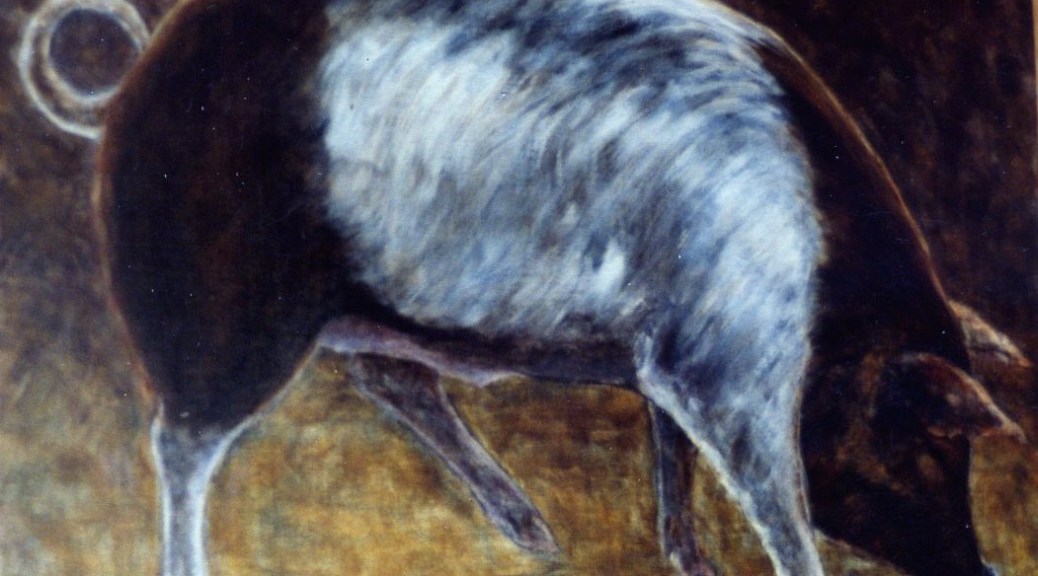
And painted a portrait…which I sold to a woman in New York City where I hope Peter Porkchop lives on.

What folk tale have you seen play out in your life?

Paintings From The Past

Today’s post comes from Cynthia in Mahtowa

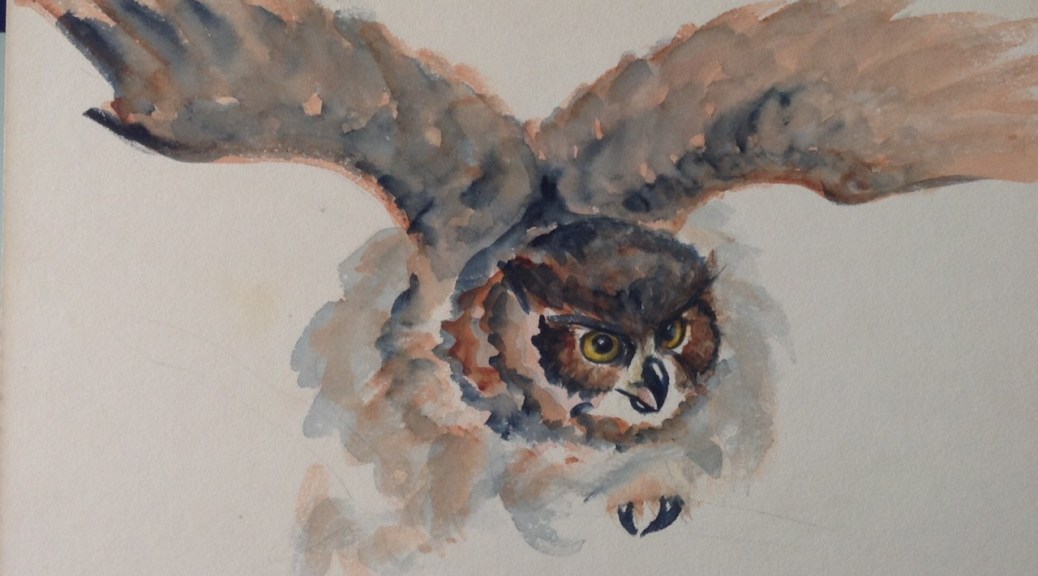
I don’t often talk about my paintings or my painting that stopped years ago.  Recently, however, I mentioned on the blog of selling a couple waterRed Roostercolors to Robert and Ruth Bly.

Barbara in Robbinsdale and Plain Jane asked to see photos of them and suggested writing and posting photos here. So, here goes.

I painted often in the late seventies and early eighties, then stopped when my marriage ended and I had to get a day job full time. My time being with and inspired by my animals diminished, while other activities, needs, demands took its place.

I first painted in oils. Then in the early eighties I met a woman Minute Goat plus1whose watercolors I admired, so I began taking lessons with her, then spent time painting with her, building a friendship and learning techniques from her.

Now that I am retired, will I return to drawing and painting? I think about it, but hesitate…fear, perhaps, that the skill is diminished or has atrophied with time? Yet to be answered.


What have you created … and kept?


First Time Foods

Today’s post comes from Cynthia in Mahtowa

Going through some old letters I had sent to my mother from my first teaching job in Port Angeles, Washington in 1964, I found a paragraph describing all the “new” foods I was eating. Foods I had never heard of in my small northeastern Minnesota hometown such as artichokes, zucchini, Swiss chard, eggplant, turnips, parsnips. (I led a very sheltered food life.)

I remember that first taste of an artichoke – a more worldly friend teaching me how to tear off a leaf, dip it in butter and scrape off the soft inner part with my lower teeth. How exotic. Later that friend’s aunt taught me to use mayonnaise with dry vermouth and garlic for dipping — still my preference.

Washington state firsts: Dungeness crab. Fresh salmon. Fresh apricots. Carrot cake.

So this got me to thinking of all the “exotic” foods that I was introduced to since then.   Five months in Switzerland, four of them living above and eating in a bakery/tea room — cheese fondue with bread dipped in kirsch (cherry brandy), lamb curry, gibfeli (croissants), café au lait, escargot, tripe soup. I have fond memories of all but the tripe soup.

On the small Italian ship I took to Europe in 1965 I had tongue and my first cappuccino. When we landed In England I had coffee with Demerara (brown) sugar. Did I try steak and kidney pie? I might have. But that really hot Indian curry in a English restaurant made me feel guilty for not eating it all because of the hungry children of India.

In Greece I watched a man slam an octopus repeatedly on the rocks. Was he trying to kill it or tenderize it? But I did not eat octopus until many years later and then in a sushi restaurant. (A friend traveling in the Orient had octopus so fresh the sucker stuck to the top of his mouth. But that may have been the least exotic thing he ate on that trip…was it duck bills or duck feet?) Squid entered my eating repertoire much later, though the first time I had it I was unnerved by the little tentacles.

When I was a child my father paid me to eat asparagus – or, tried to. He had tricked me into eating horseradish when I was five. How could I trust him to steer me right? Asparagus cooked to a gray mush? Then in 1972 I paid $2.50 for three spears of properly cooked white asparagus in a San Francisco restaurant. There I also had a “bird with a long beak” for an entrée. It had four legs and no wings…a rabbit, perhaps? Did the waiter mistranslate or was he leading me astray and making fun because I didn’t know French?

Asparagus was the first thing I planted when I moved to this farm. It still comes back every spring. I eat it sautéed it to a bright and crispy green.

smorsbrod
Smørsbrød

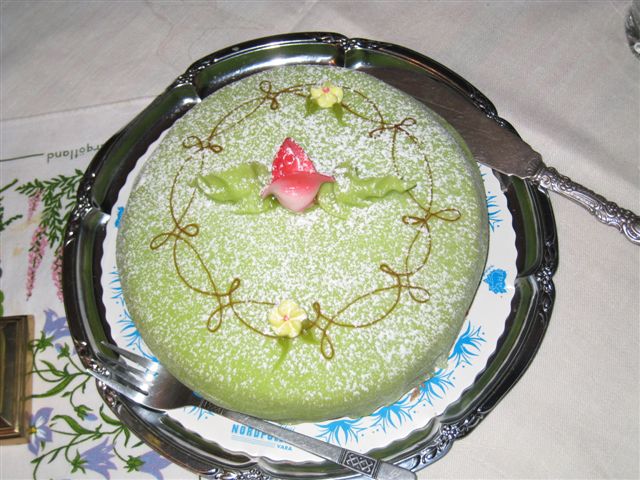
First time food that has not been repeated: Rocky Mountain “oysters” (our kid goats’ testicles). Foods have become favorites: really, really hot Mexican food, goat meat, spanakopita, lobster, clams, mussels, lamb. Swedish Princess cake made with marzipan, whipped cream, raspberries and custard. Every cake I ate in Norway. Scandinavian open face sandwiches (smørsbrød). French goat cheeses and Norwegian brown cheese. I could go on…but won’t.

What “exotic” foods have you tried and fallen in love with….or not?


Managing the Menagerie Part III: Madame Hildegard

Today’s post comes from Cynthia in Mahtowa

May:

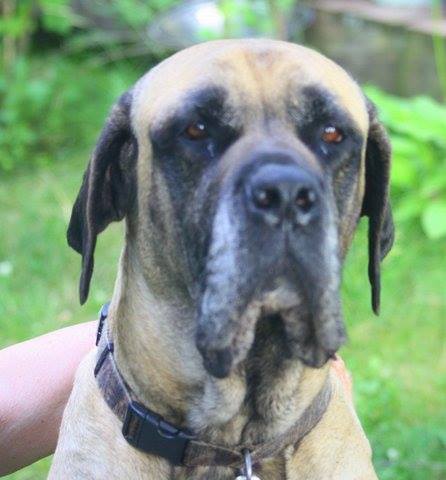
  • I adopted a 7 year old female English Mastiff named Madame Hildegard Hanson aka “Hilde.”
  • Madame Hildegard 1; red rooster 0. Bad dog!!!!]
  • Exciting week for Madame Hildegard…sighted a deer, chased a rabbit and treed a bear. Oh, and nosed a human baby. The bear trumps all…
  • (Naughty) Hildegard 1: (a second) Rooster 0. .
  • Madame Hildegard continues to believe she is in charge of making sure we have chicken meat for meals. A hen this time. Currently in the crockpot.
  • Madam Hildegard thought it would be great fun to chase the horses; Ising the Icelandic thought it was even more fun to chase Madame Hildegard. Game over, no one hurt…
  • (Not so smart) Hildegard 0: Ising the Icelandic horse: 2 This time she showed Hilde her heels.

July:

  • Madame Hildegard was in the horse barn tonight and did NOT bark at the chickens roosting 12 feet above her. Good dog, Hilde.
  • Madame Hildegard has traded her taste for chicken in favor of their eggs.

August:

Hildegard at the lake
  • Day 1: Followed me to the edge of the water and stopped in shock as her feet hit the water.
  • Day 2: Followed me as deep as her belly, but when she lost her footing she tried swimming with just her front feet.
  • Day 7: A week at the lake with friends, Hilde learned to swim, to jump off the dock into the water and fetch a stick.

October:

  • Hildegard fully integrated into farm family life.

What is your favorite pet tale?

So Fine A Saddle

Today’s post comes from Cynthia in Mahtowa


grandadIn the mid 1970s my grandfather, my father’s father, gave me his beloved saddle that he had bought in Montana in 1913. He was in Montana to work for his uncle who had homesteaded in the Judith Basin southeast of Great Falls. My grandfather had hoped to settle there as well, but he was engaged to my grandmother, who refused to move to Montana. So he brought his saddle, he had bought from an out-of-work cowboy, back to Minnesota. The saddle was custom-made by Hamley & Company, maker of “the finest saddles man could ride.” No matter where he lived and farmed, my grandfather had horses and his saddle.

number_stampRecently, I researched the saddle. Hamley & Company is still a thriving business in Pendleton, Oregon. An identifying number is stamped on the back of the cantle, and the saddle also bears the imprint of a lost brass plate that had indicated who it was built for and by whom. With this information, I asked Hamley to search their records. They were kind and helpful, but unfortunately all records prior to 1918 had burned in a fire. They could, however, confirm by the number that it was built in or about 1913.

Mack_PattersonAttached to the back of the saddle cantle, a leather bag with a metal plate is engraved with the name, “Mack Patterson.” Mack is likely the cowboy who sold the saddle to my grandfather. Doing research on Mack, I found his draft registration from Bozeman, Montana in 1917. He died in 1944 in South Carolina, where he was born. I wonder if he ever had so fine a saddle again.On_horseback

Saddle_drawing

For one of my grandfather’s birthdays in the late 1970s (he was born in 1891 and lived to 91), I gave him my ink drawing of his saddle.

What family heirloom do you treasure?

Managing the Menagerie Part II: Goat Trouble

Today’s guest post comes from Cynthia in Mahtowa

January 19. Trouble Goat did it again…got his head stuck in the cattle panel fence…wouldn’t let me position it to get back out. So I got the hack saw and sawed off the tip of the troublesome horn. A bit bloody as I went too deep, but his head came out of that fence just fine and he went right to eating. Bleeding stopped quickly and maybe now he will be able to get his head out by himself…? But. he is a goat. And even though I call him “Buddy,” not “Trouble,” and even though there is nothing on the other side of the fence to eat, I suppose he will do it again.

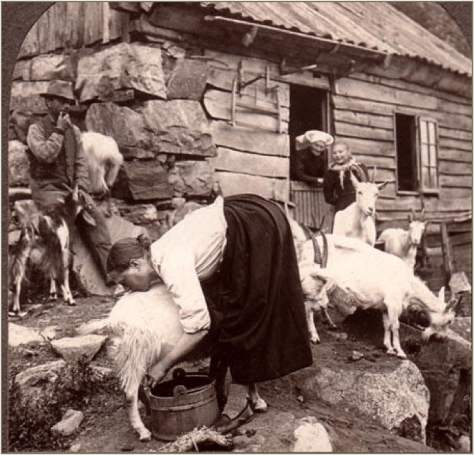
Hardanger Fjord Norway Milking Goats Near Odde 1903 (from a Singley Keystone Stereoview)


February 21 The roof shed its winter load…in time for a new load. If you’re coming to visit me, bring a pick ax…or wear crampons.

April 5. Oh, and the barn pump is running water again…first time since February (or was it January). Hauling 8 gallons of water 2x a day for horses at an end. Now they say it might rain…and the melt…more water than I want to think about sloshing about barns and house.

May 17. Goats contained two days in a row…perhaps I did find the hole in the fence after all..

May 18. Smart goats…put them in the pasture, then they are in the yard. Put them in the pasture then they are in the yard. Third time they stopped a truck on the road and sweetly followed the young woman back to me. But they ain’t smart enough to not jump the fence in front of me so I know where they are escaping. Sagging fence fixed. aha!!!!

May 22. Trouble goat figured out he could jump out the barn window…Beretta did not follow. Barrier erected promptly, leaving a view for them to look out but not follow their yearning.

June 1. Trouble goat did a no-no yesterday, butted me on the pocket of my trousers that had eggs in it. Only one (egg) casualty. Oh, and a messy pocket.

Did you have a “Trouble” animal in your life?

Managing the Menagerie Part I : Houdini Horse

Today’s guest post comes from Cynthia in Mahtowa

Fall 2012

October 10: Brush of snow on the grass, loose horses in the yard…oops, guess they found the weakness in my fencing system…never good when the animals are smarter than their keeper.

October 15: So if you spend most of the weekend fixing fence and the horse still is loose in the yard on Monday morning…

October 16: All horses (2) stayed in their proper pasture for a full 24 hours…and counting.

October17: So,the proper pasture didn’t hold the big brown horse. Leaving the goat barn after milking this evening, I opened the door to the dark and a big, darker form standing in front of me. Hallo! Her saving grace is she followed me into the horse barn…where she is now locked in. We walked that damn fence three times, fixing and straightening and tightening…where IS she getting out now????

.October 18: It’s confirmed: The horse is indeed smarter than I am.

October 19: Now she’s really messing with my mind…she wasn’t in the yard last night when I got home. She didn’t come when she was called. I worried she was caught in wire somewhere in the pasture, so I took my trusty flashlight and went looking for her, only to return and find her standing in the barn calmly eating chicken food. So was she waiting so she could freak me out or did she respond to the Icelandic’s call? Think like a horse, someone advised. Ja, sure, you betcha, no problem!

Horses in the pasture where they belong.

October 20: On Saturday, I stalked the horse at sunset, hoping to see where she was getting out. As she stood at the fence gazing across the road at the neighbor’s clover field, I thought, “Aha, I’m going to catch her at it!” Then she turned around and followed me back to the barn.

Oct 22: So, to update on Monday morning: four of us walked the fence line again with new posts to reinforce the height of the top line. Then we worked on the goat fence that still had an opening. Turned the horses loose in the goat pasture…this morning all animals were in their proper places (did I mention the goat who was escaping her pen overnight?). Final installment of the ongoing saga, finally?

October 26: Horses stayed in their pasture. The goat stayed in her pen. All is as it should be.

Have you ever been outsmarted by an animal?

Hidden History

Today’s guest post is by Cynthia in Mahtowa, and was inspired  by Reneeinnd’s July 12th blog “Overlooked Overlook” and Happy Valley Steve’s comment about “not noticing history.”

At our little long-time book club we recently read Prudence by David Treuer. The story takes place midst WWII somewhere in northwest or north central Minnesota with characters from Chicago who own a resort on a lake near an Indian reservation and a German POW camp.

germanpowcampmap

A German POW camp? In Minnesota?

None of the group had heard of such a thing. Did Treuer make it up? As it turns out, a Google search confirmed that there were indeed German POW camps in Minnesota – at least 15 of them.

Many other states also had them. Some 400,000 POWs were brought to the US to farm, work in factories, log or do whatever wasn’t getting done with American men fighting in the war. Most of the Germans were prisoners from North Africa, sent to the US by the British who no longer had room to house the number of prisoners they were capturing.

Two relatively recent MPR stories documented the camps: In March Tracy Mumford interviewed David Treuer about his novel. He grew up on the Leech Lake Reservation near Bemidji and had heard stories of a nearby camp. One of the stories told was of two prisoners trying to escape south via the Mississippi River in a row boat .

A second MPR story reported that in October, 2002 some of the former POWs and their families came from Germany to camps “to remember, learn and reconcile.”

Why had I never before heard of the camps in any of my (Minnesota or American) history classes?

Along this same line of “overlooked history,” our club also read The Assassination of Chief Hole-in-the-Day by David’s brother Anton.

2012_0406_images_05b_curio

Bagone-giizhig, known in English as Hole-in-the-Day the Younger, was a charismatic and influential chief who played a key role in relations between the Ojibwe and the U.S. government in Minnesota. Yet he won as many enemies as friends due to his actions during the U.S.-Dakota War of 1862 and his claim to be the leader of all Ojibwe. In 1868, Bagone-giizhig was assassinated by a group of other Ojibwe from Leech Lake. For many years the real reason for this killing remained a mystery.“

I have lived most of my life near the Fond du Lac Indian Reservation. I have had Ojibwe classmates and friends. We had Minnesota history in sixth grade.

Were we taught about this famous chief and I just don’t remember? Or, was it never included in our textbooks?

Other history I learned as an older adult are the hangings of the Sioux warriors in Mankato and the black men in Duluth. Not to mention the Dakota Conflict itself.

What history has been overlooked in your education that you wish you had known earlier?