Today’s post is from Renee in North Dakota
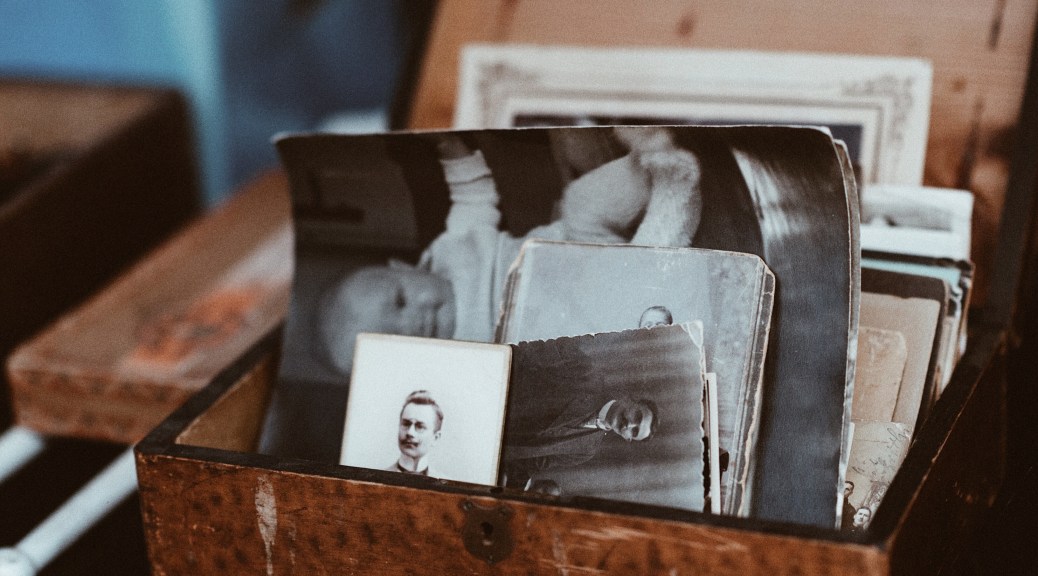
I have an old photograph of a German village street from the early 1900’s. I was given the photograph by my maternal grandmother, who wrote on the back “The only street in Grandpa’s birthplace which is on Dead End under trees”. The Grandpa she refers to is her husband, my Grandfather Ernst Bartels. I wonder where she got her information, as she never stepped foot in the place. I can hear her saying the words about the village with some derision in her voice. She was a city girl from Hamburg who met my grandfather after she immigrated to the US. She found him impossibly rustic and dull. She always felt somewhat superior to him and his family. She spoke formal German; the Bartels all spoke Plattdeutsch.
The photo always puzzled me because it seemed to be a photo of nothing. It shows a wide, muddy street with trees in the background, and behind the trees, barely discernible, a large, half-timbered house. The photo is of poor quality and is a little blurry. I never really noticed the house behind the trees before our trip to Germany. Now that I have stood on the street in the photo and was lucky enough to go inside the house, the photo is completely understandable.

My grandfather and all his siblings were born in that house. I never heard anyone in the family speak the name of the village. I had always heard that my grandfather was born in Bremen. My mother said she thought he was born in Bremerhaven. I know now that the name of the village is Neddenaverbergen. It is about 50 miles south of Bremen, and with the help of my mother’s cousin Elmer, I contacted family who still live there, and they invited us to visit them.
Neddenaverbergen is a small farming community of around 700 people. It is quiet and very tidy. There are lots of flower and vegetable gardens. Oma was wrong. There are several streets in the village. All the farmers live in the village. The farmland surrounds the village on all sides. Almost all the farm buildings are in the village as well, except for the modern buildings that house large machinery or livestock. The houses are old, and are built in the style in which the barn was attached to the house. All the houses and outbuildings are very close together, so that one neighbor’s house/barn is right next to another neighbor’s house/barn. The houses are half-timbered and made of brick. There are far fewer farmers now, and many of the residents commute to jobs in Bremen or Verden.
My grandfather was one of eight children. He was the second oldest. My great-grandfather died when Grandpa was about 17. In the old German tradition, Grandpa’s oldest brother, Johan, inherited the farm. The rest of the family, including my great-grandmother, got nothing. Several of my grandpa’s siblings were still quite young, so, in 1910, he and his brother, Otto, immigrated to southwest Minnesota where their mother had family. The boys got farms and earned enough money to bring their mother and siblings to the US before the First World War.
Johan and his family survived both World Wars. His grandson, Peter, still owns the family home. He had no interest in farming and rents the land. The house was built in 1673 by an ancestor, also named Johan . Peter converted the part that was the barn into a family room. We got a tour of the house. I loved seeing the place that my grandfather was born and where he undoubtedly milked cows. The beams that were visible in the barn/family room were thick and very solid. The inscription over the door in the blog photo says something to the effect “I Johan, have built this house for my family and I have done my best and I hope that it serves them well”.

I look at the old photograph now and it all comes into focus. I see the house. I know how the street goes right past the house, and I recognize one of the trees, now much larger. In my mind I can imagine it in color. I think of Neddenaverbergen as my village. I want to go back.
How has visiting a place changed the way you see it?