
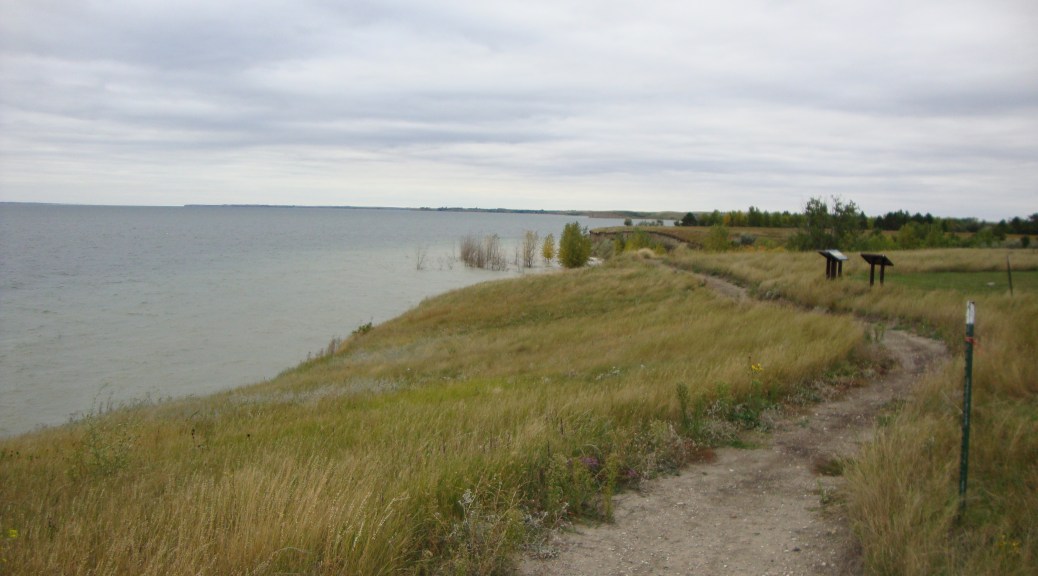
Shoreline of Lake Sakakawea by David Becker CC BY 2.0 via Wikimedia Commons
Today’s post comes from Renee in North Dakota
I have little experience with lakes, despite being born and raised in Minnesota. Rock County is one of about three counties in Minnesota with no natural lakes. We have gravel pits south of Luverne that have been turned into fishing holes, and where I caught my first sunfish with my dad. My dad loved going up to Lake of the Woods to visit his uncle and catch walleye, but I was seldom involved on those trips, so I had very little opportunity to enjoy the delights of lake life. In my imagination, a real lake is one surrounded by trees and quaint summer homes with docks leading down to blue water and little boats.
I now live in a part of the country with no natural lakes. We have dams out here, little ponds on dammed up little rivers that have been stocked with fish. People love to go fishing on them, except now that the blue-green algae season is upon us. They also have “lake homes” on some of them, which usually turn out of to be mobile homes set on grassy plots with no trees for miles. Many of these dams were built by the Corps of Engineers and the Bureau of Reclamation in efforts to control flooding and improve agricultural irrigation and water supply. The grand example of our “lake” here is Lake Sakakawea, formed by the Garrison Dam. According to Wikipedia:
” In order to construct the dam, the US government needed to purchase 152,360 acres in the Fort Berthold Reservation that would be flooded by the creation of Lake Sakakawea. These lands were owned by the Three Affiliated Tribes, who had been living there for perhaps more than a millennium. Threatened by confiscation under eminent domain the tribes protested. The tribes achieved remuneration, but lost 94% of their agricultural land. in 1947, when they were forced to accept $5,105,625, increased to $7.5 million in 1949. The final settlement legislation denied tribes’ right to use the reservoir shoreline for grazing, hunting, fishing, or other purposes, including irrigation development and royalty rights on all subsurface minerals within the reservoir area. About 1700 residents were forcibly relocated, some to New Town, North Dakota. Thus Garrison Dam almost totally destroyed the traditional way of life for the Three Affiliated Tribes.”
The lake is big and butt ugly. There are no natural beaches. The 1300 miles of shoreline are rough and abrupt. The depth can change suddenly from 10 feet to 70 feet. Sometimes when the water is low you can see the roofs of buildings that were submerged when water filled the dam. It is the largest fish hatchery in the world. I was fishing there a couple of weeks ago with fishing-fanatic friends. All I caught was a tiny perch and the trolling motor. My line was wrapped so tightly around the motor we had to head back to shore and go home. People here think this “lake” is just wonderful. They call it “the Big Water”. I want to yell at them “That is not a lake. It is a big tub of water with fish in it”!
The Corps of Engineers recently decided to give many thousands of acres of shoreline back to the Three Affiliated Tribes. These are the tribes husband works for, and the families of many of our native friends were displaced and lost land when the Dam was built. There is a certain amount of anxiety in the campers and fishers about this. The Tribes are trying to reassure everyone, saying that people will still have the same access to the lake. It interests me how differently people see the lake. Some see it as a sportsman’s paradise. Others see it as a constant reminder of trauma and loss. People in communities down stream depend on the dam to keep the Missouri River from flooding their homes. I see it as a fake, a sham. I admit I also depend on it, as it is our city’s source of really good water. The lake leaves me conflicted.
What is your favorite lake (or fish) story?


 Trail Baboon