All posts by reneeinnd

Play Time

Today’s post comes from Renee in North Dakota 

I believe that the Trail Baboons are a pretty playful bunch, so I thought they might find interesting my tools of the trade as a play therapist.

I am the only therapist at my agency who feels comfortable working with children under the age of 10. At the present time, the waiting list to see me for first appointments extends into September. I find that disturbing, but understandable, given that people don’t want to drive 90 miles to Bismarck for weekly appointments.

Husband is going to start working a second part time job as a therapist for Lutheran Social Services, and will work with children and adolescents, so I hope he can help fill a therapeutic void in our region.

I made a decision long ago that I would purchase all my toys, books, and materials myself, mainly
because I want to get the exact items I need and not have to depend on what might be in the agency budget at any particular time. The Association for Play Therapy has an annual conference and there are loads of vendors selling lots of toys, books, and games. I get what I can whenever I go. I also find lots of things at a local farm/ranch store.

Play therapy rooms need to have materials that allow for self expression and relate to the child’s everyday experience.

I am proud of my room, and I hope that the following photos will prove interesting to the Baboon community.

I have a jail, a school, a hospital, a fire station, a doll house, a kitchen area, baby dolls, a farm, and a sand tray.

I have a castle, human figures, animals, toy coffins and grave stones,miniature alcohol bottles, plastic turds, puppets, a puppet theatre, and costumes.

I have a doctor’s kit,toy guns and swords, and handcuffs.

I have books and therapeutic games. I also have a set of foam bowling pins with foam bowling balls (for irrational thoughts bowling, in which we tape an piece of paper inscribed with an irrational thought or fear on the pin, and bowl it over).

Generally, a toy is appropriate for a therapy room if it can be used to elicit feelings or help a child express feelings or tell their story. It is also important that, if thrown, the toy can’t hurt to therapist too badly.

You will notice in the photos that I have every few toys with commercial associations.

Those commercial links stifle creative play. Superheroes seem to transcend their commercial ties, and end up doing a wide variety of things in the play room.

I don’t see all my child clients in the play therapy room, mainly those age 8 and younger. My therapeutic interventions involve non-directive play, in which I make reflective statements about the child’s actions and behavior, or more directive play when there are specific issues that a child has to deal with and I more actively organize the session.

The large purple doll figure is named Meebie. It has a variety of Velcro-backed facial features and things like teardrops and broken hearts that children can use to display all sorts of faces and feelings.

The pure white cloth doll figure, called a Blanco doll, can be drawn on with washable markers and comes clean in the washing machine.

The large wooden chest is for anything in the room that is scary and needs to be locked up.

I have a new doll house. This one has two stair cases. My old one was very grand but the children were upset that there were no stairs. No one ever wanted my suggestion that they could pretend there were stairs. My new doll house, with stairs, is getting a lot of use.

None of my American Indian clients want to play with the Indian figures. I am still trying to figure that out.

The sand tray is really popular. I get the sand from a guy in Utah who sells beautiful sand in different colors and textures. I use the sand tray for general free play as well as to have children use the miniatures and other objects to show me what their world is like and how they would like their world to be. Sand tray therapy is widely used by Jungian therapists with adults as well as children, and there are hundreds of miniatures that these therapists use.

I found the scared and horrified figures at a recent play therapy convention. Kids really relate to them and use them in the sand tray.

I have lots of animal figures, wild, domestic, and fantastical. The animals are in family groups, with adult and young members.

Some people refuse to have toy weapons in their play rooms. I don’t think banning them from the play room is realistic.

The large wooden structure gets used a lot as a safe place or as a home.

I like the guy with the chain saw. He is so Freudian with the position of the saw!

What are the tools of your trade?

A Ceremonial Send-Off

Today’s guest post comes from Renee Boomgaarden, known as Renee in North Dakota.

A couple of weeks ago, husband and I were invited to a ceremony that a Native American friend organized to commemorate the fourth anniversary of his mother’s death. Our friend is Arikara, a member of the Three Affiliated Tribes (Mandan, Hidatsa, Arikara) who live on the Ft. Berthold Reservation in western North Dakota.

The ceremony took place in Bismarck while our friend was camping at the United Tribes Technical College Pow wow. It was conducted by Eric, a Lakota Indian from the Pine Ridge Reservation. He is our Arikara friend’s spiritual advisor. Eric explained that the Native American period of mourning lasts four years, and the purpose of the ceremony was to set free the mother’s spirit and bring her children out of the mourning world.

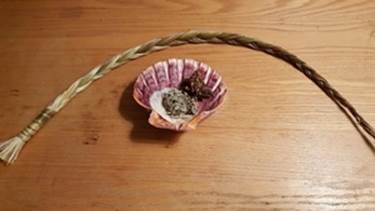
Our friend and his five siblings lined up by the camper and we observers sat across from them. A plate of food and a glass of water for the mother’s journey into the next world was set on a nearby table. The ceremony began with all present getting smudged with cedar smoke, fanned on us out of a shell with a leather-bound bunch of eagle feathers. Eric then stood between us and the siblings and directed two Lakota traditional singers to sing the song to help the mother’s spirit leave this world and travel to the next. He said prayers in Lakota to the four winds/directions. Then he brushed each of the siblings head to toe with the eagle feathers and wiped under each of their eyes with his fingers to remove any tears.

Eric then directed the singers to start the Song of Welcoming, to welcome our friend and his siblings out of the world of mourning into our world. Each sibling was given a taste of corn meal and a drink of water. We observers very formally shook hands with each of the siblings while Eric said another Lakota prayer. We then sat down to a potluck supper, the oldest person going through the line first.

Everyone mourns in their own way and in their own time. Our friend was very happy at the conclusion of the ceremony, surrounded by friends and family, sharing a meal, at peace.

Describe a ceremony that gives you comfort.

The Boomgaarden Orchestra

Today’s guest post comes from Renee Boomgaarden, aka Renee in North Dakota.

Sometime in 1925, the residents in and around Ellsworth, MN were abuzz with the news that Okke Boomgaarden had bought a $3000 accordion for his daughter, Amanda.

Okke was my great uncle, the fifth oldest of the sixteen children in my grandfather’s family. Okke was, officially, a farmer, sort of like how Don Corleone was, officially, an olive oil importer. Okke made his money bootlegging, and his barn was used for dances, not livestock. Okke had regular dances in the barn. He provided refreshments, at a cost, and members of the family provided the music.

Screenshot 2014-09-02 at 8.15.09 PM

Family historians talk about my grandfather and many of his siblings having a natural aptitude for music. All were self taught.

  • Great Uncle George learned to play the fiddle when he was 16.
  • Great Uncle Albert also played the fiddle.
  • Great Uncle Herman was a noted left handed banjo player.
  • My grandfather played the cello.
  • Great Aunt Amelia played the piano.
  • Other family members played the accordion.

In the years before the First World War they were know as The Boomgaarden Orchestra and played for dances, weddings, and harvest festivals in northwest Iowa and southwest Minnesota.

After the war, they changed their name to Mandy’s Jazz Kings, and played in Okke’s barn, joined by Okke’s children Georgie on fiddle, Jake on saxophone, and Amanda and Mabel on the accordion.

My father remembers going to some of those dances when he was a little boy, driving to Ellsworth with his parents in their Graham-Paige automobile. I wish I know more about the music the Jazz Kings and the Boomgaarden Orchestra performed.

I wish I knew what happened to my grandfather’s cello. Until I researched for this post, I never even knew he played a string instrument.

Okke died of a heart attack in 1928, and the dances stopped soon afterwards. The older members of the Jazz Kings had their own farms and families to care for and couldn’t play with the band anymore. Okke’s sons Georgie and Jake kept playing, changing the name to The Georgie Boomgaarden Orchestra. Georgie and his band played in the towns around Ellsworth until the 1970’s.

Screenshot 2014-09-02 at 8.14.53 PM

The Depression hit everybody hard. At one point, Jake’s saxophone needed $12.00 worth of repairs, but he didn’t have the money to fix it. The local doctor intervened and paid for the repairs. He had just built a night club in Ellsworth and needed musicians to play for the dances.

My grandfather felt it was important for my dad and his brother to have some kind of music training despite the tight finances. Grandpa drove Dad and Uncle Alvin to Luverne once a week to practice with a drum and bugle corps. This group was comprised of sons of World War I veterans, and you can see them in the photo at the top of this page. Dad played both drum and the bugle – he is the third boy on the right in the back row. He can still play his bugle, and has two of them in his bedroom.

Renee played bass clarinet for Concordia.

My children and I are the current Boomgaarden music amateurs along with my husband. Husband plays the cello, guitar, harmonica, and piano. He also sings. You can see me playing my bass clarinet in the Concordia College Band in 1978. Daughter plays the violin, French horn, and piano. She sings in college. Son played the trombone and sang in college. He currently sings in the church choir. I drafted husband to join the handbell choir. He drafted me to sometimes play the bass guitar in a very amateur gospel/rock and roll group.

Why do we do these thing? I have no idea. Maybe Okke will explain it to me someday in the Hereafter.

Who has the talent in your family?

Life With Father

Today’s guest post comes from Renee.

“Renee! That damn dog is looking at me again!!”

I respond to my father’s plaintive cry and remove the dog from the dining room. The cat is allowed to stay. Dad forgives cats for everything. My father believes that our animals should enjoy the bounty of our table, and he shares bits of his meals with them. Dad also believes that the dog should know when he has finished sharing, and she should just leave the room. We explain that she doesn’t think that way, and that he has to stop feeding her from the table if he wants her to leave him alone. As you can see from the photo, she waits patiently nearby while he eats. That is still too much for dad. He says that when an animal looks at him while he eats and he doesn’t feed it, he feels like the people in the parable of the Good Samaritan who walked past the victim and didn’t help. So, I remove the dog.

It has been six weeks since my 93 year old, newly widowed, father moved in with me and my husband. Things have gone pretty well, aside from his strife with the guilt-inducing terrier. He personalized his new room with photos, furniture from home, and mementos, and made it a comfortable nook where he reads, writes letters, and listens to CD’s of his favorite radio preachers. He is appreciative and meticulously clean and tidy. He is frustrated by his diminishing physical strength and his inability to fix things. He is easily hurt by a sharp word, and we need to be very patient as he struggles to understand the complicated business and health issues we discuss. He is usually quite cheerful, though, and remains curious about the world and the people around him.

Living with my father is a balancing act of providing necessary care with as much autonomy as possible. I am thankful that he is independent with all his personal care. I help out by organizing his meds and taking him to appointments and handling his business. Things will change as his health deteriorates from his cancer and cardiac disease and age, but at this point we have a pretty good thing going. He has breakfast with us every morning. He loves French press coffee. We go to work and he potters around until lunch, when we come home to eat with him. We go back to work, and then one of us slips away at 3:45pm to take him to coffee with a group of retired teachers. One of the teachers brings him home, and we meet up with him around 6:00 for supper. He goes to bed pretty early. On weekends he watches us garden. He also planned and directed the transformation of our basement and garage into temples of Dutch order and cleanliness. We have a very Jake-centric household, but that is ok with us. I am thankful that my husband is supportive of our doing this. We are both very fatigued at the end of the day.

Every day when we leave for work we make sure Dad has a bowl of Lindt chocolate truffles on the counter, a beer or two in the fridge, lots of ice cream, and Radio Heartland streaming on the computer. He really likes listening to Jimmy Dale Gilmore and the Wronglers. He knows he is shamelessly spoiled, and repays us with stories. Here is a true one from home about people I know.

Old Johnny B was a farmer and horse trader from Magnolia, MN, born around the turn of the century. (His son Dallas is still alive and went skydiving two years ago on his 95th birthday.) Many years ago Johnny bought a horse from an old German farmer, and when he got the horse home, he put it in the corral and the horse proceeded to walk right into the barn wall. The horse was blind! Johnny confronted the farmer. “Why didn’t you tell me the horse was blind?” The farmer replied in his thick accent “I did! I told you he didn’t look so good!”

I think a story like that makes up for any amount of extra work we have. He has tons of stories, and we will keep the truffles and beer in good supply as long as he can enjoy them.

Share a joke a 93 year-old might enjoy. 

Me and “The Girls”

Today’s guest post comes from Renee.

I am a healthy 56 year old person. I rarely get ill. I am not on any medications. My family history is pretty devoid of chronic health problems other than cardiovascular disease, but even that hasn’t kept many of my family members living to very advanced ages. I don’t have a family history of cancer or dementia. I will admit, with some sheepishness, that I don’t have all the yearly checkups a person my age is supposed to have.

I had my last mammogram about two years ago, and the experience still leaves me giggling. Since I don’t go the doctor very often, I don’t have regular experience with cutting edge trends in patient care. I usually have my mammogram at the local hospital, where I have had the same radiology tech for 25 years. It happens in the same room with the same level of more than adequate care each time. I think Rosie, the radiology tech, has worn the same pink scrubs since I met her. We don’t talk much during the procedure, mainly small talk about our respective families and the state of the hospital administration. We sort of ignore the real business at hand, which is fine with me.

I just shut my eyes and think of England.

My most recent mammogram took place at a local clinic where I had gone for a Pap test. The doctor noticed I hadn’t had mammogram in a while, and said I could have one right away in the clinic’s new Mammography Department. I agreed, and was whisked back to the lab/x-ray area where I met the radiology tech. At least, that’s who she said she was. I wasn’t sure, since she was elegantly dressed in designer street clothes, and was perfectly coiffed, bejeweled, and made up. She looked like a highly successful Mary Kay consultant. She oozed friendly concern, doing her best to put me at ease, and led me to the mammogram room, a tastefully appointed space that looked like an upper middle-class living room that just happened to have this weird x-ray machine in it. The lighting was subdued and lovely. The furniture was lovely. The perfectly displayed magazines were lovely. The framed Impressionist reproductions and inspirational messages on the wall (Dream!; Love Like You have Never Been Hurt!) were lovely.

I am pretty modest regarding my person and its private parts. In my professional work I frequently have to educate abused children on the proper names for private body parts, and no matter how often I have to do it, I never find it easy. (I practice saying the words out loud at home when I vacuum). I find the euphemisms for those body parts even more embarrassing than the proper names. Well, the Mary Kay radiology tech really stunned me when she started talking about the parts in question as though they were people, “girls” to be exact. “Let’s get this girl up here!” “Oh, we need to move this girl over just a little so her picture can be really beautiful!” She talked non-stop about the “girls” and their beautiful pictures as though we were at a photo shoot for a fashion magazine. I am surprised she didn’t give them names. Finally, we were done, and the girls and I went home.

I suppose the whole set up was designed to help women feel more at ease during an embarrassing, sometimes painful, and possibly frightening procedure. It didn’t have that effect on me. I want my doctors to look wise and experienced. I want my radiology techs to wear scrubs and look like medical professionals. I want the walls lined with scholarly journals. I know I have little to complain about. I am healthy, and I have never faced to specter of breast cancer. It is about time for me and the girls to go for our next photo shoot. Rosie or Mary Kay? Hmm. I also understand that I am at the age for a colonoscopy.

Oh dear!

What do you expect from a visit to the clinic?

Heavy Legacy

Today’s guest post comes from Renee Boomgaarden.

We recently made a grocery run to Bismarck. I started singing “The Wells Fargo Wagon” as I usually do whenever we buy provisions like that, and husband asked two interesting questions. Why was Wells-Fargo hauling freight to Mason City, Iowa, when everything came by train in those days? Were there stage coaches in northern Iowa at that time? Those questions puzzled me and I had no good answer until 2:00 the next morning when it came to me. Trains hauled everything to the towns, and Well-Fargo hauled things in the towns. It was a dray service.

My maternal great grandfather was a drayman. He had a business in Hamburg, Germany hauling freight on the Hamburg wharves and delivering things all over the city, just like the Wells-Fargo wagon. I wish I could have seen those wharves at the turn of the century when my great grandfather worked there. Hamburg was, and is, a very important world port, and it must have been a wild and exciting place to work. He did pretty well, I gather, since my grandmother told me that they had their own carriage with horses that had shiny, polished hooves. 145

Her parents would leave gold-edged calling cards embossed with her father’s name when they went visiting. I still have one.

We had a strange carving in our house that my great grandfather was said to have been given by an Italian sea captain. I have it in my house now. It has always been an object of fascination for me, and you can see the weird animals and fantastical landscapes carved in it. It weighs 4 lbs. It is multicolored, with streaks of black, pale green, white, and scarlet. There are ravens, a bat, a stag, and what I think may be a bear, along with a bowl-shaped recess carved in the middle.

144 (2)

My mother didn’t know what sort of stone it was made from. I took it to a chemistry class in high school and the teacher helped me with a variety of chemical tests that ruled out granite, quartz, and marble. In 1995 I was in San Francisco, walking through China Town, and I saw similar carvings out of identical stone, and was told they were jade incense burners.

In 1913 my great grandfather left Hamburg, slipped into Holland, and boarded a ship in Rotterdam that sailed to New York City. He loved to gamble and lost everything playing cards. He ran away to avoid his creditors. My grandmother, age 14, her sister, age 12, and their mother followed in April of 1914. They brought the carving with them. Why? It is heavy. It must have taken up precious space in their luggage that they could have packed with more useful things. Not only did they haul it to New York City, they hauled it to Foley, MN two years later, and then to Pipestone County a few years after that. I wonder what it meant to them. It is more weird than beautiful. It is hard to dust. Why have I hauled it from Rock County to Winnipeg to Indiana to North Dakota? I have no idea.

My great grandfather died alone in an apartment in Pipestone in 1947. He lived with my grandmother for a few years after his wife died in 1937, and my grandmother eventually kicked him out of her house because he still played cards for money. I guess she never forgave him for what he lost in Germany. I don’t know what my children will do with the carving when I am gone, but I hope one of them will keep it and ponder its mystery and keep hauling it around.

What object are you hauling around as a relic of past generations?

Dr. Bossy Pants

Today’s guest post is from Renee Boomgaarden.

I have an image problem in my family that I am at a loss to change. I am by nature bossy and controlling. My children learned early on that they ignored my advice and expectations at their peril, not only because they would be in trouble, but because I was usually right.

After my son left for college, I knew that he had to make his own decisions, and that I had to back off, only giving advice when he asked. It wasn’t a hard transition for me. He is a sensible guy. He married a sensible wife, and together they do well. It recently became apparent, however, that Son hasn’t caught on to my changed expectations in our relationship. I guess I was supposed to make a formal announcement that he could disagree with me without fear. This misunderstanding came to light last month in Cavendish, Prince Edward Island, on a tour of the house that Lucy Maud Montgomery used as model for Green Gables, home of Marilla Cuthbert, the ultimate old bossy pants.

505

The author of Anne of Green Gables grew up in Cavendish within walking distance of a lovely farm house with green trim. Relatives owned the house, and young Lucy played in the forest glades around the house, turning them in the Haunted Wood and Lover’s Lane in her books. The house has been lovingly maintained. We planned to spend a day in Cavendish exploring the Green Gables site and then hitting the beautiful pink beaches just north of town. I had heard a weather report that rain and clouds were going to move in to the area in the early afternoon. My son had his heart set on the beach. His wife and I were excited about both beach and Green Gables. Husband was happy with whatever we did.

After we had toured the house and the Haunted Wood, I innocently suggested to Son that perhaps we could go to the beach in case rain set in, and then walk the Lover’s Lane trail afterward. He agreed. No one else objected. We piled into the rental car, and then the trouble began. Son caught on that his wife was worried that we wouldn’t make it back to do the Lover’s Lane trail. He got upset at me because of my “insistence” that we go to the beach immediately, and husband started muttering about my “control” issues. Son angrily turned the car around and we went back to walk the trail. I kept saying that it really didn’t matter to me, I just didn’t want people to be disappointed in the beach if it rained. I realized, then, that Son still interpreted suggestions and ideas from me as direct orders, and he felt caught between obeying me and keeping his wife happy. I got really steamed that neither Son nor Husband would believe me, so I walked by myself on the trail while they walked on ahead.

That probably didn’t help the situation.

We managed the rest of the trip through PEI and Cape Breton Island with far less drama. We really did have a great trip, but I am still thinking my way through this image problem. At least now I have a handle on the source of the trouble.

What are some key differences between the way you see yourself, and the way others see you?

News of the World

Today’s guest post comes from Renee Boomgaarden.

Rupert Murdoch’s recent spot of bother made me think about a newpaper I read for the first time on my trip to the Pine Ridge Reservation – The Lakota Country Times. I found it to be a welcome change from our local paper and the online news services I usually read. Our local paper is published six days a week and contains day-old news and lots of typos and bad grammar. The articles are dull. We occasionally buy a Sunday New York Times in Bismarck, a real treat for our daughter who loves to read to wedding write ups.

I grew up with a weekly paper, The Rock County Star Herald, a paper mentioned quite often, along with its publisher Al McIntosh, in Ken Burns’ documentary “The War”. Al still published the paper and wrote a weekly column when I was a kid. He lived at the end of our street in a grey brick house. Wednesday was always an exciting day, since that was when the paper came out and we could see what had happened in town over the past week. It was a finely written paper and, well, personal in its tone.

The Lakota Country Times is also a weekly paper and seems to be a true community publication that prints news, goings on, and cultural information important for its readers. It describes itself as “The official legal newspaper for the Pine Ridge and Rosebud Reservation”. Its motto is “Truth, Integrity, and Lakota Spirit”.

My initial impression of the paper was that it was colorful and thick. All the pictures were in color, and there were lots of them. It had many op/ed pieces, health and public service announcements, government notices, regular and guest columnists who were all local people, ads for Indian businesses, book reviews, and pages of letters to the editor.

Some were from tribal members who were incarcerated in the SD State Penitentiary asking for prayers. Some were from Europeans who had visited the reservation in the past and were asking for the addresses of long lost friends. Others were from tribal members living in other parts of the US. One of these was from California alerting the tribe to the public sale of personal possession and artifacts of Chief Red Cloud, a very important figure for the tribe. The letter outlined how the objects had been stolen by army and government officials in the late 1800’s. I was amazed at the details that had been handed down to the letter writer from ancestors about the people who had been involved in the removal of those objects from the reservation and how the artifacts had ended up in California.

The paper dripped with wry and sarcastic humor and had a whole page of Indian cartoons I had never seen before. Any positive happening was reported with photos and extensive copy, such as the graduation of three people from an alternative high school. Obituaries were plentiful and published at no cost in a section called “The Holy Road”. There were far too many death notices for young people, a sad fact of life on the Rez. I doubt that the reporters were so disrespectful and insensitive as to hack into the phone messages of the deceased.

I think Mr. Murdock has lost touch with his readers and what is important to them. Perhaps he needs a refresher course at Pine Ridge and Rosebud to figure out what a good paper can do for a community. The Lakota Country Times has a website that gives a nice sense of what the printed edition is like. Check it out.

What newspapers have you liked and disliked over the years?

N.A.T.S.

Today’s guest post is from Renee Boomgaarden.

Our town has a wonderful vocal teacher. “Kathy” (not her real name) is a conservatory trained soprano who found true love with a local backhoe operator and successfully blended marriage and motherhood with the work of a vocal performance major. She teaches on occasion at the local college, performs with regional operas and civic choruses, and has a private vocal studio.

Kathy is really gifted at nurturing young voices and picking just the right material to challenge and inspire her students. This April, three of her oldest high school students (my daughter, daughter’s best friend, and another local girl) participated in a juried competition sponsored by the state chapter of NATS, the National Association of Teachers of Singing. The event was held at NDSU in Fargo while the Red River was cresting. Kathy is a member of NATS and participated as one of the nine judges. I drove the three girls to Fargo, along with best friend’s mother who also was the girls’ accompanist.

The singers were divided into competitive categories based on gender and year in school. Our girls were lumped in the one high school category. Most of the singers were college undergraduates, with a few singers in the graduate student and adult categories. There were separate categories for those singing Broadway musical numbers. Most of the participants sang opera arias and oratorio solos, with a few art songs thrown in. All singers started performing at 8:00 am.

It’s quite something to hear and see about 60 anxious singers preparing to compete that early in the morning. Practice rooms were at a premium. Most of the women wore rather daring and flamboyant cocktail dresses and very high heeled shoes. (By the end of the day, most of the women were walking around in bare feet). The men wore somber suits and ties. Once the 8:00 round was completed, the judges decided who would go on to the 10:30 round in which more singers would be eliminated, and so on through the 2:30 round, until the 4:00 final round in which the three best singers in each category would perform and be evaluated by all nine judges.

At 8:00, our girls were judged by two men who wrote furiously while the girls sang. They were finished by about 8:30 and they fell asleep in the van in the parking lot for two hours. Tension runs high at these events and those few minutes of singing wore the girls out. Best friend’s mom and I spent nap time listening to other singers and watching the weeping of those who were eliminated and the excitement of those who were sent on to the other rounds.

Our girls were the only high school students at the competition. Best friend has a phenomenal voice and she was the only one we expected to make it to any of the other rounds. Much to our surprise and delight, the judges decided that since there were only three high school students, all of our girls were automatically forwarded to the final round held in a lovely and intimate recital hall.

The Steinway grand took up most of the stage. The voices in the final round were truly beautiful and I don’t know how the judges decided between them. My daughter was the youngest singer in the competition. She is an alto, aka mezzo soprano at these events. Her voice is just developing strength and range. It was so interesting to hear how the voices matured as the singers got older, even among the college-age singers.

The last singer was a graduate student, a huge, barrel-chested man who closely resembled Pavarotti and looked like he was quite ill. He struggled to the stage, got himself in role, and and filled the room with an enormous, powerful baritone. He then struggled back to his seat and looked like he was going to collapse.

Daughter was awarded $10 for making it to the final round. The judges’ comments were all encouraging and kind. I am informed that she wants to do this again next year and she insists she has to have a new cocktail dress for the event. She feels she is too tall and her ankles too wobbly to wear high heels.

What have been your experiences being judged?

Puggi Lives!

A Guest Blog from Renee Boomgaarden

Recently we discussed our feeling about news stories, and I noted that there was very little in the news that I could tolerate, with the exception, I now must confess, of stories about animal rescue. I don’t mean shows about animal welfare officers rescuing pets from abuse and neglect-those shows just make me angry and upset. I mean stories about helping animals out of predicaments of their own making. You know the kind-goats stranded on bridges or with their heads stuck in fencing, bears who wander into town, get treed and tranquilized, and fall sleepily into the waiting nets of patient rescuers who transport them back to the woods, ducklings retrieved from storm sewers as their mother quacks anxiously nearby.

I think my favorite stories are those told friends and family. The story about the dog who decided it would be a good idea to roll vigorously back and forth over a decomposing porcupine (both smelly and painful) stands out, as does the tale of the poor, bored, Lakeland Terrier who spent hours independently chasing a ball back and forth over a paved parking lot until it had worn the pads off its paws.

My dad and my best friend tell the most memorable rescue stories. My friend grew up on a farm, and one day after checking the cattle she came upon a Great Grey Owl sitting on the ground under a telephone pole. She was able to walk quite close to it and saw that one pupil was quite dilated. It looked kind of stunned and she surmised it had had a head injury. She somehow managed to get it into a tall box in the back of her car and drove three hours to get it to a raptor center at the University of Minnesota. She never heard what happened to it after that.

My father loves dogs and has had his share of trauma with them over the years. He still speaks with sorrow over a favorite dog he had as a boy-a Rat Terrier named Diamond-who went down a badger hole and never came back up. It still bothers him. His all-time favorite dog, however, was Puggi the Pug, a dog he had after he retired. One day in early Spring, Dad and Puggi went to the city park in Luverne, right along the Rock River, to see if the ice had broken up. The river was still frozen over, but barely, and before he could stop her, Puggi ran out on the ice to get to some birds on the other bank.
A portion of the ice gave way and she went through and was pulled under the remaining ice by the strong Spring current. She was gone. Dad said he walked down stream about 100 feet and just stared, thinking to himself that he had lost his dog for good. His eye was caught by an old ice fishing hole in the middle of the river, and to his joy, up popped Puggi. She couldn’t scramble out of the hole on her own, so Dad laid out flat and advanced across the ice on his stomach. He grabbed Puggi and slithered back to shore. He figured she saw light coming through the hole as the current took her down stream and she swam toward it. He took her home and put her in a hot shower to warm her up. My mother was appalled at the risk he took, I don’t think he thought twice about going out on that ice.

What are your tales of animal foolishness?