All posts by reneeinnd

Tomato-zilla 2

Today’s post is from Renee in ND

Well, as I promised, here are my photos of our tomatoes, plants and fruits. You can see that the plants are as tall as I am. They are ripening quickly, and I think I will be up really late the next few nights canning and making tomato sauce. So there, Sherrilee!

??????????????
??????????????

We planted 16 tomato plants this year-far more than any couple with grown children who live hundreds
of miles away should ever plant. 8 Brandyboys and 8 San Marzano II’s. Husband likes to roast and then freeze the San Marzanos. Daughter has a particular tomato sauce that she likes me to make and freeze.

The two largest tomatoes in the photo each weigh over a pound. I have lots more, just as large, ripening as we speak. I am a quietly competitive person. I want to win, but I rarely admit it. I wrecked my right foot in a 2k run-walk several years ago because I was determined that I would reach the finish line before the heavily pregnant marathon runner. I had bad shoes and pushed myself and now I have a large bunion on my right foot that gives me twinges at times.

I want to grow the most and the biggest tomatoes. It was nice to see the variety of tomatoes that Sherrilee grew, though, and maybe I need to rethink my priorities. Maybe I need to grow unusual tomatoes. Hmm? We’ll see.

At what do you have to win?

Melons to Medora

Today’s post comes from Renee in North Dakota

Husband and I recently volunteered to provide Friday supper and Saturday breakfast and lunch at a retreat for approximately thirty people affiliated with Western ND Synod of the ELCA. The attendees were candidacy committee members and spouses, candidates for rostered ministry, seminary faculty, and the western ND bishop and synod staff. The retreat took place at the Badlands Ministries Bible Camp near Medora in the ND Badlands.

The camp is about 10 miles south of Medora in a new location near the Bully Pulpit Golf Course. Medora has no grocery store, so we hauled in everything we needed for the weekend meals. We had never seen the kitchen at the new retreat center, so we also hauled in all the pots, pans, and cooking equipment we might possibly need. It proved unnecessary, as the kitchen was marvelously equipped, but we were prepared for anything.

We started planning the menu weeks before the event, choosing quantity recipes that could be prepared ahead of time and frozen. This was our penultimate menu:

Supper

  • Charcoal grilled hamburgers from grass-fed SD Lutheran Herefords, with all the trimmings
  • Potato salad (Mrs. Untiedts’ recipe from the Grace Lutheran Cookbook from Luverne)
  • Coleslaw (Mrs. Iveland’s recipe from the Grace Lutheran Cookbook)
  • Watermelon
  • Breakfast
  • 3 kinds of egg bakes from Duluth’s own Beatrice Ojakangas’ casserole cookbook
  • Cantaloupe and honeydew melon
  • Toast
  • Homemade jelly
  • Juices
  • Coffee

Lunch

  • Smoked brisket
  • Butter chicken
  • Curried mixed vegetables
  • Rice
  • Naan
  • 2 peach crisps
  • Pecan bars

We also had a variety of chips, dips, raw veggies, fruit, quick breads, sodas, water, and unlimited coffee for people to have between meals. (And butter. Lots and lots of butter. And ice. 60 pounds of ice to keep the sodas and water cold in a large cooler.)


I had a strict food prep schedule for the weeks before the retreat, with multiple lists for what we needed to do. We were well on schedule, not even daunted by our dishwasher breaking and being unusable for the two weeks prior to the retreat.

The week before the retreat I got irrational, worrying that we didn’t have enough food for lunch on Saturday. This worry coincided with a monumental decision by husband about bratwurst. Husband is from Sheboygan, WI. He is a slow and deliberate thinker. After twenty eight years of ND bratwurst, he announced that he would now only eat bratwurst that were authentically local Sheboygan brats, like those from Miesfeld’s Market in Sheboygan. What is more, he decided that the only buns worthy of such brats were the hard rolls from the venerable City Bakery in Sheboygan. That led me to say,Why don’t we phone Miesfeld’s and order some brats for the retreat! You can grill them the night before!”

Fifteen pounds of Miesfeld’s Grand Champion brats were duly delivered by air freight, along with three dozen City Bakery hard rolls. Husband lovingly grilled the brats over charcoal, staying up until 2:30AM tending the fire. “I always thought I could grill brats in my sleep, and now I know I can!” Later that morning we loaded everything in our van and headed to the bible camp.

We really didn’t need quite so much food, as several people backed out of attending at the last minute, and the thirty people we catered for turned into eighteen very well fed souls. I am happy to say that all the dishes turned out the way we planned, and it was all good.

We loaded up the van with the leftovers on Saturday afternoon, giving away what we could, including seven melons that we couldn’t possibly finish ourselves. It is good we bought a new freezer. We call it the Lutheran freezer. It is full of Grand Champion bratwurst and hard rolls.

Husband is content.

Describe a memorable feast you provided, or consumed.

Love’s Labour’s Cost

Today’s guest post comes from Reneeinnd

One of the highlights of our trip to Brookings, SD at the end of June was the Dakota Royal Draft Horse Competition. I love seeing those gentle giants.

149

The competition involved about 12 teams of Percherons, Shires, Belgians, and Clydesdales in various rigs and numbers. Each horse weighed at least 2000 pounds.

The teams were comprised of either all geldings or all mares, and were evidently matched as close as possible for size, color, and gait. The largest teams were comprised of six horses. My favorites were the Shire horses.

I’m not sure what criteria the judges used to determine what team was the best. I imagine it had something to do with the way the drivers handled the horses and the uniformity of the team and the way the teams moved. The wagons they pulled were shiny and beautiful., and the horses looked to be pampered and well cared for.

166

There were some pretty impressive semis in the parking lot that carry these teams all over the US for competitions. I can only imagine the cost of this hobby?, passion? I can’t imagine that anyone makes much of a profit off it.

We live in a semi-arid part of the country, and gardening involves liberal use of soaker hoses. Our water bill gets pretty high in the summer, but I think it is worth the cost to have home grown veggies.

I would hate to calculate just how much more we pay for our home grown garden produce compared to just buying it in the store. Our farmers markets aren’t much to brag about, and I get a sense of accomplishment starting plants from seeds and ushering them to harvest and then putting up the produce for the winter.

I recently ran across The $64 Tomato: How One Man Nearly Lost His Sanity, Spent a Fortune, and Endured an Existential Crisis in the Quest for the Perfect Garden by William Alexander. The author calculated that every Brandywine tomato he harvested cost $64. I sure hope that isn’t the cost for our tomatoes.

I suppose there are more expensive hobbies, like draft horses or collecting rare musical instruments or sailing vintage sailboats, and at least the vegetables are healthy for us.

What hobby or activity do you pursue where cost is not the main concern?  


An Overlooked Overlook

We are taking a road trip today to a place many of us baboons have been to and even lived on, but maybe never knew of or noticed. The trip starts in Fargo, elevation 904 feet. Remember that number.

We travel south on I-29 on a really straight road, passing the little towns, crossing the Wild Rice River several times, saluting the fireworks emporiums, and admiring the potato and sugar beet fields. We are at the bottom of ancient Lake Agassiz. The soil is some of the world’s best.

After an hour we pass the Sisseton-Wahpeton tribal casino at the border and cross into South Dakota. The landscape is quite similar to what we have just passed, but there are increasing wetlands now and the terrain starts to roll slightly. We cross the continental divide, so now all the water flows south to the Gulf of Mexico instead of north into Hudson’s Bay.

It is then we notice something looming to our right. In the distant west we see a dark line of hills, a ridge that seems to pop out of nowhere. We drive closer and start to climb, and by the time we get to Summit, SD, we are at an elevation of 2014 feet. We are a thousand feet higher than we were in Fargo. This is a place where the wind howls all year long, it seems. It is no place to be in a snow storm. There are wind farms here. We are on the Coteau des Prairies, a triangular-shaped plateau that starts in northern South Dakota and extends into southwest Minnesota and northwest Iowa. It is 200 miles long and 100 mile wide. You can see the extent of the Coteau on the map.

Anyone who has been in Rock, Nobles, Lincoln, Murray, or Pipestone counties has been on the Minnesota section of the Coteau called the Buffalo Ridge. It is the drainage divide between the Mississippi and Missouri rivers. My father knew all about the Buffalo Ridge. It was significant to him and he loved his first glimpse when ever we drove from Dickinson to Luverne last year.

Lewis and Clark noticed the Coteau des Prairies, and described it in this map from 1814.

Lewis_and_Clark_Middle_Missouri_BigSioux_James

I grew up on the ridge and had never heard about it! I had looked at it over the years on our too infrequent trips home on I-29, but never really thought much about it until this past year when I drove home so many times during my parents’ illnesses.

How many baboons have been in Worthington or Pipestone or Luverne and known they were on a big plateau? The ridge is something you don’t notice until you are off it. You have to be away from it to really see it.

When have you failed to notice something that was all around you?

Group Discount

Today’s guest post comes from Renee in North Dakota

It is only to be hoped that the recent Supreme Court decision to legalize gay marriage will have a salutary effect on the price of admission to the McCrory Gardens in Brookings, SD, the largest public garden in the region outside of Omaha and the Twin Cities.

Admission used to be free, according to my son and daughter-in-law, but was increased to $6.00 and the 25 acre Formal Garden site fenced in and closed each day after 8:00pm due to public safety concerns and vandalism in the wee hours of the morning. Locals were quite unhappy with the decision to put up a fence and limit access. The 45 acre arboretum remains unfenced and open 24 hours a day.

069

We traipsed around these most beautiful gardens during a recent visit to Brookings. This August marks the 50th anniversary of the gardens, named after a former Horticulture professor at South Dakota State University. The site is on the campus and is affiliated with the Plant Science department. 40,000 annuals and perennials are planted each year, and I imagine there are scads of Horticulture students and budding landscape architects who have worked like navvies to maintain and improve the gardens.

060

There is a children’s hedge maze, a cottage garden, AAS field plots, a rock garden, and wonderfully designed garden plots dotting the landscape at every turn, loaded with annuals and perennials and shrubs and vines. The cottage by the cottage garden is a former gas station. I found it quite charming and I included a photo of it. The site also boasts of the largest selection of maple trees in South Dakota. The leaves in my other photo are from a Harlequin maple tree.

The linden trees were in bloom, scenting the air with an elusive, sweet perfume that took us quite a while to identify. Staff were setting up for a garden wedding, and we could see the bridal party having photos taken. I wonder when the first gay wedding will take place there? Perhaps the increase in weddings will help lower or even abolish the entrance fee. One can only hope. Gardens are always changing and shifting with the seasons, and so does the social fabric, even in the Dakotas.

You have 70 acres, a large budget, and an army of eager and willing horticulturists. What kind of garden would you have?


Garden Celebrities

Today’s guest post comes from Renee in North Dakota.

Earlier this week my husband asked if I thought Grover needed to be tied up, since he was going to mow the lawn and Grover was flopping around all over the place.

Grover, full name Grover Cleveland, is an unusual, blood-red peony.

Cuthbert Grant 005

He is planted in close proximity to Beverly Sills, the frilly pink German Bearded Iris, and not too far from Sarah Bernhardt, a pale pink peony that hasn’t started blooming yet. Just around the corner is Cuthbert Grant, a red shrub rose from the Morden Experiment Station in southern Manitoba, one of the Canadian Explorer series of roses. Cuthbert Grant was a Scottish Metis who worked for various fur trading companies in Manitoba and who was involved in the bloody Battle of Seven Oaks, in which settlers and Metis battled the Hudson’s Bay Company. Given his warrior history I can see why they named a deep red rose after him.

We often refer to various plants by their given names. I like it when they are named after people. We had a hybrid tea rose named Harry G. Hastings for many years. I guess Harry Hastings was a famous plantsman in Alabama or Georgia. It was a sad day when Harry didn’t bud out in the Spring. Since we called him by his first name for so many years it was sort of like losing a member of the family, or a close friend.

Cuthbert Grant 001

Grover is a very pretty, old fashioned peony that is really red, not raspberry or maroon or magenta, like most red peonies. You can see him and Beverly in one of the photos. Husband tells me that Cleveland was the only president who got married while in office, and also was the only president who was reelected after getting voted out of office. Was he chubby and red faced? Is that why they named this peony after him? I can see why Beverly the Iris got her name, as well as Sarah Bernhardt the peony.

I suppose that naming a new plant variety is a complicated affair and finding the right name is important for business. I think it would be fun to name plants. Think of all the friends, family, and historical figures you could give a nod to by naming a plant after them. Were I plant hybridizer trying to market, say, a new variety of horseradish, I might name it “Tim” describing it as sharp and piquant, and an enthusiastic propagator.

What variety of plant would you like to name, and what would you name it, and why?

Play Time

Today’s post comes from Renee in North Dakota 

I believe that the Trail Baboons are a pretty playful bunch, so I thought they might find interesting my tools of the trade as a play therapist.

I am the only therapist at my agency who feels comfortable working with children under the age of 10. At the present time, the waiting list to see me for first appointments extends into September. I find that disturbing, but understandable, given that people don’t want to drive 90 miles to Bismarck for weekly appointments.

Husband is going to start working a second part time job as a therapist for Lutheran Social Services, and will work with children and adolescents, so I hope he can help fill a therapeutic void in our region.

I made a decision long ago that I would purchase all my toys, books, and materials myself, mainly
because I want to get the exact items I need and not have to depend on what might be in the agency budget at any particular time. The Association for Play Therapy has an annual conference and there are loads of vendors selling lots of toys, books, and games. I get what I can whenever I go. I also find lots of things at a local farm/ranch store.

Play therapy rooms need to have materials that allow for self expression and relate to the child’s everyday experience.

I am proud of my room, and I hope that the following photos will prove interesting to the Baboon community.

I have a jail, a school, a hospital, a fire station, a doll house, a kitchen area, baby dolls, a farm, and a sand tray.

I have a castle, human figures, animals, toy coffins and grave stones,miniature alcohol bottles, plastic turds, puppets, a puppet theatre, and costumes.

I have a doctor’s kit,toy guns and swords, and handcuffs.

I have books and therapeutic games. I also have a set of foam bowling pins with foam bowling balls (for irrational thoughts bowling, in which we tape an piece of paper inscribed with an irrational thought or fear on the pin, and bowl it over).

Generally, a toy is appropriate for a therapy room if it can be used to elicit feelings or help a child express feelings or tell their story. It is also important that, if thrown, the toy can’t hurt to therapist too badly.

You will notice in the photos that I have every few toys with commercial associations.

Those commercial links stifle creative play. Superheroes seem to transcend their commercial ties, and end up doing a wide variety of things in the play room.

I don’t see all my child clients in the play therapy room, mainly those age 8 and younger. My therapeutic interventions involve non-directive play, in which I make reflective statements about the child’s actions and behavior, or more directive play when there are specific issues that a child has to deal with and I more actively organize the session.

The large purple doll figure is named Meebie. It has a variety of Velcro-backed facial features and things like teardrops and broken hearts that children can use to display all sorts of faces and feelings.

The pure white cloth doll figure, called a Blanco doll, can be drawn on with washable markers and comes clean in the washing machine.

The large wooden chest is for anything in the room that is scary and needs to be locked up.

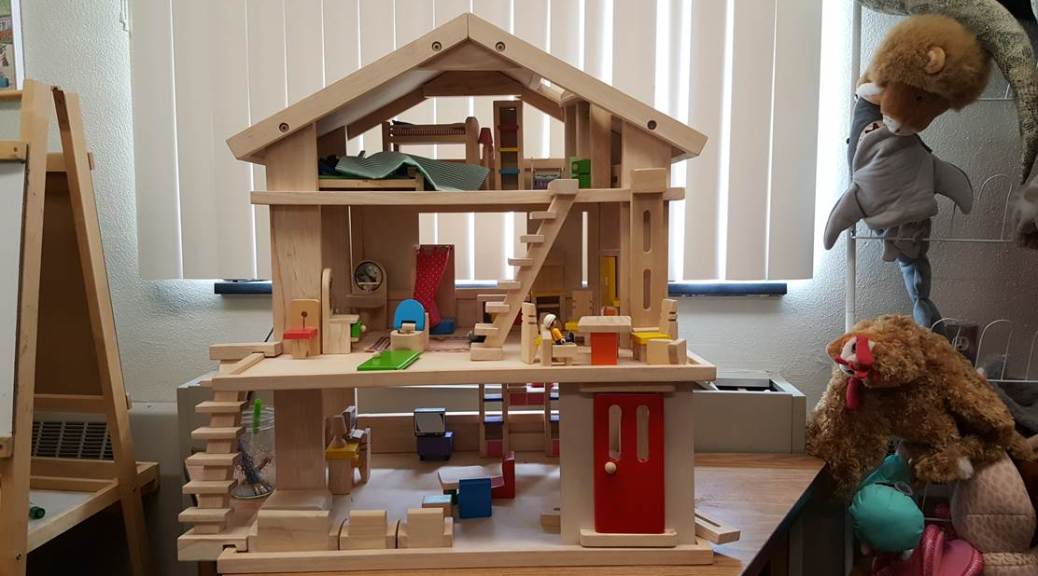
I have a new doll house. This one has two stair cases. My old one was very grand but the children were upset that there were no stairs. No one ever wanted my suggestion that they could pretend there were stairs. My new doll house, with stairs, is getting a lot of use.

None of my American Indian clients want to play with the Indian figures. I am still trying to figure that out.

The sand tray is really popular. I get the sand from a guy in Utah who sells beautiful sand in different colors and textures. I use the sand tray for general free play as well as to have children use the miniatures and other objects to show me what their world is like and how they would like their world to be. Sand tray therapy is widely used by Jungian therapists with adults as well as children, and there are hundreds of miniatures that these therapists use.

I found the scared and horrified figures at a recent play therapy convention. Kids really relate to them and use them in the sand tray.

I have lots of animal figures, wild, domestic, and fantastical. The animals are in family groups, with adult and young members.

Some people refuse to have toy weapons in their play rooms. I don’t think banning them from the play room is realistic.

The large wooden structure gets used a lot as a safe place or as a home.

I like the guy with the chain saw. He is so Freudian with the position of the saw!

What are the tools of your trade?

A Ceremonial Send-Off

Today’s guest post comes from Renee Boomgaarden, known as Renee in North Dakota.

A couple of weeks ago, husband and I were invited to a ceremony that a Native American friend organized to commemorate the fourth anniversary of his mother’s death. Our friend is Arikara, a member of the Three Affiliated Tribes (Mandan, Hidatsa, Arikara) who live on the Ft. Berthold Reservation in western North Dakota.

The ceremony took place in Bismarck while our friend was camping at the United Tribes Technical College Pow wow. It was conducted by Eric, a Lakota Indian from the Pine Ridge Reservation. He is our Arikara friend’s spiritual advisor. Eric explained that the Native American period of mourning lasts four years, and the purpose of the ceremony was to set free the mother’s spirit and bring her children out of the mourning world.

Our friend and his five siblings lined up by the camper and we observers sat across from them. A plate of food and a glass of water for the mother’s journey into the next world was set on a nearby table. The ceremony began with all present getting smudged with cedar smoke, fanned on us out of a shell with a leather-bound bunch of eagle feathers. Eric then stood between us and the siblings and directed two Lakota traditional singers to sing the song to help the mother’s spirit leave this world and travel to the next. He said prayers in Lakota to the four winds/directions. Then he brushed each of the siblings head to toe with the eagle feathers and wiped under each of their eyes with his fingers to remove any tears.

Eric then directed the singers to start the Song of Welcoming, to welcome our friend and his siblings out of the world of mourning into our world. Each sibling was given a taste of corn meal and a drink of water. We observers very formally shook hands with each of the siblings while Eric said another Lakota prayer. We then sat down to a potluck supper, the oldest person going through the line first.

Everyone mourns in their own way and in their own time. Our friend was very happy at the conclusion of the ceremony, surrounded by friends and family, sharing a meal, at peace.

Describe a ceremony that gives you comfort.

The Boomgaarden Orchestra

Today’s guest post comes from Renee Boomgaarden, aka Renee in North Dakota.

Sometime in 1925, the residents in and around Ellsworth, MN were abuzz with the news that Okke Boomgaarden had bought a $3000 accordion for his daughter, Amanda.

Okke was my great uncle, the fifth oldest of the sixteen children in my grandfather’s family. Okke was, officially, a farmer, sort of like how Don Corleone was, officially, an olive oil importer. Okke made his money bootlegging, and his barn was used for dances, not livestock. Okke had regular dances in the barn. He provided refreshments, at a cost, and members of the family provided the music.

Screenshot 2014-09-02 at 8.15.09 PM

Family historians talk about my grandfather and many of his siblings having a natural aptitude for music. All were self taught.

  • Great Uncle George learned to play the fiddle when he was 16.
  • Great Uncle Albert also played the fiddle.
  • Great Uncle Herman was a noted left handed banjo player.
  • My grandfather played the cello.
  • Great Aunt Amelia played the piano.
  • Other family members played the accordion.

In the years before the First World War they were know as The Boomgaarden Orchestra and played for dances, weddings, and harvest festivals in northwest Iowa and southwest Minnesota.

After the war, they changed their name to Mandy’s Jazz Kings, and played in Okke’s barn, joined by Okke’s children Georgie on fiddle, Jake on saxophone, and Amanda and Mabel on the accordion.

My father remembers going to some of those dances when he was a little boy, driving to Ellsworth with his parents in their Graham-Paige automobile. I wish I know more about the music the Jazz Kings and the Boomgaarden Orchestra performed.

I wish I knew what happened to my grandfather’s cello. Until I researched for this post, I never even knew he played a string instrument.

Okke died of a heart attack in 1928, and the dances stopped soon afterwards. The older members of the Jazz Kings had their own farms and families to care for and couldn’t play with the band anymore. Okke’s sons Georgie and Jake kept playing, changing the name to The Georgie Boomgaarden Orchestra. Georgie and his band played in the towns around Ellsworth until the 1970’s.

Screenshot 2014-09-02 at 8.14.53 PM

The Depression hit everybody hard. At one point, Jake’s saxophone needed $12.00 worth of repairs, but he didn’t have the money to fix it. The local doctor intervened and paid for the repairs. He had just built a night club in Ellsworth and needed musicians to play for the dances.

My grandfather felt it was important for my dad and his brother to have some kind of music training despite the tight finances. Grandpa drove Dad and Uncle Alvin to Luverne once a week to practice with a drum and bugle corps. This group was comprised of sons of World War I veterans, and you can see them in the photo at the top of this page. Dad played both drum and the bugle – he is the third boy on the right in the back row. He can still play his bugle, and has two of them in his bedroom.

Renee played bass clarinet for Concordia.

My children and I are the current Boomgaarden music amateurs along with my husband. Husband plays the cello, guitar, harmonica, and piano. He also sings. You can see me playing my bass clarinet in the Concordia College Band in 1978. Daughter plays the violin, French horn, and piano. She sings in college. Son played the trombone and sang in college. He currently sings in the church choir. I drafted husband to join the handbell choir. He drafted me to sometimes play the bass guitar in a very amateur gospel/rock and roll group.

Why do we do these thing? I have no idea. Maybe Okke will explain it to me someday in the Hereafter.

Who has the talent in your family?

Life With Father

Today’s guest post comes from Renee.

“Renee! That damn dog is looking at me again!!”

I respond to my father’s plaintive cry and remove the dog from the dining room. The cat is allowed to stay. Dad forgives cats for everything. My father believes that our animals should enjoy the bounty of our table, and he shares bits of his meals with them. Dad also believes that the dog should know when he has finished sharing, and she should just leave the room. We explain that she doesn’t think that way, and that he has to stop feeding her from the table if he wants her to leave him alone. As you can see from the photo, she waits patiently nearby while he eats. That is still too much for dad. He says that when an animal looks at him while he eats and he doesn’t feed it, he feels like the people in the parable of the Good Samaritan who walked past the victim and didn’t help. So, I remove the dog.

It has been six weeks since my 93 year old, newly widowed, father moved in with me and my husband. Things have gone pretty well, aside from his strife with the guilt-inducing terrier. He personalized his new room with photos, furniture from home, and mementos, and made it a comfortable nook where he reads, writes letters, and listens to CD’s of his favorite radio preachers. He is appreciative and meticulously clean and tidy. He is frustrated by his diminishing physical strength and his inability to fix things. He is easily hurt by a sharp word, and we need to be very patient as he struggles to understand the complicated business and health issues we discuss. He is usually quite cheerful, though, and remains curious about the world and the people around him.

Living with my father is a balancing act of providing necessary care with as much autonomy as possible. I am thankful that he is independent with all his personal care. I help out by organizing his meds and taking him to appointments and handling his business. Things will change as his health deteriorates from his cancer and cardiac disease and age, but at this point we have a pretty good thing going. He has breakfast with us every morning. He loves French press coffee. We go to work and he potters around until lunch, when we come home to eat with him. We go back to work, and then one of us slips away at 3:45pm to take him to coffee with a group of retired teachers. One of the teachers brings him home, and we meet up with him around 6:00 for supper. He goes to bed pretty early. On weekends he watches us garden. He also planned and directed the transformation of our basement and garage into temples of Dutch order and cleanliness. We have a very Jake-centric household, but that is ok with us. I am thankful that my husband is supportive of our doing this. We are both very fatigued at the end of the day.

Every day when we leave for work we make sure Dad has a bowl of Lindt chocolate truffles on the counter, a beer or two in the fridge, lots of ice cream, and Radio Heartland streaming on the computer. He really likes listening to Jimmy Dale Gilmore and the Wronglers. He knows he is shamelessly spoiled, and repays us with stories. Here is a true one from home about people I know.

Old Johnny B was a farmer and horse trader from Magnolia, MN, born around the turn of the century. (His son Dallas is still alive and went skydiving two years ago on his 95th birthday.) Many years ago Johnny bought a horse from an old German farmer, and when he got the horse home, he put it in the corral and the horse proceeded to walk right into the barn wall. The horse was blind! Johnny confronted the farmer. “Why didn’t you tell me the horse was blind?” The farmer replied in his thick accent “I did! I told you he didn’t look so good!”

I think a story like that makes up for any amount of extra work we have. He has tons of stories, and we will keep the truffles and beer in good supply as long as he can enjoy them.

Share a joke a 93 year-old might enjoy.