Today is our agency Holiday party. I wrote last year about the festivities and “planned” fun. This year the powers that be had the sense to scrap the door decorating contest, opting for a noon potluck, trivia game, and white elephant gift exchange. I am bringing cookies, and cranberry-orange glazed chicken thighs.
I am too burned out to come up with a white elephant gift. We found out yesterday that a beloved extended family member is probably going to be placed in Hospice care, which makes holiday festivities seem somewhat more frivolous than usual. I see, though, that the weather may be good when we travel Monday to Brookings, SD. It will be healing to be with family members.
My mother always had a hard time at Christmas, having lost a 7 month pregnancy in 1949 when her appendix ruptured. She did her best to keep Christmas cheerful, but it was hard. Tragedies are bad enough, but seem worse during the holidays.
What would you try to get rid of at a white elephant gift exchange? What holiday tragedies, frivolous or serious, have you had to contend with?
Yesterday was tiring but satisfying. We played in the bell choir at both morning church services, came home and packed up seven boxes of Dresden Stollen and cookies (one box had a Bremer Klaben instead of a stollen) and got them to the UPS store. We then played bells and sang at the annual Lessons and Carols service at our church in the afternoon. I got to read the Bidding Prayer again. By 5:00 PM we were done and free. We are heartily sick of being town musicians at Christmas.
By town musicians, I mean some of the few people who are active in the musical community in our small town. The majority of town musicians are affiliated in some way with our Lutheran church. Our local college had a vibrant and active music department with a band and a choir. They had music festivals for high school students and hosted lots of concerts. The recent college president decided that the music and theatre departments didn’t have enough student majors, so he closed them down last year. The Education department has enough music education majors and they need to have some sort of music going on, so they have a band of one person and a choir of six singers. Our bell choir played with them two weeks ago at a Christmas concert in the college student center. Had our bell choir not been there, it wouldn’t have been much of a concert. I should add that the decision by the college president was so unpopular he quit. I don’t think they will reinstate the music department, though.
The Lessons and Carols service was lovely, and our church music director had a local classical guitarist, someone I had never heard of, play the following piece.
The guitarist appears to be Spanish. I have no idea how he got to North Dakota, but it was delightful to hear him. We have only one more vocal choir performance next Sunday, and no rehearsals this week, so we are free to relax and chill. Christmas hysteria is over, at least in our house. I may need to order more classical guitar recordings, though.
What musical instrument would you like to hear more of? How is the Christmas hysteria at your abode?
I got a lot done this past week. Last Saturday I finally got the snowfence up. You know, I can’t figure out why 100’ this year, doesn’t fit the same posts as 100’ did last year? Which didn’t match the posts from the year before that! Sometimes I think I’d like to put wood posts at the ends of the sections, but seriously, it never lines up the same way two years in a row and I just don’t get it. We put in 500’ this year. Plus, another twenty feet in a different location that can drift. I guess I am expecting it to snow this year.
Sunday, I moved a bunch of equipment around; I got the lawnmower cleaned up and put away (I used it to mow a path for the snow fence. It wouldn’t work when I tried a month ago, because the grass was too green and wet. But now it was all brown and dried out and cut much better). Moved the scrap metal tote inside the shed, and stuff like that. And then I finally built a little door for the chickens, so I don’t have to leave the big door open six inches for them. Ready for winter!
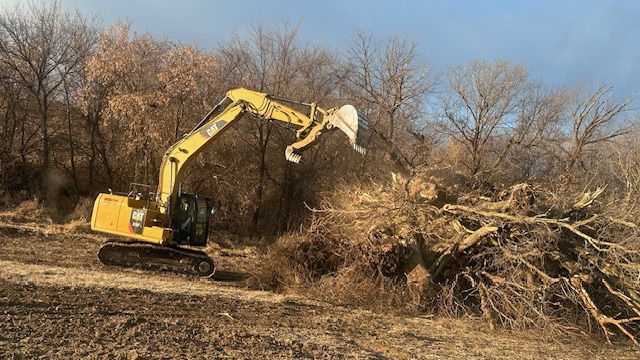
On Monday, the contractor showed up and started tearing out trees and reshaping a waterway. It’s not the best timing for dirt work, but by spring either I’m gonna have the gully in the field where it’s been running, or in the waterway where it’s supposed to be. To fix it, they had to tear out a LOT of trees. Tree’s that have come up in the last 60 years. Which meant the area didn’t drain properly. It looks a lot different.
Before :
After:
There is one GINOURMOUS brush pile!
This photo doesn’t give you any perspective. It’s HUGE This whole project came about when I hired the contractor to bury the ash from an area where I’ve been having brush piles for years and years. And then I asked if he could reshape the waterway, which turned into tearing out trees IN ORDER to redo the waterway.
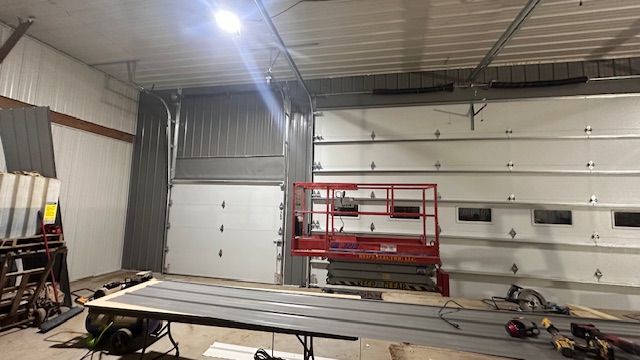
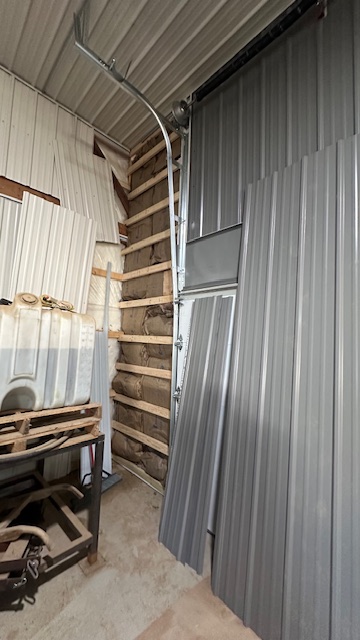
And I finished the steel inside the shop. It turned out really well. I have a few details to finish yet, and the outside steel, and the electrician will have a lot of work to do, but it really is a functional shop area. I don’t often think about if my Dad would like whatever it is I’m doing. But the shop and the waterway, I really think he would approve of those things. Friday night Padawan, still in shorts, was able to put his car into the shop to work on it. I’m kinda glad I can offer him a place like this. I have been spying on them with the shop camera. My goodness, two teenage boys can be so annoying to be around.
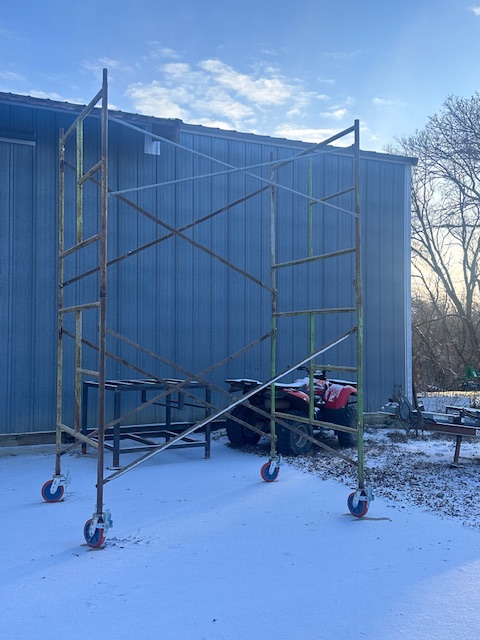
I’m beginning to clean up the shop area. I don’t need the scaffolding anymore, and I need the room, so I dragged that outside and disassembled it. PHOTO
Holiday concerts at the college this week too.
Pretty soon I can get the 40’s station back on my car radio. The one they take off in November to play TWO MONTHS of Christmas music. Bah.
PICK A HISTORICAL FIGURE TO BE ANNOYING WITH. WHAT ARE YOU TWO UP TO?
Earlier this week, my son texted me to say that he was home with our grandson, who had a sore throat, and had just cleaned up after his West Highland Terrier, who had brought a very large, very dead, cottontail rabbit into the house. The dog caught it in the backyard. Our son put it in a garbage bag and threw it in the trash can outside.
This is the second kill Baxter, the terrier, has under his belt. Last year he caught and shook to death a squirrel at my son’s in-law’s house. Baxter is a senior dog, about 10 years old. He is in good physical condition, but I am surprised he was fast enough to catch a rabbit. He was pretty dirty when he came in with the bunny, so Son had to give him a bath. Son is very grateful Baxter didn’t try to eat the rabbit. In true terrier fashion, shaking something until it is dead is reward enough. Had he chewed on it, Baxter would have needed medicine for tapeworms.
Our Cesky Terrier has great hopes of catching and shaking one of the rabbits that infest our neighborhood. His favorite pastime when we sit in the living room is to play tug of war with some of his floppy dog toys and then shake them violently when he gets them from us. No rabbit would have a chance. I am happy he hasn’t brought anything dead into the house. Many years ago one of our cats caught a bird and brought it, still living, into the house. it looked as though someone had been plucking chickens in the dining room before we were able to get the bird away from the cat and release it out of doors.
I can’t remember the last time I set out of the house to go shopping for Christmas presents for our family and loved ones. I spent much of my morning yesterday scrolling through the Amazon lists and other lists of things our son, daughter, and daughter in law wanted and conveniently sent to us. A few clicks, and their gifts were on the way. Later this week I will fill the treat boxes for our far flung friends and family and get them to UPS to deliver.
Husband and I told the kids we didn’t want any presents this year as we don’t want more possessions that we will have to move. I don’t think either of them listened to us, and we will get books at a minimum. I also told daughter that bubble bath and toiletries were good options for me if she really wanted to get me something.
Right now I don’t have the time or the energy to go physically from store to store in a mall or in a big box store shopping for people. Is that a sad commentary on our current state of affairs, or something to rejoice over? I am not sure.
How does your family gift one another? What are you hoping for this Christmas?
Husband and I have been drinking more tea lately, I suppose because it has been cold. We got a tea catalogue the other day and found some fruit teas we ordered-Rote Grutze, a German fruit tea made from hibiscus, grapes, elderberries, and blueberries, and a black tea that has rice flower, grapes, papaya bits, cinnamon, pear bits, fig bits, orange peel, nutmeg, cloves, maple syrup-, honey. and pear flavors. It is also made in Germany. They both taste really good.
We have all sorts of teas in the cupboard. I like Earl Grey and Assam teas. I guess Ostfriesland, where my ancestors come from, consumes the most tea per capital of any country in the world. We really became tea fans when we lived in Winnipeg and took tea at the Hudson’s Bay Company tea room, It was so fun to go there for tea and fancy cakes on Saturdays.
We really like our new teas. They help keep out the cold. I like my traditional black teas with lemon, not sugar. Husband likes cream and sugar in his. He also drinks iced tea like other people drink soda.
How do you take your tea?Ever had a formal English tea experience?
I am not too sure why I started thinking about Dr. Zhivago last week, but I did, and that led to memories of our Italian landlords in Winnipeg.
Angela and Emilio lived in a modest home not too far from the University, and when the house next to them came up for sale, they snatched it up. It was a very tiny, two bedroom home with a large enclosed porch and a nice sized garden in the back. There was an alley that ran in the back, and an unattached garage.
Emilio and Angela were from Calabria and immigrated to Canada in the mid 1960’s. Emilio was a ceramic tile layer and flooring guy. He had invented and perfected a way of laying tile that made him the fastest in the city. He wouldn’t let anyone watch him work because he didn’t want anyone else to learn his method. Angela was a homemaker. They bought the house next door out of an Italian desire to be able to control who lived near them. We were their first renters.
Angela told me that Emilio immigrated first, before they married, and she followed several months later. They married in Winnipeg. She told me her first impression of Winnipeg flying over the city was that the rows and rows of houses looked like rows of grave stones in a cemetery. She said that Lara’s Theme from Dr. Zhivago was “their song” since it spoke of lovers finding a place where they could be together. I thought that quite sweet. They managed to make a good life for themselves.
What are your favorite romantic movies? Did you ever have a song that you considered yours?
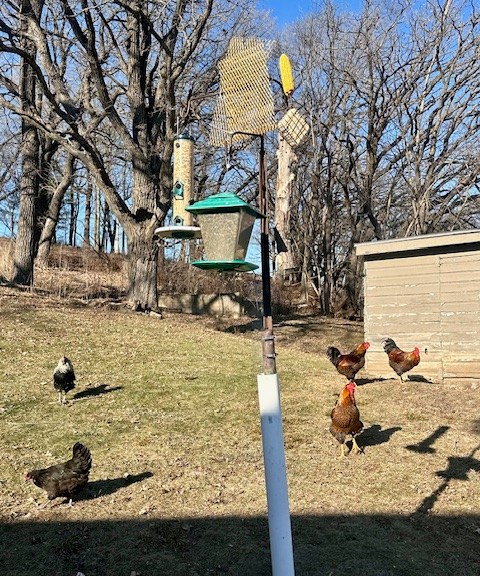
Only getting about three to five eggs a day lately. Not sure what’s up with that. Might be because I ordered roosters this spring, I’m not sure. I’ve got the chickens heated water bucket going, I’ve got the tank heater going down by the barn, and I’ve got the heat running in the shop, the wellhouse heater is on for the really cold nights, plus a heat lamp over a water bucket for Bailey. And I plugged a tractor in. This time of the year I go out and do chicken chores before I go to work, rather than doing them in the afternoon when I come home. I give the chickens fresh water, (I don’t know how many chickens we have these days. Maybe 40 or 50 and they drink about two gallons a day). I throw out a bucket of corn in the morning. If I throw it out in the afternoon or evening, the deer eat it overnight before the chickens ever get to it. Coming down our driveway at dusk, there are deer all over! One night when it was fairly pleasant out, I bet I counted 35 deer in different spots- and that’s all in a mile just on our property! And most of those are does. Stupid deer.
A lot of years, the weekend after Thanksgiving, Kelly and I put up the snow fence. This year the weather wasn’t conducive to that so our plan is to do it this weekend as it’s supposed to be in the 40s. It will be complicated a little bit by the tall grass in there, because my cow people never ran their cattle in this pasture and I didn’t have the brush mower. I tried mowing it down with the lawnmower, but the grass was just too tall and thick. The brush mower has been repaired now and I’ll pick it up next week. They fixed a lot of extra cracks and honestly it should be better than new. It wasn’t cheap, but it cost less than a new mower.
I’ve started filling our birdfeeders again: an ear of corn, a suet block, a log with the holes drilled in it for the suet pegs, and then one feeder for sunflower seeds, and one feeder for a mix. In the fall after combining, and while I’m chisel plowing, I will pick up ears of corn that I see in the fields and bring them home and put in a bucket and that’s what I use for the birds. This fall as I was picking up corn I was thinking to myself that I thought there was a place on the tractor to I put these 20 or 30 ears so they weren’t rolling around in the cab with me. And then I remembered, under one of the steps there’s a little storage area and when I opened it up, it was full of cobs from last year. Mice had gotten into it and eaten all the kernels. I chuckled to myself as I sort of remember thinking last year to remember to go get that corn, which evidently I never did. This year they were probably in the tractor a week before I remembered to go get them, and was surprised to discover the mice had already found them and cleaned off a couple ears.
My summer Padawan came out the other night with a friend of his and they wanted to work on a car in the shop.
I told him they couldn’t get into the heated part yet, but they could use the other part of the shed. And it was gonna be cold in there. He was fine with that and said it wouldn’t be a problem. It was Wednesday night when it was 8° out and the wind blowing like crazy. The thermometer in the shed said 20 degrees and here he is in shorts, because that young man does not own a pair of pants. He picked up a different car recently and he’s fixing it up by adding things I don’t understand, but things to improve the performance: custom air filters, something called an air dump, performance spark plugs, and he’s got a chip coming for it to boost engine performance. It’s a pretty slick looking car in the first place (a Kia something) I have to admit, and he is learning a lot, and this is keeping him out of trouble. He certainly had more willpower and stamina than I did at 18, I don’t think I would’ve worked in a 20° shop in shorts. For three hours. I offered him sweatpants but he wouldn’t take them. He did ask for gloves once, but I didn’t have any that fit, and I gave him some of the nitril work gloves that I wear, and they keep your hands very warm, but the next time I went out he didn’t have those on either. He said they had gotten in the way. I offered help as needed, and I helped them find the right tools, and really, he was focused and determined. His buddy didn’t quite know what they would be doing that night. He thought they were just gonna hang out and at the last minute Padawan said ‘I know a guy with a shed, let’s go work on the car.’ They’d come into the shop area to warm up as needed, and by 10:15 PM they had the car running again and they headed for home. And again, more power to them I guess. The second kid was a very nice young man. He and his family had lived in the UAE for a couple years because his mom was working over there. He builds computers for people. It was fun talking to him. The next night, Padawan and my other summer helper came out. One still in shorts, and the other without a jacket. But he had just left it somewhere and gladly accepted my jacket. Padawan was back the third night IN SWEATPANTS!
I’m making progress on the shop. Just a couple pieces of steel yet in a corner of the inside, and all the steel on the outside wall. But that will go quick.
PHOTO
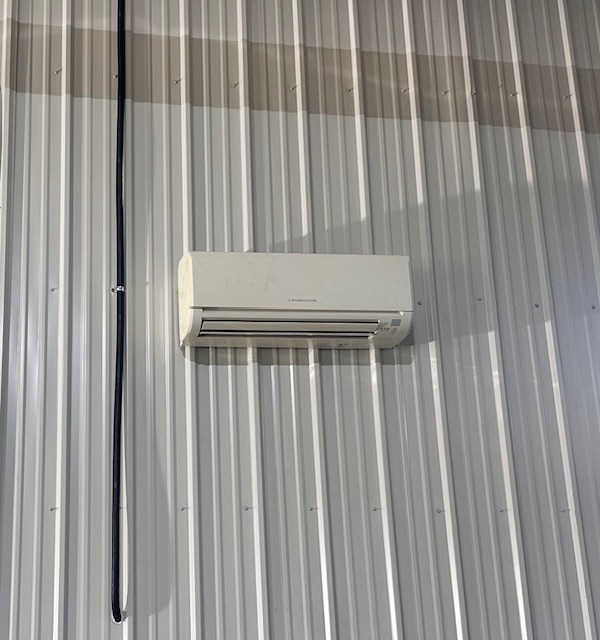
Just got AC installed, mostly to help with humidity in the summer. It’s not a ‘Man-cave’ I keep telling Kelly!
PHOTO
This was a used unit I brought home from one of the theaters and I didn’t want it sitting open all winter.
Kelly, daughter, and I saw ‘Les Mis’ at the Orpheum last week and that was as good as I remembered.
Next week is ‘Book of Mormon’, but we decided daughter didn’t need to see that one. Too many things I didn’t want to explain yet.
Our dog Kyrill, a Cesky Terrier, is a highly affiliative dog. Unlike many terriers, this dog is bred to work in packs. I have spoken with other Cesky owners who all remark that their dogs are real snugglers, wanting to be in their laps the minute the owner sits down. Kyrill is the same way. He weighs 28 pounds, and that is a lot of terrier to have in my lap!
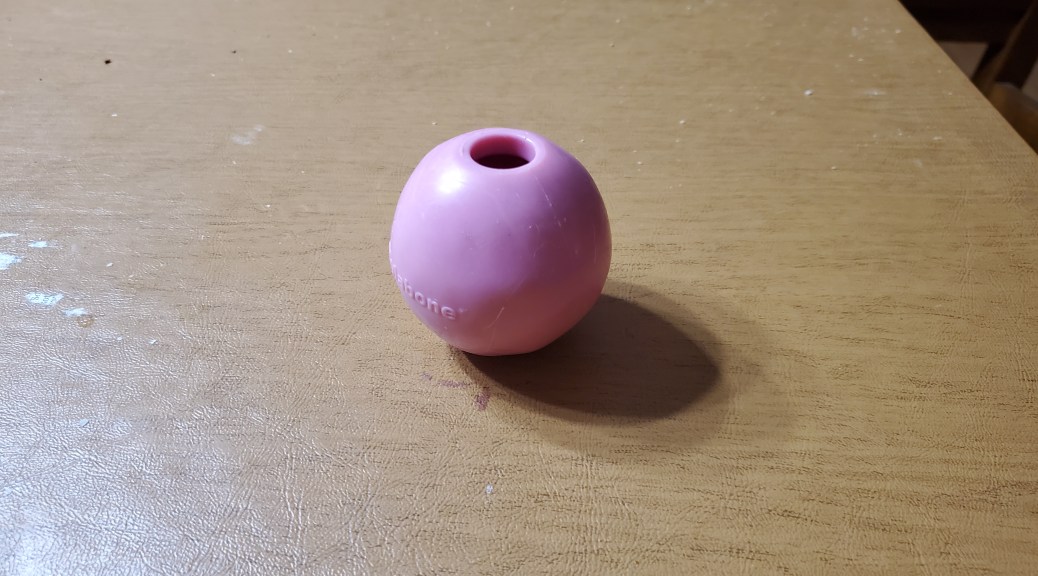
Kyrill also follows me all over the house. He is very observant of routines, and knows that when I stand up in the morning after I have my coffee and I say “Mommy has to go potty”, he races to the bathroom to be there when I arrive. Along the way he also grabs his favorite toy, the pink ball you see in the header photo, so that he can play keep away with me in the bathroom.
Kyrill is highly attached to his ball. He carries it with him whenever he goes outside. He sleeps with it. If it falls off the bed in the middle of the night and rolls under the dresser, a place he can’t reach, he whines until I drag myself out of bed and get it for him. I don’t know what it is about his ball that he loves so much. We have a green one just like it, but he isn’t attached to that one like the pink ball. It wasn’t easy to get it away from him to take the photo.
I don’t know if his ball serves the same function as the security blanket or stuffed animal of a human toddler. I had a favorite blanket that I wouldn’t let my mom wash unless I was asleep. I eventually left it on a fence post on a family vacation bear Two Harbors. Our kids had blankets and favorite stuffed animals. It is important to feel secure when you are small, even if you are a dog.
Did you have a blanket or security object when you were a child? What helps you feel secure these days?
During the last two months we have had an unusual number of mechanical failures. The CV joint on my van was leaking, requiring a new front axle. Husband needed new tires on his truck. The kitchen faucet broke, and was replaced. Our big kitchen mixer broke down and was replaced just before Christmas baking started. Last week my blow dryer gave up. I had to go to work on the coldest day of the year with wet hair. It was an expensive couple of months.
Yesterday I felt quite broken down. Monday was my annual checkup. The good news is that I am the picture of health. The bad news was getting both a Covid shot and a flu shot at the appointment. I woke up Tuesday morning feeling as though I had been hit by a truck. I stayed home from work. I felt better as the day progressed. At least that is over for another year.
What are your favorite disaster songs, poems, stories, and movies? Have you had your shots?