Category Archives: Science

Rope-a-Dopamine

My eye was caught by a recent newspaper article about what my ears have been up to.

Neuroscientists Robert Zatorre and Valerie Salimpoor wrote in the New York Times about why music gives us pleasure. It turns out that the most emotional moments in music have been shown to release the chemical dopamine in the brain.

cerebral_lobes

That has been known for a while. But there’s more:

“… what may be most interesting here is when this neurotransmitter is released: not only when the music rises to a peak emotional moment, but also several seconds before, during what we might call the anticipation phase.”

So you inherently know when you’re getting to the good part, and the anticipation of that highlight is its own reward. All we have to do is lay back and let the elastic chemicals lift us when the time is right.

I recognize the effect in my own music listening. For instance, this Patti Griffin song is a favorite, and now I see that the dopamine release point is at about 1 minute and 14 seconds in, when the sun comes out.

Anticipation is powerful in so many other areas as well. For instance, I always enjoy vacations, but my favorite part is the moment just before it begins, when no fun has been had but I have everything to look forward to.

I’ve noticed this about the State Fair in recent years. Thinking about fair food during the week leading up to opening day has become more pleasurable than eating the food, and much, much nicer than digesting it.

When is anticipation as good (or better) than the thing itself?

Sputnik Again

Today’s post comes from Tamara Kant-Waite, past president pro-tem of the Future Historians of America.

All the hubbub about last Friday’s meteor called attention to an alarming video documentation gap.

We are losing the dash cam race to the Russians.

It seems that dash cams are rolling constantly in many Russian automobiles because drivers are concerned about being victimized in crashes, scams, and road rage. Video proof of the actual sequence of events could be your only insurance against careless and unprincipled fellow travelers.

I hesitate to embed any of the actual images here because they could be disturbing for some of our more fainthearted readers. But if the sight of reckless driving, fistfights, and cars crashing into one another is your idea of great entertainment, you can spend quite a long time looking at it courtesy of the Russian dash cam fad.

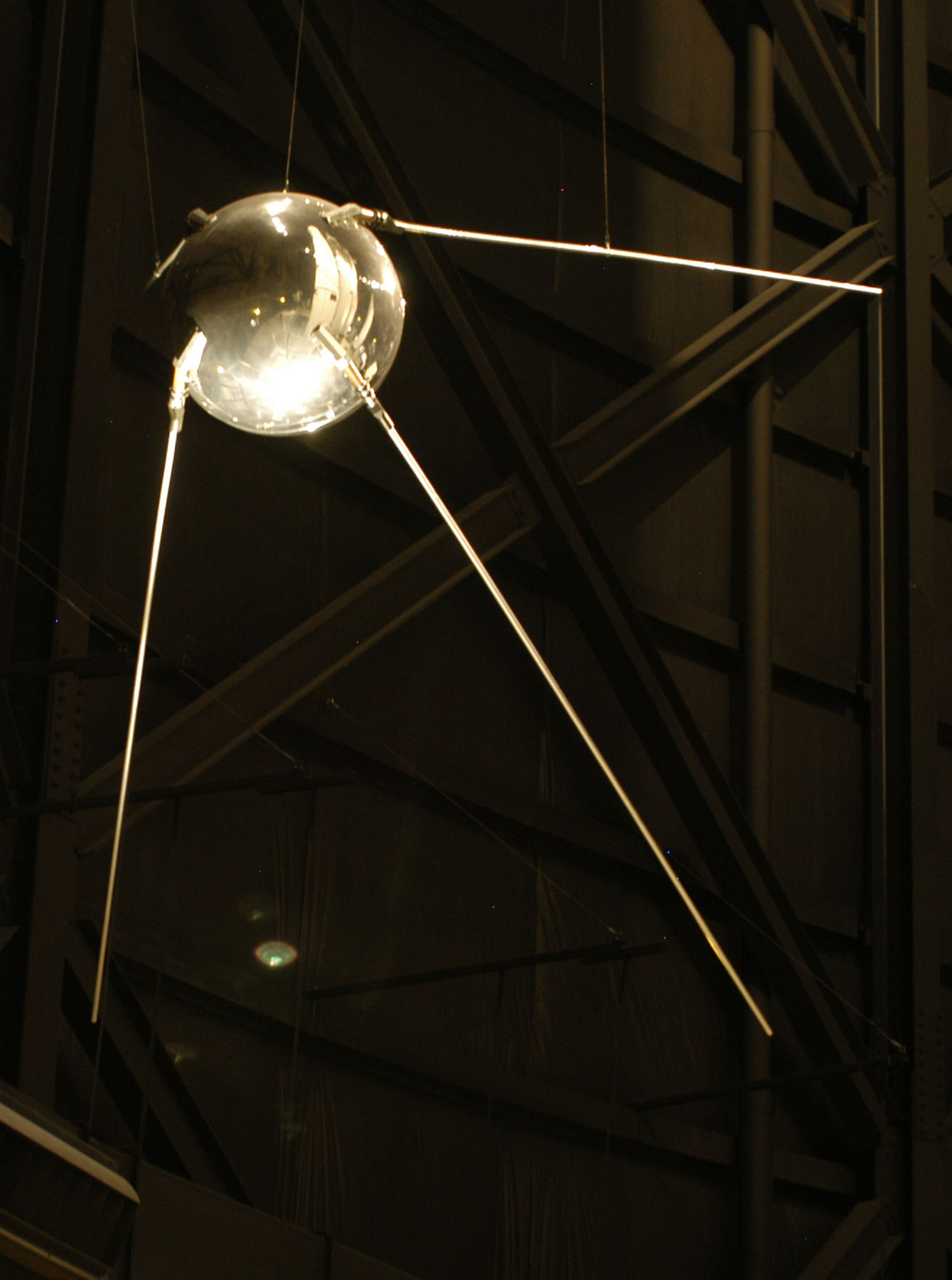
Sputnik I

Now we know why our parents taught us to be afraid – clearly Russian drivers are unhinged. Or at least a surprising number of them are going down the road with their doors swinging open and their hoods up, unable to stay between the lines and mad as hell. Not that we don’t have our own highway problems – we do. But they’re beating us silly in raw footage.

As a Future Historian, I must sound an alarm. The undocumented peoples of the Earth will surely be forgotten. And among those whose activities are recorded, the ones with eye-popping antics are most assured of a lasting place in the great story of time. Right now, the day-to-day video record of life in the United States is tame compared to the smash-bang wild west rodeo going on in Russia.

Who knew that when Khruschev said “We will bury you,” he meant they would bury us under hours and hours of high speed slapstick and real-life mayhem? Are you going to stand for this?

And if you ARE going to stand for it, could you at least stand for it in the middle of a busy street with tape rolling? Historians who have not been born yet are already hungry for raw footage, and the most compelling stuff being produced today has a distinct Russian flavor!

Yours in the fullness of Time,

Tamara K-W.

She could be right. Perhaps we need something akin to the space race to inch back ahead of the Russians in the video race. Would you put a dash cam in your car if it meant we might close this growing clip gap between the American Eagle and the Russian Bear? Would you wear a helmet cam? Or consider this – with current trends in miniaturization and personal adornments, the most ubiquitous camera of the future might be mounted on a nose ring.

How are you documenting the story of your time on Earth?

Now We’re Cooking!

It’s prehistoric remains week here at Trail Baboon. Yesterday we considered the ramifications of some ancient teeth uncovered near Tel Aviv that may upend our understanding of who was where, when.

Today comes news that our ancient, now extinct near cousins, the Neanderthals, were not the brutish, meat-only diners that many had assumed, but in fact, ate plants, and some of those plants were cooked. This is yet another step in countering the popular cultural image of the Neanderthals as dopey cavemen who were too backward and unimaginative to survive. The new vision of Neanderthals sometimes eating vegetables rather than always ripping apart some unfortunate ungulate (Elk again, mom? Really?) and devouring it raw gives us a more nuanced understanding of who they were.

Sophisticated eaters and engaging dinner companions whose laughing eyes were unfortunately shaded by their prominent foreheads. I’m sure in the years to come we’ll learn more about Neanderthal dining habits, including some of their favorite recipes:

Alley Oop Salad
Cave Dweller Cole Slaw
Bedrock Vegetarian Chili
Clubbed Squash

And my new favorite – Neander Valley Tabouli

2 cups seed of rough grass from mouth of cave
2 cups very hot water from fire keepers
1 bundle green stuff from underside of log, chopped
2 small crunchy ground melons, chopped
1 bunch ferns, (8) sliced
1/2 cup fresh chopped rotten bark flower (NOT the red one)
2 cups fresh chopped children of vine that grows up side of rock
1 clove smelly root, minced (optional)

Dressing: 1/2 cup juice of tiny yellow sun,
3/4 cup slippery juice from tree berries,
1 tablespoon tickle nose powder (black),
2 teaspoons seawater (with water removed).

Soak the grass seed from mouth of cave in hot water until mixture cools. Squeeze like helpless enemy caught in battle.
Use sharp edged rock to attack ground melons, ferns, rotten bark flower, vine children, smelly root and green stuff. Leave no survivors. Gather remains into bowl with grass seed.
Mix sun juice, slippery juice, nose powder and no water seawater. Pour over mixture.

Defend with unchecked ferocity from all interlopers and predators.

What’s the oldest recipe in your day-to-day repetoire?

Triceratops Trumps Torosaurus

Yesterday Clyde nominated the triceratops controversy as the likely topic of today’s blog.

Until he mentioned it, I didn’t know there was a triceratops controversy.

It’s an interesting situation, though. How rare and wonderful, to be the focus of a campaign to preserve your name millions of years after your extinction. We should all be so lucky.

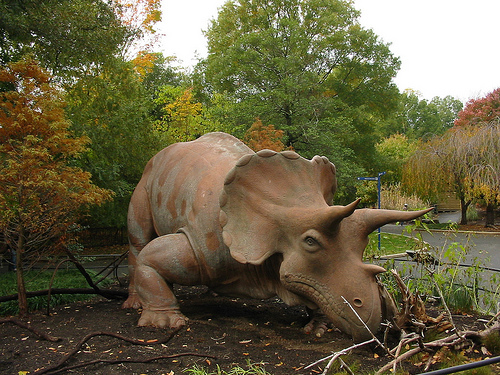
A couple of paleontologists at The Museum of the Rockies, John Scannella & Jack Horner (oh the awful rhymes he has endured), have concluded that the charming three horned dinosaur we all know as triceratops is actually a juvenile torosaurus. Originally it was thought that they were two distinct types of dinosaur since the skull shapes were so different, but now it seems that dinosaur skulls were quite changeable over time and evidence has been uncovered that plots the development of the wee triceratops into the mature torosaurus.

Triceratops!

Torosaurus!

This sparked indignation from triceratops defenders who challenged the theory because they don’t want to part with the name or the image of their favorite three horned beastie, nor do they want to let go of the idea that it can grow into a fearsome adult with jaggedy skull frills and no fenestration. Extinction is bad enough once. To top that with never-existed-ness is a terrible insult. The stage was set for a Pluto-like debate.

But wait! There’s a game saver!

It turns out the name triceratops came into usage before torosaurus, so under the rules that govern the naming of things that are no longer alive on the planet, the earlier title trumps the latter. Rather than disappear, triceratops takes over torosaurus’s territory completely, so now it is the torosaurus that is no more, and the name triceratops that will live forever, or until an asteroid crashes into the earth and erases us completely along with everything we think we know.

Happy ending? Apparently nobody loves the name torosaurus enough to put up a fight to preserve it. So in this case, it appears timing and popularity have led to a situation where the baby has taken over the adult’s name and identity completely.

The child is truly the father of the man, much in the same way the grown adult named Ron Howard will always be known as “Opie”.

Have any of your childhood features (physical or otherwise) survived the transition to adulthood?