Category Archives: Science

Brand Loyalty

Today’s post comes from marketing whiz Spin Williams, a wheeler-dealer who is always in residence at The Meeting That Never Ends.

The economy is picking up! It’s a world full of great opportunities for smart people who are willing to embrace risk and do deals. But it’s also important to know when to walk away.

Case in point:

I’m not at liberty to say who made the offer, but during a recent new business discussion at The Meeting That Never Ends we heard from a very well-known genes manufacturer who was shopping around the famous Y chromosome for a possible takeover.

x_and_y_chromosomes

Naturally, we considered it. The Y is a well known brand name in the chromosome industry, making up a significant portion of all the chromosomes out there. It comes in second only to the X chromosome, which is the runaway market leader. In fact, the X is so reliable and effective, it has a 100% market penetration. Some people love the X chromosome so much, they have two! But there is a foothold – around half the population has at least one X and a Y. It was a bit disappointing to us to learn that very few people have two Y chromosomes, and we noted that as a possible marketing goal, should we decide to do the deal.

Doing our due diligence, we discovered that the Y was for sale because its maker has come to the realization that the chromosome is almost worthless, having been shown through scientific studies to contribute very little to any sense of individual well-being or overall usefulness. Most organizations considering a takeover would have walked away at this point, but my experience has shown me that marketing is more powerful than science. As proof, I offer the fact the we still have a tobacco industry! The value of any particular thing is in the eye of the beholder, and there is solid survey information to indicate that most Y chromosome users love and defend it simply because they already have one, and not because of any inherent benefits it may bring to the table.

And there’s a sizable portion of the chromosome-consuming public that doesn’t understand the product and doesn’t know which brand it prefers.

So in spite of the Y chromosome being inferior, we felt certain we could develop a marketing plan that would boost brand loyalty and make the Y seem more fresh and hip than it does today. Whether we would get to a point where X-only consumers might actually feel some envy for those with a Y was hotly debated at the meeting, with one side expressing certainty that such envy was impractical and impossible, and the other group adamant that Y envy pretty much drives all decision making by X’s. It turns out one of the side effects of having a Y is an outsized enthusiasm for the supposed benefits of Y-ness that X’ers don’t generally seem to share.

Similarly, it was the Y-freindly crowd that was all Gung-ho for immediately pulling the trigger on this deal and sorting out the consequences later. The double-X’s in the room were feeling less impulsive, constantly asking ‘How do we monetize this?’, ‘Where’s the benefit?’ and other fun-stifling questions like that.

Because there was no getting around this fundamental conflict, we walked away from the deal. First, though, we made a surprise bid for the X chromosome, thinking a seller in the mood to divest one of His low-performing properties might take the bait on an unexpected left-field offer for the most popular genetic product in the world.

That was a non-starter, but we all had a good laugh over it.

What does it take to get you to switch brands?

Seeing Speeding Space Chunks

It appears that meteors of the sort that exploded in the air near Chelyabinsk in Russia are more common than scientists thought. The speeding rock caused a sensation when it streaked across the Russian sky last February, and the airborne blast created a concussion that broke windows. The bright light gave some people burned skin and the shock wave caused injuries on the ground.

Now some scientific analysis brings more information.

Most of the rock evaporated when it blew up 18.5 miles above Earth’s surface. Our atmosphere is 60 miles thick, or approximately the distance from St. Cloud to Minneapolis. So if the Chelyabinsk meteor were a metro area family returning home from a weekend up north at about 42,000 miles per hour (yes, that’s about how fast some of them drive), they made it to somewhere around Rogers before everything fell apart. That’s almost home by my reckoning.

Much of our worry has been focused on space rubble that’s more than a half-mile wide, but this lump was just 65 feet across. NASA is tracking more than 10,000 comets and asteroids though fewer than 1,500 have been classified as potentially hazardous to Earth. But the Chelyabinsk Chunk was made of a composite of gray and black stone, which reflects little light and is harder to spot. There may be more than 20 million asteroids with orbits that bring them close to Earth.

We can’t really protect ourselves against smaller space rocks. Gulp.

Where I once thought of space as cold, clean and empty, now I think of it as something like my basement, full of miscellaneous stuff I stopped thinking about.

Maybe rather than sending out movie-inspired space missions loaded with misfit deep-core drillers and explosives experts to destroy large threatening asteroids, we should launch misfit graffiti artists into orbit to paint the most threatening small debris so we can at least see it.

But this news, combined with our growing awareness of the long-term cost of concussions, will hasten the day when we all wear protective headgear most of the time, as both a fashion and safety statement.

Seriously.

Describe your everyday helmet – shape, color, decorations.

We Are Not Snakes!

Biologists in California have discovered some new legless lizards living in a few very specific areas, most notably at the end of a runway at the airport – LAX. These previously unknown creatures spend most of their lives underground and a very small area, and may have eyelids and ear holes, which are just a few of the tiny details that distinguish them from their more familiar writhing cousins.

Legless_Lizard

We amateurs would call them snakes anyway, because up to this point most of us didn’t know there could be a non-snake with a that distinctly snakey look – all wriggly and appendage-free.

For some reason, the notion of legless lizards at LAX made me consider the trials facing these unfortunate creatures – they spend their lives in the area the size of a small tabletop at the end of a runway that launches countless humans riding mammoth rumble-machines into exciting far-flung journeys.

So bleak – rather like living without money in South Minneapolis.
Envy is a possibility, not that there is an option to wriggle on board. “Legless Lizards on a Plane” is a bad idea for a movie on a number of levels, not the least of which is the amount of dialog it would take to repeatedly explain that they are not snakes.

So I decided they need a limerick.

The no-legged lizards at LAX
watched the planes pass while flat on their backs.
With each flight that occurred
They were profoundly stirred
with each tooth shaken free of its plaques.

Where’s the loudest place you ever lived?

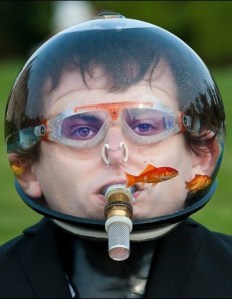
Goldfish Bowl on Head

Italian astronaut Luca Parmitano has written a blog post about the experience of having his helmet begin to fill up with water during a space walk. I think it’s fair to say this is a sensation most people will never know – the feeling that you are floating 240 miles above the Earth’s surface, moving at 17,000 miles per hour, and drowning.

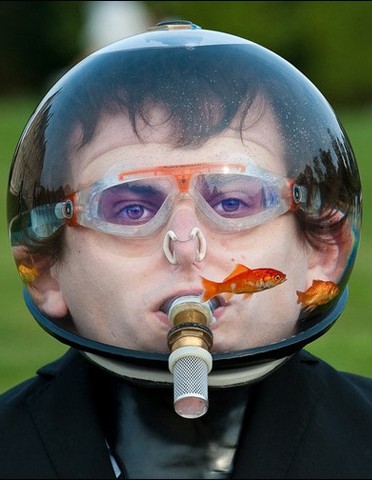
It’s definitely not one anyone’s top ten list of things to worry about – or at least it wasn’t. Though I have this vague recollection that I’ve seen a cartoon where an astronaut’s helmet (Bugs Bunny?) fills with water and he watches goldfish swim in front of his eyes. Could that have happened?  Probably.

goldfish-bowl-head

At any rate, it’s not hard in the year 2013 to find an image of someone with their head inside a goldfish bowl. Thanks, Internet!

In his account, Parmitano describes reluctantly informing mission control that something wasn’t right, suspecting (correctly) the ground controllers would respond by deciding to end the space walk early. He is told to head directly back to the airlock while his partner, Chris Cassidy, attends to some other details before joining him. At this point water is floating inside Parmitano’s helmet.

“… the Sun sets, and my ability to see – already compromised by the water – completely vanishes, making my eyes useless; but worse than that, the water covers my nose – a really awful sensation that I make worse by my vain attempts to move the water by shaking my head. By now, the upper part of the helmet is full of water and I can’t even be sure that the next time I breathe I will fill my lungs with air and not liquid.”

Parmitano has to wait for Cassidy to return to the airlock so pressurization can begin, and then he has to wait a few minutes more for the process to complete before he can remove his helmet. All the while the amount of moisture increases and he is losing communication with those outside his space suit.

“The water is now inside my ears and I’m completely cut off.”

I’m not sure how a person could manage to stay calm in such a situation, though one possible technique would be to sing a song.  Any popular song would do as a distraction, but the disc jockey in me wonders which song would be most appropriate for waiting to see if one will survive an outer-space helmet flood.

Here’s one possibility:

What song calms your nerves?

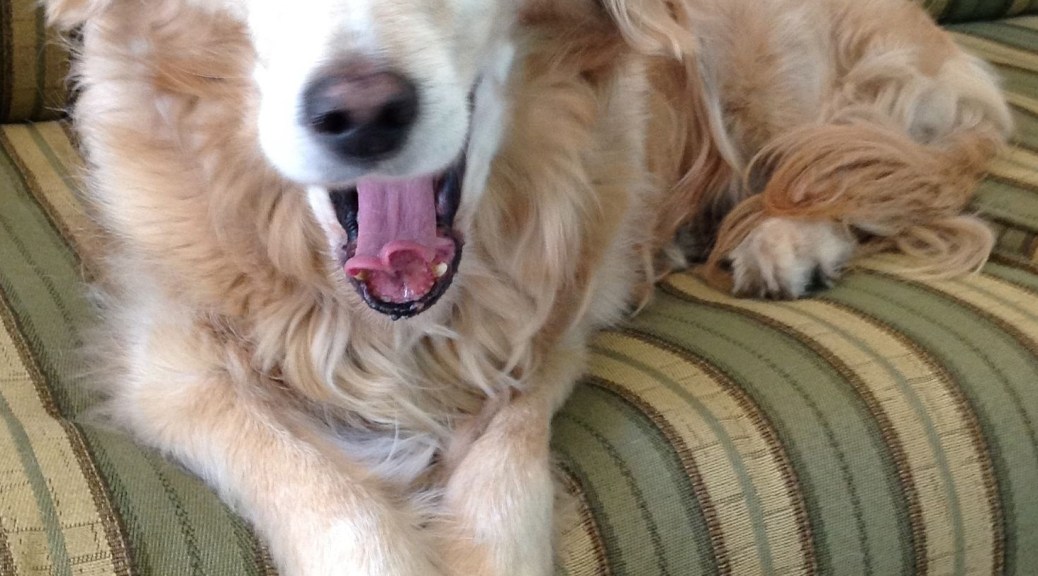
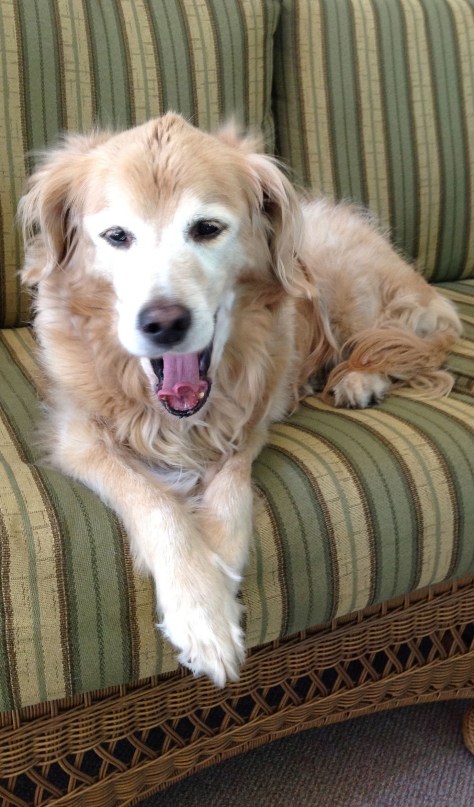
Yawn Shop

A new study says dogs yawn more in response to yawns from their owners than they do to the yawns of strangers. I just tried to make this happen with my dog by yawning several times right in her face. She wouldn’t look at me, possibly out of embarrassment. Or maybe I need to brush my teeth.

Diamond_yawning

But I did start to feel a little tired, so we took a twenty minute nap.

While sleeping I had a short dream that I was a frightened chipmunk running from a Rottweiler who had cornered me at the back of an open garage. With no easy escape, I cowered in a corner as the animal stood over me, drooling and trembling in the same way a movie villain pauses over a supposedly-vanquished superhero or secret agent to make a speech before delivering the final blow. It was a garage, so I considered grabbing a shovel from a hook on the wall and using it to force the dog to back away, but then I remembered, I’m a chipmunk – no hands. So I yawned. Amazingly, that caused the dog to pause for a moment, so I yawned again. The dog tipped its head to one side the way dogs do when they appear to be confused. I yawned a third time, and incredibly, the Rottweiler also opened its mouth wide.

Then I woke up.

I’m not sure this proves anything other than the potential fact that it is not very satisfying to fall asleep while reading science articles because it leads to complicated dreams about research. Maybe articles about yawning studies are bigger snoozers than comparable research papers. I should get a grant to study the phenomenon!

Contagious yawning has been observed and extensively documented between humans, chimpanzees and baboons, and there is reason to believe we have a stronger response to yawns from those we care about. Although the researchers in that study assumed the relationship between family members is automatically a more caring one than any relationship with others. That may not always be the case, since family members can be quite vicious towards one another (see Rottweiler, above).

There is also a theory out there that spontaneous yawning is a natural physical response intended to cool an overheated brain. I suppose you could observe this in any classroom where SAT tests are administered. Perhaps there is also a connection between test-induced yawning and spitwad formation in 16 year olds.

Back to my dog – she is definitely not responding to all the yawn cues I’m giving her, but she has started to obsessively lick a sore spot on her left rear leg. In this case, the theory of empathetic mimicry is not holding up. Although I am feeling a strong urge right now to bite my own ankles.

What makes you yawn?

Life Under Ice

Just when we had completely forgotten about its vast potential for holding deep mysteries, Antarctica’s sub-glacial Lake Vostok is back in the news. And I find nothing in this new information that will change the deep concern that grew out of our previous encounter with this topic.

Arctic_Ice_2

The news that Lake Vostok, hidden under ice for 15 billion years, is teeming with life, should give us pause. This is another step down the path originally imagined for this scientific story – the cinematic tale of research gone wrong where curiosity runs out ahead of prudence and rips the top off a container holding a monumental amount of trouble.

Already we have discovered that the story includes many of the stock characters from a standard sci-fi disaster – the researchers who are genuinely EXCITED to find that 95 per cent of the 3,500 some-odd DNA sequences found in the lake are associated with bacteria.

In case you’re wondering where we will find the dialog for this horror film, it is being written in the labs where they examine Vostok’s ice cores. For example, someone has already said this about the DNA findings ” … that doesn’t necessarily mean the unrecognized sequences are exotic forms of life.”

That line will be given to the first scientist to be engulfed and dissolved by the plasma-like creature that bubbles up out of his beaker while he has his back turned on it. Guaranteed.

Aside from all the obvious reasons NOT to take a big drink out of a chilled bottle of Vostok Spring, there is this – the scientists who found loads of bacteria in the submerged lake acknowledge that they only found recognizable life forms because that’s the only type of life they know how to look for.

Ergo, the life forms we have never encountered (if there are any) would still go undetected. They remain invisible until their effects become known!

And what of the more complex life forms living in the dark, slushy Vostokian bottoms? When we withdraw them from their chilly surroundings and introduce them to the modern world, there is no assurance that they will be grateful to us for doing it.

Much like the character in this James Taylor song, “The Frozen Man“.

You have been frozen in ice for one million years. Assuming your vital organs are intact (you didn’t donate them to science, did you?) would you want to be thawed out and re-introduced to the world?

Blogger Heads

I have to admit there are days when I wonder why continue to write six blog entries a week. There have been days when I’ve thought if not for the regular attendance of a troupe of dedicated Baboons, there would be little reason to keep the thread going.

cerebral_lobes (1)

Until now, that is.

A new neurological study indicates that keeping a brain active is one way to significantly impede the progress of dementia. Published in the scientific journal Neurology, this investigation found that a group of people who read regularly and were in the habit of writing letters had fewer of the physical changes (lesions, brain plaques, tangles) that go along with dementia.

And yes, they had to wait until the people the were studying had died. Then they took out their brains and examined them. Ugh. I wonder how it effects longevity to know that when you die they’re going to cut open your skull and put your brain in a jar? For me, that would be a huge incentive to stay alive.

Maybe I could get funding to study that.

Anyway, in the articles I saw on this topic, reading and writing were the only specific brain activities mentioned that could slow the advance of dementia, although the brain is such a multi-purpose instrument I’m sure there must be other ways to keep it “active”. Doing long division, for example. Or playing the piano or learning another language. How about rebuilding carburetors or memorizing state capitals? Suppose all you do is watch TV. Even trying to understand the activities of the Kardashians has to demand some neurological wattage. I would think knowing the names of all the current reality-TV stars is a remarkable achievement in the field of memory. At least I know it’s a mental workout I wouldn’t be able to do.

I’d be OK if reading and writing were the only sure things, brain-freshening-wise. I’m fortunate that I happen to like doing both, and blogging six days a week gives me a well regulated daily dose of each of these medicinal activities. Perhaps I should claim blogging-related expenses as physical therapy to prevent the build up of various bits of clutter and debris that can disable brains.

And maybe I should charge guest bloggers a surprisingly hefty fee for partaking of this brain therapy along with me, just like a clinic or a hospital would. But I can’t – I’m too kind-hearted.

Plus, I’m planning to take a couple of weeks off and I need the help.

So if you have an idea for a guest post, please send me a note and let me know what you want to write. I’ll write back to confirm the assignment, and you’ll feel better instantly. The deadline for finished pieces is July 15th – one week from today.

Write to me at connelly.dale@gmail.com, and give your melon the workout it deserves. A post a day keeps dementia at bay!

Would you donate your dead body to science? Why or why not?

Until now,

Asteroid Busters

NASA has issued an “all hands on deck” call for assistance in finding possibly threatening asteroids and developing plans to confront them. This “Grand Challenge” acknowledges the power of crowd sourcing to solve difficult problems. If two heads working on a conundrum are better than one, two billion heads applied to the same stumper are a great marketing opportunity for your brand.

The deadline to respond to NASA’s Request for Information is July 18th.

That’s coming up fast – almost as fast as a careening out-of-control asteroid bent on Earth’s destruction! So you’d better get started on your schematics. Get out a sharp pencil and a big piece of paper. All you have to do is design a system that will …

“… capture and de-spin an asteroid with the following characteristics:

  • a. Asteroid size: 5 m < mean diameter < 13 m; aspect ratio < 2/1
  • b. Asteroid mass: up to 1,000 metric tons
  • c. Asteroid rotation rate: up to 2 revolutions per minute about any axis or all axes.
  • d. Asteroid composition, internal structure, and physical integrity will likely be unknown until after rendezvous and capture.
Image: NASA/Advanced Concepts Lab

Simple, eh? Maybe so.

The beauty of crowdsourcing is that there are brains out there that will see this problem from just enough of a skewed angle to come up with an approach that no one else could think of.

The ugly of crowdsourcing is that millions of others will mimic each other with the same obvious but impractical and flat-out dumb idea.

NASA has given us a head start, releasing this image of one possible approach to creating a super-sophisticated space vehicle that could capture and transport a speeding space rock.

The idea has its roots in childhood play. It can’t be a coincidence that it looks so much like this extremely simple ball-in-cup game. Who didn’t play this as a kid? Or as an adult?

ball-in-cup

My problem with this approach is that I hated the ball-in-cup game. I found it incredibly frustrating and ultimately (because I couldn’t do it), boring.

I would never go this way with the Grand Asteroid Challenge. I’d go back to the solutions we tried on the hot, muggy, buggy nights of my youth and launch a giant sheet of super-sticky double-sided Asteroid Fly Paper. NASA could partner with 3M on this one. Building a thin but tough, mobile, super-sticky landing strip and putting it in the path of an onrushing asteroid wouldn’t be simple, but I believe it would be extremely satisfying. And the larger you make your sheet of Asteroid Fly Paper, the greater the chance you’ll get the asteroid you don’t expect – the one that wasn’t on your radar.

Once they’re trapped in the goo, we can examine freshly humbled space rocks to our heart’s content.

And no, I don’t know how we’ll get them off the paper, or even get close to them without getting stuck ourselves. That would be a DIFFERENT Grand Challenge.

How would you capture and control dangerous asteroids in space?

Your Name Here

I love this new picture from NASA of the surface of the planet Mercury.

Image of the Day from NASA
Image from NASA/Johns Hopkins University Applied Physics Laboratory/Carnegie Institution of Washington

This past March, the Messenger spacecraft (launched in 2004), achieved its goal of photographing 100% of Mercury’s surface. Since it is the closest planet to our Sun, I assumed Mercury’s surface was nothing but a molten mess of bubbling goo – not too inviting as a tourist destination. But now I can see that the surface is solid and it has craters. What’s even better, a naming convention has been established to pair Mercury’s pockmarks with dead writers, painters, musicians and other artists.

One of the most recent names approved for a surface feature on Mercury honors the Hawaiian slack-key guitarist Gabby Pahinui. Alvin Ailey, Bela Bartok, Glinka, Goethe, Goya, Grainger and Grieg are other names attached to similar Mercurian blemishes .

There are more standards when it comes to bestowing space names. On Venus, the International Astronomical Union names craters for women no longer on our planet, who, while they were here, made outstanding or fundamental contributions to their chosen field.

If you want to get your name on a crater of our very own Moon, you need to be an astronaut, cosmonaut, scientist or polar explorer. All dead, I’m afraid. It appears you can’t plant your name on a distant planet as a living person, which makes sense. Otherwise everything out there would already be tagged with the names of politicians and tycoons.

There are other guidelines for naming features on various bodies in outer space, though to qualify you would have to be, among other things, a mythological deity, a character from Shakespeare, or a coal field.

I’m guessing, were you able to take a survey of those who have received this unusual honor, only the astronauts, cosmonauts and some of the scientists might have taken a moment to consider that their life’s work would someday cause their name to be permanently attached to a crater. But I’m fairly certain it never crossed Vivaldi’s mind.

Walt Whitman, however, probably knew it was going to happen for him. And it did!

What in the world (or outer space) should be named after you?

Advancing, Icily

Screen shot 2013-06-11 at 9.11.13 PM

Now that the weather has turned warmer, I was not expecting to write about ice – especially after so many months with the opportunity right outside my window every single day. But this video from the Jet Propulsion Laboratory amazed me. The scientists there have figured out what might cause unusual markings they’ve seen on the surface of Mars. Downhill tracks that have a distinctive profile – a certain shape that helps explain how they were formed.

Under the right temperature conditions, dry ice can glide down a slope on a cushion of gas.

I love it that researchers were able to duplicate the effect here on Earth. Sliding blocks of dry ice down sand dunes is a form of light entertainment I hope to try someday – a kind of stranded-in-the-desert shuffleboard, I guess.

The notion of ice in motion reminded me of this incident from a couple of months ago, when the slowly melting lake ice in Lake Mille Lacs was pushed by a spring wind to create a real-life version of the voracious ice monster in a child’s nightmares. It comes across as the evil spawn of a slithering blob and a slow-motion avalanche.

Fun, at first. But horrifyingly relentless as it creeps, creepily.

I realize that we do not have to worry much about hurricanes, tsunamis and earthquakes in the Upper Midwest, but it feels like the ice is all around us, and on the advance.

What natural phenomenon strikes you as unnatural?