

Today’s post comes from Steve and Molly Grooms
I think every parent dreads the day when a child asks “that question.” I sure did. And yet it is almost inevitable that some day your child will come to you to ask the question you have avoided for years. And you can’t avoid it any longer.
“Daddy, I have a big question. You have to tell me: Is Santa real?”
This crisis of faith occurred for me when I was in fourth grade. I was playing with classmates during recess when I overheard a conversation that shook me up. One of my more cynical classmates was explaining that Santa Claus was an elaborate fiction. All that stuff about flying reindeer and delivering presents down the chimney was just a lie.
I didn’t join the conversation, but I began debating the issue in my head. I was that kind of kid.
By coincidence, a few weeks later I joined my dad as he ran an errand at his office at Collegiate Manufacturing, his employer in Ames. His office was in the third floor of the old Masonic Building. Because it was three stories tall, that building was one of the tallest structures in Ames.
While Dad fussed with his paperwork, I wandered over to the window on the north side of the building. Ames had a white Christmas that year, getting a drop of about five inches of snow the day before Christmas Eve. I was already experienced in woods wisdom at that age, having played outdoors for years. Looking out over rows of homes I suddenly knew the truth. Every home below me had an unblemished coat of snow, with no marks of sleigh runners and no reindeer footprints. Santa was a fraud.
All that came back to me when I became a parent and began teaching my daughter about Santa Claus. I bought books for her that showed in detail how Santa did his miraculous work. But when she turned nine I could tell she was beginning to harbor doubts.
Just before Christmas that year, the Pioneer Press Dispatch ran a huge color photo of Santa’s sleigh flying through the night sky. At the head of the team of reindeer was one that had a bright red nose. Molly stared at that photo in silent wonder for several minutes. She finally said, “And I was beginning to think Rudolph wasn’t real.”
Weeks later, right after Christmas, Molly came to me with a serious expression. “Daddy, we need to talk.” A group of friends at school had been debating Santa. Some believed in him. Some did not. Molly volunteered to resolve the matter, saying, “I’ll ask my dad.
He always tells me the truth.” The group agreed to let her research the question by talking to me.
With mixed emotions, I told her. As I remember, I made a big deal of the fact “Santa” was a fiction but Christmas love was not. Rather than debunking Santa I told Molly the love of parents was the true Christmas miracle. She instantly joined the great conspiracy to perpetuate the Santa story with younger children, and it touched me to see how hard Molly worked to preserve the secret with kids who still believed.
All this comes to mind because I just got a note from my daughter. For readers who might not know, Liam is my daughter’s five-year-old son. I’ll let Molly finish this story:
Liam came home yesterday, helped himself to a Christmas cookie and said, “Mom, we need to talk. About Santa.”
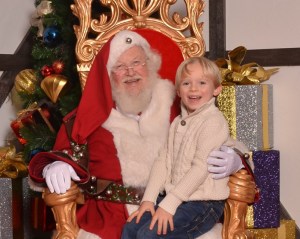
My heart sank. “What about Santa, Hon?”
Liam crammed the rest of the cookie into his mouth, dusted his hands off on his pants and said, “Well, it’s more about his wife.” He leveled a very mature almost-six-year-old look at me and said in a conspiratorial whisper, “She’s not really real, you know. That’s what they say at school.”
After 15 minutes of discussion on the merits of having a wife to look after the elves and reindeer, not to mention to work as an attorney or teacher so that you can essentially run a non-profit for the world’s children, we decided she must really exist after all.
As he left the kitchen in a trail of crumbs and with a red and green sugar cookie mustache, my heart almost broke.
Stay young, little one. Treasure what could be, as well as what is. Believe in magic and your own heart. And dang it–Listen to your mother, not your friends, for just a little longer…
Do you recall how you learned about Santa? Or how you told a child?

 Trail Baboon