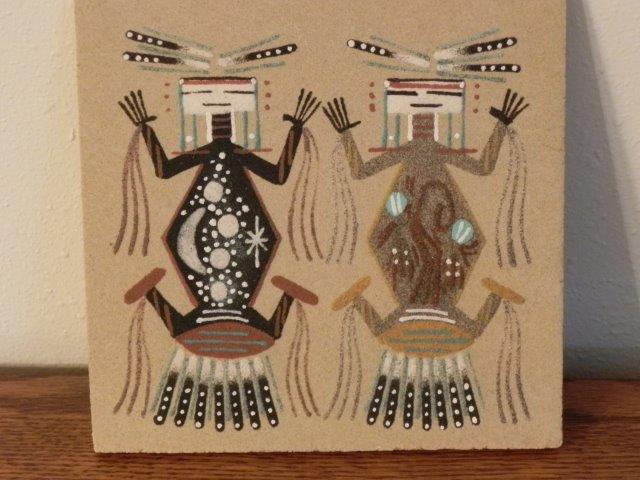
As I have explained before, for my wife Christmas is a six-month season. She often buys gifts in the summer, stores them away, and then rediscovers them, usually under our bed, often after Christmas. Last week she found two objects of clouded origin and unknown purpose.
Her initial recollection of when and where she purchased the objects led me down the wrong path in trying to discover what they are. So I put the photo up on Facebook and asked for explanations, encouraging the submission of smart-ass answers. My son re-posted in his Facebook page, from where, as I expected, came the answer. He has many professionally-creative Facebook friends of wide background and interests.
One of the answers, from one of my friends, was in Japanese. I do not know if Kazuki was right or not. Maybe. My two favorite smart-ass answers were 1) a Zanfir flute/pipe and 2) this link from one of my son’s friends.
This evening I will explain what they are. I bet during the day someone will correctly identify them. They are, by the way, nifty little devices. If you know the answer, you know the answer.
What mysterious objects have you run across in your life?
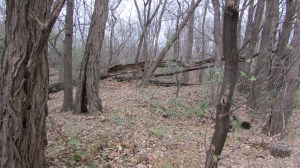
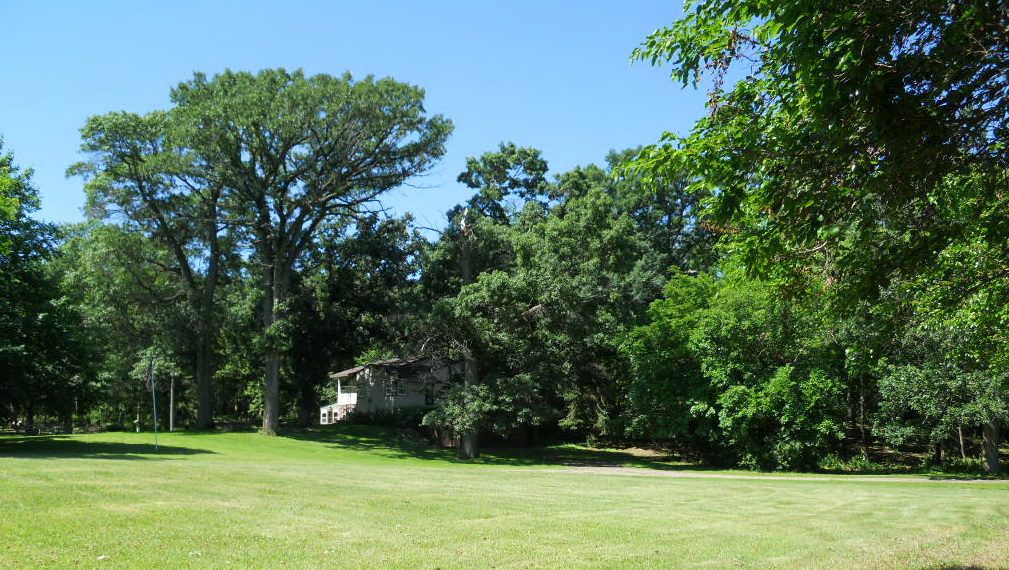
I sit at my computer and look out my apartment window into the woods at the top of a ravine in Mankato and see this.
Look at that mess. Nature is just untidy, disorderly. It needs a correcting human hand. No, you say? But then you are not the son of a man who was a pioneer born a century too late.
This is my father having fun. You cannot recognize it, I suspect, but I know he is smiling. It is one of only two or three pictures of my father smiling. Was I born with the same urge or did I learn it at our tractor’s knee? Nurture/nature? Is it a male thing?
Earlier this week just to get outdoors, I stepped into the snarled pile. I pushed at one of the upright pieces of tree trunk in a desultory way. It toppled to the ground. The itch was in my palms. With a back nearly as decayed as the trunk I just toppled, it would have been wise to walk away. I pushed at three more with my foot and found them as badly rotted. The itch was in my palms. Beside me was a deep ravine, already full of rotted trunks and dead brush.
I suspect from watching my father that many of the pioneers had a lust to reduce nature to human terms. Many of the first pioneers just kept moving on and doing it over and over again. This is a topic on which I have read extensively. I am sure you can see why.
Forty years ago I took a class on literature of the North Woods, which is not a large body of work, not much of it very good. The best piece we read was Robert Treuer’s The Tree Farm, which is a book well worth a read. Here is a part of a paper I wrote for that class.
“On his tree farm Treuer must walk the edge between nature wild and nature cultured; he must keep the wilder aspects of nature at bay without destroying nature or allowing nature to destroy or reduce him. The dangers of the North Woods are survived if the necessary precautions are taken. It is not a nature that threatens to rise up and destroy us with alarming ease. If we dress and build appropriately, the cold can be kept out. With some care the storms can be withstood, the rapids can be run, and the bears will not eat us. Nevertheless, past history and current news tells us that lives can be lost or ruined if one forgets the rules or tempts nature too much. We live in this region to live with nature and survive it while keeping it as natural as we can.
“So too in our day-by-day lives we want that nature within the right bounds. We move to the country but we cultivate a lawn. We mow that lawn right up to the edge of the woods, always feeling the urge to push out a little more and tame another few square feet. One summer’ neglect, however, will find the weeds back at our door. Two summers will return it all to brush. It takes constant effort to keep nature within the bounds we prescribe without losing the nearness to nature we reached out for when we moved here.”
I scratched my itchy palms. Today the snarl looks like this, all accomplished without using a single tool.
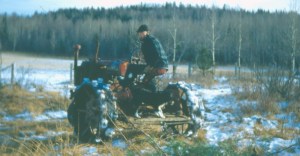
When done with the deed, I felt as my father did in this photograph of him going home after a day of clearing land, pipe in mouth, satisfaction on his face. (Don’t miss the dog riding on the tractor platform.) My son’s photographer friends find this image iconic, say that it represents a larger moment in time than 1957 (ca.) and more than just my father.
My 13-year-old daughter is very excited that Halloween is on Friday night this year.
She asked me about the origins of Halloween and I being a good recovering Catholic coming from a good Catholic household knew that Halloween is the celebration of the fighting from the spirits on the day before all souls day.
On all souls day heaven comes down and takes the good spirits directly to heaven with no stop in purgatory on the way but if you’re not a good spirit you may end up going to hell instead.
My father was a person who was involved in activities at the Catholic church and was asked on numerous occasions to spend the night of all souls day in church guarding against the possibility that the spirits could be taken to evil places if they were not guarded properly. This evolved into our wearing costumes and hiding from the demons.
When people from other parts of the world, and ask what is this Halloween holiday it’s a hard one to explain.
“Well we have the children dressed up as ghosts and goblins and they go knock on peoples doors and threatened that we will trick you if you don’t give us a treat and beg for candy expecting for the house to be prepared for our begging. Some of the side benefits are that you can go to someone’s house you don’t like and toilet paper their tree sold their windows egg their cars and do awful things to people in the name of the holiday tradition.”
I remember my favorite costume was that of a pirate in fifth-grade complete with big blousey sleeves on my pirate shirt.
In later life I went to the barbershop and got hair clippings to glue on along with a putty nose to complete my Wolfman attire.
At my house now if I get 10 kids it’s a big year – this is because of my long driveway.
My work associate took great delight in hiding in the bushes outside his house so that when children came to get candy from his wife at the door upon their turning around to leave the house he would spring out with raised hands and yell boo and make them cry and run away sometimes dropping the candy bags they were so scared.
I think any place that allows people to exhibit such behavior should be celebrated. We are such a predictable anal society today that I think finding an excuse for people to get into costume and take on identities while dangerous is also good therapy.
It makes me think that I should start contemplating my costumes once again. The only thing that’s kept me from doing it is the realization that it’s just going to be for those 10 kids to come down the driveway.
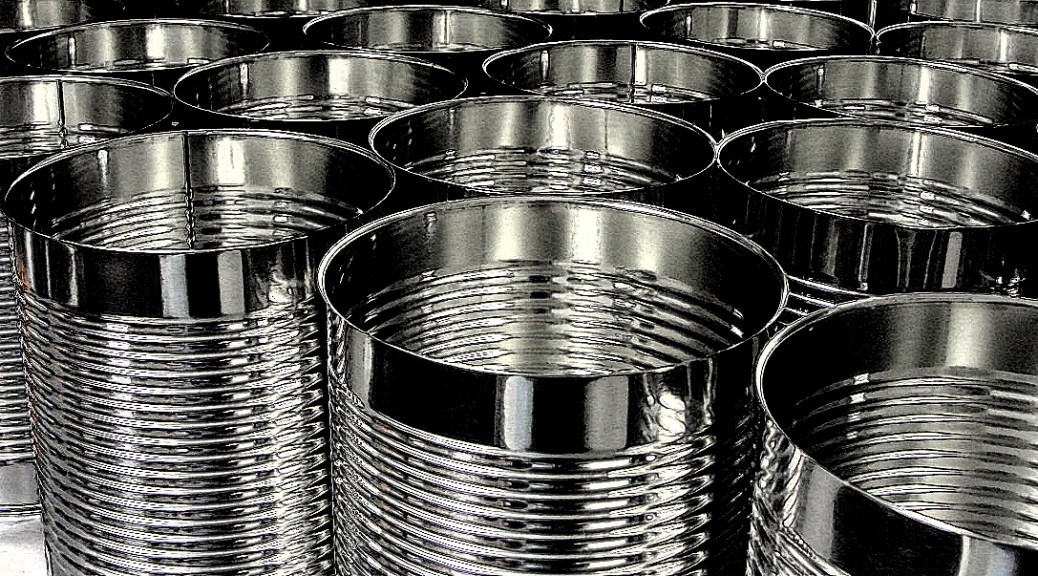
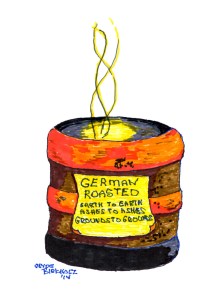
In an effort to save a couple bucks, I bought a can of Folgers Coffee. Not a can actually, a plastic. Can we call it a plastic? If the English can call a can a tin, I declare that we can. Usually I buy coffee in a bag, the better stuff.
As far as taste goes, it was an error to buy the plastic. As far as economics go, it was a wise decision, but barely. My mother would have been proud of me. Frugality, punctuality, individuality—the three virtues of Adeline Anne, bless her departed self.
As I opened the plastic, I wondered how farmers would have survived the last century without coffee cans. In our neck of the woods, Duluth’s own Arco brand was the most common. The one pound cans were particularly prized, but that caught my mother at odds–to pay more per ounce for her coffee to have the size of can she and my father wanted. Life is full of dilemmas.
They were everywhere on our farm. Grain scoops, chicken feed scoops, clothes pin holders, grease containers, egg baskets, retainers of nuts and bolts and screws and washers and cotter pins (wonderful word that–cotter pins). In the garden they were watering cans and baby plant protectors. In the house, holders of my mother’s mammoth assortment of buttons, crayon container, coin collector, shoe lace storage (odd ones left over when one broke because they could be used to tie plants to support sticks; my mother was cheap), sewing kit, flower pots, and many more uses. The wonder is that we had that many around, considering how weak my mother made their coffee—frugality again.
Now, of course, I have this plastic, which will be empty in a few weeks. However, I cannot think of a storage use for it. I could keep my cotter keys in it, except I gave up all my cotter keys three years ago. We live in a smallish apartment and have eliminated all the stuff we can, which means we have little to store, and no business keeping a plastic in which to store nothing.
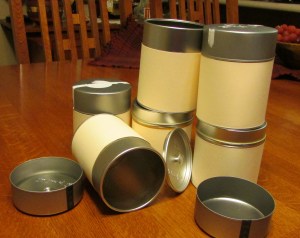
I also have these perfect little tins, which I acquired by ordering an expensive tea. I say tins because tins of tea sounds much more elegant than cans of tea. (Do not, please, tell Adeline Anne I used to order expensive tea instead of buying Lipton’s.)
Are not these tins perfect for storing cotter keys or lots of other things? Well, if I stored cotter keys in them, then they would have to be cans. Nope, haven’t found a use yet. But I am keeping them, so help me. Maybe I will go out and buy some cotter keys.
The plastic, is of course, an environmental error as well, unless I can find a permanent use for it. Now that I think frugally about it: I am going to be cremated.
Maybe that’s the true meaning of good to the last drop.
What would Adeline Anne think of your spending habits?
Today’s guest post comes from Barbara in Robbinsdale.
One of the reasons I like to travel – especially when it’s “over the surface” of the country by car or train, is that I always come home with a slightly different perspective on my life.
Being in touch with all that space just gives one pause, and last month’s road trip to Utah is no exception. The highway (I-70) that we drove through Colorado’s Rocky Mountains was lined with aspens that look like yellow flames in the dark evergreen forests.
In southern Utah, one canyon made you think you’re in a cathedral, and the second must have been dropped there from another planet.
We noticed all kinds of little differences between there and home – names like Grizzly Creek and Hanging Lake; towns called Eagle, Leadville, Rifle, Yellowcat. Road signs warned of “Falling Rocks” or “Avalanche Area”.
And sure enough, several times along Utah’s scenic Highway 12, we slowed for small groups of cattle grazing in the ditch.
The Cathedral-like Zion National Park, Utah
Undeniably True
Bryce Canyon – Extraterrestrial Scenery
My favorite road sign, “View Point Ahead”, echoed my mood.
I am prepared to come home from any journey with a change in point of view – I look forward to it. This time I’ve arrived with shifted priorities, ready to explore what I can and cannot do with my life.
He’s got Japanese roots, but was actually born in Georgetown, KY. He was named after Miles Davis, one of the greatest jazz musicians of all time.
He’s kind of blue, and he’s reached the age where he’s comfortable with his body and his looks
Miles has visited each coast, been to Canada several times, and almost been to Mexico. He’s traveled nearly the equivalent of a one-way trip to the Moon. He’s gotten a few bumps and bruises along the way, suffered a few minor internal ailments, but otherwise has aged pretty darn gracefully for being 23 years old.
He’s into the Neo-Renaissance thing, and has many and varied interests.
He’s been a good friend for all the right reasons: faithful, reliable, and dependable. He also gets along great with my wife since he spent a lot of time with her the first half of his life, and they’re still on good terms with each other. He can keep a secret better than anyone I’ve known (when we’re out together with the windows closed and I rant about bad drivers or outrageous/stupid/ignorant things I hear on the radio). Based on a few close calls we’ve had, he’s always been willing to put himself in harm’s way to protect me.
He’s health conscious, but also has a sense of humor.
Sometime in the next year or so, Miles will retire, hopefully to a good home that will take care of him in his last years. I don’t want to be the one to pull his spark plugs, so I’d like to either sell him to someone who will use him gently for his remaining time, or donate him to the radio station he learned to love after all those years, Minnesota Public Radio. His favorite show was Leigh Kamman’s The Jazz Image. Yeah, late Saturday night drives home while listening to all those great jazz tunes were some damn good times together.
He’s interested in politics.
His politics were always a little bit different, but he’s a live and let live kind of car, so that’s cool.
He’s a long-time supporter of worthwhile charities
But his heart (engine) has always been good and true, and he believes in helping those less fortunate, (maybe getting a good meal out of the deal after taking the Big Brother (owner) and his Little Brother up to the BWCA for some canoeing and camping.)
When he slowly rolls to his final stop, I hope he’ll be c(a)remated rather than tossed into an open graveyard with hundreds of other rusted old heaps. Better to recycle his useful elements ASAP than have him slowly decay and pollute the ground water.
As his final day approaches, I find myself feeling sad and melancholy. I took him for granted for the first twenty years or so. I always assumed he be there, start on command, get me where I wanted to go fast and efficiently. I would let him go weeks, even months without a shower; throw trash in his backseat; let dust, dirt, mud, and a multitude of food crumbs accumulate in his cracks and crevices; and delay taking him in for regular checkups. At least I made sure he got his annual or biannual oil transfusion. I wasn’t nearly as good a friend to him than he was to me.
He loves to visit wild places, and he’s a firm believer in self-reliance and personal responsibility.
Yet Miles never complained, always had a smile on his grille, always purred like a tiger when I started him up each day. But only rarely would I pat him on the roof and say, “Nice job, Miles. That was a bad storm you just got us through,” or “Thanks for a smooth ride.” Even though I ignored him a lot, I was grateful for every safe trip we ever took, even the shortest trips down to the local convenience store for gas, or bananas and milk, or a late-evening summer ice cream run.
So thanks Miles. For everything: Every new mile. Every new road. Every new town. Every new vista. And all the old ones, too. I’ll miss you when you’re gone. Ashes to ashes, rust to rust.
My question: Why do we anthropomorphize and befriend inanimate objects such as cars? Tell me about your most trusted and rusty friend.
Today’s guest post comes from Renee Boomgaarden, known as Renee in North Dakota.
A couple of weeks ago, husband and I were invited to a ceremony that a Native American friend organized to commemorate the fourth anniversary of his mother’s death. Our friend is Arikara, a member of the Three Affiliated Tribes (Mandan, Hidatsa, Arikara) who live on the Ft. Berthold Reservation in western North Dakota.
The ceremony took place in Bismarck while our friend was camping at the United Tribes Technical College Pow wow. It was conducted by Eric, a Lakota Indian from the Pine Ridge Reservation. He is our Arikara friend’s spiritual advisor. Eric explained that the Native American period of mourning lasts four years, and the purpose of the ceremony was to set free the mother’s spirit and bring her children out of the mourning world.
Our friend and his five siblings lined up by the camper and we observers sat across from them. A plate of food and a glass of water for the mother’s journey into the next world was set on a nearby table. The ceremony began with all present getting smudged with cedar smoke, fanned on us out of a shell with a leather-bound bunch of eagle feathers. Eric then stood between us and the siblings and directed two Lakota traditional singers to sing the song to help the mother’s spirit leave this world and travel to the next. He said prayers in Lakota to the four winds/directions. Then he brushed each of the siblings head to toe with the eagle feathers and wiped under each of their eyes with his fingers to remove any tears.
Eric then directed the singers to start the Song of Welcoming, to welcome our friend and his siblings out of the world of mourning into our world. Each sibling was given a taste of corn meal and a drink of water. We observers very formally shook hands with each of the siblings while Eric said another Lakota prayer. We then sat down to a potluck supper, the oldest person going through the line first.
Everyone mourns in their own way and in their own time. Our friend was very happy at the conclusion of the ceremony, surrounded by friends and family, sharing a meal, at peace.
Today’s guest post comes from Renee Boomgaarden, aka Renee in North Dakota.
Sometime in 1925, the residents in and around Ellsworth, MN were abuzz with the news that Okke Boomgaarden had bought a $3000 accordion for his daughter, Amanda.
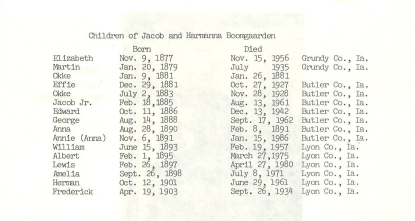
Okke was my great uncle, the fifth oldest of the sixteen children in my grandfather’s family. Okke was, officially, a farmer, sort of like how Don Corleone was, officially, an olive oil importer. Okke made his money bootlegging, and his barn was used for dances, not livestock. Okke had regular dances in the barn. He provided refreshments, at a cost, and members of the family provided the music.
Family historians talk about my grandfather and many of his siblings having a natural aptitude for music. All were self taught.
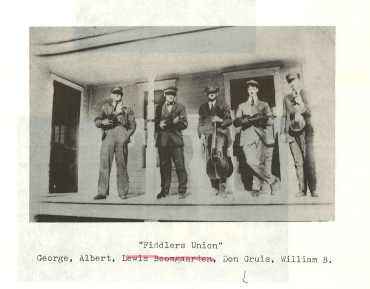
Great Uncle George learned to play the fiddle when he was 16.
Great Uncle Albert also played the fiddle.
Great Uncle Herman was a noted left handed banjo player.
My grandfather played the cello.
Great Aunt Amelia played the piano.
Other family members played the accordion.
In the years before the First World War they were know as The Boomgaarden Orchestra and played for dances, weddings, and harvest festivals in northwest Iowa and southwest Minnesota.
After the war, they changed their name to Mandy’s Jazz Kings, and played in Okke’s barn, joined by Okke’s children Georgie on fiddle, Jake on saxophone, and Amanda and Mabel on the accordion.
My father remembers going to some of those dances when he was a little boy, driving to Ellsworth with his parents in their Graham-Paige automobile. I wish I know more about the music the Jazz Kings and the Boomgaarden Orchestra performed.
I wish I knew what happened to my grandfather’s cello. Until I researched for this post, I never even knew he played a string instrument.
Okke died of a heart attack in 1928, and the dances stopped soon afterwards. The older members of the Jazz Kings had their own farms and families to care for and couldn’t play with the band anymore. Okke’s sons Georgie and Jake kept playing, changing the name to The Georgie Boomgaarden Orchestra. Georgie and his band played in the towns around Ellsworth until the 1970’s.
The Depression hit everybody hard. At one point, Jake’s saxophone needed $12.00 worth of repairs, but he didn’t have the money to fix it. The local doctor intervened and paid for the repairs. He had just built a night club in Ellsworth and needed musicians to play for the dances.
My grandfather felt it was important for my dad and his brother to have some kind of music training despite the tight finances. Grandpa drove Dad and Uncle Alvin to Luverne once a week to practice with a drum and bugle corps. This group was comprised of sons of World War I veterans, and you can see them in the photo at the top of this page. Dad played both drum and the bugle – he is the third boy on the right in the back row. He can still play his bugle, and has two of them in his bedroom.
Renee played bass clarinet for Concordia.
My children and I are the current Boomgaarden music amateurs along with my husband. Husband plays the cello, guitar, harmonica, and piano. He also sings. You can see me playing my bass clarinet in the Concordia College Band in 1978. Daughter plays the violin, French horn, and piano. She sings in college. Son played the trombone and sang in college. He currently sings in the church choir. I drafted husband to join the handbell choir. He drafted me to sometimes play the bass guitar in a very amateur gospel/rock and roll group.
Why do we do these thing? I have no idea. Maybe Okke will explain it to me someday in the Hereafter.
Today’s guest post comes from Barbara in Robbinsdale.
7:00 p.m.
One of the books that (some of) our Baboons read for a recent Baboon Book Club (BBC) gathering was A Slender Thread by Diane Ackerman.
In it she told some of her experiences helping to staff a volunteer crisis hotline for humans, juxtaposed with her observations of the squirrel population in her yard and their crises. I am not, as she was, gathering material for National Geographic, but reading her work has changed me in this way: I’m allowing myself to sit for more than a few minutes to watch the wildlife just outside our back yard screen porch.
Last night was outstanding.
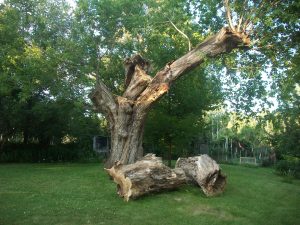
Our big yard must be heaven for the critters. Lined with hedges and a terraced “rock wall” (the chipmunk highway), it has plenty of trees for the squirrels, flowers for the bees and butterflies, and berries for the birds. The huge once-majestic box elder tree has lost all its major limbs now, and the last two are still sitting where they landed beneath it – these now provide another hiding place for the animals.
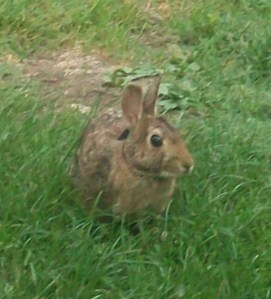
We have several resident cottontails that we see regularly for silflay (the morning/evening meal in the meadow, as told in Richard Adams’ Watership Down.
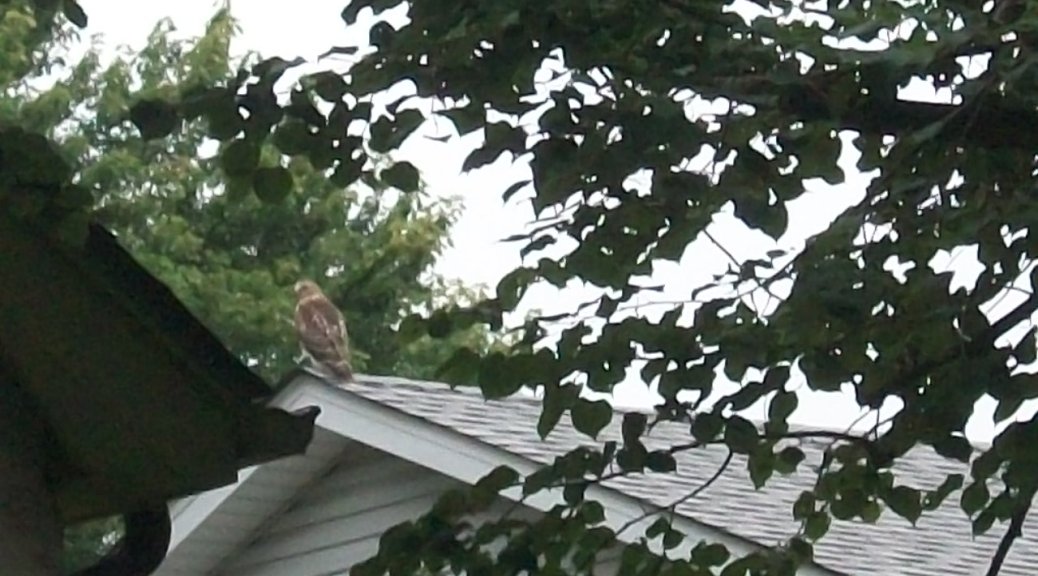
I’ve dubbed them Flopsy, Mopsy, and Mombunny, though of course I can’t tell the younger ones apart. I am watching them closely tonight, because earlier a hawk of some kind (Northern Harrier?) swooped toward a chipmunk who was hanging out by the herb garden.
7:30
There are now three robins hunting for stuff through the grass – no wait, four – no… five robins. A squirrel just shot across the lawn with a huge green (unhusked) walnut clamped in its jaws. Flopsy scampers around the fallen tree sections, with Mopsy close on his heels. Careful, Flopsy – that hole is where the beehive is, I think. Mombunny is now over by the rock wall on her hind legs, now nibbling on a wild rose twig, now heading for the back 40 – lippity lippity, not very fast.
8:00
It’s quieter – just two bunnies left feasting on the clover, Flopsy washing his face like a cat would. He only hops off when Mopsy gets too close, and then they’re racing around again.
8:30
Really getting dark now – if their ears didn’t twitch, I’d never see them in the grass. I leave them finally – all I can make out is two darker spots in the dark green of the “way back” lawn/meadow, where they’re probably contemplating how to get back into the veggie garden just beyond.
And that story is for another day
What has been the most critter friendly place you’ve lived?
A long time ago I was witness to a case of mistaken identity that came close to having disastrous results. This took place at the first home I remember living as a child. I was still quite young, 5 years old or so, I think, and had two older sisters and one younger brother.
Our family had close relationships with several of our neighbors. On this particular day, we – my mom and us kids – had been somewhere with another neighbor family. They dropped us off at our house and as we walked up to our front door, we all saw it – an animal in the flower bed that was next to the front steps. My brother, who is 2 ½ years younger than I am, toddled towards this animal, calling “Kitty, kitty, kitty” and holding out his hand.
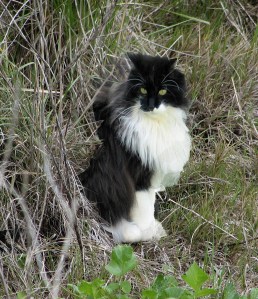
Well. This creature did bear some resemblance to a cat – a long-haired black and white cat – but it definitely wasn’t what any of the rest of us would call a kitty.
All of us girls were struck dumb with shock and horror, because we knew what could happen if our brother tried to pet the animal. I was too scared to move but luckily my mom was not. I rarely saw my mother running, but she did then – and the sight of my mom sprinting and snatching up my brother before he could get closer to this creature would have made me laugh out loud, if I hadn’t been so frightened.
Somehow we managed to all get in the house without anything disastrous happening. Later, I heard that the cute black and white animal was probably rabid, so who knows what would have happened if my brother had managed to get close to this “kitty.” Oddly enough, now my brother has a special way with cats, but I’m pretty sure he knows exactly what is and what isn’t a kitty and will never again mistake a skunk for a cat.
(skunk photo: Kevin Collins / CC-BY 2.0)
When have you been involved in or witnessed a terrible case of mistaken identity?



 puter and look out my apartment window into the woods at the top of a ravine in Mankato and see this.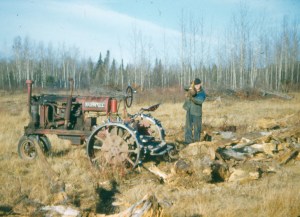






 Trail Baboon