Category Archives: The Baboon Congress

Music: The Most Powerful Art Form

Today’s guest post comes from Chris in Owatonna.

How many times have you been to an art museum, looked at a certain painting or sculpture, and started to choke up or cry, feel joy or triumph?

I certainly don’t recall any extreme emotional moments looking at art.

How many times have you looked at a photograph, read a book or a poem, watched a play, or experienced any other art form, and been moved to tears or other powerful emotions?

Once or twice? I’ll admit I’ve done that on rare occasions. A few years ago, I surprisingly choked up at the climax of The Help by Katherine Stockett. And yes, it was the book, not the movie.

Now, how many times has music brought you to tears of either extreme joy or great sorrow?

For me, dozens of times.

Right now, I bet some of you are saying, “Wait a sec. What about movies? Lots of movies make me cry. What about the ability of the filmmakers and actors to elicit such powerful responses?”

To that, I say try watching the movie with the sound turned off or the music edited out somehow. Example: the scene at the end of It’s a Wonderful Life where Harry makes the toast to “My big brother George, the richest man in town.” Everyone singing Hark the Herald Angels Sing sets up that line. Without the music, it’s just a happy party. The song signifies the town coming together for George and the apparent miracle that saves him. That’s why my waterworks start. The old cliché, “Cue the violins,” rings true because without an effective musical score, most movies would carry much less emotional impact.

This leads me to my point. I’ve stumbled across another one of those rare moments: a song that is arranged and sung so powerfully, so perfectly, that it stunned me into silence, then brought tears to my eyes. The last time that happened was the first time I heard Eva Cassidy sing Over the Rainbow on the Morning Show way back in February of 2000. I remember that day as vividly as September 11, 2001. It was just before 8:00 and I was cleaning up my breakfast dishes. Through the whoosh of the water, I heard this sweet voice and simple accompaniment. Mesmerized, I turned off the water, went to the living room, turned up the volume, and listened attentively. When she hit the last high note, then finished with that gorgeous chord progression and final arpeggio on the guitar, I melted. I couldn’t buy the CD fast enough, and when I got it, listened continuously for days. I’m sure I listened 100 times that first day, putting it on endless replay. By now, I’ve listened to Eva sing Over the Rainbow THOUSANDS of times. It can still make me cry on occasion, at the right moment for whatever reason.

This young man’s name is Sam Robson, and the performance I’ve linked of him belongs in the rarified strata of Eva’s best singing. I hope you enjoy it as much as I have. I only wish he’d put it onto a CD so I could buy a copy. In the few weeks since I first heard this, I’ve listened at least 100 times and can’t get it out of my head. Please listen on your best speakers, or better yet, with a good pair of headphones. And no distractions or multitasking. Just soak up this most beautiful noise.

What music moves you to tears?

Pastels and Pixels

Today’s guest post comes from Clyde.

I am an addict without a support group.

Clouds. I am addicted to clouds. Not ICloud or Dropbox or Mozy. No, the things up there in real space, not in etherspace. The white, gray, blue, pink, purple, yellow, orange things. The puffy, stringy, tiered, tumbling, feathery things. The spring, fall, summer, winter things. The gay, brooding, ominous, exhilarating, majestic, mysterious things.

I got this addiction when I started pastels. Delightful and fulfilling it is to paint clouds in pastel. You layer on the dust, push it around, coloring your fingertips. If it goes right, which it often does for clouds, in a few minutes you have the top portion of the painting completed. Wise you are to make the sky the major portion of the painting.

Then came, sorry to say, the digital camera. I can shoot and shoot clouds and pick out the best. At least the theory was to pick out the best. Pretty soon I was keeping all the pictures, printing most of them, on the premise that any view of clouds might work in one picture or another. First I had a file called “Clouds.” Then I had files labeling clouds by colors, forms, moods, seasons.

Just when I thought I was getting control of my addiction, we went to Seattle, which is Sin City for the cloud addict.

It must be on our genes.

What’s in your genes?

Furry Humans

Today’s guest post comes from Joanne in Big Lake

I am not an animal person. We had some dogs growing up and I enjoyed them, but once on my own, I learned that apartments don’t like pets and I was allergic anyway. That was my excuse when we did have a house and the kids really wanted a dog.

Even so, I always enjoy interacting with other people’s pets.

I was astounded to learn that animals have very distinctive personalities, quirky behaviors and dysfunctions just like their human owners. My first realization came while I was working in the home of someone who had 2-3 dogs. One was a giant, dumb and friendly labrador named Bruno who would force his 50 lb blockhead onto my lap or under my hand, begging for love and attention. Another dog was a jumpy and smart little miniature doberman named Taz who would run around underfoot.

One day when owners were out, the UPS man dropped a package outside the door. Our menagerie of dogs and human went to retrieve package, the dogs barking a chorus of “let’s get the mailman.” Unfortunately, the package was just out of reach. When I inched the door open just a little more to reach the mail, the dogs exploded out of the house like corks, racing madly after the UPS truck. I was horrified as I watched them streak down the long driveway tailing the UPS truck, wondering if they might get hurt or run away. Luckily, I was finally able to corral them back into the house. I tried to pick up Taz, but he evaded me and went up steps alone with a distinct limp. Then Taz sneaked away to his little doggie retreat out of sight.

When the owner returned, I felt very chagrined to inform her of Taz’s injury. Her very nonchalant response was, “Oh he does that all the time – he’s just faking it.” I was stunned. I had never heard of a pet faking an injury to avoid punishment or garner attention. She continued to say that they had brought Taz to the vet on a couple occasions for his “injury” before they caught on, and noticed he was inconsistent with his act as well. I found this absolutely hysterical as it never occurred to me a pet would employ such a clever trick.

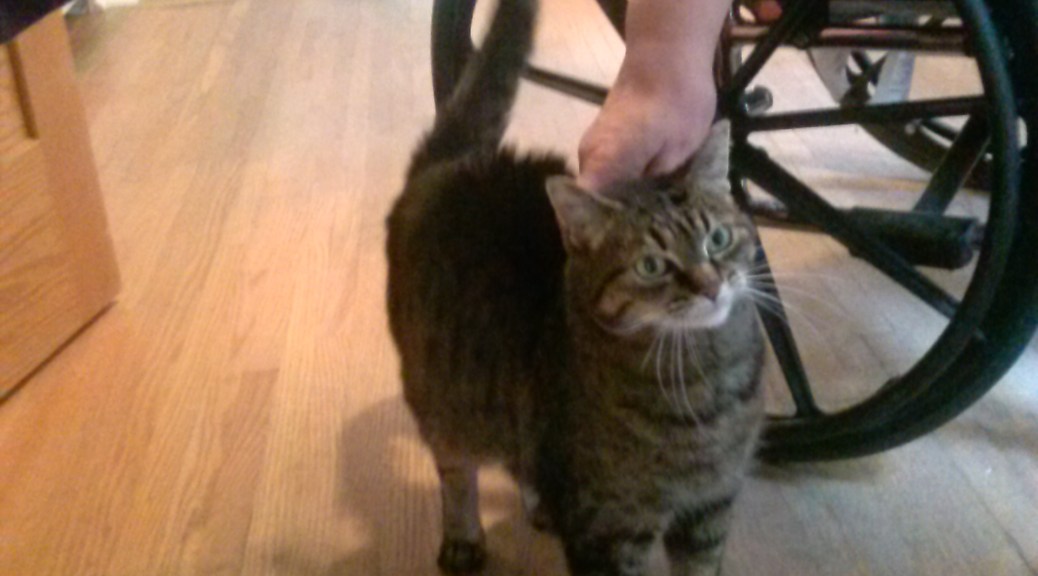
Another woman I know has 4 indoor cats and supports a welfare state for an outside herd of feral cats on her large, pastoral property. Helios, an old tom in the house, is a grumpy old man in every sense of the word. I get a snarly meow just walking past him. Additionally, he will only, and I mean ONLY drink running water from the well water tap. Calpurnia sticks to herself and actually snores while she sleeps. Siete always finds a place to snuggle on my friend’s lap and sleeps there for hours. Pita (short for Pain in the Ass) always gets into things – one reason why the toilet paper is not on a holder but hidden after she had TP’d the entire house. One or two of them will only eat from a certain bowl with a Christmas holly design on it. If there isn’t food in it, they won’t eat.

I guess it’s true – animals are people, too!

Describe an unusual pet personality trait.

Ice Cream Sociable

Today’s guest post comes from Verily Sherrilee.

Recently, we celebrated a great achievement of one of our own. 

Trail Baboon reader and contributor Beth-Ann Bloom won last year’s Ice Cream Dream Flavor Contest sponsored by Kemps.  If you were around last summer you probably remember the daily voting that the baboon community embraced enthusiastically; a few of us even made it to the State Fair to sample Beth-Ann’s ice cream when the voting was narrowed down to only two candidates.   

Beth-Ann’s “Mini-Sota Donut” creation was the big winner and now we have a cold treat celebrity in our midst.

It has been a “Miss America” kind of year for Beth-Ann – serving as an ice cream ambassador with TV spots and even a personal appearance at the Woodbury Cub!  Now that Mini-Sota Donut is finally hitting store shelves, she’s been inundated with queries about where to find her ice cream.

Ice Cream might be the most sociable summertime treat. There is an urgency to any ice-cream based gathering (eat it before it melts!) and it welcomes a multitude of add-ons. Our ice cream get-together was a potluck affair – everybody brought a little something to the party. Contributions included bananas, chocolate sauce, sprinkle, root beer and ginger ale (for floats) and some apple caramel sauce.  We ate out of bright-colored ice cream soda dishes and plied Beth-Ann with questions about the process of becoming a frozen dessert diva and what the past year has brought her. She will be able to gift a charity (ice cream for the food shelf) and she will be one of the celebrity judges for the Kemps contest at the fair this year.

You will notice if you look closely at the carton that each “scround” (that’s what they call the rounded-off square cartons) of Mini-sota Donut Ice Cream bears Beth-Ann’s signature – a rare honor in a world where only TV chefs, pop stars, movie stars and Hall of Fame athletes get to have their names put on food.

Congratulations once again to Beth-Ann as she prepares to pass on the Ice Cream Crown to a new winner.

What food is a “must-have” for your most sociable get-togethers?

Tiny Paper Storm

Today’s guest post comes from Sherrilee.

Art Fry is my hero.

That’s right, my hero. I know, I know. Heroism brings to mind Superman, Wonder Woman, firefighters and soldiers – the sort of super-human person who arrives a the last moment to rescue the helpless and the lost. For me, that guy is Art Fry, an inventor who provided me with an essential workplace tool.

Art Fry was born on August 19, 1931 in Owatonna, Minnesota. He studied chemical engineering at the University of Minnesota and while he was still in school, he took a job at 3M; back then it was called Minnesota Mining and Manufacturing Company. From the beginning he worked in the new product development area. In 1973 he came up with a use for another engineer’s unique adhesive; he got the idea because little slips of paper that he used to mark his choir book always fell out. It was the birth of the Post-It® Note.

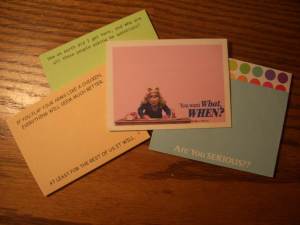
Post-It note

I’ve been in love with Post-It® Notes from the time I entered the workforce. I can’t get enough of them! Little notes about which store to call, little notes about ordering more of that bestseller, little notes with birthdays that I don’t want to forget, little shopping lists, little to-do lists, little bookmarks – you name it.

No matter the task, I can figure out how using a Post-It® Note will improve the process! And I’m not alone. Take a look at how these guys have used Post-It® Notes to waste vast amounts of company time.

PostIts

Seeing all this Post-It® Note carnage is fun but also troubling, since I don’t like waste and I’ve become something of a collector. At home I have a little basket in my studio with all my Post-It® Notes pads and at work I have over 40 pads of notes, from little arrow-shaped notes to large lined notes. I have funny workplace notes and notes from hotels around the world, Disney notes and Muppets notes. I have a couple of pads that are over 25 years old; these are the ones that I think are particularly hilarious so I have used them sparingly over the years. If anyone ever creates a Post-It® Note Museum, I’m destined to be a major benefactor.

And now as a promotional deal, 3M is running a Dreams for Good contest for people who “like” their Post-It® Note Facebook page. The rules are rather involved, but basically you write down your idea for improving the world on a Post-It® Note and send in a picture of it. If your entry is a winner, you get $25,000 to start putting your inspiration into practice.

Sounds like it would be fun to enter, but winning would be a lot of work.

All of this commotion can be traced directly to Art Fry’s brilliant solution to a rather ordinary problem. So you can have your winged and caped heroes and crusaders. Art Fry rescued me from a world without Post-It® Notes. And for that, I will always be grateful.

Name a simple invention that has improved your life.

Lick Your Wounds

Today’s guest post comes from Steve Grooms.

Let’s imagine that life has beaten you up lately, and now you hurt. Maybe the Powers That Be at your office decided to erase a favorite application off all the hard drives and force you to learn a new one. Maybe someone said something unkind when you were at a vulnerable moment. Or—if you are like me—maybe you said something incredibly stupid, or you sent out a tasteless group email that you desperately would like to suck back now.

Band-Aid_close-up

For many of us, taking one of life’s little blows isn’t a great challenge. But sooner or later you are going to experience a cluster of indignities in a short span of time. Maybe you clash with your teenager and then have a flat tire on the way to work. Maybe you try on last year’s pants and find you can’t even get the zipper up now, as you have supersized your butt, and a day later you learn your taxes are going to be audited.

Just imagine that you are hurting. You need to do something profoundly comforting because you are stuck in a bad place. You need to lick your wounds.

What do you do?

Do you lose your pain by throwing yourself into company, maybe going to a party you’d hoped to avoid because now you know that forcing yourself to be social will fix what is wrong? Do you whip out your phone and call the one person on earth who will never let you down? Or are you more inclined to hide from the world, retreating into a quiet place where you surround yourself with things you trust to bring you peace of mind?

What activity will cure you now? Do you read? If so, what author or book can you trust to make you feel better? (This is a time I often re-read books from favorite authors.) Is there a particular location that will soothe you? What music will you put on, or do you prefer the purity of silence?

I am told that some folks can make themselves feel better if they dress up. Ha! My normal clothing is extremely unstylish. When I feel blue, I’m apt to lower my standards, going from a comfy sweatsuit to an OLD comfy sweatsuit that is so threadbare it would make a stranger worry whether I could afford my next meal.

Perhaps you turn to food if you need to feel better? What food? Something sweet? Something your mom used to cook? How ambitious do you feel when you are repairing a bad mood? Many folks turn to alcohol at such moments, and I don’t need to mention how risky that is!

Some folks know they can wash away a bad mood by soaking in the tub. Others go for a
run or take a long hike in a beautiful place. Some grab a dog and lose their pain by making the dog happy.

A woman friend was prone to depressions. Her cure was to clean her home. When Beth was down she would grab a vacuum cleaner and suck all the dirt out of her environment, running the machine nonstop for several hours at a stretch. If sufficiently disturbed, she would wash everything in her home “larger than a paper clip,” including the walls and the underside of furniture.

What do you do when you need to lick your wounds?

Christmas Newsletter

Today’s guest post comes from Donna.

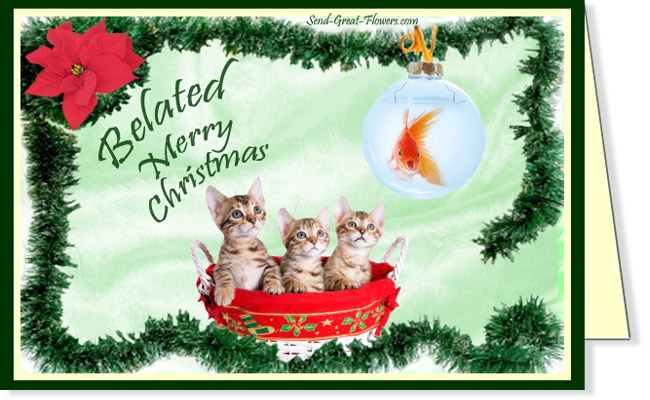
belated-cat-humor-christmas-ecard-lg

July 17, 2103

Greetings Family and Friends,

School starts up again in less than a month so I decided now would be a good time to send out my (not a typo) Christmas cards. And because it’s been over ten years since I’ve sent cards, I’ve committed to a newsletter. And feeling like a fish out of water – which in my experience feels just as slippery as when it’s in the water – I’m following the advice from an online site called, Ten Tips For Writing a Holiday Newsletter, written by somebody named Richard, whose last name I can’t remember. So let’s get started!

1. Prepare your audience to be bored. No matter how hard I try, this letter will likely be a bit tedious and tiresome. However, the nap you take while reading it will improve your brain function, disposition and personality. Science says so.

2. Consider your readers. The conversation should include things you’d talk about if they were right there with you at your kitchen table. Since I don’t have a kitchen table, we’d be sitting on the floor amid the dust bunnies, chatting about whatever comes to mind, picking the occasional cat hair off our tongues.

3. Invite your children to contribute to the writing. I did, and they declined. All three of them.

4. Enjoy the process; don’t act like writing the letter is a duty or a chore. I’m here to tell you I’m having a ball! Anything to put off running the vacuum!

5. Be real. Mention setbacks as well as achievements. Well, let’s see …

Achievement: I joined a gym to qualify for reduced insurance premiums. Setback: I have to exercise to get the reduction. Achievement: I became a deacon at my church, which involves serving communion. Setback: Sometimes I have to go to church.

Achievement: After 35 years, next year I will retire from teaching. Setback: Yeah – I’m that old.

6. Avoid boasting. Indeed it can get irksome when people exaggerate about how talented, smart, successful, well traveled, and well groomed their cats are.

7. Don’t embarrass anybody. I remember our last family newsletter said something about middle child’s (then teenager) ever-changing hair color, and she did NOT see the humor. These days she sticks with her own lovely natural dark blonde. Granted, the upper body tattoos she acquired during college detract from the loveliness but that’s neither here nor there.

8. & 9. Read the newsletter aloud and proofread. I was as surprised as you are, dear Family and Friends, for the homework assignment. Please complete and turn it in by Monday. Apparently Richard So & So believes in graduation requirements.

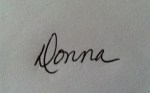
10. Keep it short – one page or less. Leave enough space at the bottom for a brief handwritten personal note and/or a handwritten personal signature. I craftily included both elements in my closing. See below.

Until 2023,
IMG_0226

What do you do that is out of sync with the season?

First Fruits

Today’s guest post comes from Edith.

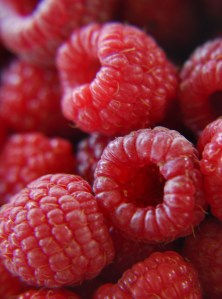
On July 8, 2013, I tasted my first raspberry.

Well, not my first raspberry ever. Not even my first raspberry this year – that is, if you count frozen raspberries that you buy in a bag at the grocery store. It was the first raspberry I picked and ate in my backyard this year.

Fresh_raspberries

Last year, 2012, was very hot and very dry. I seemed to spend hours every week moving sprinklers around, trying to get enough moisture to my poor raspberry plants, as well as the herbs, currant and gooseberry bushes, and flowers. It didn’t work. Normally I get a nice summer crop of raspberries and a seemingly unending and unlimited supply of fall raspberries starting in late August or early September and continuing until November, unless there is a severe frost earlier. Last year, not only was I cruelly disappointed by my “crop” of black currants (a couple handfuls at most) and gooseberries (three. yes, three gooseberries), but the always-dependable raspberries did not do what they’ve always done. The summer crop was sort of okay, but the fall crop was small and pitiful. Normally what I put in the freezer lasts quite a few months, but the small amount I had last year was gone before Thanksgiving.

So today when I spied a few red berries, I picked them and popped them in my mouth.

Man! The sweetness! The flavor! Such a sweet and tangy, lush, juicy explosion of everything that makes a raspberry perfect.

There is nothing like a raspberry that you pick and eat while still warm from the sun (although the ones I pick on a nippy morning in late October might be even better). And looking at the amount of raspberries that are still green and hard, I should be enjoying them for a few weeks to come, until they take some time off, and then come back with even more abundance in the fall.

I look forward to the first taste of raspberries all winter and spring and today it was everything I had hoped for.

What’s your favorite fresh-picked food?

Whaddaya Know?

Today’s guest post comes from Steve Grooms.

During most of my life, I have been trying to acquire the knowledge that would permit me to function as effectively as I want to. I learned years ago how to cook perfectly done hard-boiled eggs, for example. But that knowledge wasn’t original. I learned from others.

My search for knowledge took a strange turn when the internet became so central to how we live. Now it is usually not important to know much at all, if only you know how to tease answers from the internet with cleverly written Google search strings. It is still nice to know things, for you might not even know enough to do a search if you are totally clueless. And yet if you know just a little, you can get the rest from a computer.

It is obvious that we now live in a brave new world where knowing things isn’t all that important if you just know how to acquire knowledge. Are you a rotten speler? Well, all you really need to know is how to spell words well enough that your spell-checker can figure out what you meant to say. As I remember grade school, a lot of precious time was spent memorizing multiplication tables. Now I use my computer’s calculator to handle the most basic math, such as how old am I? Or how about the arcane calculations needed to divide up a luncheon check, with tips? It used to be that only a few people had that skill, and they might get invited to lunch a lot, but most folks can divide a check and figure the tips with apps on their telephones.

In spite of all of that, I think I’m aware of a few—very few—things I know that I learned all on my own and which might not known by anyone else. Unique knowledge. What a strange concept!

Years ago I worked out a technique for keeping celery in my fridge in great eating condition. Celery used to die a revolting death in the fridge before I got around to eating it. No more. (And I’m in such a generous mood, I’ll share this.) You buy a head of celery. It will come in a plastic bag that is shot through with little holes. Chop off some of the messy top material of the head, but then very carefully carve off a small slice at the base of the head (like you would cut the base of a Christmas tree before putting it up in a bucket of water). Tear off two or three paper towels and soak them in water. Wrap the celery head in the wet towels, then pop the whole mess back in that bag full of holes and store it low in the fridge. Within a day your celery will be in better shape than when you bought it, and you might be able to keep it this crisp and tasty for a week or so.

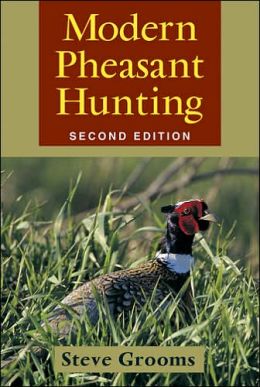
I made several original discoveries when I spent so much time reflecting on pheasants. Depending on how you count, I have written about pheasants in four books. Much of what I said had been written by someone else somewhere else . . . much, but not all of it.

One of the issues I pondered is the difficulty of getting a good closeup photo of a wild rooster. You might think with telephoto lenses this would be easy, but it is quite the opposite. Pheasants are shy. They live in dense cover that obscures them. It is all but impossible to get their portrait.

And yet some photographers do it, and I finally figured out how. In spring the vegetation isn’t as thick in pheasant country as it is in fall. Roosters gather harems of hens, and part of that process is that they strike showy poses to impress their hens. A springtime rooster might sit in the open trying to look magnificent, even with a human photographer nearby snapping photos of this.

And yet there is a problem. A springtime rooster putting himself on display will be so horny that the naked facial tissue around his eyes be engorged and exaggerated. That is, his face looks nothing at all like it will look in fall when people hunt him. I finally realized that every gorgeous closeup portrait of a rooster I had seen was a photo obviously taken in spring. I made the mistake of noting this and then sassing all those photos of springtime roosters.

roostercover_2

I got my just deserts. When I revised my first pheasant book, the publisher was proud to find a great photo of a rooster that could go on the cover. You already know what it looked like. It was a spring rooster with engorged wattles that was on full sexual display. I begged the publisher to not use a photo I had mocked in my last pheasant book, but they were determined to stick with the photo they had picked.

Do you know something that nobody else knows?

Story Theater

Today’s guest post comes from Barbara in Robbinsdale

It sounds like Husband is mumbling something to me from the front room, but no… as I approach I realize that he is just rehearsing again. Tomorrow his volunteer group will present two stories at our regional library, and he has one of the leads – Little Beaver – in one; he will be Narrator in the other.

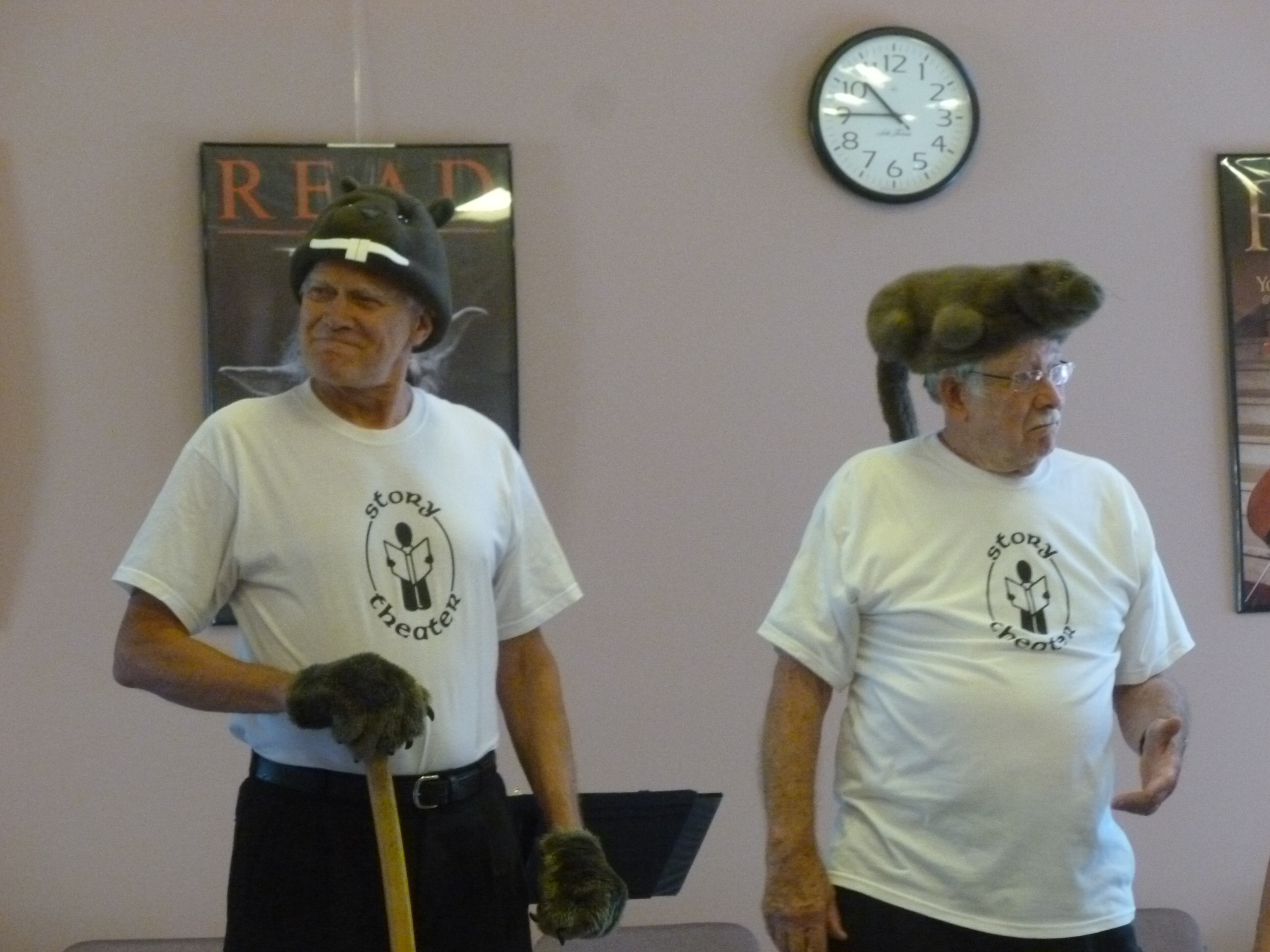
Michael is part of a group called Story Theater, a collection of Senior (and I don’t mean high school) volunteers in the Robbinsdale School District, who act out tales from books for elementary school kids. (I’m aware of at least one other district that also has Story Theater.) During the school year S. T. members rehearse every other Monday, and then travel to a different school almost weekly, in their Story Theater t-shirts and headgear, with their props and script stands, and to promote a love of reading for 1st – 5th graders.

Photo courtesy of Gina Purcell, Crystal-Robbinsdale Sun Post

They’re really pretty good – adopting different characters’ voices and inflection, projecting their voices, and engaging the kids whenever possible. The group used to read the script standing behind their stands, till George Lillquist – a former middle school drama director, among other things – came on board as Director a few years ago. Now there is more memorization of lines, and therefore more eye contact and communication with the other players and the audience.

Costumes are an amazing array of headgear (and have become more elaborate and sophisticated over the years), fashioned by the Props Committee. For instance, Little Beaver’s hat is brown plush with white trim for teeth, and has a beaver’s tail/paddle at the back.

Little Beaver and Otter

As I see it, Story Theater serves several purposes. It shows the kids how reading can be fun, and that older folks can have fun volunteering. It keeps alive the art of oral storytelling, and each story has a moral for the kids to take with them.

But the most fun for me is seeing Husband and his colleagues out there, stretching their skills, having a ball as they make a bunch of little kids laugh.

What children’s story would you include in Story Theater’s repertoire?