
Today’s guest blog is by Steve Grooms
The first days of August in 1931 were so hot in New York City that people couldn’t sleep. The residents of a large apartment building in Queens had the additional problem that the man in room 1G was out of control, getting up at all hours to pound out bizarre melodies on his piano. On the evening of August 6, the musician went crazy, hallucinating that Mexicans with knives were lying under his bed. He suddenly pitched forward and fell dead. Bix Beiderbecke was only 28 years old.
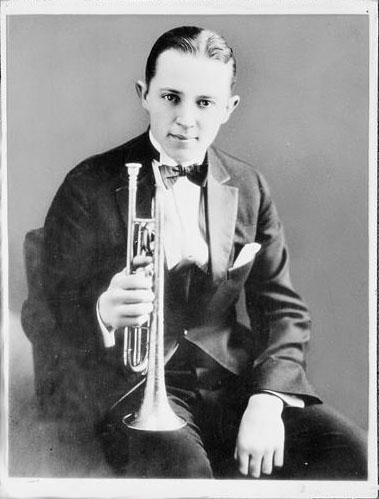
The cause of death was listed as pneumonia, but that was probably a fiction to comfort Bix’s parents. Most scholars think he died of a seizure suffered during an attack of the “DTs.” Simply put, Bix had finally killed himself with Prohibition bootleg booze. Bix’s health also suffered because of the heavy work schedule of jazz artists. I could make the case that Bix was crushed to death by the conflict of high and low culture. Others have concluded that Bix died of humiliation. In the words of his friend Eddie Condon, “Bix died of everything.”
The body was shipped back to Davenport, Iowa, for a quiet burial. The family was ashamed of their alcoholic son. Even the jazz world failed to note the passing of the cornet player who was one of the giants of jazz’s formative years. Bix lay in obscurity for decades until later commentators rediscovered his work and created a new identity for him as jazz’s first “dead saint” and romantic cult figure.
Now, almost century after Bix’s tragically brief career, historians can’t agree about almost anything about his life. Battles are fought over his name, his sexual orientation, what made his music distinct, his musical legacy, why he died and many other issues. We know almost every movement he made in his short life, and yet Bix will forever be a mysterious figure wreathed in contradictions and conundrums.
What we know for sure is that Bix was a musical genius, born with perfect pitch and an almost mystical ability to think creatively during his solo improvisations. When he was a toddler he would stand below the piano, his arms stretched up to play keys he could not see. He acquired a cornet and taught himself to play it, and one consequence was that Bix learned strange fingering for producing some notes. His idiosyncratic fingering might account for the pure, sweet tone everyone tried in vain to imitate. A friend said the notes coming from Bix’s horn were as pretty as the “sound of a girl saying yes.”
While many early jazz players liked silly effects, such as barnyard noises, Bix was a purist who impressed audiences with the stunning creativity of his solos. In the early years of jazz, the cornet or the trumpet was the instrument that drove the group’s pace and presented the melody. The magic of Bix’s playing is his creative way of spraying pretty little notes in patterns that progress in a supremely logical and pleasing way. He proved that jazz tunes could be both hot and beautiful at the same time.
Bix came to the attention of the jazz world in 1924 when he was the boy wonder star in a band known as the Wolverines. He hit his peak in 1926 while playing in various groups. In 1927 he joined the most famous band of the era, the Paul Whiteman Orchestra. Already by 1927 Bix began seeing himself as a musical ghost, a pathetic creature stuck playing in a style that had become outdated.
What we have of Bix today is a pathetically small body of recordings made between 1924 and 1930 . . . just six years. In addition to his cornet work, Bix wrote and recorded some odd piano compositions. The surviving recordings are a tiny percentage of Bix’s musical output. It is hard for the modern ear to pick out Bix’s playing in the ensemble sound, and it is even more difficult to appreciate how radically superior his playing was when compared to other cornetists.
As someone who has studied Bix for twenty years, I can only urge others to take the effort to become familiar with this tormented, inebriated genius from the earliest years of jazz. The best way to meet Bix now is through a documentary film produced by Playboy entitled “Bix: Ain’t None of Them Play Like Him Yet.” The film, which is sometimes sold by Amazon.com, is in the Netflix system. Electronically remastered versions of his recordings continue to be issued almost every year.
His most famous recording is “Singing the Blues.” Bix’s horn comes in at the one-minute mark:
“I’m Coming Virginia” captures Bix’s reflective, poignant side. Again, Bix’s horn appears one minute into the recording:
Have you ever grieved the death of a celebrity you didn’t personally know?





 Trail Baboon